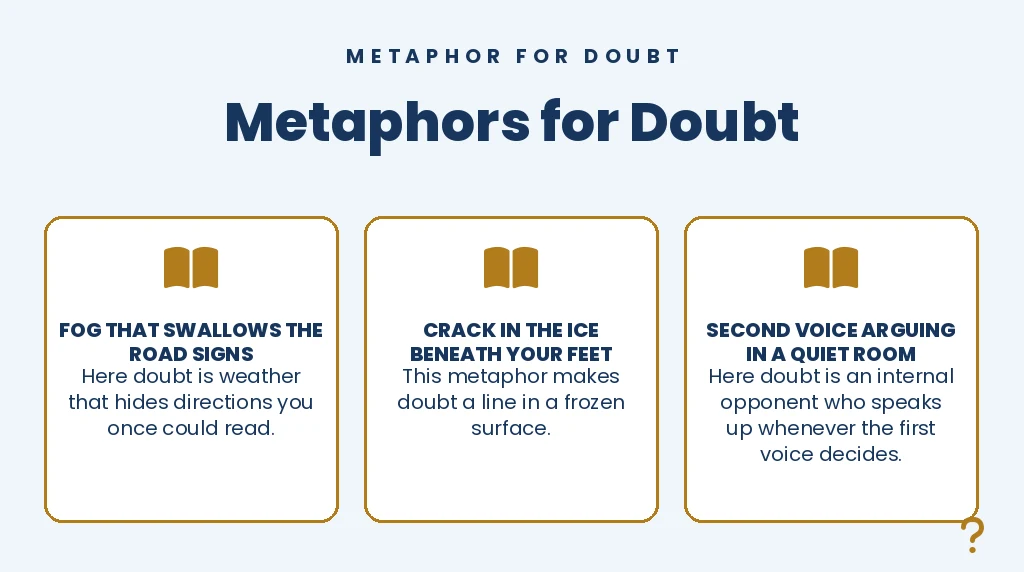
You’ve checked the facts twice. Still, doubt is fog that swallows the road signs, and you’re left squinting at a journey you mapped perfectly yesterday. Or it’s a compass spinning near a magnet, pointing everywhere and nowhere, while the clock demands an answer.
Doubt has no single face, which is why it’s hard to write about. It can be a whisper of caution that saves you. Or a slow leak, quietly emptying every plan you make. A good metaphor gives it shape and speed, so instead of saying a character felt unsure, you show uncertainty pausing their hand and fogging their map.
Here are twenty original metaphors for doubt, from healthy hesitation to paralyzing uncertainty. Each comes explained, with its meaning, an alternative, and examples. You’ll also find positive and negative angles, plus ready-made sentences for students, novelists, and speakers.
Quick Metaphors for Doubt
If you need a strong image fast, start with this list of twenty metaphors for doubt.
- Doubt is a fog that swallows the road signs.
- Doubt is a crack in the ice beneath your feet.
- Doubt is a second voice arguing in a quiet room.
- Doubt is a loose thread pulled from a sweater.
- Doubt is a shadow cast by a small candle.
- Doubt is a locked gate on a familiar path.
- Doubt is sand slipping through cupped hands.
- Doubt is a question mark carved into a door.
- Doubt is a compass spinning near a magnet.
- Doubt is a bridge that sways in the wind.
- Doubt is a seed that splits the stone of certainty.
- Doubt is a radio tuned between two stations.
- Doubt is a leak draining a full tank slowly.
- Doubt is an echo that answers every statement.
- Doubt is a guest who arrives without knocking.
- Doubt is a maze drawn in pencil.
- Doubt is a hand hovering over the doorbell.
- Doubt is a cloud passing over the sun of a decision.
- Doubt is a jury that never reaches a verdict.
- Doubt is a foot held above the first step.
Metaphors for Doubt and Their Meanings
Each metaphor below comes with a plain explanation, a note on why it works, an alternative expression, and three short examples. Jump to the ones matching your feeling.
1. Doubt Is a Fog That Swallows the Road Signs

Meaning
Doubt becomes weather here, hiding directions you once read easily. The road hasn’t changed. Neither have you. But every sign has blurred, so each step forward feels like a guess.
Why It Works
Fog is familiar, blameless, and temporary, which suits doubt perfectly. It slows you without stopping you. That’s how someone moves when they no longer trust the route.
Alternative Expression
Or try “a mist rolling over a familiar map,” the same lostness, softer.
Examples in Writing
Formal Example: By the third hearing, the minister’s certainty had become fog swallowing his own policy’s road signs.
Casual Example: I knew this recipe by heart, but today doubt rolled in like fog and I measured everything twice.
Creative Example: The signs were still there, nailed to their posts, but the fog had eaten their letters one by one.
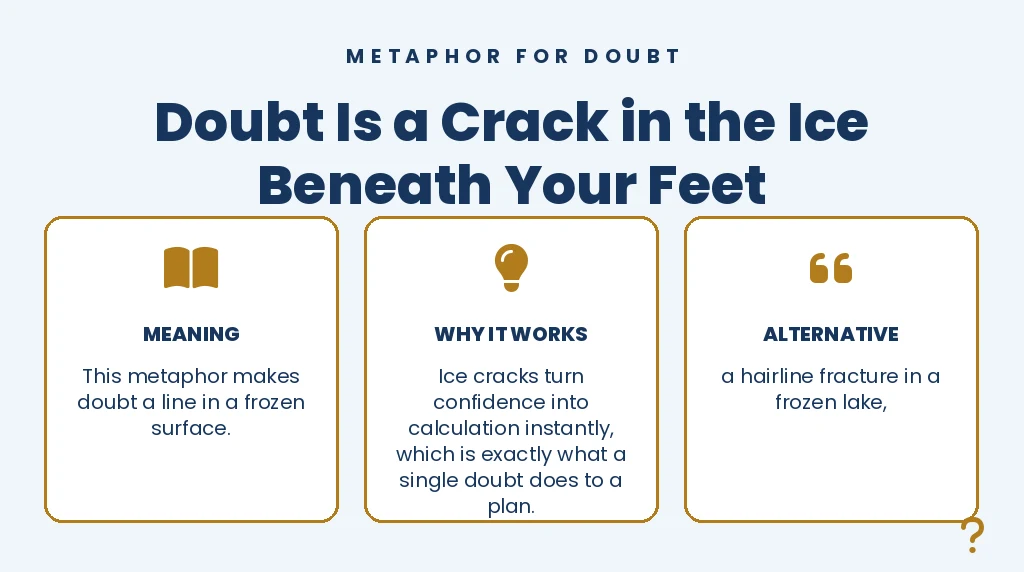
2. Doubt Is a Crack in the Ice Beneath Your Feet
Meaning
Picture a thin line in a frozen surface. Everything still holds, for now. But one crack makes the whole crossing feel dangerous.
Why It Works
One crack, and confidence becomes calculation. A single doubt does the same to a plan. There’s quiet suspense, too, since neither character nor reader knows if it will spread.
Alternative Expression
Think “a hairline fracture in a frozen lake,” danger stated quietly.
Examples in Writing
Formal Example: One inconsistent witness put a crack in the ice beneath the prosecution’s feet; every later answer sounded careful.
Casual Example: Her pause on the phone was the crack in the ice; suddenly the whole plan felt thin.
Creative Example: The crack sang under his boots, a thin bright note, and the far shore had never looked further.
3. Doubt Is a Second Voice Arguing in a Quiet Room

Meaning
Doubt becomes an inner opponent here, speaking up whenever the first voice decides. The room is quiet. The argument is endless. Both voices, after all, belong to the same person.
Why It Works
Most people know doubt as an inner debate, so readers recognize it instantly. The quiet room matters, too: the argument grows loudest when life is calm and time stretches.
Alternative Expression
Or go sharper: “a lawyer cross-examining your own thoughts,” a second voice with teeth.
Examples in Writing
Formal Example: The memoir describes his doubt as a second voice arguing in a quiet room, undefeated by success.
Casual Example: I decided to apply, I really did, but the second voice started arguing around midnight, as usual.
Creative Example: In the quiet room of her skull, the second voice cleared its throat and began, politely, to object.
4. Doubt Is a Loose Thread Pulled From a Sweater
Meaning
It starts with one small inconsistency. Pull at it, and the whole garment of a belief unravels, row by row, faster than anyone expected.
Why It Works
Everyone has ruined a sweater this way, so the mechanics feel true. Doubt also grows through investigation here: each answer undoes more of what felt solid.
Alternative Expression
A close cousin is “a snag that unknits the whole sleeve,” same damage, narrower path.
Examples in Writing
Formal Example: The audit found one loose thread in the accounts, and pulling it unraveled the company’s whole story.
Casual Example: His excuse had one loose thread, and once I pulled it, the entire story came apart.
Creative Example: She only meant to tug the thread straight; by winter her faith lay in yarn at her feet.
5. Doubt Is a Shadow Cast by a Small Candle
Meaning
A small flame throws a huge shadow, and doubt borrows that unfair proportion. One tiny uncertainty, held close to the light of attention, darkens a whole wall of confidence.
Why It Works
The physics is real, so the psychology persuades: doubts look biggest at night, in private, under close attention. It suits insomnia scenes and late-night decisions.
Alternative Expression
For a modern twist, try “a giant thrown by a pocket lamp,” same exaggeration, updated.
Examples in Writing
Formal Example: The biographer notes how one unanswered letter became a shadow cast by a small candle, covering the statesman’s final years.
Casual Example: By 3 a.m. my tiny worry was a shadow cast by a small candle, basically the whole ceiling.
Creative Example: The candle was an inch tall; the doubt it threw reached the roof beams and wore his father’s face.
6. Doubt Is a Locked Gate on a Familiar Path
Meaning
Doubt blocks something routine here. The path is known and loved; you’ve walked it for years. But today a gate stands locked across it, and the key is nowhere obvious.
Why It Works
Familiarity makes the blockage sting, which sets this apart from ordinary uncertainty. It suits writers, athletes, and believers whose trusted habits suddenly stop working.
Alternative Expression
Or try “a door that forgot its key,” a sadder, more personal blockage.
Examples in Writing
Formal Example: After twenty years of preaching, the pastor met doubt as a locked gate on a familiar path.
Casual Example: I have written this report a hundred times, but today the gate is just locked and I cannot start.
Creative Example: The path knew his footsteps by heart, yet the gate stood across it, wearing a brand-new lock.
7. Doubt Is Sand Slipping Through Cupped Hands
Meaning
Certainty drains away here, grain by grain. You cup your hands tighter. But the tighter you grip, the faster your confidence escapes through your fingers.
Why It Works
The image is physical, slightly panicked, matching how people chase reassurance that won’t stay. It suits slow losses of faith, memory, or trust better than sudden shocks.
Alternative Expression
Or say “water carried in open palms,” same leak, cooler texture.
Examples in Writing
Formal Example: As testimony piled up, the defendant’s story became sand slipping through cupped hands.
Casual Example: Every fact I memorize for this exam turns into sand slipping through my hands by morning.
Creative Example: He cupped his certainty like beach sand, and the beach, grain by grinning grain, took it back.
8. Doubt Is a Question Mark Carved Into a Door
Meaning
A carved question mark can’t be wiped away like chalk. Doubt here is permanent and public, cut into the entrance of a decision everyone must walk through.
Why It Works
Doors promise passage and certainty, so a question mark carved into one is quiet sabotage. It suits institutional doubt: investigations, audits, scandals that mark a doorway forever.
Alternative Expression
Sharper still: “an asterisk carved over the entrance,” fine print nobody can remove.
Examples in Writing
Formal Example: The inquiry left a question mark carved into the laboratory’s door for every later result to pass.
Casual Example: Since that rumor started, there is basically a question mark carved into my office door.
Creative Example: Someone had carved it deep, at eye height, so every visitor read the question before the name.
9. Doubt Is a Compass Spinning Near a Magnet
Meaning
A compass near a magnet points at everything except north. Doubt here has a cause nearby: a charismatic person, a loud opinion, bending your inner needle off course.
Why It Works
Unlike fog or sand, this image names a cause: something close and powerful is interfering. So the doubt isn’t weakness but distortion, gone once the magnet is removed.
Alternative Expression
Or write “a needle bullied by a hidden magnet,” interference made deliberate.
Examples in Writing
Formal Example: Around the founder, the young manager’s judgment became a compass spinning near a magnet.
Casual Example: After one call with my uncle, my compass was spinning near a magnet about the whole career change.
Creative Example: Her needle danced for every strong voice in the room and rested only when she stood alone outside.
10. Doubt Is a Bridge That Sways in the Wind
Meaning
Doubt strikes mid-commitment here. You’re already halfway across, the bridge swaying under your feet, and turning back looks no safer than going on.
Why It Works
Swaying bridges create doubt in the body before the mind, which makes the image vivid, physical. Timing matters, too: this uncertainty arrives after the decision, when retreat is expensive.
Alternative Expression
Or picture “a rope crossing groaning over a gorge,” sway with sound and height.
Examples in Writing
Formal Example: Halfway through the merger, the board’s confidence became a bridge swaying in the wind.
Casual Example: We are mid-renovation, broke and dust-covered, and this bridge is swaying hard, honestly.
Creative Example: The bridge rolled beneath her like a ship’s deck, and every plank asked her the same question.
11. Doubt Is a Seed That Splits the Stone of Certainty
Meaning
Seeds split rock by growing slowly inside tiny cracks. A small doubt enters a solid belief the same way and, given time, quietly breaks the stone apart.
Why It Works
The slowness is the point: nothing dramatic happens, yet the result is total. It suits long conversions, investigations, and marriages where one patient question changes everything.
Alternative Expression
Or say “a root working through a foundation,” stone traded for a house.
Examples in Writing
Formal Example: The historian argues one pamphlet became a seed splitting the stone of the empire’s certainty.
Casual Example: One weird detail in his story was the seed; a year later my trust in the whole thing had split.
Creative Example: The question was small enough to hide in a crack, and it grew the way seeds do, in darkness, without permission.
12. Doubt Is a Radio Tuned Between Two Stations
Meaning
Between stations, a radio gives you two voices at once, static over both. Doubt feels like that: mixed signals, two loyalties or two futures interrupting each other.
Why It Works
Static irritates in a way readers feel physically, and the two half-heard stations mirror real dilemmas. It suits characters torn between families, countries, careers, or versions of themselves.
Alternative Expression
A modern cousin: “two tabs playing audio at once,” same clash, updated.
Examples in Writing
Formal Example: The defector’s memoir describes those years as a radio tuned between two stations, loyal to neither signal.
Casual Example: My brain about this job offer is just a radio between two stations, and both are mostly static.
Creative Example: Two voices sang through the static of him, one calling him home, one calling him onward, neither clear.
13. Doubt Is a Leak Draining a Full Tank Slowly
Meaning
Confidence is fuel in a tank here. No crash, no theft. Just a quiet leak, discovered only when the gauge reads empty, far from anywhere.
Why It Works
Leaks explain losses with no villain and no dramatic scene, like motivation fading across a long project. The full tank matters: the person started strong, making the empty gauge sadder.
Alternative Expression
Or mechanize it: “a battery losing charge in the cold,” same slow drain.
Examples in Writing
Formal Example: The report blames no single failure; volunteer morale was a full tank drained slowly by a leak of small doubts.
Casual Example: Nobody ruined the project; it just leaked confidence a drip at a time until the tank was dry.
Creative Example: All winter the tank sang lower, drip by patient drip, and spring found the engine silent.
14. Doubt Is an Echo That Answers Every Statement
Meaning
An echo repeats your words back, twisted by distance. Doubt works like that, hearing a question inside every answer, so no decision ever gets the last word.
Why It Works
Echoes are your own voice made strange, exactly how rumination feels at 2 a.m. The image implies empty rooms and canyons, too, places where you’re alone with sound.
Alternative Expression
Sharper and funnier: “a parrot that only knows the word really,” the echo turned comic.
Examples in Writing
Formal Example: In the interview, the chess champion called his doubt an echo answering every statement, strongest before the biggest matches.
Casual Example: I say I am sure, and something in my head echoes it back as a question, every time.
Creative Example: The canyon of her chest gave every brave sentence back to her, thinner, later, and full of holes.
15. Doubt Is a Guest Who Arrives Without Knocking
Meaning
Doubt arrives as an uninvited visitor who walks straight in. No knock. He shows up at inconvenient hours, weddings, exams, launch days, and takes the best chair like he owns it.
Why It Works
Personification gives doubt dialogue, manners, and timing, making inner conflict dramatic. The missing knock stings most: doubt never asks permission or checks the schedule.
Alternative Expression
Or say “a relative who lets himself in,” intrusion made familiar.
Examples in Writing
Formal Example: The commencement speaker warned graduates that doubt is a guest who arrives without knocking, usually on the morning of opportunity.
Casual Example: My doubt never books ahead; it just shows up on exam morning and takes the good chair.
Creative Example: He was pouring tea when Doubt walked in, wet shoes on the carpet, and asked what smelled like fear.
16. Doubt Is a Maze Drawn in Pencil
Meaning
A maze is confusing enough, but pencil adds quiet hope: the walls can be erased. Doubt here feels overwhelming yet changeable, a tangle thinking created and can undo.
Why It Works
Frustration and agency in one image. That’s rare for doubt. It fits therapy scenes, planning sessions, and stories where the way out is redrawing, not escaping.
Alternative Expression
Or try “a knot drawn instead of tied,” the puzzle made flat, solvable.
Examples in Writing
Formal Example: The counselor reframed the student’s panic: her future was a maze drawn in pencil, impressive, and entirely erasable.
Casual Example: My five-year plan feels like a maze right now, but it is drawn in pencil, thankfully.
Creative Example: All night he paced the grey corridors, until someone handed him an eraser the size of a door.
17. Doubt Is a Hand Hovering Over the Doorbell
Meaning
One small, precise moment: the second before commitment. The hand is raised, the decision made, yet something holds the finger an inch from the bell, rehearsing consequences.
Why It Works
Everyone has hovered over a send button, a doorbell, a phone call, so the suspense is instant. It suits apologies, proposals, confessions, any threshold moment in a story.
Alternative Expression
The digital version: “a thumb paused above the send button,” same heartbeat, digitized.
Examples in Writing
Formal Example: The negotiator’s hesitation was a hand hovering over the doorbell, one ring away from ending the dispute.
Casual Example: I have been a hand hovering over the doorbell about texting him back for three days now.
Creative Example: His finger hung in the cold air, close enough to feel the bell’s brass chill, rehearsing every future.
18. Doubt Is a Cloud Passing Over the Sun of a Decision
Meaning
The decision itself is sunlight here: clear, warm, settled. Doubt is only a cloud crossing it, dimming the light a while without destroying the sun behind it.
Why It Works
It’s a reassuring image, useful for healthy, passing doubt. Clouds move by definition, so clarity quietly promises to return if the person simply waits.
Alternative Expression
Or shrink the sky: “a hand passing over a lamp,” the same dimming, indoors.
Examples in Writing
Formal Example: The judge treated the objection as a cloud passing over the sun of a decision already made in law.
Casual Example: I still want the house; this week is just a cloud passing over the sun of the decision.
Creative Example: For one grey minute the light went out of her yes, and then the cloud remembered it had somewhere else to be.
19. Doubt Is a Jury That Never Reaches a Verdict
Meaning
The mind becomes a courtroom stuck in deliberation. The evidence is in, the arguments finished, yet twelve inner jurors keep asking to hear everything one more time.
Why It Works
Courtrooms dramatize the demand for proof, doubt’s favorite game. A hung jury also explains the exhaustion: deliberation without verdict drains more than bad news.
Alternative Expression
Lighter still: “a meeting that refuses to adjourn,” courtroom traded for office.
Examples in Writing
Formal Example: The editorial describes parliament as a jury that never reaches a verdict, deliberating while the country waits outside.
Casual Example: My inner jury has been deliberating this haircut for a month and still cannot reach a verdict.
Creative Example: Twelve of him sat around the long table of his mind, passing the same evidence hand to hand, forever.
20. Doubt Is a Foot Held Above the First Step
Meaning
Beginnings get refused here. The staircase is there, the destination wanted, but the foot hangs in the air, because the first step is where doubt concentrates its strength.
Why It Works
Starting is the most doubt-dense moment of any project, and the suspended foot makes that visible. It implies its own ending, too: feet can’t hover forever, so the story must resolve.
Alternative Expression
Or add height: “a diver still counting on the board,” the pause plus height.
Examples in Writing
Formal Example: The founder’s biography opens with a foot held above the first step, three years between idea and incorporation.
Casual Example: My novel is still a foot held above the first step; the outline is perfect and totally unwritten.
Creative Example: The stair waited, the door waited, and his foot wrote small circles in the air above them both.
Positive Metaphors for Doubt
Doubt is not always the enemy of good decisions. In healthy doses it works like a filter or proofreader, catching careless ideas before they do damage. These six metaphors show that protective side.
- Doubt is a sieve that catches careless ideas. It strains a plan before the plan can hurt you.
- Doubt is a pause button on a runaway train. It buys back the seconds a rash choice would steal.
- Doubt is a gardener pruning weak branches. It cuts what would break so the rest grows stronger.
- Doubt is a lantern carried into a dark claim. It shows the corners a sales pitch hopes you skip.
- Doubt is a safety net under a bold leap. It lets you jump higher because falling costs less.
- Doubt is a proofreader for hasty decisions. It circles the sentence you almost signed your name to.
Negative Metaphors for Doubt
When doubt overstays, it stops protecting and starts stealing: beginnings, momentum, and years. These six metaphors describe that destructive side, where uncertainty hollows out strong plans.
- Doubt is a termite colony inside a beam. It hollows strong plans quietly, bite by silent bite.
- Doubt is a brake pedal pressed at green lights. It keeps you safe and permanently late.
- Doubt is a thief who steals beginnings. It takes the first step and leaves the journey undone.
- Doubt is a winter that delays every spring. It postpones growth long after the cold should have passed.
- Doubt is a weight tied to a rising balloon. It holds bright ideas at rooftop height, never sky.
- Doubt is a hall of mirrors in a small room. It multiplies one worry until the room has no exit.
Metaphors for Doubt in Sentences
The table below shows six metaphors in sentences, with a note on what each communicates.
| Example sentence | What it communicates |
|---|---|
| By Friday, doubt was a fog that had swallowed every road sign in the plan. | Directions that were clear becoming unreadable. |
| He made the decision, then the second voice started arguing in the quiet room. | An inner debate that reopens settled choices. |
| Around her manager, his judgment was a compass spinning near a magnet. | Doubt caused by a strong nearby influence. |
| Nobody attacked the charity; a slow leak of small doubts drained its tank. | Confidence lost gradually, without one big event. |
| For three years, the committee was a jury that never reached a verdict. | Endless deliberation with no decision. |
| His application stayed a foot held above the first step until the deadline passed. | Hesitation that kills a beginning. |
How to Use Metaphors for Doubt Naturally
First, decide whether your doubt is protective or paralyzing. Protective doubt is brief, so reach for the sieve, the lantern, or the passing cloud. Paralyzing doubt is slow and heavy, so try the leak, the jury, or the hovering foot. Matching the image to doubt’s role in the scene is most of using it naturally.
Next, give your doubt a cause when you can. A compass spins because a magnet is near; ice cracks because weight pressed it. Scenes feel honest when uncertainty grows from evidence or pressure, not magic. Even one small trigger, a pause on the phone, makes the metaphor land as observation, not decoration.
Finally, let doubt resolve at the speed it arrived. Fog lifts gradually, verdicts arrive suddenly, and hovering feet must land or withdraw. Keep one metaphor per moment, cut competing images, and read the line aloud. If the uncertainty feels physical, readers will believe it.
Metaphor vs. Simile: What Is the Difference?
A metaphor states that one thing is another thing; a simile compares using like or as. Write that doubt is a fog that swallows the road signs and feeling and weather fuse into one image. The reader stands inside the fog.
A simile keeps a little distance, making uncertainty sound wry or reflective rather than oppressive. Metaphors hit harder and suit genuine paralysis; similes suit narrators looking back with perspective. Choose by how trapped the character should feel.
Here’s the same idea both ways. Metaphor: doubt is a fog that swallows the road signs. Simile: doubt hung over his plans like a fog that swallowed the road signs. The metaphor strands the reader inside the weather; the simile describes it from one step back.
Common Mistakes When Writing Doubt Metaphors
- Making doubt pure weakness: Real doubt often protects people. If every doubtful character is simply cowardly, the writing loses the sieve, lantern, and proofreader side of the feeling.
- Skipping the trigger: Uncertainty that arrives from nowhere reads as plot convenience. Give it a crack, a pause, or a magnet, however small, so readers accept it.
- Mixing speeds: Fog, leaks, and seeds are slow; verdicts and doorbells are sudden. Pairing a slow image with an instant cure breaks the metaphor’s physics.
- Repeating the same image: Calling doubt a fog on every page turns weather into wallpaper. Rotate images as the doubt changes, from mist to jury to hovering foot.
- Forgetting resolution: Doubt metaphors imply endings, lands, lifts, verdicts, landings. A doubt that never resolves in image or action leaves readers stranded with the character.
Frequently Asked Questions
What is a good metaphor for doubt?
One of the strongest is doubt is a fog that swallows the road signs: clear directions become unreadable, without blaming the traveler. For inner debate, a second voice arguing in a quiet room feels instantly familiar. Choose by whether doubt comes from the world or within.
What is the difference between doubt and uncertainty?
Uncertainty is a state of not knowing; doubt is uncertainty leaning against something. You can be uncertain about the weather and perfectly calm, but doubt argues with a belief, a person, or a plan. In writing, uncertainty fills the air like fog; doubt is the voice commenting on it.
How do you describe self-doubt in writing?
Focus on the body and threshold moments: the hand hovering over the doorbell, the foot held above the first step. Self-doubt lives in almost-actions: drafts deleted, applications unsubmitted, questions swallowed. Pair one physical pause with a single image, and readers will feel the hesitation.
Is doubt always a bad thing?
No. Healthy doubt works like a sieve or proofreader, catching careless ideas before they become expensive mistakes. Scientists, judges, and good friends use it professionally. It turns harmful only when it never resolves, when the jury deliberates forever and the foot never lands. Dose and duration decide.
What are some metaphors for doubt in poetry?
Poets favor weather, water, and thresholds: fog swallowing road signs, sand slipping through cupped hands, a hand hovering over a doorbell. These images fit one stanza yet carry a whole inner life. Verse rewards metaphors that drift, drip, or sway.
Conclusion
Doubt is simply the mind asking for one more look. Handled well, it sharpens every decision it touches. Its natural partner is trust, the quiet force across the scale, because honest writing about uncertainty is really about learning when to stop weighing and start trusting.
As you write, remember doubt belongs to the family of emotions that make characters feel human rather than programmed. Match the image to your scene’s speed and stakes: fog for confusion, jury for deadlock, hovering hand for the threshold. Then let it work without apology. One honest metaphor steadies the reader’s step.