He kept the insult in his pocket for eleven years, folded small, and took it out at night like a photograph. Revenge is a debt nobody agreed to pay, yet whole lives get organized around collecting it. It is also a boomerang with your name carved on it, because the throw feels glorious for exactly one second. Stories keep returning to this dark little engine, and so does everyday speech.
Plain statements about revenge sound flat because the feeling itself is layered: hurt at the bottom, pride in the middle, and a strange sweetness on top. Metaphors separate those layers. Call revenge a dish, a fire, a chain, a garden weed, and readers know whether you mean cold patience, hot rage, slavery to the past, or something that grows while you sleep. One image tells the whole moral temperature.
Here are twenty original metaphors for revenge, each explained with its meaning, the reason it works, a close alternative, and three examples in formal, casual, and creative writing. After them come positive and negative sets, sentences ready to lift, practical advice, and answers to common questions. Students of literature, novelists, essay writers, and anyone untangling a feud on the page will find these useful.
Quick Metaphors for Revenge
Here are all twenty metaphors in one quick list, ready to scan before you read the detailed breakdowns.
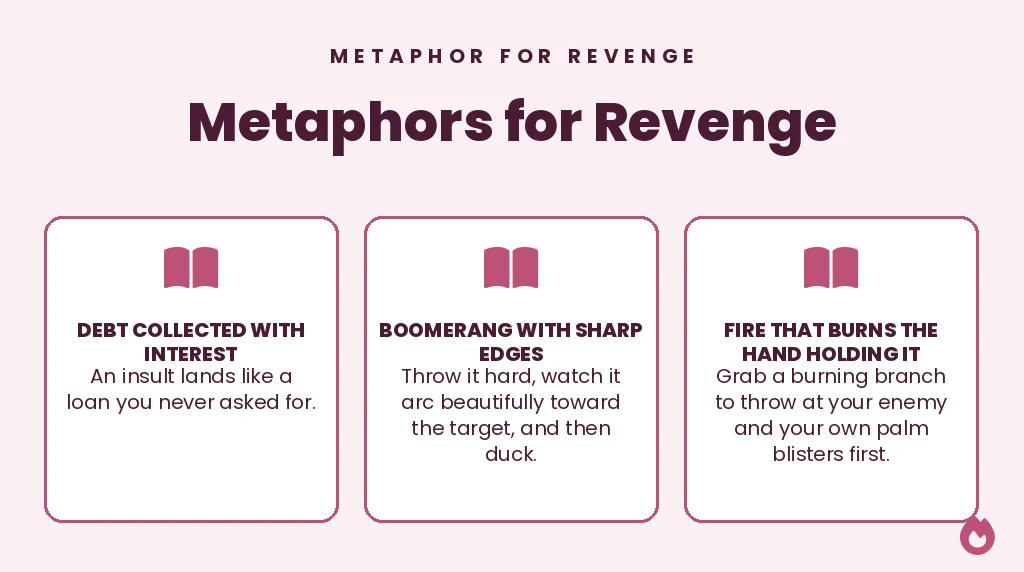
- Revenge is a debt collected with interest.
- Revenge is a boomerang with sharp edges.
- Revenge is a fire that burns the hand holding it.
- Revenge is a seed planted in dark soil.
- Revenge is a chain that ties two enemies together.
- Revenge is a cold dish eaten alone.
- Revenge is a splinter worked deeper by picking.
- Revenge is a mirror that doubles every wound.
- Revenge is a wolf you feed in secret.
- Revenge is a storm you summon over your own house.
- Revenge is an old song played until everyone hates it.
- Revenge is a chess game played against a photograph.
- Revenge is a poison poured into two cups.
- Revenge is a locked room where you keep the key and the prisoner.
- Revenge is a tailwind that pushes you off a cliff.
- Revenge is a bookkeeping error in the heart.
- Revenge is a winter stored in the chest.
- Revenge is a train that only runs backward.
- Revenge is a signature written in someone else’s ink.
- Revenge is a garden weed with deep roots.
Metaphors for Revenge and Their Meanings
Each metaphor below looks at payback from a different angle: the money owed, the wound kept open, the trap that catches its own maker. Read them in order or jump to the ones that fit your story.
1. Revenge Is a Debt Collected With Interest
Meaning
An insult lands like a loan you never asked for. Instead of writing it off, the injured person keeps the account open for years.
Why It Works
Money language makes emotion measurable, and everyone understands interest. The image explains escalation without a psychology lecture: small wrong, long wait, huge repayment.
Alternative Expression
A ledger image from the same account book is “an invoice the heart keeps resending”.
Examples in Writing
Formal Example: In the committee’s report, the feud between the two departments reads as a debt collected with interest.
Casual Example: She did not just prank him back. That was a debt collected with interest, plus a late fee.
Creative Example: For twenty years the old sailor kept his ledger dry.
2. Revenge Is a Boomerang With Sharp Edges
Meaning
Throw it hard, watch it arc beautifully toward the target, and then duck. What goes out in anger tends to circle back.
Why It Works
Boomerangs are famous for returning, so cause and effect sit inside one object. The image suits feuds, office politics, and online pile-ons, anywhere retaliation invites retaliation.
Alternative Expression
A thrown object with the same home address is “an echo that comes back carrying a knife”.
Examples in Writing
Formal Example: The minister warned that sanctions imposed in haste can be a boomerang with sharp edges.
Casual Example: Posting that screenshot felt great for a day. Boomerang with sharp edges, though. It came back.
Creative Example: He carved his curse, threw it spinning into the dusk.
3. Revenge Is a Fire That Burns the Hand Holding It
Meaning
Grab a burning branch to throw at your enemy and your own palm blisters first. Anger kept alive for payback works exactly like that grip.
Why It Works
Burns are instant and unmistakable, so the cost of revenge becomes physical in one line. The image also explains a hard truth people resist: the enemy often sleeps fine.
Alternative Expression
A coal carried the same painful way is “a hot coal pocketed for a long journey”.
Examples in Writing
Formal Example: The mediator told both families that revenge is a fire that burns the hand holding it.
Casual Example: Holding that grudge is just a fire in your own hand, bro. He moved out. You are the one still burning.
Creative Example: All winter she carried the little fire from room to room, warming her hatred and blackening her own fingers.
4. Revenge Is a Seed Planted in Dark Soil
Meaning
Nothing shows above ground for a long time. The hurt goes in quietly, gets watered by memory in private.
Why It Works
Seeds explain the delay between injury and repayment better than almost any image. They also explain secrecy, since seeds do their early work underground.
Alternative Expression
A colder seed in the same soil is “a bulb buried before winter, waiting for its spring of spite”.
Examples in Writing
Formal Example: Historians trace the uprising to a humiliation decades earlier, a seed planted in dark soil that finally broke the surface in a violent spring.
Casual Example: That comment at the wedding? Seed planted. Watch the family group chat next year.
Creative Example: In the black garden behind his ribs, one seed drank every rainy memory and waited, patient as winter.
5. Revenge Is a Chain That Ties Two Enemies Together
Meaning
Link by link, the avenger fastens himself to the very person he hates. Every plan requires studying the enemy, thinking about the enemy, scheduling life around the enemy.
Why It Works
Chains carry slavery and imprisonment in one clang, and the twist here lands hard: the jailer is shackled too. The image suits writing about obsession and freedom.
Alternative Expression
A rope with the same two prisoners is “a knot that tightens whichever side pulls”.
Examples in Writing
Formal Example: The reconciliation report describes the villages’ revenge killings as a chain that ties two enemies together.
Casual Example: You check his profile every day. That is not winning, that is a chain, and you are both on it.
Creative Example: They dragged their bright chain through the years, two proud prisoners, each swearing the other one was the jail.
6. Revenge Is a Cold Dish Eaten Alone
Meaning
Old advice says revenge tastes best served cold, but nobody mentions the seating. The meal is eaten alone, at a table set for one enemy who often does not even attend.
Why It Works
The image borrows the famous saying and then turns it, which gives readers a small jolt of recognition followed by doubt. Food also brings taste into the argument.
Alternative Expression
A banquet with the same empty chairs is “a feast laid for guests who stopped caring years ago”.
Examples in Writing
Formal Example: The editorial calls the lawsuit a cold dish eaten alone, noting that the plaintiff won damages long after the public stopped watching.
Casual Example: He finally got picked over me for the team and celebrated by himself. Cold dish, eaten alone.
Creative Example: At the long table of his revenge there was one plate, one candle.
7. Revenge Is a Splinter Worked Deeper by Picking
Meaning
A small injury goes in and should, with time, work itself out. Instead, fingers return to it daily: pressing, probing, reopening.
Why It Works
Nearly everyone has made a splinter worse with impatient fingers, so the lesson is stored in the body already. The metaphor also correctly blames the habit, not the original injury alone.
Alternative Expression
A healing wound treated the same way is “a scab peeled fresh every morning”.
Examples in Writing
Formal Example: The therapist’s essay compares rumination to a splinter worked deeper by picking, arguing that attention, not time, is the real medicine withheld.
Casual Example: Stop rereading that chat. Splinter, deeper, every single night.
Creative Example: Under the skin of his pride the tiny insult traveled, helped along by his own devoted hands.
8. Revenge Is a Mirror That Doubles Every Wound
Meaning
Hold a wound up to a mirror and now there are two. Retaliation works by reflection: your enemy’s cruelty comes back wearing your face.
Why It Works
Mirrors are honest and a little merciless, which is the right equipment for this idea. The doubling also captures escalation neatly: nothing is healed, everything is multiplied.
Alternative Expression
A copying machine with the same multiplication is “a photocopier set to pain, spitting out duplicates”.
Examples in Writing
Formal Example: The peace study calls retaliatory violence a mirror that doubles every wound.
Casual Example: You keyed his car because he keyed yours. Mirror, doubled wound, congratulations to nobody.
Creative Example: Face to face the two widows stood, each holding a mirror, each bleeding twice.
9. Revenge Is a Wolf You Feed in Secret
Meaning
Every grudge keeper owns an animal. It gets fed on reheated memories, screenshots, and other people’s small failures, always in private, always after dark.
Why It Works
Feeding makes the person responsible, which is the uncomfortable heart of the metaphor. Nobody claims a wolf wandered in fully grown.
Alternative Expression
A pet with the same appetite is “a guard dog trained only to bite the past”.
Examples in Writing
Formal Example: The judge’s sentencing remarks warned the defendant that a wolf fed in secret eventually hunts in public.
Casual Example: Every time you stalk her wins and stew, you are feeding the wolf. It is not even hungry anymore. You are.
Creative Example: Behind the cottage of his heart something scratched nightly, well fed on leftovers of an old betrayal.
10. Revenge Is a Storm You Summon Over Your Own House
Meaning
Dark clouds gather exactly where you aimed them: overhead, at home. A campaign of payback floods your own calendar, your own sleep, your own family dinners with weather meant for somebody else.
Why It Works
Storms ignore intentions, and that indifference is the lesson. The house makes the damage domestic and personal rather than heroic.
Alternative Expression
A flood with the same wrong address is “a dam broken upstream of your own fields”.
Examples in Writing
Formal Example: The biography portrays the libel suit as a storm the author summoned over his own house.
Casual Example: That anonymous complaint wrecked our whole team, including you. Storm, own house, great work.
Creative Example: He read the old curse by candlelight, and by dawn the rain was only falling on his side of the valley.
11. Revenge Is an Old Song Played Until Everyone Hates It
Meaning
Once, the grievance had a melody people sympathized with. Played at every gathering for ten years, the same verses about the same betrayal.
Why It Works
Everyone has watched a good story die from repetition, so the social cost of a grudge becomes audible. The metaphor is gentler than fire or wolves, which makes it useful in family writing and comedy.
Alternative Expression
A record with the same worn groove is “a scratched record stuck on the worst chorus”.
Examples in Writing
Formal Example: The columnist observes that the party’s founding grievance, an old song played until everyone hates it.
Casual Example: Uncle, the 2016 argument again? That song has closed every dinner this year.
Creative Example: The tavern keeper sighed as the minstrel of grievance tuned his one string for the thousandth night.
12. Revenge Is a Chess Game Played Against a Photograph
Meaning
The opponent in the picture never moves, never ages, and never apologizes. Meanwhile the real person has changed jobs, cities, maybe character.
Why It Works
Chess promises a thinking opponent, and the photograph quietly removes him, which exposes the madness in one detail. It is a thoughtful image rather than a violent one, perfect for essays about memory and time.
Alternative Expression
A duel with the same absent opponent is “a sword fight with a shadow on the wall”.
Examples in Writing
Formal Example: The memoir’s narrator finally sees his twenty year rivalry as a chess game played against a photograph.
Casual Example: He forgot the whole thing years ago. You are playing chess against a photograph, mate.
Creative Example: Move by move he outplayed the smiling boy in the frame.
13. Revenge Is a Poison Poured Into Two Cups
Meaning
The pour looks careful and one sided until you notice both glasses came from the same bottle. Plots of payback contaminate the plotter: suspicion becomes a habit, trust curdles.
Why It Works
Poison suggests slow, invisible damage rather than a single dramatic wound, which matches how plotting changes a person. The two cups give the idea a clean visual symmetry readers remember.
Alternative Expression
A shared drink from the same dark well is “a well poisoned upstream of both houses”.
Examples in Writing
Formal Example: The ethicist describes corporate sabotage as a poison poured into two cups.
Casual Example: Spreading that rumor hurt her, sure, but now nobody trusts you either. Two cups, one poison.
Creative Example: The apothecary of revenge labeled both bottles carefully, and drank first from the wrong one every night for years.
14. Revenge Is a Locked Room Where You Keep the Key and the Prisoner
Meaning
One room, one prisoner, and a guard who can never leave his post. Keeping an enemy punished inside your mind requires staffing the prison forever: remembering the charges, patrolling the memory, refusing every parole hearing.
Why It Works
The double role is the sting: keeper and captive in one body. Rooms and keys make the arrangement easy to visualize.
Alternative Expression
A cell with the same staffing problem is “a prison whose only full time guard is you”.
Examples in Writing
Formal Example: The chaplain’s memoir calls unforgiveness a locked room where you keep the key and the prisoner.
Casual Example: You could just, you know, unlock the room. He is not even in there anymore. You are.
Creative Example: Every night the jailer climbed the stairs of himself, rattled the one locked door.
15. Revenge Is a Tailwind That Pushes You Off a Cliff
Meaning
At first the wind feels like help. Payback energy is real energy: it sharpens focus, funds long projects.
Why It Works
The betrayal inside the image is what makes it stick: help and harm from the same force. It describes high achievers fueled by spite especially well, the rivals who build empires and then cannot stop.
Alternative Expression
A current with the same friendly push is “a helpful river carrying you politely toward the falls”.
Examples in Writing
Formal Example: The profile concludes that the founder’s spite was a tailwind that pushed him off a cliff.
Casual Example: Proving your ex wrong built your whole gym routine. Careful, that tailwind has a cliff at the end.
Creative Example: Wings spread, the spiteful wind at his back, the young lord soared gloriously toward the edge of the world.
16. Revenge Is a Bookkeeping Error in the Heart
Meaning
Somewhere in the ledger, a figure got written twice, or a kindness got filed under insults. Years later the accounts refuse to balance, and the owner keeps auditing other people for the missing sum.
Why It Works
Bookkeeping is dry, exact, and quietly comic, which cools a hot topic just enough to think about it. The metaphor also offers hope: errors can be found and corrected.
Alternative Expression
A scale with the same faulty reading is “a balance weighed with a thumb on the pan”.
Examples in Writing
Formal Example: The family therapist suggests treating decade old grievances as a bookkeeping error in the heart.
Casual Example: She helped you twice after that fight, remember? Your heart has a bookkeeping error, not a case.
Creative Example: In the counting house of the chest, one red figure glowed for years.
17. Revenge Is a Winter Stored in the Chest
Meaning
Some people carry weather with them. A cold season moves into the chest and stays past its time, frosting conversations, slowing the blood.
Why It Works
Cold is felt in the body before it is understood, and stored winter explains emotional numbness better than heat images can. It also suggests the saddest cost: seasons missed.
Alternative Expression
Ice kept in the same cold store is “a glacier calving slowly into every conversation”.
Examples in Writing
Formal Example: The novelist renders the patriarch’s forty year feud as a winter stored in the chest.
Casual Example: He walks in and the room drops ten degrees. Winter storage, still fully stocked.
Creative Example: Snow lay on the orchard of her heart in midsummer.
18. Revenge Is a Train That Only Runs Backward
Meaning
All that engine, all that coal, and the only destination is yesterday. A life organized around payback keeps excellent service to the past: same station, same grievance.
Why It Works
Trains stand for direction and purpose, so reversing one exposes wasted effort elegantly. The image also captures routine: grudges run on timetables, with daily departures of rumination.
Alternative Expression
A road making the same pointless journey is “a highway whose every exit leads back to the scene”.
Examples in Writing
Formal Example: The historian concludes that the region’s politics became a train that only runs backward.
Casual Example: Every conversation with him goes back to that one deal. Backward train, daily service.
Creative Example: Whistle blowing, sparks flying, the great black engine hauled its passengers proudly into last year, and last year, and last year.
19. Revenge Is a Signature Written in Someone Else’s Ink
Meaning
Look closely at the handwriting of a revenge act and you will see the original villain holding the pen. To answer cruelty with cruelty is to let your enemy author your behavior.
Why It Works
Signatures stand for identity, so borrowing ink becomes a loss of self, not just a loss of temper. The metaphor reframes restraint as authorship: declining revenge means writing in your own hand.
Alternative Expression
A voice borrowed the same unwilling way is “an echo promoted to spokesman”.
Examples in Writing
Formal Example: The commencement address warned graduates that revenge is a signature written in someone else’s ink.
Casual Example: You lied because she lied first? That is her ink, your signature. Just saying.
Creative Example: The letter of vengeance waited on the desk, and only at the last line did he recognize the handwriting as his enemy’s.
20. Revenge Is a Garden Weed With Deep Roots
Meaning
Pull the visible leaves and the plant applauds your gardening. Deep in the soil, the root system spreads into beds it was never planted in, flavoring friendships, work, and sleep with bitterness.
Why It Works
Anyone who has weeded knows the lie of the easy pull, so the metaphor teaches patience and depth in one tug. It also explains spread: grudges colonize neighboring parts of a life.
Alternative Expression
An ivy with the same underground habits is “a vine that fruits bitterness in every room it enters”.
Examples in Writing
Formal Example: The community report compares the feud to a garden weed with deep roots.
Casual Example: Cutting him off was leaf work. The root is still in there, watering itself every time his name comes up.
Creative Example: Beneath the tidy lawn of the family, one dark root traveled from grave to cradle, drinking.
Positive Metaphors for Revenge
Writers sometimes need the rare bright side of this dark topic: the moment payback energy turns into growth, success, or self respect.
- Revenge is a whetstone for a blunted ambition. It sharpens goals that comfort had left dull.
- Revenge is a receipt kept, not a debt chased. It proves what you survived without costing you another year.
- Revenge is a garden planted over an old insult. It answers buried hurt with something that feeds people.
- Revenge is a trophy polished by your own success. It shines brightest when the rival is not even mentioned.
- Revenge is a door closed quietly and forever. It ends the story without a speech or a scene.
- Revenge is a sunrise after a long watch. It pays the injured party in light instead of pain.
Negative Metaphors for Revenge
The darker shelf is fuller, for obvious reasons.
- Revenge is a mortgage on your happiest years. It takes monthly payments from a life that owed nothing.
- Revenge is a treadmill facing a photograph of the finish line. It burns a whole body to arrive at a picture.
- Revenge is a leak in the roof of the soul. It drips on every room, including the ones joy was using.
- Revenge is an anchor disguised as a weapon. It holds the thrower in place long after the target sails away.
- Revenge is a second helping of the original poison. It serves the same injury again, seasoned this time by your own hand.
- Revenge is a candle burned at both ends for somebody else. It spends your light on a person who left the room years ago.
Metaphors for Revenge in Sentences
The table below sets six of these metaphors inside complete sentences, with a short note on what each one communicates.
| Example sentence | What it communicates |
|---|---|
| By the trial’s end, his revenge was a debt collected with interest, and nobody remembered the original amount. | Payback grew far beyond the size of the first wrong. |
| She held the grudge like a fire in her own hand while her rival slept soundly abroad. | The keeper of anger suffers more than the target does. |
| Their feud became a chain that tied two enemies together through three generations. | Revenge imprisons both sides and outlives its cause. |
| He finally won the argument online and celebrated alone, a cold dish eaten in an empty kitchen. | Delayed victory often arrives without an audience or flavor. |
| Every scandal fed the wolf she kept in secret, until the wolf began choosing her friends for her. | A nurtured grudge eventually takes control of a life. |
| Letting go of the lawsuit felt like unlocking a room and discovering he had been the prisoner all along. | Forgiveness frees the keeper more than the offender. |
How to Use Metaphors for Revenge Naturally
Start by deciding where your sympathy sits. If your writing condemns revenge, reach for fires in hands, backward trains, and locked rooms, because those images bill the avenger for the damage. If your character is still mid feud and proud of it, a debt with interest or a seed in dark soil lets readers feel the seduction before the cost arrives.
Match the heat of the metaphor to the heat of the scene. A splinter or a bookkeeping error suits quiet, modern, almost comic resentment. Wolves, storms, and poisons belong to stories with real danger. Formal essays usually prefer chains, mirrors, and ledgers, while casual writing can carry boomerangs and cold dishes without breaking a sweat.
Use one metaphor per scene and let it finish its work. Revenge writing fails when three warnings pile up in a paragraph and the story drowns in advice. Let a character feed the wolf across a whole chapter instead, one small scene at a time.
Metaphor vs. Simile: What Is the Difference?
A metaphor states that one thing is another thing, while a simile compares two things using like or as. Revenge is a boomerang declares an identity, and the sentence hits accordingly.
Dark topics often benefit from that choice of distance. A metaphor about poison accuses; a simile about poison observes. Fiction and speeches usually take the metaphor and its force.
Here is one idea in both forms. Metaphor: “His revenge was a winter stored in the chest.” Simile: “His revenge sat in him like a winter stored in the chest, chilling every room he entered.” Same weather, same warning.
Common Mistakes When Writing Revenge Metaphors
- Glamorizing the payback: Shiny, consequence free revenge images teach the opposite of what most stories mean, so let the boomerang come back at least once.
- Stacking every warning into one paragraph: Fire, poison, chains, and wolves together sound like a lecture, and readers stop listening to lectures quickly.
- Repeating the famous cold dish line unchanged: The saying is so well known that using it straight adds nothing, so twist it, question it, or choose a fresher meal.
- Making the target purely evil and the avenger purely noble: Real feuds are messier, and metaphors with two cups and two prisoners respect that mess.
- Forgetting the cost to bystanders: Storms and weeds spread beyond their target, and honest revenge writing shows the neighbors getting wet too.
Frequently Asked Questions
What is a good metaphor for revenge?
A good metaphor for revenge shows both the pull and the price. A boomerang with sharp edges captures the return of harm in one object. A debt collected with interest explains why payback keeps growing. A fire that burns the hand holding it suits writing that warns.
Why do writers compare revenge to a boomerang?
Boomerangs are built to return, and retaliation behaves the same way in feuds, politics, and online arguments. One strike invites the next, and the original thrower becomes a target with a known address. The image compresses that whole cycle into a single flying object, which is why teachers and editorial writers reach for it so often.
What does revenge is best served cold mean?
The famous saying claims that delayed, calm revenge is more satisfying and more effective than hot, impulsive payback. Writers have repeated it for generations, often while doubting it. This article twists the idea into a cold dish eaten alone, because patient revenge frequently arrives after the audience, the anger, and even the enemy have all left the table.
How do I write about revenge without sounding preachy?
Let the image carry the warning instead of announcing it. Show a character feeding a wolf in secret or guarding a locked room for years, and readers will draw the conclusion themselves. One concrete metaphor per scene is enough. The moment a narrator starts listing lessons, the story stops and the sermon starts, and audiences can tell the difference instantly.
Can revenge ever be described positively in writing?
Yes, when the payback is really transformation. Writers describe success as the finest revenge: a garden planted over an old insult, a trophy polished by your own work, a sunrise after a long watch. These images keep the energy of the grievance but spend it on building rather than harming, which is why readers find them satisfying rather than sour.
Conclusion
Every metaphor in this collection circles the same drain: revenge promises relief and delivers rent. Writers studying the language of war and conflict will recognize these weapons, though the wounds here are usually self inflicted and the battlefield is a single chest.
That is why the honest images matter, and why the story rarely ends at the strike. Look at how writers picture the shape of failure and you will see the avenger’s usual address.