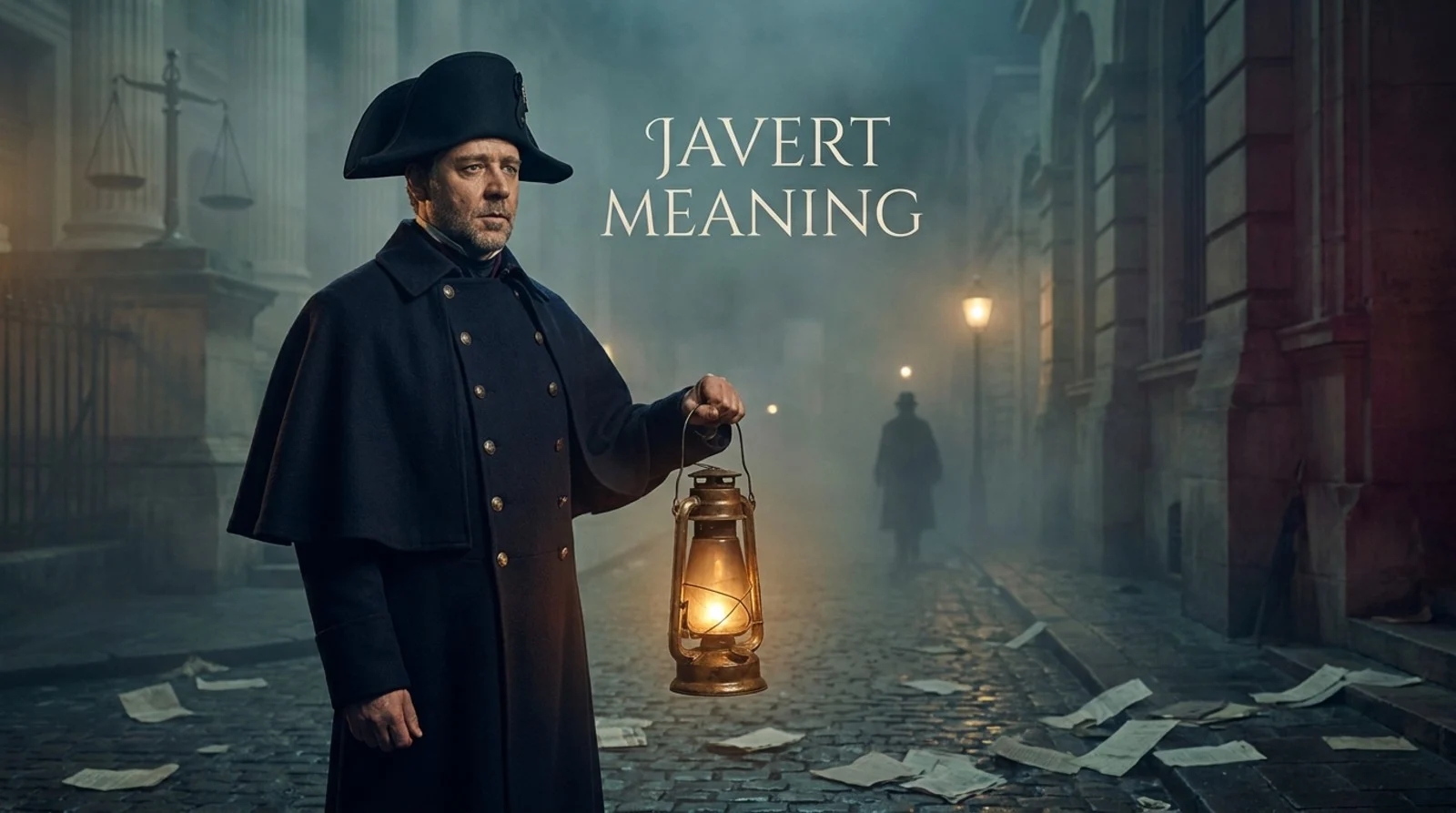
If you are searching for Javert meaning, Javert is the surname of Inspector Javert, one of the most important characters in Victor Hugo’s Les Misérables. He is a police inspector who believes deeply in law, order, duty, and punishment. His life becomes centered on pursuing Jean Valjean, a former convict who has rebuilt his life as a respected and compassionate man.
But Javert means more than simply a police officer or antagonist.
In Les Misérables, Inspector Javert represents absolute loyalty to the law and a rigid idea of justice. His character becomes especially important because Jean Valjean represents mercy, forgiveness, change, and moral compassion. Their conflict creates one of the novel’s central questions: What happens when the law and morality point in different directions?
What Does Javert Mean?
Javert is primarily a fictional surname associated with Inspector Javert, a major character in Victor Hugo’s Les Misérables.
The word does not have a commonly used English dictionary meaning in the way words such as “justice” or “freedom” do. Its literary significance comes from the character attached to the name.
In the novel, Javert is a police inspector who sees society through a strict division between:
- Law and crime
- Obedience and disobedience
- Authority and rebellion
- Criminals and respectable people
- Punishment and accountability
For Javert, the law provides a clear structure for understanding the world. A person who breaks the law is a criminal, and a person who follows it deserves respect.
This simple worldview works for him until he encounters Jean Valjean.
Valjean has committed a crime and served time in prison, yet he later becomes a generous and responsible member of society. His transformation challenges Javert’s understanding of human nature.
That conflict gives the name Javert its deeper literary meaning.
Who Is Inspector Javert?
Inspector Javert is one of the principal characters in Les Misérables, published by Victor Hugo in 1862.
He works as a police officer and spends much of the story pursuing Jean Valjean. Javert knows Valjean as a former prisoner and remains convinced that his criminal past defines him.
Javert is not presented as a simple criminal-hunting villain. Hugo gives him a much more complicated role.
Javert genuinely believes that enforcing the law protects society. He takes his responsibilities seriously and has little tolerance for people who violate established rules.
His personal identity is closely connected to his profession.
For Javert, being an officer is not merely a job. It is a moral system.
That is why his encounters with Valjean become so powerful. Valjean repeatedly demonstrates that a person can change, while Javert struggles to accept that possibility.
Javert Meaning in Les Misérables
The deeper meaning of Javert comes from what he represents.
He can be understood as a symbol of:
- Strict law and order
- Absolute obedience
- Institutional authority
- Moral rigidity
- Punishment
- Duty
- Legalism
- An unforgiving view of justice
- Resistance to personal change
Javert believes that society needs clear rules. From his perspective, allowing criminals to escape punishment could weaken the entire social structure.
The problem is that human beings are rarely as simple as legal categories.
Jean Valjean is the clearest example.
Valjean begins the story as a convicted man, but his life changes dramatically. He becomes capable of kindness, sacrifice, and compassion. Javert has difficulty reconciling the criminal he once knew with the morally responsible man he encounters later.
This is where Javert becomes more than a character.
He becomes a representation of a worldview that struggles when reality becomes morally complicated.
What Does Javert Symbolize?
Javert symbolizes justice without flexibility.
That does not mean that Hugo presents every law or every form of justice as wrong. Instead, Javert shows what can happen when obedience to rules becomes so absolute that compassion and individual circumstances disappear.
His worldview leaves very little room for:
- Forgiveness
- Rehabilitation
- Personal transformation
- Mercy
- Moral complexity
Javert sees the law as something stable and objective. Valjean’s life shows him that human character can change.
That contradiction eventually becomes impossible for Javert to ignore.
Javert as a Symbol of Law
Javert’s strongest symbolic association is the law.
He believes that rules create order and that society depends on people respecting authority. His devotion to this principle explains his relentless pursuit of Valjean.
From Javert’s perspective, letting a known criminal escape justice is not a small mistake. It threatens the system he has devoted his entire life to protecting.
Javert as a Symbol of Moral Rigidity
Javert’s problem is not simply that he believes in law.
His deeper problem is that he has difficulty imagining a moral world outside the categories established by the law.
A person can be legally guilty yet morally transformed.
A person can break a rule for compassionate reasons.
A respected person can have a criminal past.
These ideas become increasingly important as Valjean’s story develops.
Javert struggles because accepting them would require him to reconsider the foundation of his identity.
Javert and Jean Valjean
The relationship between Javert and Jean Valjean is the central force behind Javert’s character development.
Valjean has served a prison sentence after stealing bread and later faces years of suspicion because of his past.
After an encounter with the Bishop of Digne, Valjean begins a completely different life. He becomes a successful and charitable man and eventually takes responsibility for others.
Javert, however, continues to associate Valjean with the identity of a former convict.
Their relationship can be understood through a simple contrast:
| Javert | Jean Valjean |
|---|---|
| Law | Mercy |
| Punishment | Forgiveness |
| Fixed identity | Personal transformation |
| Authority | Compassion |
| Duty | Sacrifice |
| Order | Moral responsibility |
| Past actions | Possibility of change |
This contrast is one reason their relationship remains so memorable.
Valjean does not simply escape Javert physically. His life challenges Javert’s entire understanding of what a person can become.
Why Is Javert Obsessed With Jean Valjean?
Javert’s pursuit of Valjean is partly professional, but it becomes deeply personal because Valjean repeatedly disrupts Javert’s understanding of justice.
Javert knows Valjean as a former convict. He expects him to behave according to the identity attached to that past.
Instead, Valjean repeatedly acts with courage and compassion.
- He protects other people.
- He accepts personal sacrifice.
- He helps those who are vulnerable.
- He repeatedly places another person’s needs above his own safety.
For Javert, these actions create a problem that cannot be solved simply by arresting Valjean.
If Valjean is truly capable of goodness, then Javert must reconsider the belief that a criminal identity permanently defines a person.
That possibility threatens the certainty on which Javert has built his life.
Is Javert a Villain?
Javert functions as an antagonist, but describing him as simply a villain misses much of his literary purpose.
He does harmful things in the course of enforcing the law, and his relentless pursuit of Valjean creates serious danger. At the same time, Javert does not see himself as evil.
He believes he is doing his duty.
That distinction matters.
Hugo gives Javert a coherent internal philosophy. Javert believes that society needs authority and that criminals must face consequences. His actions come from those beliefs rather than from a desire to cause suffering for its own sake.
This makes him more interesting than a conventional villain.
He represents a system of thinking.
The real conflict is not simply good person versus bad person. It is also rigid justice versus compassionate morality.
Javert and the Meaning of Justice
Justice is one of the most important ideas connected to Javert.
For him, justice is closely tied to law.
If someone commits a crime, punishment follows. If someone breaks the law, authority must respond.
Valjean’s story introduces another idea of justice: a person’s circumstances, intentions, transformation, and capacity for redemption also matter.
This creates two competing approaches.
Legal justice asks:
What rule was broken, and what punishment applies?
Moral justice can ask:
What happened, why did it happen, has the person changed, and what response is ethically appropriate now?
Javert is comfortable with the first framework.
Valjean’s life forces him to confront the second.
Hugo uses this tension to explore a much larger question about society: Can justice exist without compassion?
Javert’s Character Traits
Several traits define Inspector Javert throughout the novel.
Strict
Javert follows rules closely and expects other people to do the same.
Disciplined
His professional identity requires strong self-control and commitment to duty.
Determined
Once Javert believes someone has violated the law, he does not easily abandon the pursuit.
Authoritarian
He places significant trust in official authority and established institutions.
Uncompromising
Javert has difficulty accepting exceptions, even when circumstances are complicated.
Loyal to Duty
His personal beliefs are deeply connected to his responsibility as an officer.
Judgmental
He tends to classify people according to their legal and social status.
Resistant to Change
This becomes one of his most important characteristics because Valjean’s transformation challenges his entire worldview.
Javert’s Moral Conflict
Javert’s most important conflict appears when his understanding of Valjean can no longer fit the evidence in front of him.
Valjean is not behaving like the person Javert believes he should be.
- He shows mercy.
- He protects others.
- He accepts responsibility.
- He repeatedly demonstrates that human beings can change.
For Valjean, transformation is possible.
For Javert, identity has been much more fixed.
This creates a psychological and philosophical crisis for the character. Javert has spent his life believing that the law provides a reliable distinction between right and wrong. Valjean introduces circumstances where that distinction becomes much harder to maintain.
Javert is forced to confront a possibility he has spent his life rejecting: a person can be more than their worst act.
Why Does Javert Kill Himself?
Javert’s suicide is one of the most significant moments in Les Misérables.
After Valjean has the opportunity to kill Javert, Valjean instead chooses mercy and allows him to live.
This act profoundly disrupts Javert’s worldview.
Javert is then placed in an impossible position.
If he arrests Valjean, he would be punishing a man who showed him mercy and whose actions demonstrate genuine moral goodness.
If he allows Valjean to remain free, he would be violating the principles of law and duty that have defined his entire life.
He cannot comfortably accept either option.
Javert’s suicide therefore represents the collapse of his rigid moral framework.
It is important not to reduce the scene to a simple message such as “Javert was wrong and Valjean was right.” Hugo’s construction is more complex. Javert’s tragedy comes from his inability to reconcile two ideas that he has always kept separate:
law and mercy.
His worldview leaves him without a way to integrate them.
Javert vs. Jean Valjean: The Deeper Contrast
The two characters can be read as opposing approaches to human behavior.
Valjean’s story is built around transformation.
Javert’s worldview is built around permanence.
Valjean asks us to consider what a person can become.
Javert asks us to consider what happens when society defines a person by what they have already done.
This makes their conflict larger than a police officer chasing a former prisoner.
It becomes a debate about identity.
Valjean’s Central Idea
A person’s past does not have to determine their future.
Javert’s Central Idea
A person’s actions establish their place within the legal and social order.
Hugo places these ideas against each other throughout the novel.
The result is a conflict that remains relevant far beyond the plot of Les Misérables.
What Does Javert Represent in Modern Terms?
The character can still be useful when discussing situations involving strict rule-following versus human judgment.
For example, imagine a workplace where an employee makes a serious mistake but later takes responsibility, repairs the damage, and changes their behavior.
A rigid approach might focus entirely on the original violation.
A restorative approach might consider the person’s actions afterward as well.
Calling someone “Javert-like” in a literary discussion can therefore suggest that the person is:
- Extremely strict about rules
- Focused heavily on authority
- Unwilling to make exceptions
- Suspicious of people who break rules
- More concerned with enforcement than compassion
This should be understood as a literary reference rather than a formal dictionary definition.
Javert Meaning in One Simple Example
Imagine two people looking at the same situation.
One person says:
“The rule was broken, so the punishment must follow.”
Another says:
“The rule was broken, but we also need to consider why it happened, what has changed, and what response is fair now.”
The first perspective is closer to Javert’s worldview.
The second perspective is closer to the moral complexity represented by Valjean.
This example captures the central meaning of Javert without requiring a detailed knowledge of Les Misérables.
Is Javert Based on a Real Person?
Javert is a fictional character created by Victor Hugo.
However, Hugo drew inspiration from the real social and political world around him. The novel is deeply concerned with poverty, punishment, crime, social inequality, policing, imprisonment, revolution, and redemption.
The character therefore feels realistic because his beliefs reflect real institutional attitudes toward law and criminality.
Javert is not simply an invented policeman with a personal grudge. He represents a recognizable form of authority.
Javert and Victor Hugo’s Larger Message
Victor Hugo uses Javert to explore the limitations of a justice system that focuses heavily on punishment while giving little attention to rehabilitation or compassion.
This does not make the character useless or purely negative.
Javert’s commitment to order reflects a genuine social need. A society cannot function without rules, institutions, and accountability.
The tension appears when those systems become incapable of recognizing individual circumstances.
That is what makes Javert such an effective literary character.
He represents something society needs, while also showing the danger of taking that principle to an absolute extreme.
Javert Meaning in Literature
In literary analysis, Javert can be described as a symbolic embodiment of rigid law and institutional authority.
His importance comes from the contrast between his worldview and Valjean’s transformation.
He can represent:
- Law without mercy
- Authority without flexibility
- Punishment without rehabilitation
- Identity defined by the past
- Duty placed above personal compassion
- The difficulty of accepting moral change
His final crisis gives these ideas their strongest expression.
Javert discovers that reality cannot always fit neatly into the categories he has trusted throughout his life.
Common Questions About Javert
What does Javert mean?
Javert is the surname of Inspector Javert, a major fictional character in Victor Hugo’s Les Misérables. In literary interpretation, Javert is strongly associated with strict law, authority, duty, and rigid justice.
What does Javert symbolize?
Javert symbolizes uncompromising law and order. His character also represents moral rigidity and the conflict between legal justice and compassion.
Who is Javert in Les Misérables?
Inspector Javert is a police officer who spends much of the story pursuing Jean Valjean, a former convict who has transformed his life.
Why does Javert hate Jean Valjean?
Javert’s relationship with Valjean is more complicated than simple hatred. Javert believes Valjean’s criminal past makes him a person who must remain accountable to the law. Valjean’s transformation repeatedly challenges that belief.
What does Javert represent compared with Jean Valjean?
Javert represents strict law, order, and fixed judgment, while Valjean represents transformation, mercy, sacrifice, and redemption. Their contrast drives much of the novel’s moral conflict.
Is Javert a villain?
Javert acts as an antagonist, but Hugo gives him a serious moral philosophy rather than presenting him as a simple evil character. He genuinely believes that enforcing the law protects society.
Why does Javert suicide?
Javert becomes unable to reconcile his absolute commitment to the law with Valjean’s act of mercy and his evidence of genuine moral transformation. This conflict destroys the framework through which Javert has understood his life.
What is the main difference between Javert and Valjean?
Javert tends to see identity as fixed by behavior and legal status, while Valjean’s story emphasizes the possibility of personal transformation and redemption.
Is Javert a real name?
Javert is best known as the surname of Inspector Javert in Les Misérables. Its cultural and literary recognition comes primarily from Victor Hugo’s novel and later adaptations.
Conclusion
The meaning of Javert goes far beyond the name of a police inspector in Les Misérables. Inspector Javert represents strict law, authority, duty, and a rigid idea of justice. His relentless pursuit of Jean Valjean becomes a deeper conflict between following rules and recognizing a person’s ability to change.
What makes Javert memorable is the way his certainty is eventually challenged. Valjean’s mercy forces him to face a world where justice cannot always be separated from compassion. His tragedy shows the danger of viewing people only through their past actions or legal status.
In this sense, Javert remains one of Victor Hugo’s most powerful characters because he turns a simple question about law and crime into a much bigger question about justice, mercy, identity, and human transformation.