
You might own a powerful pickup truck, a family SUV, or a travel trailer, but there is one number you should never ignore: GVWR. Understanding GVWR meaning helps you know how much total weight your vehicle is designed to handle when fully loaded. It is more than a technical abbreviation on a sticker. It is an important part of choosing the right vehicle, loading cargo safely, and avoiding unnecessary strain on its components.
GVWR stands for Gross Vehicle Weight Rating. It is the maximum total loaded weight specified by the vehicle manufacturer. This includes the vehicle itself, passengers, cargo, fuel, and other items being carried. For example, if a truck has a GVWR of 7,000 pounds, its actual loaded weight must not exceed that rating. Knowing this limit makes everyday decisions easier, from packing for a road trip to carrying building materials in a pickup bed.
What Does GVWR Mean?
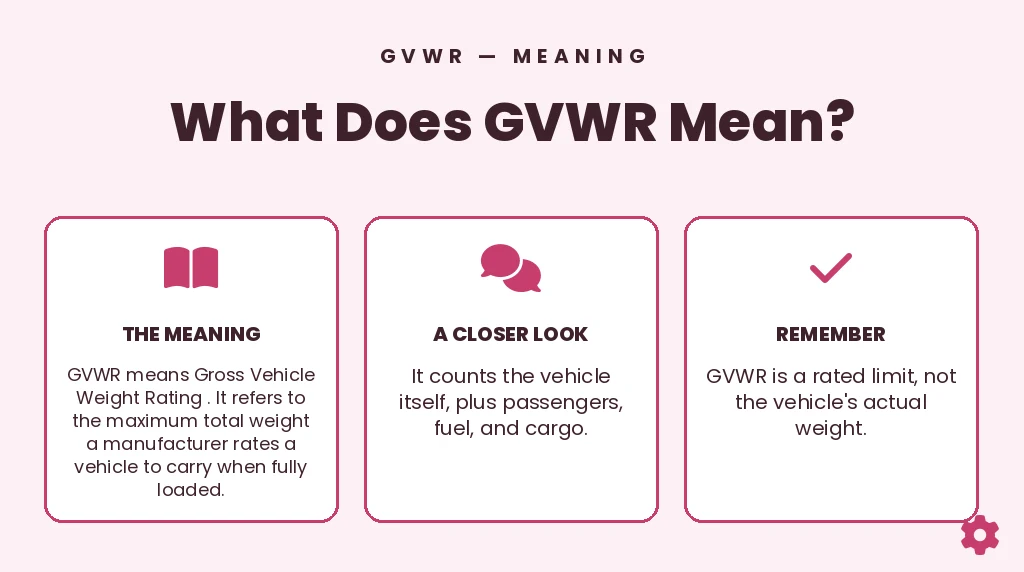
GVWR means Gross Vehicle Weight Rating. It refers to the maximum total weight a manufacturer rates a vehicle to carry when fully loaded.
This rating applies to the complete vehicle, not just the cargo area. The vehicle’s own weight counts toward the limit, along with its passengers, luggage, fuel, accessories, and other loads.
Consider a pickup truck with a GVWR of 7,000 pounds. If the truck weighs 5,000 pounds with its standard equipment and fluids, the remaining capacity is approximately 2,000 pounds. That remaining amount must cover the driver, passengers, cargo, and any additional equipment that contributes to the vehicle’s loaded weight.
The important distinction is that GVWR is a rated limit, not the vehicle’s actual weight. The actual weight changes depending on what the vehicle carries. The GVWR generally stays fixed for that vehicle configuration.
How Does GVWR Work in Real Life?
Imagine you are loading a truck for a weekend camping trip. You add family members, coolers, tents, food, bicycles, and other supplies. Every item adds weight, even if the truck looks almost empty.
The total loaded weight is what matters.
Here is a simple example:
| Item | Weight |
|---|---|
| Truck with standard equipment and fluids | 5,000 lb |
| Driver and passengers | 500 lb |
| Camping gear and luggage | 400 lb |
| Additional equipment | 200 lb |
| Actual loaded weight | 6,100 lb |
| Truck’s GVWR | 7,000 lb |
| Remaining weight capacity | 900 lb |
In this example, the truck is 900 pounds below its GVWR, assuming the figures are accurate and all other applicable weight limits are satisfied.
Now imagine adding heavy tools and construction materials weighing another 1,100 pounds. The loaded weight would reach 7,200 pounds, exceeding the truck’s GVWR by 200 pounds.
This example shows why checking weight matters before a journey, especially when carrying heavy equipment or transporting several passengers.
GVWR vs. GVW: What Is the Difference?

GVWR and GVW sound similar, but they describe two different things.
- GVWR (Gross Vehicle Weight Rating): The maximum total loaded weight specified by the manufacturer.
- GVW (Gross Vehicle Weight): The vehicle’s actual total weight at a particular time, including its current load.
For example, a van may have a GVWR of 8,500 pounds but weigh only 6,900 pounds when loaded for a delivery. Its GVW is 6,900 pounds, while its GVWR remains 8,500 pounds.
If you add more packages, the actual weight increases. The manufacturer’s rating does not automatically increase with it.
| Feature | GVWR | GVW |
|---|---|---|
| Meaning | Maximum rated loaded weight | Actual loaded weight |
| Changes with cargo? | Generally no | Yes |
| Specified by manufacturer? | Yes | No, measured or calculated |
| Main purpose | Establishes the vehicle’s rated weight limit | Shows the vehicle’s current weight |
The simplest way to remember the difference is this: GVWR tells you the limit; GVW tells you what the vehicle weighs now.
GVWR vs. Curb Weight
Curb weight is the weight of a vehicle with its standard equipment and operating fluids, generally including fuel, but without passengers or cargo. Exact conventions can vary by manufacturer.
GVWR includes that base vehicle weight plus the weight of everything it carries.
For example, suppose an SUV has a curb weight of 4,400 pounds and a GVWR of 5,800 pounds. The difference is 1,400 pounds.
That difference gives you a starting point for understanding its carrying capacity. However, you must also account for passengers, accessories, and other applicable manufacturer limits.
| Feature | Curb Weight | GVWR |
|---|---|---|
| Describes | Vehicle’s base operating weight | Maximum rated loaded weight |
| Includes passengers? | Generally no | Yes |
| Includes cargo? | No | Yes |
| Changes during normal loading? | Not with ordinary cargo | Generally no |
| Useful for | Understanding the vehicle’s base weight | Checking total loading limits |
Do not assume the entire difference between curb weight and GVWR is available for cargo alone. Passengers and added equipment use part of that capacity.
GVWR vs. Payload Capacity
Payload capacity tells you how much additional weight a vehicle can carry. It is closely related to GVWR, but it is not the same thing.
A simple estimate is:
Payload capacity = GVWR − vehicle weight
For instance, if a pickup truck has a GVWR of 7,200 pounds and its relevant base weight is 5,100 pounds, the calculated difference is 2,100 pounds.
That does not mean you can place 2,100 pounds of cargo in the bed without considering anything else. The driver, passengers, accessories, and other carried items all use payload capacity.
Actual payload can also depend on the specific vehicle configuration and equipment. Use the manufacturer’s payload information and applicable loading labels rather than relying on a model’s advertised maximum.
Example: How Much Can Your Truck Carry?
Suppose the figures for your particular truck are:
- GVWR: 7,200 pounds
- Actual vehicle weight before adding people and cargo: 5,100 pounds
- Driver and passengers: 450 pounds
- Added accessories: 150 pounds
The remaining capacity under the GVWR calculation is:
7,200 − 5,100 − 450 − 150 = 1,500 pounds
That 1,500 pounds is the remaining weight budget for cargo and any other items not already included in the calculation. Axle ratings, tire limits, and other manufacturer restrictions still apply.
GVWR vs. Towing Capacity
GVWR and towing capacity answer different questions.
GVWR concerns the total loaded weight of the vehicle itself. Towing capacity concerns the maximum trailer weight the vehicle is rated to tow under specified conditions.
For example, a truck might have a GVWR of 7,000 pounds and a maximum towing capacity of 10,000 pounds. Those numbers are not contradictory. One applies to the truck’s loaded weight, and the other applies to its trailer-towing capability.
When towing, the trailer’s tongue weight or pin weight usually places additional load on the towing vehicle. That load must be included when checking the truck’s GVWR and rear axle limits.
You must also check the vehicle’s gross combination weight rating (GCWR), which covers the allowable combined weight of the loaded towing vehicle and trailer, along with the trailer’s own weight limits.
A high towing capacity does not guarantee that you can tow a trailer at its maximum weight while carrying a full load of passengers and cargo. Several ratings must work together.
Where Can You Find GVWR on a Vehicle?
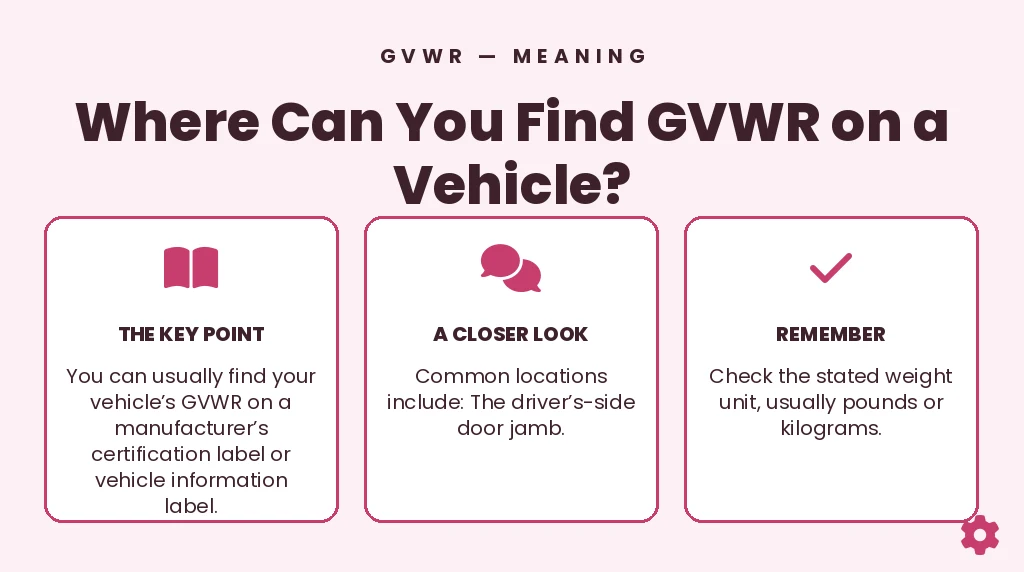
You can usually find your vehicle’s GVWR on a manufacturer’s certification label or vehicle information label.
Common locations include:
- The driver’s-side door jamb.
- The driver’s-side door frame.
- A label near the driver’s seat or door opening.
- The vehicle’s owner’s manual or manufacturer documentation.
On many vehicles sold in the United States, the certification label on the driver’s door area lists the GVWR and gross axle weight ratings.
For a truck, van, SUV, RV, or trailer, the exact label location can vary. Some vehicles also have separate tire and loading information labels.
How to Check Your Vehicle’s GVWR
- Park the vehicle safely and open the driver’s door.
- Look along the door frame and door jamb for the manufacturer’s certification label.
- Find the line marked GVWR.
- Check the stated weight unit, usually pounds or kilograms.
- Compare the rating with the actual loaded weight and other applicable limits before carrying a heavy load.
If the label is missing, damaged, or difficult to read, consult the owner’s manual or contact the manufacturer or an authorized dealer. Do not guess the rating from the vehicle’s appearance or engine size.
A vehicle registration document may contain weight-related information, depending on the jurisdiction, but the manufacturer’s certification label is an important source for the vehicle’s specified GVWR.
How Is GVWR Calculated?
Vehicle manufacturers establish GVWR based on the vehicle’s design, configuration, and engineering limits. It is not simply the vehicle’s curb weight plus an arbitrary amount of cargo.
Relevant factors can include:
- Chassis and frame design.
- Suspension capacity.
- Axle ratings.
- Tire and wheel load ratings.
- Braking performance.
- Vehicle configuration and equipment.
- Applicable safety requirements and testing.
These factors help determine the load the vehicle is rated to carry. A vehicle may have strong brakes or a powerful engine and still have a relatively low GVWR because other components or design limits constrain its rating.
For vehicle owners, the key point is that you generally should not try to calculate a new GVWR yourself. Use the rating provided by the manufacturer for your exact vehicle.
What Happens If You Exceed GVWR?
Exceeding the GVWR means the vehicle is carrying more total weight than its manufacturer-rated limit. This can affect safety, handling, and component life.
Potential consequences include:
Reduced Braking Performance
A heavier vehicle requires more effort to slow down. Excessive loading can increase stopping demands and place additional strain on the braking system.
Poor Handling and Stability
Too much weight can affect steering response, cornering, and overall control. An uneven load can create additional problems even when the total weight appears acceptable.
Extra Stress on Tires and Suspension
Overloading can increase the demands on tires, wheels, suspension components, and axles. Tire pressure and axle loading must also remain within their specified limits.
Greater Wear and Potential Damage
Repeated overloading can accelerate wear and contribute to damage involving suspension parts, tires, brakes, and other components.
Possible Legal or Compliance Issues
Depending on the vehicle, its use, and local regulations, exceeding applicable weight limits may lead to penalties or other compliance problems. Commercial vehicles can be subject to additional requirements.
The exact consequences depend on the vehicle, the amount and distribution of the load, operating conditions, and local rules. The safest approach is to remain within the manufacturer’s ratings and applicable legal limits.
GVWR, GAWR, and GCWR Explained
These three abbreviations appear in vehicle specifications, but each measures something different.
| Term | Full Form | What It Covers |
|---|---|---|
| GVWR | Gross Vehicle Weight Rating | Maximum rated loaded weight of one vehicle |
| GAWR | Gross Axle Weight Rating | Maximum rated load for a specific axle |
| GCWR | Gross Combination Weight Rating | Maximum rated combined weight of a towing vehicle and trailer |
Understanding all three matters when carrying heavy cargo or towing.
For example, a loaded truck could remain below its GVWR but still exceed its rear GAWR if too much weight is concentrated over the rear axle. Similarly, the combined truck and trailer could exceed the GCWR even when each vehicle appears to be within its own weight rating.
That is why total weight alone does not tell the whole story. Weight distribution and the limits of individual components matter, too.
Does GVWR Include Passengers, Fuel, and Cargo?
Yes. GVWR refers to the total loaded vehicle weight, so passengers and cargo count toward the limit. Fuel and operating fluids are also part of the vehicle’s weight under normal operating conditions.
Here is a quick guide:
| Item | Counts Toward GVWR? |
|---|---|
| Vehicle itself | Yes |
| Driver | Yes |
| Passengers | Yes |
| Luggage and cargo | Yes |
| Fuel carried in the tank | Yes |
| Added accessories | Yes, if fitted to the vehicle |
| Trailer being towed | Not as part of the towing vehicle’s GVWR itself, but the trailer’s tongue or pin load affects the towing vehicle |
The final distinction is important. A trailer’s entire weight is not included in the towing vehicle’s GVWR, but the portion of the trailer’s load transferred to the truck or SUV must be considered. The combined weight is relevant to GCWR.
Why GVWR Matters When Buying a Truck, SUV, or RV
GVWR is worth checking before buying a vehicle, particularly if you regularly carry passengers, tools, sports equipment, building supplies, or camping gear.
A vehicle with a higher towing capacity is not automatically the best option for heavy cargo. You need to consider how much the vehicle can carry after accounting for its own weight and the equipment fitted to it.
Before purchasing, ask yourself:
- How many passengers will usually travel with me?
- Will I carry heavy tools, equipment, or luggage?
- Do I plan to tow a trailer or camper?
- Will additional accessories reduce the available payload?
- Do the axle ratings and tire capacities support my intended use?
For RV owners, these checks are especially useful because water, food, clothing, batteries, and camping equipment can add considerable weight. For commercial drivers, the same principle applies to tools, deliveries, and other loads.
Choose a vehicle whose ratings suit your real needs, not just your occasional best-case scenario.
Frequently Asked Questions
1. What does GVWR stand for?
GVWR stands for Gross Vehicle Weight Rating. It is the maximum total loaded weight specified by the vehicle manufacturer, including the vehicle itself, passengers, cargo, and other carried items.
2. Is GVWR the same as the actual weight of a vehicle?
No. GVWR is the manufacturer’s maximum rated weight, while actual loaded weight is what the vehicle weighs at a particular time. The actual weight changes as passengers, cargo, fuel, and equipment are added or removed.
3. Does GVWR include passengers and cargo?
Yes. Passengers and cargo count toward GVWR, along with the vehicle itself and its operating fluids. Added equipment and accessories also use part of the available weight capacity.
4. Where can I find the GVWR on my truck?
Check the manufacturer’s certification label, commonly located on the driver’s-side door jamb or door frame. You can also consult the owner’s manual or manufacturer documentation if the label is missing or unreadable.
5. What is the difference between GVWR and payload capacity?
GVWR is the maximum rated total loaded weight of the vehicle. Payload capacity describes the additional weight it can carry. A basic estimate is GVWR minus the relevant vehicle weight, but the manufacturer’s payload information and other loading limits should also be checked.
6. Can I tow a trailer that weighs more than my truck’s GVWR?
The trailer’s total weight can be greater than the towing vehicle’s GVWR because the two ratings measure different things. However, the towing vehicle must stay within its GVWR, axle limits, and other applicable ratings. You must also check towing capacity, GCWR, and the trailer’s own ratings.
7. What happens if my vehicle exceeds its GVWR?
Overloading can reduce handling and braking performance, increase stress on tires and suspension components, and contribute to damage. Depending on local rules and vehicle use, it can also create legal or compliance issues.
8. Is GVWR listed on a vehicle registration?
It depends on the jurisdiction and the type of vehicle. Registration documents may include weight-related details, but the manufacturer’s certification label or official manufacturer documentation is an important source for the vehicle’s specified GVWR.
9. Can I increase my vehicle’s GVWR?
You should not assume that adding stronger suspension components, tires, or other aftermarket parts increases the vehicle’s official GVWR. The rating reflects the manufacturer’s specification for the vehicle configuration. Any proposed modification must be evaluated under applicable manufacturer guidance, certification requirements, and local laws.
Final Thoughts
Understanding GVWR meaning helps you make safer, more informed decisions when loading a vehicle, choosing a truck, or planning a towing trip. The rating tells you the maximum total weight your vehicle is designed and rated to carry, while GVW describes its actual weight at a given time.
Before loading up, check the GVWR label, account for passengers and equipment, and consider axle ratings, tire limits, and towing specifications where relevant. A few minutes spent checking these numbers can help you avoid overloading and protect your vehicle on the road.