Have you ever received a message that simply said “yh” and wondered if the person meant yes, agreed with you, or just wanted to end the conversation? You’re not alone. Short text abbreviations can make everyday conversations confusing, especially when a reply contains only two letters.
The YH meaning in text is usually “yeah,” an informal way to say yes, agree with someone, or acknowledge what they have said. People use it in text messages, social media chats, and other casual online conversations because it’s quick to type and easy to understand. For example, if you ask a friend, “Are we still meeting tonight?” and they reply “yh,” they’re probably confirming the plan.
However, the meaning of YH in texting isn’t always about agreement alone. The surrounding conversation, punctuation, and sender’s usual communication style can affect how the reply feels. Let’s explore its meaning, common uses, real-life examples, and the best ways to respond.
What Does YH Mean in Text?
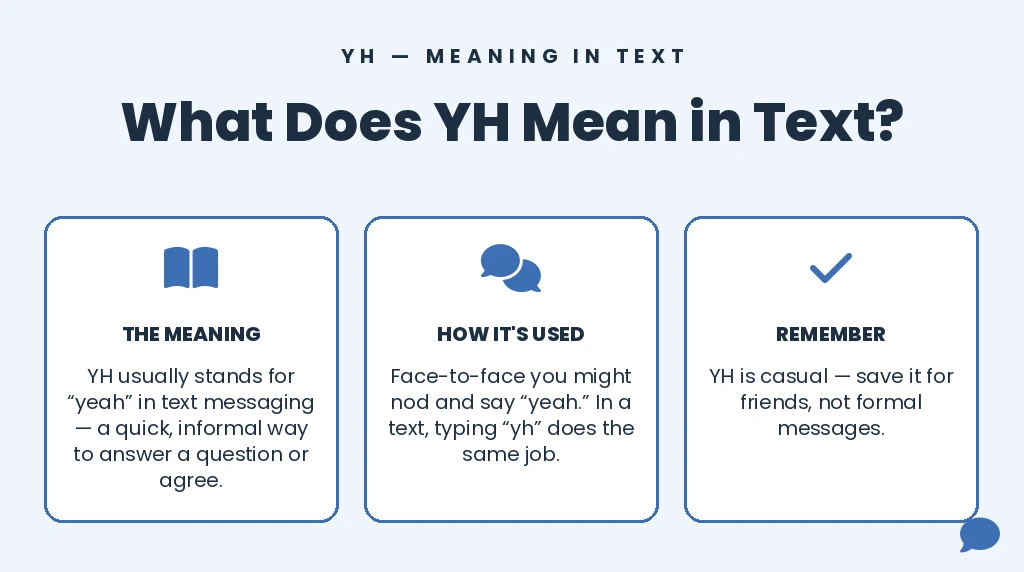
YH usually stands for “yeah” in text messaging. It’s an informal written shortcut people use when they want to answer a question, agree with a statement, or confirm something without typing a full response.
Think of YH as a compact version of an everyday spoken word. When you’re talking to someone face-to-face, you might nod and say “yeah.” In a text conversation, typing “yh” can serve the same basic purpose.
For example:
Alex: Are you coming over later?
Sam: yh
Meaning: Yeah, I’m coming over later.
In this exchange, the sender uses YH to give a quick affirmative answer. There’s no complicated hidden meaning. The exact interpretation comes from the question that came before it.
YH is common in informal digital communication, where people often shorten words to save time. It belongs to the broader family of texting slang and messaging shortcuts that includes expressions such as “yep,” “idk,” and “btw.”
Here are the main things to remember about the YH definition:
- Primary meaning: Yeah.
- Implied meaning: Yes, I agree, or I acknowledge what you said.
- Communication style: Casual and informal.
- Common settings: Text messages, private chats, and social media conversations.
- Tone: Usually neutral or casual, although context can make it sound enthusiastic, hesitant, or dismissive.
One important distinction is that YH doesn’t automatically communicate a strong emotion. A person can use it when they’re happy, busy, distracted, or simply trying to reply quickly. The abbreviation alone doesn’t tell you which feeling applies.
What Does YH Stand For?
In everyday texting, YH is generally understood as a shortened written form of “yeah.” People don’t usually treat it as a formal acronym with a separate full phrase.
This distinction matters because not every short combination of letters works the same way. An acronym typically represents the initial letters of words, while a texting shortcut may simply use fewer letters to represent a familiar expression.
For example:
| Term | Meaning | Type |
|---|---|---|
| YH | Yeah | Informal shortening |
| LOL | Laughing out loud | Initialism |
| BRB | Be right back | Initialism |
| IDK | I don’t know | Initialism |
| BTW | By the way | Initialism |
YH may be described as a texting abbreviation or slang expression. Calling it an acronym is understandable in casual discussion, but “shortened form of yeah” is the more precise explanation for its ordinary use.
Is YH Short for Yeah or Yes?
YH is generally short for “yeah,” but people often use it to communicate “yes.” The difference is subtle.
“Yeah” is an informal affirmative expression. “Yes” is a more direct and often more formal answer. In everyday speech, however, both can express agreement or confirmation.
Consider these examples:
Question: “Did you submit the assignment?”
Reply: “yh”
Meaning: “Yeah, I submitted it.”
Now consider this conversation:
Question: “Do you agree with the decision?”
Reply: “yh”
Meaning: “Yes, I agree.”
The written abbreviation stays the same, but the intended meaning follows the question. That’s why reading the surrounding message is more useful than trying to assign YH one rigid interpretation.
How Is YH Used in Text Messages?
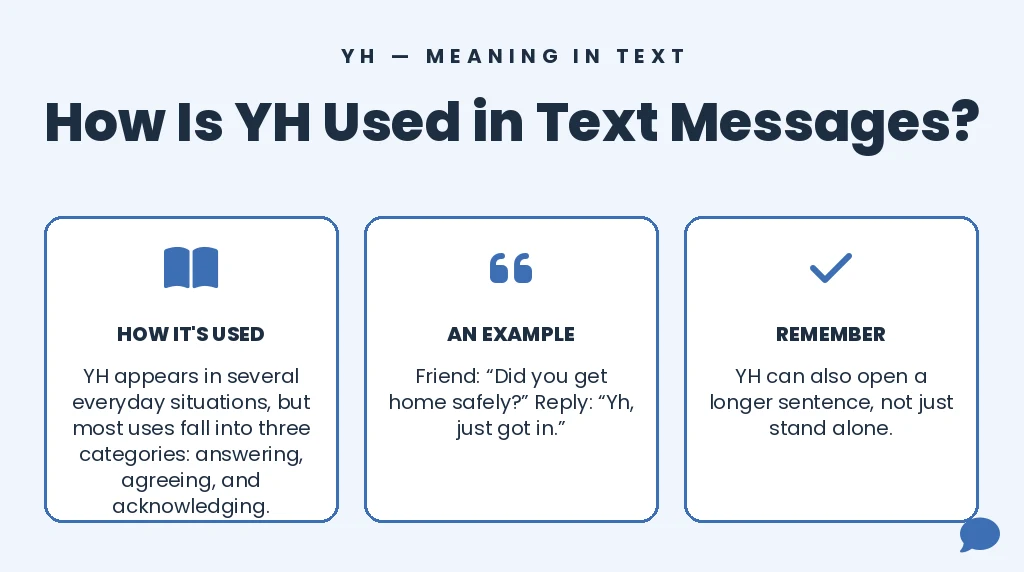
YH appears in several everyday situations, but most uses fall into three categories: answering, agreeing, and acknowledging. Understanding these common patterns makes the abbreviation easier to interpret without overthinking a short reply.
To Answer a Yes-or-No Question
One of the most common uses of YH is to answer a question that expects a simple yes or no.
Instead of typing a complete sentence, someone can send YH when the answer feels obvious from the conversation.
Examples:
Friend: Did you get home safely?
You: yh
Here, the reply means “Yeah, I got home safely.”
Another example:
Friend: Are you free this weekend?
You: yh, why?
The second example adds a question of its own. The sender confirms their availability and invites the other person to explain their plans.
YH works best when the original question provides enough information to understand the answer. If the question involves several choices, a two-letter reply might not be clear enough.
To Agree With Someone
People also use YH to show agreement with another person’s opinion, observation, or suggestion.
For instance:
Mia: That new restaurant is expensive.
Jordan: yh, but the food was good.
Jordan agrees with Mia while adding a personal observation. The abbreviation makes the exchange feel relaxed and conversational.
Here are a few more examples:
- “This homework is difficult.” → “yh, it’s taking forever.”
- “That was a great movie.” → “yh, I loved it.”
- “We should leave early.” → “yh, good idea.”
- “Today’s weather is beautiful.” → “yh, finally!”
Notice that YH doesn’t need to stand alone. It can introduce a longer sentence, making the message sound more natural than a one-word response.
To Confirm Plans or Information
YH can also confirm that someone understands or accepts an arrangement.
This use is especially common when people are organizing meetups, discussing schedules, or sharing simple instructions.
Example:
Friend: Let’s meet outside the library at 4 PM.
You: yh, see you there.
The sender confirms the plan. The additional words make the reply more specific and friendly.
Other examples include:
- “Your appointment is tomorrow at 10.” → “yh, thanks for reminding me.”
- “I’ll send you the notes tonight.” → “yh, sounds good.”
- “Bring your headphones tomorrow.” → “yh, got it.”
- “We’re taking the bus instead.” → “yh, okay.”
A quick YH can be enough for a straightforward arrangement. For important plans, though, a fuller response is often better because it reduces confusion.
To Keep a Conversation Moving
Text messaging doesn’t always require complete sentences. Sometimes people exchange quick acknowledgments because they want to keep the conversation flowing.
For example:
Friend: I just finished my workout.
You: yh, nice!
Friend: I’m completely exhausted now.
In this case, YH helps acknowledge the first message. The added “nice!” provides a little more warmth.
However, there’s an important difference between acknowledging someone and actively engaging with them. If a friend shares a long, emotional story and receives only “yh,” they might feel ignored. A short reply isn’t automatically rude, but it may not offer the support the situation calls for.
The key is to match your response to the message. A quick update may need only a quick acknowledgment. A meaningful conversation often deserves more attention.
YH Meaning on Social Media and Messaging Apps
The basic YH meaning generally stays the same across messaging platforms. The surrounding conversation can change, but the abbreviation usually means “yeah” in ordinary English-language chats.
YH Meaning on WhatsApp
On WhatsApp, people may use YH in private chats, family groups, friend groups, and everyday conversations.
For example:
Friend: Are you bringing snacks tonight?
You: yh, I’ll bring some chips.
The abbreviation makes the reply quick and informal. The second part of the message clarifies what the sender plans to do.
WhatsApp conversations often include a mix of complete sentences, voice notes, emojis, and shortened words. YH fits naturally into that informal style.
YH Meaning on Snapchat
On Snapchat, YH can appear in direct messages between friends or people who communicate casually.
For example:
Friend: Did you see my snap?
You: yh lol
Here, YH confirms that the sender saw the snap. The addition of “lol” can make the response feel more playful, depending on the conversation.
A short reply on Snapchat doesn’t automatically mean someone has lost interest. They may be answering quickly, multitasking, or simply using their usual texting style.
YH Meaning on Instagram DMs
In Instagram direct messages, YH usually serves as a quick affirmative response or acknowledgment.
For example:
Friend: That outfit looks great on you.
You: yh? thank you 😭
In this example, the question mark adds uncertainty or surprise. The sender might be asking for reassurance, expressing disbelief, or reacting playfully to the compliment.
This illustrates an important point: punctuation and the words around YH can affect the message’s tone. The abbreviation itself still doesn’t establish a particular emotion.
YH Meaning on TikTok
People may use YH in TikTok-related conversations when discussing videos, sharing opinions, or responding to messages.
For example:
Friend: This trend is everywhere right now.
You: yh, I’ve seen it all week.
The sender agrees with the observation and adds context.
The same principle applies to comments and other online conversations. YH is a convenient shorthand, not a special TikTok-only term.
YH in Group Chats and Gaming Chats
In group chats, YH can help people respond quickly to suggestions or confirm that they understand a plan.
For example:
Player 1: Ready for another round?
Player 2: yh
Player 3: Let’s go!
The abbreviation is useful when the group needs a quick answer. It can also acknowledge a teammate’s suggestion without interrupting the conversation.
In gaming chats, however, speed and clarity matter. If a message concerns a specific action, such as choosing a location or confirming a strategy, a more detailed reply can prevent mistakes.
What Does YH Mean From a Girl or a Guy?
A common question is whether YH carries a different meaning depending on who sends it. In ordinary texting, it doesn’t have a gender-specific definition. A girl and a guy can both use it to mean “yeah.”
The sender’s personality, relationship with the recipient, and communication habits are more useful clues than gender alone.
YH Meaning in Text From a Girl
When a girl texts YH, she usually means “yeah,” “yes,” or “I agree,” depending on the conversation.
For example:
You: Are you coming to the birthday party?
Her: yh, I’ll be there.
This is a straightforward confirmation. There’s no need to search for a hidden meaning.
Now consider a different exchange:
You: Do you like this song?
Her: yh, it’s catchy.
Here, YH communicates agreement or a positive opinion.
If she replies with only “yh,” you might wonder if she’s interested in talking. However, one brief response doesn’t provide enough evidence to draw that conclusion. She could be busy, distracted, tired, or simply accustomed to short messages.
The best approach is to interpret her reply in context rather than assuming it reveals her feelings.
YH Meaning in Text From a Guy
When a guy texts YH, it generally carries the same meaning: “yeah.”
For example:
You: Did you finish the game?
Him: yh, finally.
The reply confirms that he finished. The word “finally” adds information about how he feels about the experience.
Another example:
You: Want to grab coffee tomorrow?
Him: yh, sounds good.
This is an affirmative answer to an invitation. It doesn’t need a special interpretation simply because a guy sent it.
If he responds with only YH, consider how he normally texts. Some people send short replies to almost everyone. Others write longer messages when they have more time or something specific to say.
Look for a pattern across conversations rather than interpreting a single abbreviation as proof of attraction, annoyance, or disinterest.
Does YH Mean Someone Is Dry Texting?
YH can come across as dry texting in certain situations, but the abbreviation alone doesn’t establish that.
Dry texting generally refers to replies that seem brief, low-effort, or lacking in conversational engagement. A message such as “yh” may feel that way when the other person has shared something meaningful and receives little response.
Compare these examples:
Example A: Ordinary confirmation
Friend: Are we meeting at 5?
You: yh
This is a perfectly reasonable response. The question only needs a simple confirmation.
Example B: A conversation that feels one-sided
You: I finally got the job I’ve wanted for months!
Friend: yh
This reply might feel disappointing because the news invites a more enthusiastic response.
Even then, you can’t know the friend’s intention from those two letters alone. They might be distracted, unsure how to respond, or unaware that their reply sounds cold.
To judge the overall communication, consider:
- Consistency: Does the person regularly send short messages?
- Engagement: Do they ask questions or contribute to conversations?
- Context: Was the original message casual or emotionally important?
- Follow-through: Do they make plans and keep them?
- Clarity: Do they explain when something is wrong instead of leaving you guessing?
A pattern of disengagement may tell you more than one short reply. Avoid treating every brief message as a personal rejection.
What Does YH Mean Depending on Tone and Punctuation?
Although YH usually means “yeah,” the way someone writes it can influence how the message feels. Capitalization, punctuation, extra words, and the surrounding conversation all play a role.
The important distinction is that these signals aren’t fixed rules. Different people have different texting habits, so the same message can feel different to different readers.
| Text message | Possible meaning | Context to consider |
|---|---|---|
yh | Yeah, yes, or agreement | Usually a simple, casual response |
yh! | Enthusiastic agreement | The exclamation mark may add energy |
yh sure | Agreement or acceptance | The conversation determines the tone |
yh lol | Casual acknowledgment or amusement | The earlier message may explain the humor |
yh... | Possible hesitation or uncertainty | The ellipsis can suggest something is left unsaid |
YH | Yeah | Capitalization alone doesn’t establish anger |
yh :) | Friendly acknowledgment | The smiley may soften the reply |
yh ig | Yeah, I guess | May suggest uncertainty or reluctant agreement |
Does YH With a Period Sound Rude?
Not necessarily. Some people use periods in almost every message, while others rarely use punctuation in casual chats.
A reply such as “yh.” might seem abrupt if the sender normally writes warmly and uses emojis. However, it could be completely ordinary for someone who prefers concise messages.
Rather than judging punctuation in isolation, compare the message with the person’s usual style. A sudden change in communication may be worth noticing, but even that doesn’t prove a particular emotion.
What Does YH With an Ellipsis Mean?
An ellipsis consists of three dots: ...
When someone writes “yh…,” they may be hesitating, expressing uncertainty, or suggesting that the conversation isn’t finished. The punctuation can also reflect a personal writing habit.
For example:
Friend: You still think that was a good idea?
You: yh…
Depending on the earlier conversation, this could suggest uncertainty or reluctance. However, the sender might simply use ellipses frequently.
The surrounding words provide more reliable clues than the punctuation alone.
YH vs. Yeah, Yea, Yes, Yep, and Yup
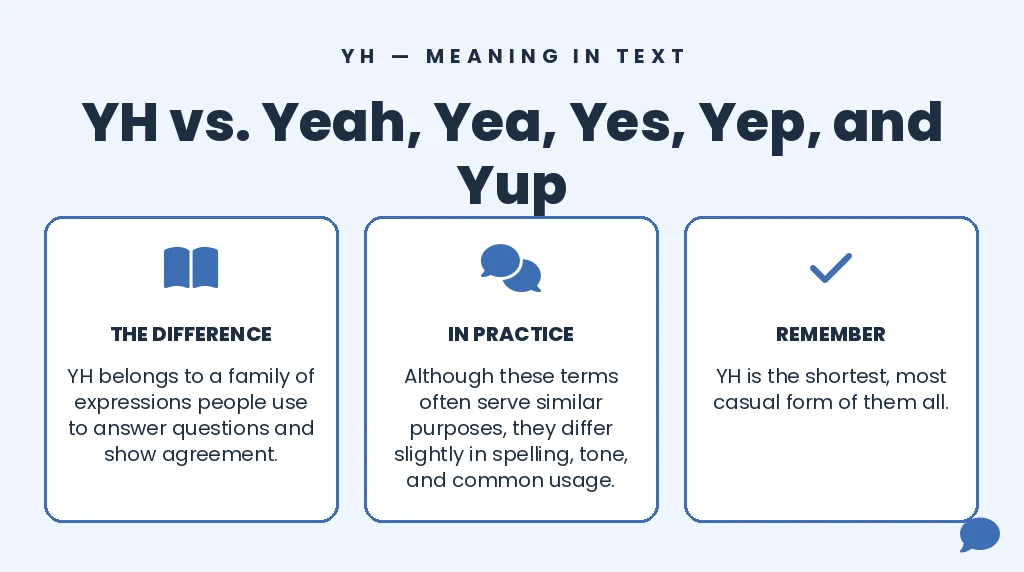
YH belongs to a family of expressions people use to answer questions and show agreement. Although these terms often serve similar purposes, they differ slightly in spelling, tone, and common usage.
| Term | Basic meaning | Typical tone | Example |
|---|---|---|---|
| YH | Yeah | Brief and informal | “yh, I’m coming.” |
| Yeah | Yes or agreement | Conversational | “Yeah, that works.” |
| Yea | Yes or affirmative vote | Context-dependent | “Yea, I support the proposal.” |
| Yes | Affirmative answer | Neutral or formal | “Yes, I understand.” |
| Yep | Yes | Casual and clear | “Yep, see you soon.” |
| Yup | Yes | Very informal | “Yup, got it.” |
| Ya | Can represent “yeah” or “you,” depending on context | Informal | “Ya, that’s fine.” |
| Nah | No | Casual and negative | “Nah, not today.” |
| Mm-hmm | Yes or acknowledgment | Conversational | “Mm-hmm, I understand.” |
| Sure | Agreement or willingness | Context-dependent | “Sure, let’s go.” |
| Okay | Acceptance or acknowledgment | Neutral | “Okay, I’ll do that.” |
These expressions overlap, but they’re not always interchangeable. A person may choose one because it feels more natural in a particular conversation.
YH vs. Yeah
The main difference between YH and yeah is spelling. YH is a shortened written form, while “yeah” is the complete word.
For example:
- YH: “yh, I’ll call you later.”
- Yeah: “Yeah, I’ll call you later.”
Both messages communicate the same basic idea. The first is more abbreviated, while the second is easier to read and looks more complete.
People may choose YH because they type quickly, prefer short messages, or regularly use texting slang. There’s no universal rule that makes one version friendlier than the other.
YH vs. Yea
YH and yea can both communicate agreement, but they aren’t the same spelling.
“Yea” has an established use in voting and formal expressions of affirmative support. It’s also used informally in some conversations as an affirmative expression.
YH, by contrast, usually represents the casual spoken word “yeah” in digital messages.
For example:
Friend: Are you joining us tonight?
Reply: yh
The intended meaning is “yeah.” In a voting context, however, “yea” may be the more appropriate word.
YH vs. Yes
YH is informal shorthand, while yes is a complete word that works in casual and professional communication.
Compare these messages:
- “yh, I understand.”
- “Yes, I understand.”
Both express agreement or confirmation. The second sounds more polished and may be better for a professional conversation.
Use YH when you’re chatting casually with people who understand the abbreviation. Choose “yes” when clarity, formality, or a professional tone matters.
YH vs. Yep and Yup
Yep and yup are informal ways to say yes. They often work as standalone answers, just like YH.
For example:
Question: Did you send the photos?
Reply A: yh
Reply B: yep
Reply C: yup
All three responses can confirm that the photos were sent.
The difference comes down to personal preference and conversational style. Some people prefer written shorthand, while others use complete informal words. None of these options automatically signals a stronger level of interest or friendliness.
YH vs. YW
YH and YW look similar, but their usual meanings are different.
- YH: Yeah.
- YW: You’re welcome.
For example:
Person A: Thanks for helping me with the assignment!
Person B: yw
Here, YW responds to the expression of gratitude. Replacing it with YH would change the meaning of the reply.
This distinction is useful because texting abbreviations can look alike even when they serve completely different purposes.
How Should You Reply When Someone Texts YH?
Your response should depend on what the person is answering. You don’t need a special reply every time someone sends YH.
Sometimes the best response is to continue with the conversation. In other situations, a simple acknowledgment is enough.
When YH Confirms Your Plans
If someone uses YH to accept an invitation or confirm a time, acknowledge the arrangement and move on.
Example:
You: Let’s meet at the coffee shop at 3.
Them: yh
You: Great, see you there!
Other natural replies include:
- “Cool, see you then!”
- “Sounds good.”
- “Perfect, I’ll be there.”
- “Awesome, thanks for confirming.”
These responses work because they acknowledge the agreement without making a simple exchange unnecessarily complicated.
When YH Shows Agreement
If someone agrees with your opinion, you can add your own thought or continue discussing the subject.
Example:
You: That movie had a great ending.
Them: yh
You: I didn’t expect that twist at all.
You could also reply with “Exactly,” “Right?” or “That’s what I thought.”
The goal is to build on the conversation rather than simply exchange short acknowledgments indefinitely.
When YH Acknowledges Your Message
Sometimes YH just means the other person has understood what you said.
For example:
You: Don’t forget to bring your notebook.
Them: yh
You could respond with “Thanks!” or leave the conversation there. If the message doesn’t require further discussion, another reply may not be necessary.
When You Can’t Tell What the Person Means
If the message is ambiguous and the answer matters, ask a clear follow-up question.
For example:
You: Do you want to go to the beach or stay home?
Them: yh
This answer doesn’t identify which option they prefer. You can ask:
- “Which one do you mean?”
- “Beach or home?”
- “Are you saying yes to the beach?”
Clarifying the choice is better than guessing and making the wrong plan.
When YH Feels Like a Conversation Ender
If you’re trying to have a longer conversation and the other person repeatedly replies with short answers, you can ask an open-ended question or give the conversation some space.
For example:
You: How was your day?
Them: yh
This reply doesn’t directly answer the question. Instead of assuming they don’t want to talk, you could ask, “Everything okay?” if you have a reason to be concerned.
However, you don’t need to keep a conversation alive at all costs. If the other person seems busy, it may be better to let them respond when they have time.
Is YH Rude or Friendly in Texting?
YH isn’t inherently rude or friendly. It’s a short, informal expression whose tone depends on how someone uses it.
A quick “yh” can be perfectly polite when you’re confirming a simple detail. The same reply may feel dismissive when someone expects a thoughtful response to important news.
Consider these two examples.
A normal, friendly exchange:
Friend: Want me to save you a seat?
You: yh, thanks!
The response is casual and appreciative.
An exchange that might feel dismissive:
Friend: I’ve had a really difficult week, and I don’t know what to do.
You: yh
The reply may come across as uncaring because it doesn’t acknowledge the person’s feelings or invite them to continue.
The issue isn’t the abbreviation itself. It’s the mismatch between the message and the response.
When someone shares important news, a more considerate reply might be:
“I’m sorry you’ve had such a rough week. Want to talk about it?”
That response shows attention and gives the person room to explain.
Signs That YH Is Probably Neutral
A short YH is more likely to be neutral when:
- The person is answering a straightforward yes-or-no question.
- The conversation is moving quickly.
- They usually send short messages.
- The reply clearly confirms a plan or fact.
- Nothing else suggests conflict or discomfort.
Signs That a Reply Might Feel Dismissive
A short response may feel less engaged when:
- It repeatedly ignores direct questions.
- The person never contributes to the conversation.
- They respond briefly to important or emotional messages.
- Their communication changes noticeably without explanation.
These signs don’t establish the sender’s intentions. They simply provide context for deciding whether you need to ask a question or adjust your expectations.
When Should You Use YH in Texting?
YH is most useful when the conversation is casual and both people understand common texting abbreviations. It’s quick, easy to type, and generally clear in familiar contexts.
However, short forms aren’t appropriate for every audience or situation.
When YH Is Appropriate
You can generally use YH in situations such as:
- Casual chats: Talking with friends, siblings, or people who regularly use texting slang.
- Quick confirmations: Answering a simple question about plans.
- Group conversations: Acknowledging a suggestion or confirming that you’ve understood.
- Social media messages: Replying informally to a direct message or casual comment.
- Fast exchanges: Responding when a full sentence would feel unnecessarily formal.
For example:
Friend: Bringing your laptop tomorrow?
You: yh
This reply is suitable when the question is straightforward and the context is clear.
When to Use Yes Instead of YH
Use “yes” or a complete sentence when the situation calls for clear, professional communication.
Examples include:
- Emails to clients or managers.
- Messages to teachers or university staff.
- Formal requests and business discussions.
- Conversations about important deadlines or commitments.
- Situations where the recipient might not recognize texting slang.
Compare these versions:
| Casual message | More professional message |
|---|---|
| “yh, I’ll send it.” | “Yes, I’ll send it this afternoon.” |
| “yh, that works.” | “Yes, that time works for me.” |
| “yh, got it.” | “Understood. I’ll take care of it.” |
| “yh, I’ll be there.” | “Yes, I’ll attend the meeting.” |
The more formal versions provide clarity and show that you’ve considered the audience. You don’t need to avoid all informal language at work, but your writing should fit the relationship and the task.
Why Do People Use YH Instead of Yeah?
People use YH because texting often favors speed and convenience. Typing two letters takes less effort than typing the full word, especially during quick conversations.
However, speed isn’t the only reason. Digital communication has developed its own informal writing habits, and abbreviations help people create a casual tone without writing complete sentences every time.
Here are a few common reasons people choose YH:
- Convenience: It’s quick to type when someone needs a simple answer.
- Personal texting habits: Some people naturally shorten common words.
- Casual tone: It fits conversations that don’t require formal language.
- Conversation flow: Short replies help keep quick exchanges moving.
- Peer communication: Friends may adopt similar shorthand because they communicate frequently.
YH isn’t necessarily more expressive than “yeah.” It simply offers a shorter way to communicate a familiar response.
It’s also worth remembering that abbreviations vary between people and communities. One person might use YH every day, while another might prefer “yep,” “yeah,” or “okay.” Neither preference changes the basic meaning.
Common Examples of YH in Text Messages
The following examples show how YH works in everyday conversations. Pay attention to the question or statement before the abbreviation because that context determines the intended meaning.
| Situation | Example conversation | Meaning of YH |
|---|---|---|
| Confirming plans | “Are we meeting tomorrow?” “yh” | Yeah, we are. |
| Answering a question | “Did you eat lunch?” “yh” | Yeah, I did. |
| Agreeing with an opinion | “That song is catchy.” “yh fr” | Yeah, for real. |
| Accepting an invitation | “Want to come with us?” “yh, sure” | Yeah, I’d like to. |
| Acknowledging instructions | “Bring your ID.” “yh, got it” | Yeah, I understand. |
| Responding to good news | “I passed my exam!” “yh, congrats!” | Acknowledgment with congratulations. |
| Confirming availability | “Are you free tonight?” “yh, after 7” | Yeah, after 7. |
| Responding to a suggestion | “Let’s watch a comedy.” “yh, good idea” | Agreement. |
| Answering a casual check-in | “You home?” “yh” | Yeah, I’m home. |
| Replying in a group chat | “Everyone ready?” “yh” | Yeah, I’m ready. |
More YH Examples in Natural Conversations
Example: Talking to a friend
Emma: Have you started the assignment?
Noah: yh, just finished the first part.
Emma: Nice. I’m still on question two.
Here, YH answers the question before Noah adds more information. The reply feels natural because the conversation is informal.
Example: Confirming a meetup
Liam: I’ll pick you up at 6:30.
Ava: yh, that works.
Liam: See you then!
The abbreviation confirms the arrangement. The extra words make the response clearer and more conversational.
Example: Discussing an opinion
Mia: I think the second episode was better.
Jay: yh, the ending was amazing.
Mia: Right? I didn’t see it coming.
YH signals agreement, while the rest of the message adds a reason for that agreement.
These examples demonstrate an important principle: YH works best when the context is already clear. If you need to communicate a detailed opinion, explain a complicated decision, or respond to something emotional, a longer message will usually serve you better.
Frequently Asked Questions
What does YH mean in text?
YH usually means “yeah” in text messages. People use it as an informal way to say yes, agree with someone, or acknowledge information in casual online conversations.
What does YH stand for in texting?
YH generally represents the word “yeah.” It’s an informal shortening rather than a conventional acronym with a separate multiword expansion.
Is YH short for yeah?
Yes. In ordinary texting, YH is commonly used as a shortened written form of “yeah.” It serves as a quick affirmative response in casual conversations.
Does YH mean yes?
Yes, it often communicates “yes” even though its direct written equivalent is “yeah.” The surrounding question determines the exact interpretation.
What does YH mean from a girl?
When a girl texts YH, she generally means “yeah” or “yes.” It doesn’t automatically reveal romantic interest, annoyance, or any other specific emotion. Consider the full conversation before interpreting her intentions.
What does YH mean from a guy?
When a guy sends YH, it usually means “yeah.” He may be agreeing with you, confirming plans, or answering a question. His usual communication style provides more context than the abbreviation alone.
How do you reply to YH?
Reply according to the conversation. You can say “cool,” “sounds good,” “okay,” or “great” when someone confirms a plan. If their answer is unclear, ask a follow-up question instead.
Is YH rude or friendly?
YH is neither inherently rude nor inherently friendly. It can be a perfectly normal short reply, but it may feel dismissive when someone expects a more thoughtful response. Context matters.
What is the difference between YH and yeah?
YH is an abbreviated spelling of “yeah,” while yeah is the complete word. Both can communicate agreement or confirmation. YH is generally more abbreviated and informal.
Where is YH commonly used?
YH is used in casual text messages, instant messaging, and social media conversations. It may appear in WhatsApp chats, Snapchat messages, Instagram DMs, TikTok conversations, and other informal online exchanges.
What does YH mean on Snapchat?
On Snapchat, YH usually means “yeah.” Someone might use it to answer a question, confirm something, or acknowledge a message. The platform doesn’t give the abbreviation a different standard meaning.
What does YH mean on Instagram?
In Instagram DMs, YH generally means “yeah” and functions as an informal affirmative reply. The meaning depends on the conversation rather than the platform itself.
Is YH slang or an acronym?
YH is best described as informal texting shorthand or an abbreviation for “yeah.” Although people sometimes call it an acronym, it doesn’t usually represent the initial letters of a longer phrase.
Can YH have a different meaning in another context?
Yes. Letter combinations can have specialized meanings in particular communities or technical settings. However, in ordinary English-language texting, YH most commonly means “yeah.” Use the surrounding conversation to identify its intended meaning.
Conclusion
The YH meaning in text is usually “yeah,” a casual way to say yes, agree with someone, or acknowledge a message. You’ll often see it in everyday texts, group chats, and social media conversations because it’s short and easy to type.
Its tone depends on the situation. A simple “yh” can be a perfectly normal confirmation, while the same brief response might feel distant during an important conversation. Punctuation, additional words, and the sender’s usual texting habits can all help you interpret the message.
When someone sends you YH, start with the straightforward meaning instead of assuming there’s a hidden message. If the context doesn’t make the reply clear, ask a quick follow-up question. That’s usually the easiest way to keep the conversation natural and avoid unnecessary misunderstandings.