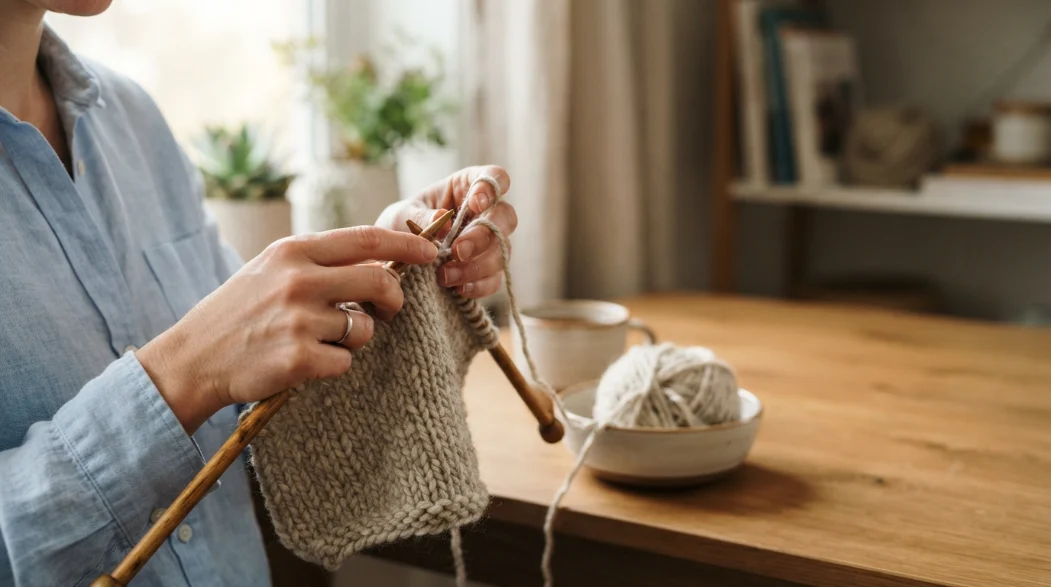
If you are learning to knit and keep seeing the word purl, you are looking at one of the two basic stitches that make up most knitting projects. The purl meaning in knitting is simple: a purl is a basic knitting stitch created with the working yarn at the front of the work to form a new loop.
A purl stitch is more than just another stitch to memorize. Along with the knit stitch, it helps create texture, stretch, structure, and countless knitting patterns. Ribbing, seed stitch, stockinette, and many textured designs all depend on combinations of knit and purl stitches.
Once you understand what purl means in knitting, instructions such as “purl one,” “P1,” “knit one, purl one,” and “purl across” become much easier to understand.
What Does Purl Mean in Knitting?
In knitting, purl means making a purl stitch using a specific needle and yarn movement.
In simple terms:
A purl stitch is a basic knitting stitch worked with the working yarn at the front of the fabric.
When you make a purl stitch, the new loop is formed in a way that produces a different surface appearance from a knit stitch.
Look closely at knitted fabric and you will notice small V-shaped stitches on one side and rounded bumps on the other. The same basic stitch structure can look different depending on which side of the fabric you are viewing.
This is an important idea for beginners because a purl stitch on one side of the fabric can appear as a knit stitch on the opposite side.
What Is a Purl Stitch?
A purl stitch is one of the two fundamental stitches used in knitting. The other is the knit stitch.
To make a basic purl stitch, you generally:
- Bring the working yarn to the front of the work.
- Insert the right needle into the next stitch.
- Wrap the yarn around the needle.
- Pull the new loop through.
- Move the completed stitch from the left needle to the right needle.
The movement may feel unfamiliar during your first few attempts. That is completely normal. You are coordinating two needles, several loops, and the working yarn at the same time.
After some practice, the movement becomes much more natural.
What Does Purl Mean on a Knitting Pattern?
Knitting patterns often use abbreviations to save space. The word purl is commonly shortened to P.
Here are some common examples:
| Pattern instruction | Meaning |
|---|---|
| P | Purl |
| P1 | Purl one stitch |
| P2 | Purl two stitches |
| P across | Purl every stitch across the row |
| K1, P1 | Knit one, purl one |
| P2, K2 | Purl two, knit two |
| Purl to end | Continue purling until the row ends |
For example, if a pattern says P1, K1, repeat across, you purl one stitch, knit the next stitch, and continue following that sequence across the row.
Once you understand these abbreviations, knitting patterns become much easier to read.
How to Do a Purl Stitch
The basic purl stitch follows a straightforward sequence.
Bring the Yarn to the Front
Start with your knitted work on the left needle. Bring the working yarn toward the front of the work.
This is one of the main differences between a standard knit stitch and a standard purl stitch.
Insert the Right Needle
Insert the right needle into the next stitch according to the pattern instructions.
Try not to hold the needles too tightly. Excess tension can make the stitch harder to work.
Wrap the Yarn
Wrap the working yarn around the right needle.
This creates the yarn loop that will become your new stitch.
Pull the Loop Through
Use the right needle to pull the new loop through the existing stitch.
You should now have a new loop on the right needle.
Remove the Old Stitch
Slide the original stitch off the left needle.
Your purl stitch is now complete.
With practice, these movements eventually become one smooth motion rather than five separate steps.
Purl vs Knit: What Is the Difference?
The knit stitch and purl stitch are the two basic building blocks of knitting.
They use different movements and produce different visible textures.
| Feature | Knit Stitch | Purl Stitch |
|---|---|---|
| Common abbreviation | K | P |
| Yarn position in the basic movement | Behind the work | In front of the work |
| Typical visible texture | Small V shapes | Raised bumps |
| Common uses | Smooth fabric and patterns | Texture and pattern construction |
| Often used in | Stockinette and many patterns | Ribbing and textured designs |
One useful thing to remember is that knit and purl are closely connected. The back of a knit stitch has the appearance of a purl, and the back of a purl has the appearance of a knit.
That is why the same fabric can look completely different from its front and back.
Why Are Purl Stitches Important?
Purl stitches are important because they give knitters another way to shape and organize fabric.
With only knit and purl stitches, you can create a surprising number of textures and patterns.
Purl stitches are commonly used for:
- Ribbing
- Seed stitch
- Moss stitch
- Textured borders
- Decorative patterns
- Sweater cuffs
- Hat edges
- Sock tops
- Necklines
- Reversible designs
The bigger lesson is that knitting does not require hundreds of complicated techniques to produce interesting results. Simple stitches become much more powerful when they are arranged in different sequences.
Common Knitting Patterns That Use Purl Stitches
Ribbing
Ribbing is one of the most familiar uses of knit and purl stitches.
A simple ribbing pattern may use:
K1, P1
Another common version is:
K2, P2
Alternating stitches creates vertical ridges and gives the fabric useful stretch.
Ribbing is often found on:
- Sweater cuffs
- Hat edges
- Sock openings
- Waistbands
- Necklines
Stockinette Stitch
Stockinette is a very common knitted fabric.
A basic stockinette structure is created by knitting on one side and purling on the other.
The front normally shows neat V-shaped stitches, while the reverse side displays the characteristic purl bumps.
This makes purling essential even when the finished fabric appears to be mostly made of knit stitches.
Seed Stitch
Seed stitch uses alternating knit and purl stitches to create a small, textured surface.
Instead of producing smooth rows of Vs, the fabric develops a scattered pattern of raised bumps.
It is useful for scarves, borders, blankets, and other projects where texture is desired.
Reverse Stockinette
Reverse stockinette intentionally places the purl side of the fabric on the outside.
The result is a visibly textured surface rather than the smooth V-shaped appearance associated with regular stockinette.
It is a good example of how changing which side of the fabric faces outward can completely change its appearance.
How to Recognize a Purl Stitch
Learning to recognize stitches is one of the most useful skills for a beginner.
A purl stitch generally looks like a small horizontal bump or rounded bar on the side facing you.
A knit stitch usually looks like a small V.
A simple visual memory trick is:
- Knit: looks like Vs
- Purl: looks like bumps
This becomes especially useful when you lose your place in a pattern.
Instead of guessing, you can look at the stitches already on your needle and identify what you are seeing.
Knit and Purl From the Opposite Side
One concept often surprises new knitters:
The appearance of a stitch changes when you look at the opposite side of the fabric.
A knit-looking stitch on one side corresponds to a purl-looking stitch on the other side.
This is why you should not think of knit and purl as completely unrelated structures.
They are two ways of working the same basic knitted loops, and their appearance depends on the side of the fabric you are viewing.
Understanding this makes pattern instructions much easier to follow.
What Does “Knit One, Purl One” Mean?
When a knitting pattern says K1, P1, it means:
- Knit one stitch.
- Purl one stitch.
- Repeat the sequence as instructed.
For example:
K1, P1, K1, P1, K1, P1
creates an alternating pattern of knit and purl stitches.
This combination is especially common in ribbing because alternating the stitches creates a stretchy structure.
You may find this instruction around the edges of sweaters, hats, socks, and other garments.
Common Purl Stitch Mistakes
Purling is a basic technique, but beginners often encounter a few common problems.
Holding the Yarn Too Tightly
Tight tension can make it difficult to insert the needle into the next stitch.
Try to keep your hands relaxed and allow the yarn to move smoothly.
Leaving the Yarn in the Wrong Position
For a standard purl stitch, the working yarn needs to be at the front of the work.
If the yarn is behind the needles when you start the movement, the result may not match the pattern.
Accidentally Creating Extra Stitches
Incorrect yarn movement can sometimes create an additional loop.
If your stitch count suddenly increases, check how you are moving the yarn between stitches.
Confusing Knit and Purl
The two movements can feel very similar when you are first learning.
Spend some time practicing each stitch individually before combining them into patterns.
Making Every Stitch Too Tight
Beginners sometimes pull the yarn after every stitch because they want the work to look neat.
Too much tension can make the next row difficult.
Aim for consistent tension, not extremely tight tension.
Purl Stitch Tips for Beginners
A few simple habits can make learning easier:
- Practice with medium-weight yarn.
- Use needles that feel comfortable in your hands.
- Start with a small practice swatch.
- Count your stitches regularly.
- Pay attention to yarn position.
- Learn to recognize knit and purl stitches visually.
- Avoid pulling every stitch too tightly.
- Practice slowly before trying to increase your speed.
- Read the full row instruction before starting.
- If you make a mistake, stop and inspect the stitches instead of continuing blindly.
The goal is not perfect stitches from the first row. The goal is developing consistent movement and tension.
Why Does My Purl Stitch Look Different From a Knit Stitch?
That difference is expected.
A knit stitch and a purl stitch have different visible surfaces because of how the loop is formed and which side of the fabric you are viewing.
Purl stitches generally appear as bumps or small horizontal bars.
Your tension also affects the appearance. Loose stitches may look open, while tight stitches can appear compact.
The yarn itself matters too. A fluffy yarn can hide stitch definition, while a smooth yarn makes the individual stitches easier to see.
What Is the Difference Between Purl and Reverse Stockinette?
Stockinette stitch normally shows the smooth side with rows of V-shaped knit stitches.
Reverse stockinette shows the purl side instead.
Both use the same basic knit and purl stitches. The main difference is which side of the fabric is presented as the visible surface.
This is a useful reminder that purl stitches are not simply something used on the “inside” of a project. They can also become the main visual feature of the finished design.
Purl Meaning in Simple Words
If you need a quick definition:
Purl means making a basic knitting stitch with the working yarn at the front of the work.
It is one of the two fundamental knitting stitches and is used to create texture, ribbing, patterns, and different fabric surfaces.
Once you know how to knit and purl, you can combine them in many different ways to create useful and decorative knitted fabrics.
Purl Stitch Terms Every Beginner Should Know
Understanding related knitting vocabulary can make tutorials and patterns easier to follow.
| Term | Simple meaning |
|---|---|
| Purl | A basic knitting stitch |
| Knit | The other fundamental knitting stitch |
| P1 | Purl one stitch |
| P2 | Purl two stitches |
| K1 | Knit one stitch |
| Ribbing | A pattern made by alternating knit and purl stitches |
| Stockinette | A common fabric pattern using knit and purl rows |
| Reverse stockinette | Fabric with the purl side facing outward |
| Stitch | A loop formed in knitted fabric |
| Row | A horizontal sequence of stitches |
| Round | A complete circular pass when knitting in the round |
| Working yarn | The yarn used to create new stitches |
How Purling Fits Into Learning to Knit
If you are completely new to knitting, learning the purl stitch is an important milestone.
A useful progression is:
- Learn how to cast on.
- Practice the basic knit stitch.
- Learn the purl stitch.
- Practice switching between knit and purl.
- Learn to recognize stitches visually.
- Try simple patterns such as ribbing.
- Move on to more complicated stitch combinations.
Once knit and purl feel comfortable, many beginner patterns become much easier to understand.
You start reading the fabric itself rather than relying entirely on written instructions.
Frequently Asked Questions
What does purl mean in knitting?
Purl means making one of the two basic knitting stitches. In the standard purl movement, the working yarn is positioned at the front of the work.
What is a purl stitch?
A purl stitch is a basic knitting stitch that creates a characteristic raised or bumpy appearance on the visible side of the fabric.
Is purl the same as knit?
No. Knit and purl are different basic knitting movements. They create different visible textures, although they are closely connected and represent opposite sides of the same knitted structure.
What does P1 mean in knitting?
P1 means purl one stitch. It is a common abbreviation found in knitting patterns.
What does K1 P1 mean?
K1 P1 means knit one stitch followed by one purl stitch. Repeating this sequence creates a simple ribbed texture.
Is purling difficult for beginners?
Purling can feel awkward when you first learn it because the hand movement differs from knitting. Regular practice usually makes the movement much more comfortable.
Why do knitting patterns use purl stitches?
Purl stitches help create texture, ribbing, borders, contrast, and decorative patterns. They are also essential in many common knitted fabrics.
How can I tell a knit stitch from a purl stitch?
A knit stitch usually looks like a small V, while a purl stitch generally looks like a small bump or horizontal bar on the visible side.
What does “purl across” mean?
“Purl across” means to make a purl stitch in each stitch across the row, unless the pattern gives another instruction.
What is reverse stockinette?
Reverse stockinette is a knitted fabric structure that intentionally shows the purl side on the outside. It has a textured, bumpy appearance instead of the smooth V-shaped surface of regular stockinette.
Conclusion
Understanding the purl meaning is one of the first important steps toward becoming comfortable with knitting. A purl stitch may seem confusing at first, but once you understand the basic movement and learn to recognize its raised texture, it becomes much easier to use.
Knit and purl stitches work together to create everything from simple ribbing and stockinette to detailed textured patterns. Start with a small swatch, practice your tension, and focus on making each stitch consistently. With a little practice, purling will become a natural part of your knitting routine.
Read More Related Articles:
- 111 Meaning | The Hidden Message Behind This Powerful …
- Kismet Meaning | The Hidden Story of Fate, Destiny, and the …
- What This Ancient Word Really Means in Yoga, Sanskrit, and …
