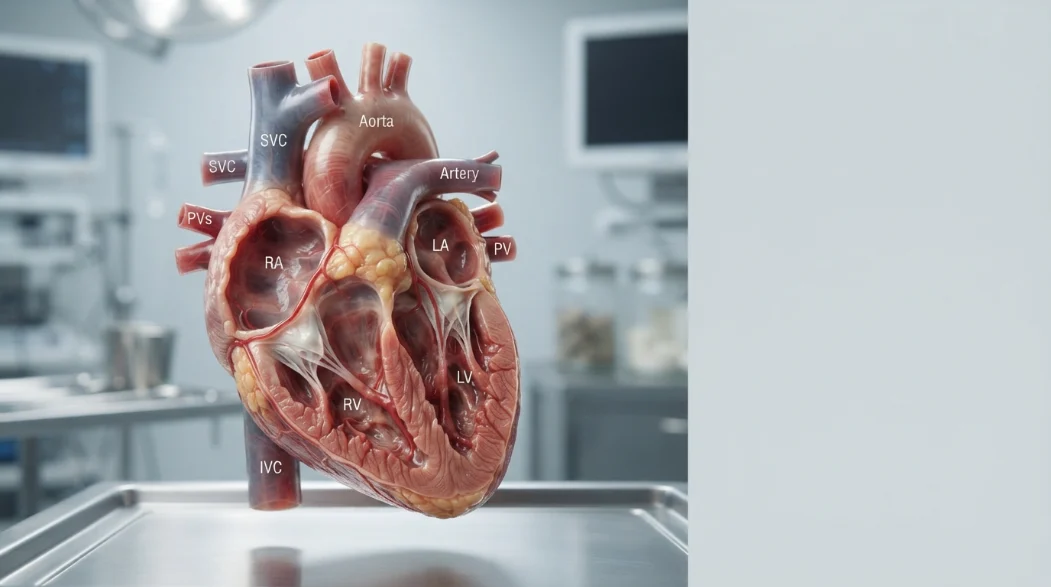
The atria meaning refers to the two upper chambers of the heart: the right atrium and the left atrium. Their main job is to receive blood returning to the heart and pass it into the ventricles, the two lower chambers.
Think of the atria as the heart’s receiving rooms. The right atrium receives blood that has returned from the body, while the left atrium receives oxygen-rich blood coming back from the lungs. From there, blood moves into the ventricles, which pump it onward.
Understanding the atria makes human heart anatomy much easier to follow. They are small but essential parts of the cardiovascular system, helping maintain the continuous movement of blood through the lungs and the rest of the body.
What Does Atria Mean?
Atria is the plural form of atrium.
In human anatomy, the word refers specifically to the two upper chambers of the heart. These chambers sit above the right and left ventricles.
| Term | Meaning |
|---|---|
| Atrium | One upper chamber of the heart |
| Atria | Both upper chambers of the heart |
| Right atrium | Receives blood returning from the body |
| Left atrium | Receives oxygen-rich blood from the lungs |
| Ventricles | Lower chambers that pump blood out of the heart |
So, if you see the phrase “atria of the heart,” it simply means the heart’s two upper chambers.
Atria Definition in Anatomy
The atria are receiving chambers that collect blood before it enters the ventricles.
The right atrium receives mostly oxygen-poor blood from the body’s tissues. This blood arrives through the superior vena cava, inferior vena cava, and coronary sinus.
The left atrium receives oxygen-rich blood from the lungs through the pulmonary veins.
The atria then contract and help move blood into their corresponding ventricles.
This arrangement creates a simple sequence:
Body → Right atrium → Right ventricle → Lungs → Left atrium → Left ventricle → Body
That pathway is the basic framework behind normal blood circulation.
What Are the Two Atria?
The heart has two atria, and each has a different role in circulation.
Right Atrium
The right atrium receives oxygen-poor blood returning from the body.
Three major pathways bring blood into this chamber:
- Superior vena cava: carries blood from the upper body
- Inferior vena cava: carries blood from the lower body
- Coronary sinus: drains blood from the heart muscle itself
After receiving this blood, the right atrium passes it through the tricuspid valve into the right ventricle.
The right ventricle then pumps the blood toward the lungs through the pulmonary arteries.
Left Atrium
The left atrium receives oxygen-rich blood returning from the lungs.
This blood arrives through the pulmonary veins. It then moves through the mitral valve into the left ventricle.
The left ventricle pumps the blood into the aorta, sending it throughout the body.
A useful way to remember the difference is:
Right atrium receives from the body. Left atrium receives from the lungs.
How Do the Atria Work?
The atria work as part of a coordinated sequence called the cardiac cycle.
Blood is constantly returning to the heart. The atria receive that blood and help fill the ventricles.
The basic process looks like this:
- Blood returns to the atria.
- The atria fill with blood.
- The atria contract.
- Blood moves into the ventricles.
- The ventricles contract.
- Blood leaves the heart and continues through circulation.
The atria are not the main pumping chambers. The ventricles produce the stronger force needed to send blood to the lungs and the rest of the body.
Still, the atria play an important supporting role in ventricular filling.
Atria and Ventricles: What Is the Difference?
One of the easiest ways to understand heart anatomy is to compare the atria with the ventricles.
| Feature | Atria | Ventricles |
|---|---|---|
| Location | Upper chambers | Lower chambers |
| Number | Two | Two |
| Main role | Receive blood | Pump blood out |
| Right side | Receives blood from the body | Pumps blood toward the lungs |
| Left side | Receives blood from the lungs | Pumps blood to the body |
| Muscle thickness | Generally thinner | Generally thicker |
The difference in muscle thickness makes sense because the ventricles have a much harder pumping job.
The right ventricle sends blood to the nearby lungs, while the left ventricle must push blood through the body’s systemic circulation.
Why Are the Atria Important?
The atria help keep blood moving through the heart in the correct direction.
They also act as an important link between the veins and ventricles. Without properly functioning atria, the heart’s filling pattern can be disrupted.
Their role becomes especially clear when you follow the two sides separately.
Right-Side Flow
Body → Venae cavae → Right atrium → Tricuspid valve → Right ventricle → Pulmonary arteries → Lungs
Left-Side Flow
Lungs → Pulmonary veins → Left atrium → Mitral valve → Left ventricle → Aorta → Body
Together, these pathways form the circulation that supplies tissues with oxygen and removes carbon dioxide.
What Is the Function of the Atria?
The main atria function is receiving blood and helping fill the ventricles.
Their functions can be summarized as follows:
- Receive returning blood
- Help move blood into the ventricles
- Support efficient ventricular filling
- Help maintain one-way blood flow
- Participate in the coordinated cardiac cycle
- Contribute to normal circulation throughout the body
The atria also contain structures involved in the heart’s electrical system. The sinoatrial node, located in the right atrium, normally initiates the electrical signal that sets the heart’s rhythm.
This is one reason the atria are important beyond simply being storage spaces for returning blood.
Why Does the Heart Have Two Atria?
The two atria allow the heart to handle the pulmonary and systemic sides of circulation separately.
The right side deals with blood returning from the body and sends it to the lungs for oxygenation.
The left side receives that oxygenated blood and sends it into the circulation that supplies the body.
This separation helps maintain an organized flow:
Right side → lungs
Left side → body
The wall between the two atria, called the interatrial septum, helps keep the two blood streams separated.
Atria in Simple Everyday Terms
If medical terminology feels complicated, imagine the heart as a transportation hub.
The atria are arrival areas.
People arrive from different places, gather briefly, and then move into the next part of the station.
The right atrium receives blood returning from the body. The left atrium receives blood returning from the lungs. The ventricles are the powerful departure areas that send blood on its next journey.
This analogy is not a substitute for anatomy, but it can make the basic arrangement easier to remember.
Atria Meaning in Biology
In biology, atria generally refers to the upper receiving chambers of the heart in animals that have this type of cardiac structure.
In humans, the term specifically describes the right and left chambers of the four-chambered heart.
Students may encounter the word in lessons about:
- Human heart anatomy
- Cardiovascular systems
- Blood circulation
- Pulmonary circulation
- Systemic circulation
- The cardiac cycle
- Heart valves
- Electrical conduction
The surrounding context usually tells you exactly how the term is being used.
Common Terms Connected to the Atria
Learning a few related terms can make heart diagrams much easier to understand.
Venae Cavae
The superior and inferior venae cavae carry oxygen-poor blood from the body into the right atrium.
Pulmonary Veins
The pulmonary veins carry oxygen-rich blood from the lungs into the left atrium.
Tricuspid Valve
This valve sits between the right atrium and right ventricle. It helps prevent blood from flowing backward during ventricular contraction.
Mitral Valve
The mitral valve sits between the left atrium and left ventricle and helps maintain one-way blood flow.
Ventricles
The ventricles are the two lower chambers of the heart. They receive blood from the atria and pump it out of the heart.
Interatrial Septum
The interatrial septum is the wall separating the right and left atria.
Atria vs. Atrium
A common language question is the difference between atrium and atria.
Atrium is singular.
Atria is plural.
For example:
- “The right atrium receives blood from the body.”
- “The atria receive blood before it enters the ventricles.”
You may also see the word atrium used in other biological contexts, but in discussions of human heart anatomy, it usually refers to one of the heart’s upper chambers.
What Happens When the Atria Contract?
When the atria contract, they push additional blood into the ventricles.
This happens near the end of the ventricular filling phase of the cardiac cycle.
The contraction is sometimes called the atrial systole.
Most ventricular filling happens passively as blood flows from the atria into the ventricles. Atrial contraction then provides an additional contribution to ventricular filling.
This coordinated timing allows the heart to fill before the ventricles contract and send blood onward.
How the Atria Fit Into Blood Circulation
The atria sit at an important crossroads in circulation.
Here is the complete simplified route:
1. Body tissues
Blood returns carrying less oxygen.
2. Right atrium
The blood enters through the venae cavae.
3. Right ventricle
Blood passes through the tricuspid valve.
4. Lungs
The right ventricle sends blood toward the lungs.
5. Left atrium
After oxygenation in the lungs, blood returns through the pulmonary veins.
6. Left ventricle
Blood passes through the mitral valve.
7. Body tissues
The left ventricle pumps blood through the aorta.
This cycle repeats continuously.
Common Misunderstandings About the Atria
“The atria pump blood throughout the body.”
Not exactly.
The atria receive blood and help move it into the ventricles. The ventricles provide the main pumping force for sending blood to the lungs and body.
“The right atrium contains oxygen-rich blood.”
Normally, no. The right atrium receives mostly oxygen-poor blood returning from the body’s tissues.
“The left atrium receives blood from the body.”
Normally, the left atrium receives oxygen-rich blood from the lungs through the pulmonary veins.
“Atria and ventricles are the same thing.”
They are both heart chambers, but they have different locations and primary functions.
Frequently Asked Questions
What does atria mean?
Atria is the plural of atrium. In human anatomy, it refers to the two upper chambers of the heart, the right atrium and left atrium.
What are the atria of the heart?
The atria are the heart’s two upper chambers. They receive blood returning to the heart and help move it into the ventricles.
What is the singular of atria?
The singular form is atrium. For example, one upper heart chamber is an atrium, while both are called the atria.
What is the function of the atria?
The primary function of the atria is to receive blood and help transfer it into the ventricles. They also play a role in the heart’s electrical and mechanical activity.
What is the difference between the right and left atrium?
The right atrium receives mostly oxygen-poor blood from the body. The left atrium receives oxygen-rich blood from the lungs.
Are the atria the upper or lower chambers?
The atria are the upper chambers of the heart. The ventricles are the lower chambers.
Do the atria pump blood?
The atria contract and help push blood into the ventricles, but the ventricles provide the main pumping force that sends blood toward the lungs and body.
What is the difference between atrium and atria?
Atrium means one chamber. Atria means two or more atria. In the human heart, there are two: the right atrium and left atrium.
Why are the atria important?
The atria receive blood returning to the heart and help fill the ventricles. This makes them an essential part of the normal circulation process.
Final Takeaway
The simplest atria meaning is the two upper chambers of the heart. The right atrium receives blood returning from the body, while the left atrium receives oxygen-rich blood from the lungs.
From there, blood moves into the ventricles and continues through circulation. Once you understand this basic pathway, terms such as atrium, atria, ventricles, pulmonary veins, venae cavae, and heart valves become much easier to connect.
Read More Related Articles:
- 111 Meaning | The Hidden Message Behind This Powerful …
- Kismet Meaning | The Hidden Story of Fate, Destiny, and the …
- What This Ancient Word Really Means in Yoga, Sanskrit, and …
