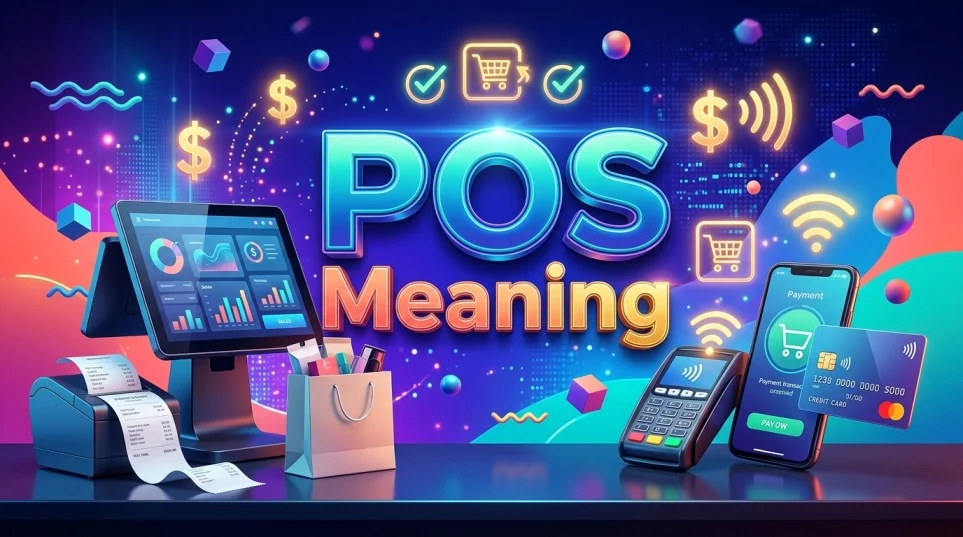
POS meaning depends on where you see the abbreviation, but its most common business meaning is Point of Sale. It refers to the place or system where a customer pays for a product or service. A POS system can include a checkout terminal, payment reader, software, and tools for tracking sales and inventory.
For example, when you pay for groceries with a debit card, the checkout system that records your purchase and processes your payment is part of the point-of-sale process. Businesses use POS systems to manage transactions, issue receipts, monitor products, and understand sales performance.
However, POS can mean other things in different settings. In texting, it can be an offensive slang abbreviation. In grammar, it can stand for part of speech, and in cryptocurrency, PoS commonly means Proof of Stake. Understanding the context helps you identify the correct definition without confusing a business term with an internet abbreviation.
What Does POS Stand For?
POS most commonly stands for Point of Sale in retail, restaurants, banking-related payment contexts, and business operations. It describes the point where a customer completes a purchase.
The term can refer to the checkout location itself or the technology used to record and process a transaction.
Imagine buying a coffee at a local café. The employee enters your order, the system calculates the total, you pay by card or cash, and a receipt is generated. The software and equipment managing these steps form part of the café’s POS system.
POS does not refer to only one machine. Modern systems can combine several tools, depending on the business and its needs.
What Is a POS System?
A POS system is a combination of hardware and software that helps a business accept payments, record sales, and manage everyday transactions.
Older point-of-sale setups often relied on a cash register. Modern systems may use a tablet, computer, smartphone, barcode scanner, receipt printer, or card reader.
Main Components of a POS System
| Component | What It Does |
|---|---|
| POS software | Records orders, calculates totals, and stores sales information |
| POS terminal | Provides an interface for processing a transaction |
| Card reader | Accepts supported debit and credit card payments |
| Barcode scanner | Identifies products and speeds up checkout |
| Receipt printer | Prints receipts for customers |
| Cash drawer | Stores cash payments |
| Inventory tools | Help track stock levels and product movement |
| Sales reports | Show revenue, product performance, and transaction trends |
Not every business needs every component. A small service provider may use a tablet and payment reader, while a supermarket may need multiple checkout terminals, barcode scanners, and inventory tools.
How Does a POS System Work?
A typical POS transaction follows a straightforward process:
- The order is entered. The cashier scans products or selects services in the software.
- The total is calculated. The system applies relevant prices, discounts, and taxes.
- The customer pays. Payment may be made using cash, a card, or another supported method.
- The transaction is recorded. The system saves the sale and generates a receipt or digital confirmation.
- Business records are updated. Depending on the setup, stock levels and sales reports are updated automatically.
Card payments may involve additional steps through a payment processor, the merchant’s acquiring bank, and the customer’s card issuer. A POS terminal does not independently guarantee that every transaction will be approved.
POS Meaning in Banking
In banking, POS commonly refers to a Point of Sale transaction. This usually means a payment made to a merchant using a debit card, credit card, or another supported payment method.
You may see a POS entry in your bank statement or mobile banking app after purchasing something at a shop.
For example:
| Bank Statement Entry | Possible Meaning |
|---|---|
| POS PURCHASE | A purchase made through a merchant’s payment system |
| POS DEBIT | Money deducted for a point-of-sale transaction |
| POS REVERSAL | A transaction that has been reversed or corrected |
| POS REFUND | A refund associated with a merchant purchase |
The exact labels depend on the bank and its transaction-reporting system.
Why Does a POS Transaction Appear on Your Bank Statement?
A POS transaction may appear after you pay at a restaurant, supermarket, pharmacy, fuel station, or another merchant.
If you do not recognize the transaction, check the amount, date, merchant description, and any related receipt. Merchant names on statements sometimes differ from the store name displayed to customers.
If the payment still looks unfamiliar, contact your bank through its official app or the phone number on your card. Ask about the transaction and follow the bank’s process for reporting unauthorized activity. Do not share your PIN, password, or one-time verification code with anyone claiming to investigate the payment.
POS Meaning in Retail and Business
In retail, POS refers to the checkout process and the tools used to complete sales. It can also support tasks that happen behind the counter, such as tracking stock and reviewing business performance.
A useful POS system can help a shop owner answer questions such as:
- Which products sell most often?
- How much revenue did the store generate today?
- Which items need restocking?
- How many transactions were completed?
- Which discounts were applied?
- How do sales compare across different days?
Consider a clothing shop that sells 30 shirts in one week. If its POS software tracks each sale and updates inventory, the owner can see which sizes are selling quickly and reorder stock before popular options run out.
This makes a POS system more than a payment tool. It can become a source of useful operational information, although the quality of the reports depends on accurate product records and correct system setup.
POS Meaning in Restaurants
Restaurants use POS systems to enter orders, calculate bills, send order details to kitchen displays or printers, and process payments.
For example, a server enters two burgers and a drink into the restaurant’s POS software. The order reaches the kitchen, the bill reflects the selected items, and the final payment is recorded when the customer leaves.
Some restaurant systems also manage table assignments, reservations, delivery orders, and tips.
POS Machine Meaning
A POS machine is a device used to accept or process payments at the point of sale. In everyday conversation, people often use the term for a card payment terminal.
A typical POS machine may allow customers to insert a chip card, tap a contactless card, or use another supported payment method. Some devices also support PIN entry and printed receipts.
The distinction is simple:
- POS system: The broader combination of software and equipment used to manage transactions.
- POS machine: Usually the physical device used to accept or process a payment.
- POS terminal: A device or terminal through which a transaction is entered or processed. The exact usage can vary by provider.
A POS machine does not necessarily include the full inventory, employee management, and reporting features of a complete POS system.
Different Types of POS Systems
Businesses choose POS technology according to their size, workflow, and payment requirements.
| POS Type | Typical Use |
|---|---|
| Traditional POS | Established shops and businesses with fixed checkout counters |
| Mobile POS (mPOS) | Sellers using smartphones or tablets with compatible payment tools |
| Cloud-based POS | Businesses that access software and records through internet-connected services |
| Restaurant POS | Cafés, restaurants, and food-service businesses |
| Retail POS | Shops that need checkout, product, and inventory features |
| Self-service POS | Kiosks where customers place orders or complete purchases themselves |
A cloud-based system may let an owner review sales remotely, but features, offline access, and data synchronization depend on the provider. Businesses should check these details before choosing a system.
POS Meaning in Texting and Slang
In texting and online conversations, POS can have a very different meaning from the business definition.
One common slang meaning is “piece of sh*t.” It is a vulgar and insulting expression used to describe a person, object, or situation that someone strongly dislikes. When applied to a person, it can be particularly offensive.
For example:
- “That old phone is a POS.” This means the speaker thinks the phone is terrible.
- “He called the broken laptop a POS.” This means he used an insulting phrase to describe the laptop.
The tone depends on the conversation. Friends may use the phrase jokingly, but it can also communicate genuine anger or disrespect.
POS can also be used to mean “parent over shoulder” in some online conversations. Someone may use it to warn another person that a parent is nearby and can see their screen.
Because slang changes between communities, neither interpretation should be assumed without considering the surrounding message.
POS Meaning in Grammar
In grammar and language learning, POS often stands for Part of Speech.
A part of speech identifies the grammatical role a word plays in a sentence. Common categories include nouns, verbs, adjectives, adverbs, pronouns, and prepositions.
For example, in the sentence “The happy child runs quickly”:
| Word | Part of Speech |
|---|---|
| The | Article or determiner, depending on the grammatical framework |
| happy | Adjective |
| child | Noun |
| runs | Verb |
| quickly | Adverb |
You may see POS labels in dictionaries, language-learning apps, spelling tools, and natural language processing systems.
In this context, POS has nothing to do with payment machines or retail transactions.
PoS Meaning in Cryptocurrency
In cryptocurrency, PoS stands for Proof of Stake. It is a consensus mechanism used by some blockchain networks to help validate transactions and maintain agreement about the state of the network.
Under a typical Proof of Stake model, participants lock or stake eligible cryptocurrency according to the network’s rules. A protocol selects validators and may reward them for participating correctly. Penalties can apply in some networks if validators violate specified rules.
Proof of Stake is different from Proof of Work, which relies on computational work to help secure a network.
The capitalization varies. POS is common in business contexts, while PoS is often used for Proof of Stake. However, capitalization alone is not enough to determine the intended meaning.
POS vs. PoS: What Is the Difference?
| Abbreviation | Full Form | Main Context |
|---|---|---|
| POS | Point of Sale | Retail, payments, and business |
| POS | Part of Speech | Grammar and language tools |
| POS | Piece of sh*t | Informal and offensive slang |
| POS | Parent over shoulder | Some texting and online communities |
| PoS | Proof of Stake | Cryptocurrency and blockchain |
The surrounding words usually provide the strongest clue. A bank statement mentioning a POS purchase is referring to a payment. A blockchain article discussing validators and staking is likely referring to Proof of Stake.
Real-Life Examples of POS
Here are practical examples that show how the abbreviation works in different settings.
Business: “Our store installed a new POS system.”
Meaning: The store introduced technology for recording sales and managing checkout operations.
Banking: “I found a POS debit on my bank statement.”
Meaning: The statement shows a debit associated with a point-of-sale transaction.
Retail: “The POS report showed that winter jackets sold quickly.”
Meaning: The sales system provided information about product performance.
Texting: “This broken charger is a POS.”
Meaning: The sender is using an insulting slang expression to describe the charger.
Grammar: “The app identifies the POS of each word.”
Meaning: The app identifies the grammatical category of each word.
Cryptocurrency: “The blockchain uses PoS.”
Meaning: The network uses a Proof of Stake consensus mechanism.
These examples show why the same three letters can mean different things across otherwise unrelated topics.
Advantages of Using a POS System
A POS system can make routine business tasks easier when it is configured correctly.
- Faster checkout: Scanning products and calculating totals can reduce manual work.
- More organized records: Transactions are recorded in a consistent format.
- Better stock visibility: Integrated inventory features help identify low-stock products.
- Useful sales reports: Owners can review revenue and product performance.
- Fewer manual calculations: Automated totals and configured taxes can reduce some common errors.
- Improved customer service: Staff can spend less time on paperwork and more time helping customers.
These benefits are not automatic. Incorrect product prices, poor staff training, unreliable internet access, and badly maintained inventory records can still cause problems.
How to Choose a POS System for a Small Business
If you are choosing a POS system, start with the tasks your business needs to complete rather than buying the system with the most features.
- Identify your business type. A clothing shop, café, salon, and mobile seller have different requirements.
- Check payment support. Confirm that the system supports your preferred payment methods and local payment providers.
- Compare the full cost. Consider software subscriptions, hardware, transaction fees, setup, and support.
- Review inventory features. Product tracking is important for businesses that sell physical goods.
- Ask about security. Check how the provider protects payment information, controls staff access, and handles updates.
- Test reporting tools. Make sure the reports answer the questions you need to manage your business.
- Check offline capabilities. Ask what happens if the internet connection fails and how transactions synchronize later.
For a small shop, a simple and reliable setup may be more useful than an expensive system filled with features the staff rarely use.
Frequently Asked Questions
1. What does POS mean?
POS usually means Point of Sale, the place or system where a customer completes a purchase. In other contexts, it can mean Part of Speech, Proof of Stake, or an informal slang expression.
2. What does POS stand for in banking?
In banking, POS usually refers to a Point of Sale transaction, such as a card payment made at a store, restaurant, or other merchant.
3. What is a POS system used for?
A POS system records sales, calculates bills, processes supported payments, and may manage inventory, receipts, customer records, and business reports.
4. What is the difference between a POS machine and a POS system?
A POS machine usually refers to a physical payment device. A POS system is the broader setup of software and hardware used to manage sales and transactions.
5. What does POS mean in texting?
In texting, POS can mean “piece of sh*t,” a vulgar expression of contempt. In some conversations, it can also mean “parent over shoulder.”
6. What does POS mean in grammar?
POS means Part of Speech. It identifies a word’s grammatical category, such as noun, verb, adjective, or adverb.
7. What does PoS mean in crypto?
PoS means Proof of Stake, a blockchain consensus mechanism in which eligible participants stake cryptocurrency under the network’s rules to help validate transactions.
8. Why is there a POS transaction on my bank statement?
It may represent a purchase made through a merchant’s payment terminal. Check the date, amount, and merchant description. If you cannot identify it, contact your bank using an official channel.
9. Is POS the same as a card reader?
Not exactly. A card reader is one device used to accept card payments. A POS system can include the reader along with transaction software, sales records, inventory features, and reporting tools.
10. How can I tell which meaning of POS is correct?
Look at the context. Words such as payment, merchant, receipt, and transaction suggest Point of Sale. Words such as noun, verb, and adjective suggest Part of Speech. Blockchain, staking, and validators suggest Proof of Stake.
Conclusion
The most common POS meaning is Point of Sale, a place or system where a business records a purchase and accepts payment. POS systems can do much more than process card transactions, since many also support sales reports, stock tracking, and daily business operations.
However, POS is not limited to retail. It can refer to an offensive slang phrase, a grammatical category, or other terms depending on the setting. In cryptocurrency, PoS commonly means Proof of Stake. The best way to identify the intended definition is to look at the surrounding words and the situation in which the abbreviation appears.