
The word adamant describes someone who stands firmly by a decision, belief, or opinion and refuses to change their mind. If a friend is adamant about keeping a promise, a parent refuses to change a family rule, or a manager insists on following a particular plan, the word fits those situations. In simple English, adamant means firmly determined and unwilling to change your position.
However, being adamant does not always mean being unreasonable. Someone may stand firm because they have strong evidence, clear values, or an important boundary to protect. In other situations, refusing to listen to new information can make a person seem stubborn. Understanding this difference helps you use the word accurately in everyday conversations, professional writing, and formal discussions.
What Does Adamant Mean?

Adamant is an adjective used to describe a person who is very firm about something and does not want to change their opinion, decision, or position.
For example, if someone says, “I am adamant about finishing my education,” they mean that completing their education is a firm commitment, not something they plan to abandon easily.
Here are the key points to remember:
- Part of speech: Adjective
- Simple meaning: Firmly determined or unwilling to change one’s mind
- Pronunciation: AD-uh-munt
- Common phrase: Adamant about something
- Another common structure: Adamant that something is true or should happen
The word can describe determination, strong beliefs, firm refusals, and resistance to pressure. Its emotional tone depends on the situation. It can communicate admirable conviction or an unwillingness to compromise.
Adamant Meaning in Simple Words

In simple words, adamant means sticking to what you believe or have decided, even when other people try to change your mind.
Imagine your friends want you to cancel a plan, but you have already made a commitment. You tell them, “I am adamant about keeping my promise.” You are making it clear that you do not intend to change your decision.
Consider these everyday examples:
- A student is adamant about telling the truth.
- A customer is adamant that they paid the bill.
- A mother is adamant about setting a bedtime for her children.
- A worker is adamant about receiving the salary they were promised.
- A traveler is adamant about visiting a particular destination.
Each example involves a firm position. The person may listen to others, but they are not easily persuaded to change their mind.
How to Use Adamant in a Sentence
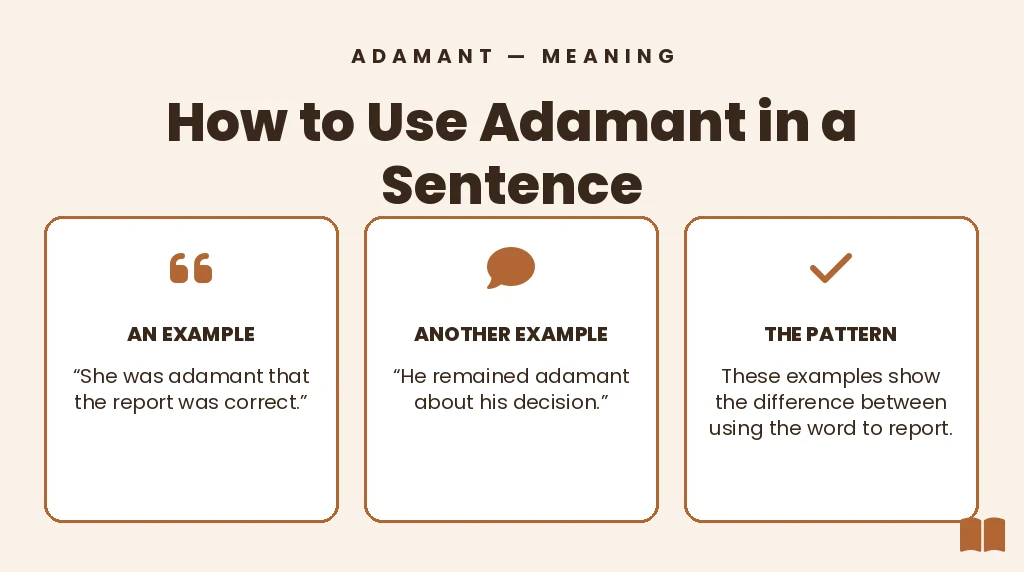
The word adamant is most commonly used with about, that, or in refusing. Choosing the right structure makes your sentence sound natural.
| Sentence structure | Example |
|---|---|
| Adamant about + noun or activity | She is adamant about her decision. |
| Adamant that + clause | He is adamant that he followed the rules. |
| Adamant in refusing + action | They were adamant in refusing the offer. |
| Remain adamant | The coach remained adamant despite the criticism. |
| Be adamant about doing something | I am adamant about protecting my privacy. |
Formal Examples
These examples show how the word works in professional or academic writing.
- The director remained adamant about maintaining the original safety standards.
- The witness was adamant that she had seen the vehicle clearly.
- The committee was adamant in its refusal to approve the proposal.
- The researcher remained adamant about reporting the findings accurately.
Casual Examples
In everyday conversation, adamant can express a strong preference, refusal, or belief.
- My brother is adamant about choosing the restaurant himself.
- She was adamant that she had left her keys on the table.
- Dad is adamant about everyone being home before midnight.
- I am adamant about not lending my laptop to anyone.
Creative Examples
You can also use adamant to make descriptive writing more precise.
- She was adamant about following her dreams, even when the road became difficult.
- He remained adamant, like a tree holding its ground against a powerful wind.
- The young athlete was adamant that one failure would not define his future.
These examples show the difference between using the word to report a decision and using it to communicate a person’s character or determination.
Adamant Synonyms
Synonyms are words with similar meanings, but they are not always interchangeable. The best choice depends on how strong, formal, or emotional you want your sentence to sound.
| Synonym | Meaning | Example |
|---|---|---|
| Determined | Having a firm goal | She is determined to graduate. |
| Resolute | Firm in purpose or belief | He remained resolute during the crisis. |
| Firm | Not easily changed or weakened | She took a firm position on the issue. |
| Unwavering | Not changing or weakening | He showed unwavering support. |
| Insistent | Repeatedly demanding or emphasizing something | They were insistent on getting an answer. |
| Steadfast | Loyal and consistent | She remained steadfast in her beliefs. |
| Unyielding | Refusing to give way or compromise | The negotiator took an unyielding position. |
| Persistent | Continuing despite difficulty or resistance | He was persistent in seeking a solution. |
Which synonym should you choose?
Use determined when someone is committed to reaching a goal. Use resolute for strong purpose, especially in formal writing. Use insistent when someone keeps pressing a point. Use unwavering when a belief or commitment does not weaken.
Adamant is particularly useful when you want to emphasize that a person is firmly committed to a position and resistant to persuasion.
Adamant Antonyms
Antonyms are words with opposite or contrasting meanings.
| Antonym | Meaning | Example |
|---|---|---|
| Flexible | Willing to adjust | She is flexible about the meeting time. |
| Yielding | Willing to give way | He became yielding during negotiations. |
| Hesitant | Unsure about acting | I was hesitant to accept the offer. |
| Uncertain | Not confident about something | She was uncertain about her choice. |
| Indecisive | Struggling to make a decision | He is indecisive when shopping. |
| Open-minded | Willing to consider different ideas | The manager remained open-minded. |
| Compliant | Willing to follow a request or rule | The employee was compliant with the procedure. |
The most suitable opposite depends on the context. Flexible is a good contrast when discussing decisions, while open-minded is useful when discussing beliefs and willingness to consider other viewpoints.
Adamant vs. Stubborn: What Is the Difference?
Adamant and stubborn both describe people who are difficult to persuade, but they do not carry exactly the same tone.
Adamant emphasizes firmness. It can suggest that a person has a clear reason for maintaining a position.
Stubborn often suggests that someone refuses to change their mind even when there may be a good reason to reconsider.
| Situation | Adamant | Stubborn |
|---|---|---|
| Protecting a personal boundary | She was adamant about saying no. | She was stubborn about saying no. |
| Refusing to accept evidence | He was adamant that he was right. | He was stubborn and ignored the evidence. |
| Working toward a goal | She was adamant about finishing her degree. | She was stubborn about finishing her degree. |
| Discussing a disagreement | Emphasizes a firm position | Can emphasize unwillingness to compromise |
Neither word is automatically positive or negative. Context matters. A person who refuses to break an important promise may be described as adamant in a positive sense. Someone who rejects every reasonable suggestion may be described as stubborn in a critical sense.
A useful distinction is this: adamant describes how firmly someone holds a position, while stubborn often draws attention to their resistance to changing it. The meanings overlap, so this is a difference in emphasis rather than an absolute rule.
Is Adamant a Positive or Negative Word?
Adamant is generally neutral. It can sound positive, negative, or simply descriptive depending on the person’s reasons and behavior.
Positive use: A person stands firmly for honesty, safety, fairness, or personal boundaries.
Example: “The nurse was adamant about following the safety procedure.”
Here, the word suggests responsible firmness.
Negative use: Someone refuses to consider reliable evidence or reasonable alternatives.
Example: “He was adamant that his answer was correct, even after the mistake was explained.”
Here, the word may suggest excessive rigidity.
Neutral use: Someone has a strong preference or a clear decision.
Example: “Maya is adamant about booking the morning flight.”
This sentence reports a preference without necessarily praising or criticizing Maya.
When deciding if adamant is the right word, ask yourself whether the person is standing firm for a good reason, refusing to reconsider, or simply expressing a strong preference. That context helps readers understand the intended tone.
Adamant Meaning in Relationships
In relationships, adamant describes someone who holds firmly to a belief, decision, expectation, or personal boundary.
For example:
- “She was adamant about needing honest communication.”
- “He was adamant that they should discuss the problem calmly.”
- “They remained adamant about not having children.”
- “She was adamant about keeping certain parts of her life private.”
The word can express healthy self-respect. Someone who clearly communicates a boundary does not have to change it simply because another person disagrees.
However, being adamant about every disagreement can make a relationship difficult. Healthy communication involves knowing when to stand firm and when to consider another person’s perspective.
The important distinction is between maintaining a necessary boundary and refusing to compromise on every preference. A firm boundary protects a person’s well-being, while ordinary disagreements may benefit from discussion and flexibility.
Common Mistakes When Using Adamant
Understanding common usage errors makes the word easier to use naturally.
1. Using Adamant as a Noun
Incorrect: “His adamant surprised everyone.”
Correct: “His adamant refusal surprised everyone.”
Adamant is normally an adjective. Related nouns include determination, resolve, and insistence.
2. Using the Wrong Preposition
Less natural: “She is adamant for her choice.”
More natural: “She is adamant about her choice.”
You can also say, “She is adamant that her choice was correct.”
3. Assuming Adamant Always Means Stubborn
The words overlap, but adamant does not automatically criticize someone. It can describe a well-reasoned position or a reasonable refusal.
4. Confusing Adamant With Adamantly
Adamant is an adjective, while adamantly is an adverb.
- Adjective: “He is adamant about the deadline.”
- Adverb: “He adamantly refused to change the deadline.”
Use the form that fits the sentence’s grammar.
Adamant vs. Adamantly
Both words express firmness, but they perform different grammatical roles.
| Word | Part of speech | Example |
|---|---|---|
| Adamant | Adjective | She is adamant about her decision. |
| Adamantly | Adverb | She adamantly defended her decision. |
Use adamant to describe a person or their position. Use adamantly to describe how someone speaks, refuses, argues, or defends a belief.
For example, “The manager was adamant” describes the manager. “The manager adamantly rejected the proposal” describes the manager’s action.
Frequently Asked Questions
1. What does adamant mean in simple words?
Adamant means firmly determined and unwilling to change your mind about something. An adamant person strongly maintains a decision, belief, or position.
2. Is adamant a positive or negative word?
It can be either, depending on the situation. It may describe someone standing up for a good principle or someone refusing to consider reasonable evidence.
3. What is a synonym for adamant?
Common synonyms include determined, resolute, firm, insistent, steadfast, and unwavering. The best option depends on the sentence.
4. What is the opposite of adamant?
Common opposites include flexible, yielding, hesitant, and open-minded. The most accurate antonym depends on whether the context involves decisions, beliefs, or behavior.
5. How do you use adamant in a sentence?
You could write, “She was adamant about completing the project on time.” This means she was firmly committed to finishing the project.
6. What does adamant about something mean?
It means having a firm position, preference, or belief about a particular matter. For example, “He is adamant about his privacy” means he strongly insists on protecting it.
7. What does adamantly mean?
Adamantly is the adverb form of adamant. It describes an action carried out with strong determination or refusal to change position, as in “She adamantly denied the accusation.”
8. What is the difference between adamant and stubborn?
Adamant emphasizes firmness and determination. Stubborn often emphasizes resistance to changing one’s mind, sometimes despite good reasons to reconsider.
9. Can you be adamant about something without being rude?
Yes. You can firmly communicate a decision or boundary while remaining respectful. For example, “I understand your suggestion, but I am adamant about keeping this information private.”
10. What does it mean to remain adamant?
To remain adamant means to continue holding the same firm position despite pressure, disagreement, or attempts to persuade you otherwise.
Final Thoughts
The meaning of adamant goes beyond simply refusing to change your mind. It describes a firm position, a strong conviction, or a decision that someone is not willing to abandon easily.
Use it when you want to communicate determination clearly and precisely. Remember that adamant is an adjective, adamantly is an adverb, and stubborn can carry a more critical tone. These small distinctions will help you use the word naturally in conversations, essays, emails, and professional writing.
Read More Related Articles:
Proscribed Meaning |What This Powerful Word Really Means …
What Does PRN Stand For? Full Form, Definition & Uses 2026
What Does Luffy Really Mean? Origin, Symbolism & Hidden …