By January, the river wears winter’s glass armor, bright in the low sun and brittle under a boot. The current still runs somewhere below, hushed and dark, sealed in like a letter nobody may open. Ice turns a living landscape into a paused one, beautiful and faintly dangerous at once.
Writers lean on ice when they need cold to mean more than temperature. Ice can suggest emotional distance, patience, preservation, or a trap with a pretty face. A single frozen image can slow a scene down and make readers feel the stillness in their own shoulders.
This article gathers twenty original metaphors for ice, each explained with its meaning, the reason it works, an alternative phrasing, and examples in formal, casual, and creative writing. Students, poets, novelists, and speakers will find images for frozen lakes, cold hearts, and everything between.
Quick Metaphors for Ice
In a hurry? Browse the quick list below, then jump to the detailed entries for the images that suit your piece.
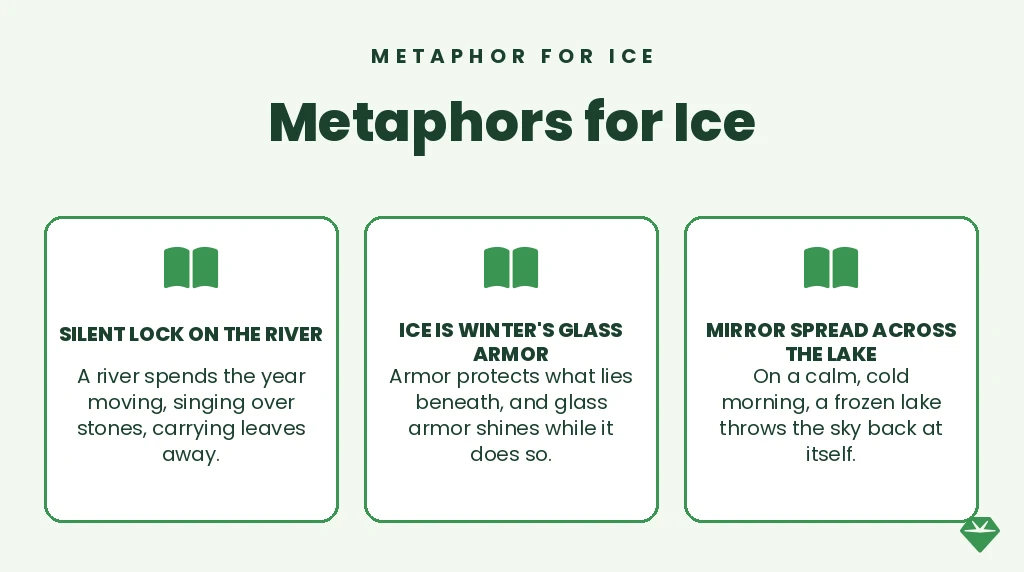
- Ice is a silent lock on the river.
- Ice is winter’s glass armor.
- Ice is a mirror spread across the lake.
- Ice is time caught mid-step.
- Ice is a cold blanket over sleeping water.
- Ice is a diamond that cannot last.
- Ice is a knife edge beneath a skate.
- Ice is a bridge built by the cold.
- Ice is crystal grown in the dark.
- Ice is a prison for ships.
- Ice is a sculpture that slowly melts.
- Ice is the breath of winter made solid.
- Ice is a trap dressed in sparkle.
- Ice is a memory the water refuses to drop.
- Ice is a floating mountain with hidden depths.
- Ice is a silent thief of warmth.
- Ice is a seal pressed over the pond.
- Ice is nature’s deep freezer.
- Ice is a glass floor over dark water.
- Ice is a page where winter writes.
Metaphors for Ice and Their Meanings
Each entry below unpacks one image: what it means, why readers respond to it, and how to phrase it another way. Read them in order or jump straight to the ones your draft needs.
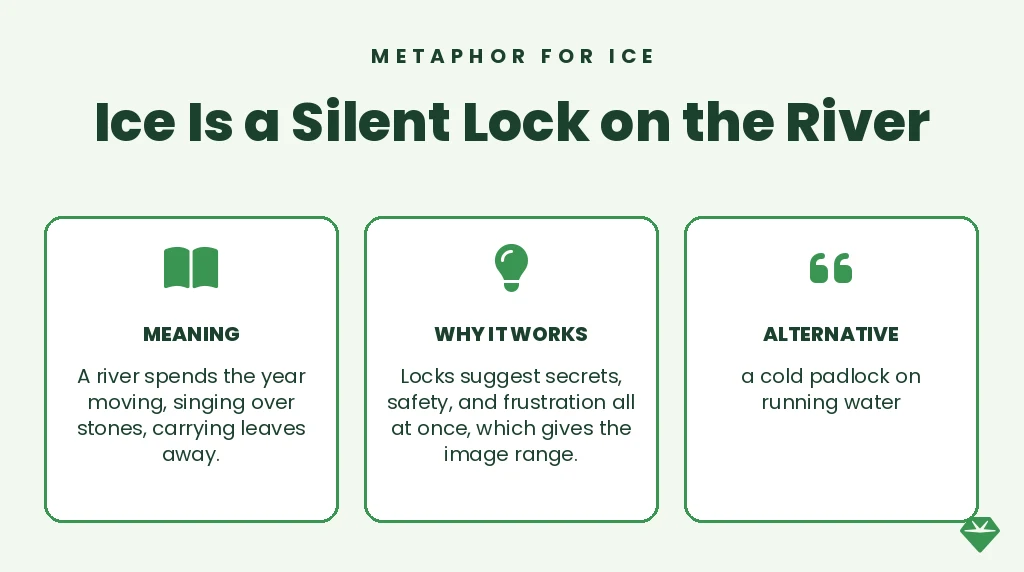
1. Ice Is a Silent Lock on the River
Meaning
A river spends the year moving, singing over stones, carrying leaves away. Then ice closes over it like a lock clicking shut.
Why It Works
Locks suggest secrets, safety, and frustration all at once, which gives the image range. Readers also hear the silence in it, since a locked river stops talking.
Alternative Expression
A harder, more mechanical variant is “a cold padlock on running water” for scenes of control.
Examples in Writing
Formal Example: By December, ice had become a silent lock on the river, halting trade until the thaw.
Casual Example: The river is basically a silent lock right now. Nothing moves till March.
Creative Example: The silent lock of the ice held the river’s voice prisoner, and the valley forgot the sound of water.
2. Ice Is Winter’s Glass Armor

Meaning
Armor protects what lies beneath, and glass armor shines while it does so. A frozen lake covers fish, weeds, and slow currents with a bright shield.
Why It Works
The pairing of armor and glass sets up a useful tension: defense and fragility together. Readers who hide tender feelings behind a polished surface will recognize themselves. That mix makes the image a favorite for guarded characters.
Alternative Expression
A simpler, more lyrical option is “a bright shield the season wears” when armor feels too warlike.
Examples in Writing
Formal Example: The pond in January wore winter’s glass armor, clear above the weeds and strong enough to bear skaters.
Casual Example: Her smile is winter’s glass armor. Pretty, polished, and one crack away from tears.
Creative Example: Winter’s glass armor spread over the marsh, and every reed stood frozen at attention inside it.
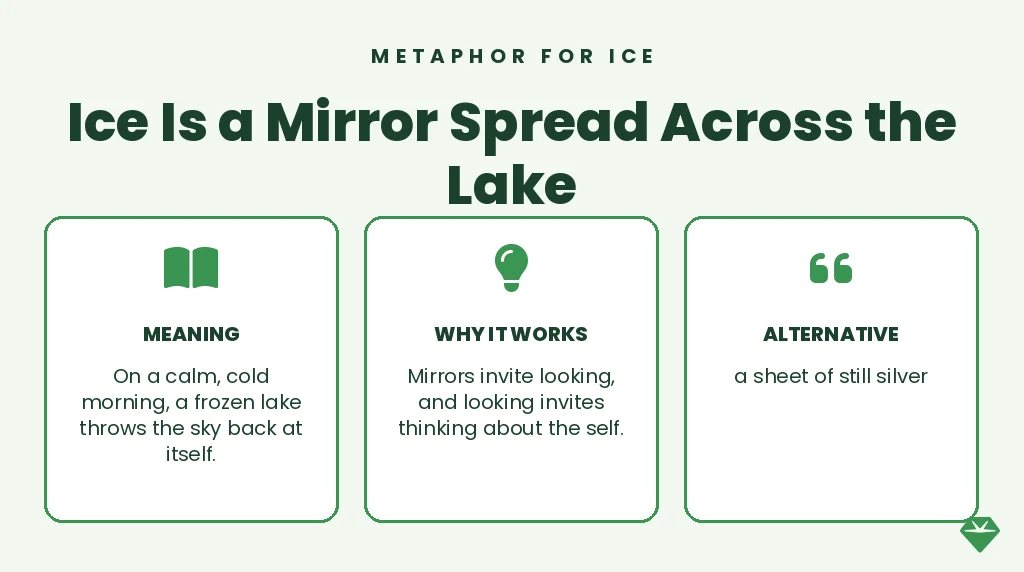
3. Ice Is a Mirror Spread Across the Lake
Meaning
On a calm, cold morning, a frozen lake throws the sky back at itself. Hills, clouds, and early light lie doubled on the surface.
Why It Works
Mirrors invite looking, and looking invites thinking about the self. That makes the image useful far beyond weather writing, in scenes of memory and self examination. It is also simply accurate, since still ice really does reflect like polished glass.
Alternative Expression
A quieter variant with the same shine is “a sheet of still silver” for dawn or moonlit scenes.
Examples in Writing
Formal Example: At dawn the frozen lake served as a mirror spread across the valley, returning every ridge to itself.
Casual Example: The lake is a mirror spread across the whole bay today. Bring your camera.
Creative Example: A mirror spread across the lake gave the mountains a twin, and the geese landed twice, once in the sky and once below it.
4. Ice Is Time Caught Mid-Step
Meaning
A frozen waterfall stops with its motion still visible: curves, splashes, and bubbles suspended in place. Nothing has vanished, yet nothing can move.
Why It Works
Everyone has wished a moment would hold still, or feared one would never end. That shared wish gives the image emotional range, from nostalgia to dread. It also describes real scenes, like falls and fountains, with pleasing accuracy.
Alternative Expression
A plainer version for reports and essays is “a clock stopped with its hands in the air.”
Examples in Writing
Formal Example: The frozen cascade presented ice as time caught mid-step, its spray suspended in clear columns.
Casual Example: Look at that fountain. Pure time caught mid-step.
Creative Example: Time caught mid-step on the waterfall kept its white foot raised all winter, waiting for permission to land.
5. Ice Is a Cold Blanket Over Sleeping Water
Meaning
A blanket suggests rest, and frozen lakes really do let life slow down beneath them. Fish drift in dim water, plants wait, and the surface keeps the worst of the wind away.
Why It Works
Pairing cold with a blanket surprises readers in a gentle way, so the line stays memorable. It also matches the science: ice insulates, and lakes rarely freeze solid to the bottom. Cozy and accurate is a rare, useful mix.
Alternative Expression
A homelier version for rural settings is “a white quilt tucked over the pond.”
Examples in Writing
Formal Example: Researchers note that lake ice acts as a cold blanket over sleeping water, keeping depths stable through storms.
Casual Example: The pond is tucked under a cold blanket right now. The fish are fine down there.
Creative Example: The cold blanket settled over the sleeping water, and the lake dreamed in slow green light.
6. Ice Is a Diamond That Cannot Last
Meaning
Sunlight turns a sheet of ice into a field of sparks, each crystal flashing like a cut stone. The beauty is real, and so is the deadline.
Why It Works
Diamonds promise forever, so giving one an expiry date creates a small, sharp ache. Readers feel beauty and loss in the same breath. Love stories, elegies, and speeches about fleeting youth all borrow this contrast well.
Alternative Expression
A drier, wittier variant is “a jewel with an expiry date” for light or ironic scenes.
Examples in Writing
Formal Example: The frost on the orchard turned each branch into a diamond that cannot last, gone by the following noon.
Casual Example: Ice is a diamond that cannot last. Enjoy the sparkle this week, because it is already melting.
Creative Example: The diamond that cannot last crowned the river all morning, spending its riches on light.
7. Ice Is a Knife Edge Beneath a Skate
Meaning
Glide across a rink and you ride on a sheet that is basically a blade laid flat. Ice supports the skater while staying thin, sharp, and unforgiving.
Why It Works
Grace balanced on danger is a combination readers never tire of. The image also has real physics behind it, since skates truly move on a thin film above a hard edge. It suits risk, performance, and any poise that could collapse quickly.
Alternative Expression
A more graceful variant is “a blade the lake lends to dancers” for lyrical or romantic scenes.
Examples in Writing
Formal Example: For the skater, the frozen surface remained a knife edge beneath the skate, demanding respect at every turn.
Casual Example: Remember, that ice is a knife edge under your skates. Pretty does not mean safe.
Creative Example: She crossed the knife edge of the lake at dawn, stitching silver lines behind her.
8. Ice Is a Bridge Built by the Cold
Meaning
No engineer draws it and no crew pours it, yet winter builds crossings all the same. People, sleds, and even trucks travel over frozen straits that block boats all summer.
Why It Works
A bridge stands for connection, so the image quickly turns weather into opportunity. It is grounded in real life too, since ice roads serve northern towns every year. Writers use it for unlikely links between separated people or places.
Alternative Expression
A plainer, sturdy variant is “a road the frost lays down” when the scene involves travel.
Examples in Writing
Formal Example: Each winter, the frozen channel becomes a bridge built by the cold, linking the island to the mainland.
Casual Example: Give it two cold weeks and the lake turns into a bridge built by the cold. We can drive across.
Creative Example: The bridge built by the cold arrived without ceremony, and the village walked over the sea to visit its cousins.
9. Ice Is Crystal Grown in the Dark
Meaning
Frost ferns spread across a window overnight, each frond built molecule by molecule without light or help. Ice behaves like a crystal garden that prefers darkness and patience.
Why It Works
Growth usually means warmth and spring, so growing in the dark flips expectations pleasantly. The image suits quiet change: habits forming, grief healing, skill building while nobody watches. It also matches the true crystal structure of ice.
Alternative Expression
A softer, more fanciful version is “flowers the winter grows without soil.”
Examples in Writing
Formal Example: On the unheated windows, frost appeared as crystal grown in the dark, each pattern unique by morning.
Casual Example: Check the window. Crystal grown in the dark, all over the glass again.
Creative Example: Crystal grown in the dark climbed the greenhouse panes, a garden the cold kept for itself.
10. Ice Is a Prison for Ships
Meaning
Explorers once sailed north and simply stopped. Ice closed around their hulls and held them for months, sometimes years, sometimes forever.
Why It Works
A prison implies sentence and helplessness, which matches the historical record of trapped expeditions. Readers feel the unfairness of a jailer that never sleeps and never negotiates. The image extends neatly to any situation where progress freezes without warning.
Alternative Expression
A colder variant with the same grip is “a white jailer with no key.”
Examples in Writing
Formal Example: The expedition learned too late that polar ice is a prison for ships, patient and nearly escape proof.
Casual Example: The harbor turns into a prison for ships by February. The fishing boats just wait it out.
Creative Example: The prison for ships tightened its white walls, and the masts stood like chimneys over a frozen town.
11. Ice Is a Sculpture That Slowly Melts
Meaning
Artists carve swans, castles, and whole hotels from ice, knowing the work carries its own ending. Every drip edits the piece.
Why It Works
Effort poured into something temporary touches a nerve in most readers. Weddings, childhoods, and good seasons all share that structure. The image also flatters real ice festivals, where masterpieces genuinely vanish within weeks.
Alternative Expression
A shorter, wistful phrasing is “art with a built in goodbye” for poems and speeches.
Examples in Writing
Formal Example: The festival centerpiece stood as a sculpture that slowly melts, drawing crowds precisely because it would vanish.
Casual Example: Our snow fort is a sculpture that slowly melts. Photograph it now or lose it.
Creative Example: The swan, a sculpture that slowly melts, wept clear tears into the plaza all afternoon.
12. Ice Is the Breath of Winter Made Solid
Meaning
On the coldest mornings your own breath hangs visible, a small cloud that proves the air can almost be touched. Ice takes that idea further: the season itself exhales, and the exhale hardens into sheets, needles, and shells.
Why It Works
Breath makes winter feel alive rather than merely cold, which suits personification rich writing. The image is gentle, so it balances the traps and prisons elsewhere in this list. It also fits fog, rime, and the frost on a window at dawn.
Alternative Expression
A tender, compact variant is “a sigh you can hold in your hand.”
Examples in Writing
Formal Example: Rime on the branches presented ice as the breath of winter made solid, coating every twig by sunrise.
Casual Example: The whole fence is white. That is the breath of winter made solid, basically.
Creative Example: The breath of winter made solid settled on the orchard, and the trees wore it like lace.
13. Ice Is a Trap Dressed in Sparkle
Meaning
Thin ice glitters exactly like thick ice, which is the entire problem. The surface invites skaters, children, and deer onto a sheet that cannot hold them.
Why It Works
Readers distrust pretty surfaces in life, from flattering offers to charming strangers. That instinct gives the image instant moral weight. It works in safety writing, certainly, but also in any scene where attraction and danger arrive in the same package.
Alternative Expression
A blunter version for warnings and thrillers is “a beautiful lie on the pond.”
Examples in Writing
Formal Example: Rangers warn that early ice is a trap dressed in sparkle, indistinguishable from safe ice at a glance.
Casual Example: Do not trust it. That pond is a trap dressed in sparkle this week.
Creative Example: A trap dressed in sparkle waited under the moon, patient as a jewel thief.
14. Ice Is a Memory the Water Refuses to Drop
Meaning
Lakes keep their winter for a long while. Ice lingers in shaded bays weeks after the air warms, holding the shape of cold days that have already passed.
Why It Works
Held memories, welcome or otherwise, sit at the center of many stories. The image lets writers talk about grief, nostalgia, or old habits through weather instead of direct statement. It also rings true for anyone who has seen late ice in April.
Alternative Expression
A simpler, more direct variant is “the lake remembering winter” for quiet reflective passages.
Examples in Writing
Formal Example: In the shaded coves, ice persisted as a memory the water refuses to drop, surviving well into spring.
Casual Example: That bay is a memory the water refuses to drop. Still frozen, honestly.
Creative Example: A memory the water refuses to drop clung to the north shore, white and stubborn under the returning sun.
15. Ice Is a Floating Mountain With Hidden Depths
Meaning
An iceberg shows a bright peak and hides roughly nine tenths of itself below the waterline. Sailors learned to respect the part they could not see.
Why It Works
Hidden bulk is a fact of icebergs, so the metaphor carries real authority. Writers borrow it for personalities, problems, and data: small surface, huge depth. A famous shipwreck keeps the warning vivid for every new reader.
Alternative Expression
A more visual option is “a mountain that shows only its forehead” for playful or poetic writing.
Examples in Writing
Formal Example: The berg drifted south as a floating mountain with hidden depths, tracked by patrols until it melted.
Casual Example: His quiet mood is a floating mountain with hidden depths. Do not ram into it.
Creative Example: A floating mountain with hidden depths carried its white summit past the harbor, trailing a cold shadow a mile long.
16. Ice Is a Silent Thief of Warmth
Meaning
Cold rarely attacks all at once. It seeps through gloves, thins the feeling in your fingers, and empties a cabin degree by degree.
Why It Works
Theft implies stealth and loss, which matches how hypothermia and frostbite actually begin. No drama, just quiet subtraction. The image also suits emotional cooling: affection drained slowly by neglect rather than ended by one big fight.
Alternative Expression
A measured, scientific flavor comes from “cold that steals by degrees.”
Examples in Writing
Formal Example: Expedition medics describe deep cold as a silent thief of warmth, taking dexterity long before it takes consciousness.
Casual Example: This wind is a silent thief of warmth. My coffee went cold in four minutes.
Creative Example: The silent thief of warmth emptied the tent by inches, until even the lamplight seemed to shiver.
17. Ice Is a Seal Pressed Over the Pond
Meaning
A seal closes a jar, a letter, a bargain. Ice does the same to a pond, pressing a smooth lid over the surface and keeping everything beneath it untouched.
Why It Works
Seals carry a sense of finality and ceremony, which lifts an ordinary freeze into something deliberate. The image is compact, easy to picture, and quietly official. It suits endings, agreements, and any scene where a chapter closes for the season.
Alternative Expression
A more practical phrasing is “a lid stamped by the frost” for homely, down to earth scenes.
Examples in Writing
Formal Example: Overnight, the freeze set ice as a seal pressed over the pond, and the herons moved on.
Casual Example: The pond got its seal pressed over it last night. Winter has officially signed off on us.
Creative Example: A seal pressed over the pond kept the moon’s reflection locked inside until March.
18. Ice Is Nature’s Deep Freezer
Meaning
Glaciers and permafrost store things for astonishing lengths of time: seeds, carcasses, even ancient air trapped in bubbles. Nothing rots in the deep cold.
Why It Works
A freezer is familiar and slightly comic, which makes deep time feel approachable. The image also happens to be nearly literal, since scientists genuinely read old climates from ice cores. Humor plus accuracy gives the line staying power.
Alternative Expression
A grander version for science features is “the planet’s cold storage.”
Examples in Writing
Formal Example: Permafrost functions as nature’s deep freezer, preserving seeds and animal remains for tens of thousands of years.
Casual Example: My balcony in January is nature’s deep freezer. The drinks stay cold for free.
Creative Example: Nature’s deep freezer kept the mammoth through a hundred centuries and delivered it, whiskers and all, to the astonished diggers.
19. Ice Is a Glass Floor Over Dark Water
Meaning
Clear ice offers a strange bargain: walk on it, and the lake shows you its depths. Fish slide beneath your boots, weeds wave in slow motion, and the dark underneath stays close enough to think about.
Why It Works
A floor you can see through breaks a basic expectation, so readers lean in. The image captures transparency with risk attached, useful for open secrets and visible dangers. Anyone who has crossed black ice knows the exact feeling.
Alternative Expression
A lighter, friendlier phrasing is “a window you can walk on” for travel and nature pieces.
Examples in Writing
Formal Example: The lake that week formed a glass floor over dark water, through which anglers watched fish gather below.
Casual Example: Walking on a glass floor over dark water is magical and mildly terrifying. Ten out of ten.
Creative Example: The glass floor over dark water carried her gently, while the lake kept its secrets moving below.
20. Ice Is a Page Where Winter Writes
Meaning
A fresh sheet of ice records everything that crosses it: fox prints, skate lines, the scrawl of wind blown snow. Nothing stays secret for long on that white surface.
Why It Works
Writing and reading are intimate acts, so the image turns a frozen lake into a shared text. Trackers and hunters genuinely read ice this way, which grounds the poetry. It also provides a graceful closing image about evidence, memory, and passing seasons.
Alternative Expression
A plainer variant for essays is “a white notebook for the frost.”
Examples in Writing
Formal Example: Trackers treat new ice as a page where winter writes, reading crossings and hunts from the marks left behind.
Casual Example: The pond is a page where winter writes. You can see exactly where the deer crossed.
Creative Example: On the page where winter writes, the fox had signed its name in a neat diagonal line.
Positive Metaphors for Ice
Cold gets a bad reputation, yet ice stores water, preserves food, and records the past. These six images show the generous side of frozen water.
- Ice is a free freezer for mountain villages. It keeps food, medicine, and seed stores safe through the summer.
- Ice is a storyteller of ancient air. It traps tiny bubbles that let scientists read climates from long ago.
- Ice is a water bank for dry seasons. It stores winter snowfall and pays it out slowly as meltwater.
- Ice is a playground polished by winter. It gives skaters, anglers, and children a bright second ground.
- Ice is a preserver of lost things. It holds mammoths, ships, and supplies in near perfect condition.
- Ice is a lantern of blue light. It glows inside caves and crevasses where the sun squeezes through.
Negative Metaphors for Ice
The same qualities turn dangerous when ice traps, cracks, or deceives. These six images carry the warning side of the season.
- Ice is a traitor under your boots. It looks solid at dawn and gives way by noon.
- Ice is a slow flood waiting for spring. It stores a season of water and releases it in a single rush.
- Ice is a thief of fingers and toes. It steals feeling first and flesh soon after.
- Ice is a roadblock that strangles rivers. It jams channels until water climbs over banks and into homes.
- Ice is a silencer of the spring. It keeps buds, nests, and shallow ponds locked past their season.
- Ice is a wrecking crew for pipes and docks. It expands inside cracks and splits stone, wood, and iron.
Metaphors for Ice in Sentences
Seeing the images inside real sentences shows their tone at a glance. Each example below pairs one sentence with the idea it communicates.
| Example sentence | What it communicates |
|---|---|
| By January the river wore winter’s glass armor, bright and brittle. | A hard surface that looks strong but can crack |
| The lake became a mirror spread flat under the moon. | Stillness, beauty, and reflected light |
| Time itself seemed caught mid-step in the frozen waterfall. | Motion stopped in a single instant |
| The harbor ice turned into a prison for ships by December. | Being trapped with no quick escape |
| Her welcome was ice: polished, sparkling, and cold. | Emotional coldness under a smooth surface |
| Under the sparkle, the pond hid a trap dressed for skaters. | Danger disguised as an attraction |
How to Use Metaphors for Ice Naturally
Choose by the kind of cold you mean. Emotional distance calls for glass armor or a silent thief of warmth, while wonder calls for mirrors and diamonds. If the cold protects something, reach for the blanket or the deep freezer. The right choice depends on whether your scene fears the ice or thanks it.
Keep the intensity honest. Ice is a slow, quiet force, so it rarely suits sudden explosions or loud chaos. Let one image settle and do its work across a paragraph rather than stacking three frozen comparisons together. Readers feel cold best when the writing itself slows down.
During revision, check the physical details. Does your ice creak, sparkle, trap, preserve, or deceive? Each verb points to a different metaphor on the list. Swapping a single verb often fixes a sentence that felt almost right, so reread with the senses, not just the eyes.
Metaphor vs. Simile: What Is the Difference?
A metaphor declares that one thing is another, while a simile compares two things with like or as. Saying the lake is a mirror makes the claim outright. Saying the lake shines like a mirror keeps the comparison at arm’s length and lets readers judge the fit.
Use metaphors when you want certainty and mood, especially in poetry, fiction, and speech making. Use similes when you explain, teach, or soften a claim for careful readers. Many strong paragraphs mix both, opening with a simile to introduce an idea and closing with a metaphor to seal it.
Here is the same thought in both forms. Metaphor: “The pond was a trap dressed in sparkle.” Simile: “The pond was like a trap dressed in sparkle.” The first sounds like a verdict. The second sounds like a warning offered for consideration.
Common Mistakes When Writing Ice Metaphors
- Saying cold twice: Writing “the icy ice” or “frozen ice” piles the same idea on itself. Let the metaphor carry the chill and cut the extra adjective.
- Mixing fire and ice carelessly: Pairing frozen images with burning ones in a single line confuses readers unless the clash is the deliberate point.
- Forgetting the melt: Ice is temporary, and good writing respects that deadline. A metaphor that treats ice as eternal stone loses its special ache.
- Using ice for loud scenes: Ice works in silence and stillness, so it fits arguments and explosions poorly. Choose thunder or volcanoes for noise instead.
- Skipping the senses: A frozen image with no shine, creak, or numbness feels abstract. Add one physical detail and the metaphor turns real.
Frequently Asked Questions
What is a good metaphor for ice?
A mirror spread across the lake is the most flexible choice, covering beauty, stillness, and reflection at once. For danger, a trap dressed in sparkle works better, while a diamond that cannot last suits themes of fleeting beauty. Match the image to your exact kind of cold, and the line will feel chosen rather than borrowed.
What does ice symbolize in writing?
Ice commonly symbolizes emotional coldness, stalled time, purity, preservation, and hidden danger. A frozen lake can mean a heart that will not open, a community waiting out hard years, or a secret kept perfectly intact. Context decides which meaning dominates, so place one or two supporting details nearby to steer the reader toward your intended sense.
How can I describe ice without saying it is cold?
Show what the ice does instead of naming its temperature. Let it lock a river, seal a pond, steal the feeling from fingers, or hold a ship prisoner until spring. Actions like these make readers supply the cold themselves, which feels stronger than any adjective. One precise verb often replaces a whole cluster of chilly descriptions.
Can ice be a positive metaphor?
Yes. Ice preserves food and medicine, stores water for dry months, and keeps ancient air samples safe for scientists. Calling it a water bank, a deep freezer, or a cold blanket over sleeping water highlights care rather than cruelty. Positive ice metaphors suit writing about patience, protection, and resources saved for the right season.
What is the difference between an ice simile and an ice metaphor?
A metaphor states the identity directly: “the lake is a mirror.” A simile compares with like or as: “the lake is like a mirror.” Metaphors sound bolder and more poetic, similes sound clearer and more cautious. Choose the metaphor for impact, the simile for explanation, and feel free to use both across a longer piece.
Conclusion
Ice rewards patient writers. It can lock, seal, preserve, deceive, or shine, and each verb on this list opens a different scene. Pick the image whose action matches your meaning, give it one honest physical detail, and let the cold do the rest without piling on extra comparisons.
For more images built on shine and surface, explore metaphors for beauty, and for the slow force that ice both stops and stores, read our collection of metaphors for time. Winter writing improves quickly once you start noticing what the ice is actually doing.