Life rarely follows a smooth path. Some days feel like climbing a steep mountain, while others resemble walking through a storm with no clear way out. These moments are more than obstacles; they shape our character, test our patience, and reveal strengths we never knew we had. A metaphor for challenges helps transform these difficult experiences into powerful images that readers can feel and understand. Instead of simply saying that life is hard, you can describe a challenge as a raging storm, a locked door, or a winding road that demands courage and determination.
The right metaphor can make ordinary writing more vivid, emotional, and memorable. Writers, students, teachers, and bloggers can use these comparisons to express struggle, resilience, uncertainty, and personal growth in fresh ways. In this guide, you will discover meaningful metaphors for challenges, explore what each one represents, and learn how to use them in everyday conversations, essays, stories, and creative writing in 2026.
Quick Metaphors for Challenges
Here are some memorable metaphors you can use to describe obstacles, difficult situations, and personal struggles.
- Life is a mountain waiting to be climbed.
- Challenges are storms testing the strength of our roots.
- A difficult situation is a maze without a map.
- Every obstacle is a locked door waiting for a key.
- Adversity is a furnace that tests our strength.
- A setback is a detour on the road to success.
- Challenges are waves crashing against a determined shore.
- Fear is a wall standing between us and opportunity.
- Hardship is a heavy backpack carried through life.
- A difficult season is winter before spring.
- Problems are knots waiting to be untangled.
- Life’s challenges are stepping stones across a river.
- Adversity is a rough road toward a distant destination.
- A challenge is a puzzle missing its final piece.
- Difficult times are clouds covering the sun.
- Pressure is a weight testing our balance.
- A struggle is a battle fought within ourselves.
- Challenges are fires that reveal what can withstand the heat.
- Uncertainty is a fog hiding the road ahead.
- Every challenge is a seed buried beneath the soil.
Metaphors for Challenges and Their Meanings
| Metaphor | Meaning |
|---|---|
| A mountain to climb | A demanding goal or obstacle |
| A storm at sea | An unpredictable and difficult period |
| A maze without a map | Confusion and uncertainty |
| A locked door | A barrier blocking progress |
| A furnace | A test of strength and endurance |
| A detour | An unexpected change of direction |
| Waves against the shore | Repeated difficulties |
| A wall | A barrier created by fear or circumstances |
| A heavy backpack | Emotional burdens and responsibilities |
| Winter before spring | A difficult period before improvement |
| A tangled knot | A complicated problem |
| Stepping stones | Small victories leading to progress |
| A rough road | A journey filled with obstacles |
| A missing puzzle piece | An unresolved problem |
| Clouds covering the sun | Temporary sadness or discouragement |
| A weight on the shoulders | Stress and pressure |
| An inner battle | A conflict involving thoughts or emotions |
| A refining fire | A difficult experience that tests or changes you |
| Thick fog | Uncertainty about the future |
| A seed beneath the soil | Hidden potential during difficult times |
1. Life Is a Mountain to Climb

Meaning
A mountain represents a difficult challenge that requires patience, effort, and determination. Reaching the summit symbolizes achieving a goal after overcoming obstacles.
Why This Metaphor Works
Mountain imagery makes a difficult task feel physical and understandable. It communicates that progress may be slow and that reaching a goal often requires persistence. This metaphor works particularly well in motivational speeches, personal essays, and stories about achievement.
Alternative Expression
“Every great achievement begins at the foot of a steep mountain.”
Examples in Writing
Formal Example:
Overcoming financial hardship was a mountain she had to climb before building a stable future.
Casual Example:
Finishing this degree feels like climbing a mountain, but I’m not giving up.
Creative Example:
The summit disappeared behind the clouds, yet I kept placing one tired foot before the other.
2. Challenges Are Storms at Sea

Meaning
This metaphor describes unpredictable difficulties that disrupt your plans and test your ability to remain steady.
Why This Metaphor Works
A storm at sea combines uncertainty, danger, movement, and emotional pressure. It is especially useful when describing family problems, career setbacks, or periods when several difficulties arrive together.
The image does not suggest that you can control every storm. Instead, it emphasizes learning to navigate difficult circumstances.
Alternative Expression
“I am a sailor learning to steer through rough waters.”
Examples in Writing
Formal Example:
The unexpected closure of the business created a storm that tested the entire team’s resilience.
Casual Example:
This month has been a storm at sea, and I’m just trying to stay afloat.
Creative Example:
The waves swallowed my plans, but I held tightly to the wheel and searched for calmer waters.
3. A Difficult Situation Is a Maze Without a Map
Meaning
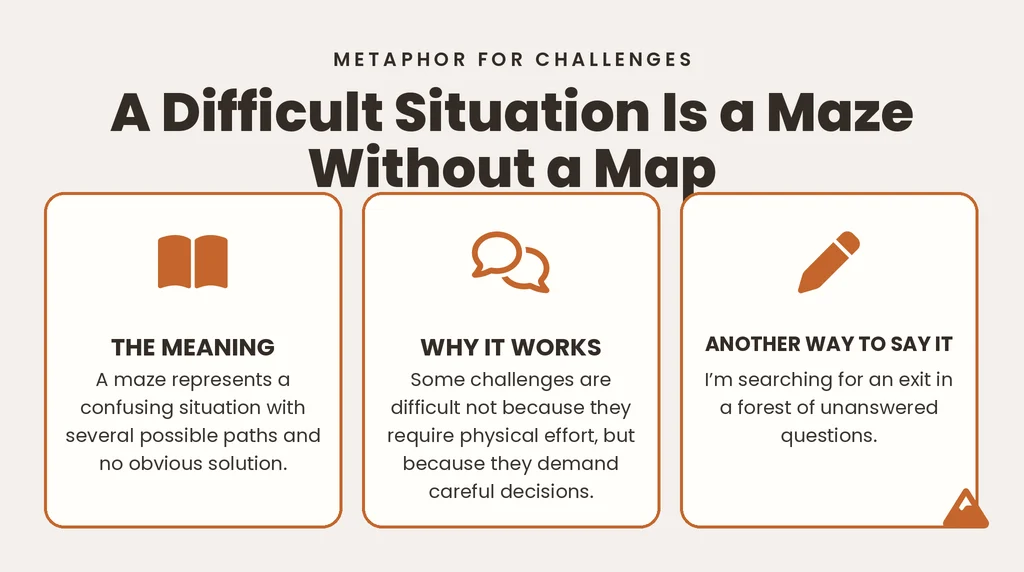
A maze represents a confusing situation with several possible paths and no obvious solution.
Why This Metaphor Works
Some challenges are difficult not because they require physical effort, but because they demand careful decisions. This metaphor captures uncertainty, frustration, and the fear of choosing the wrong direction.
It works well in reflective writing, mystery stories, and essays about personal decisions.
Alternative Expression
“I’m searching for an exit in a forest of unanswered questions.”
Examples in Writing
Formal Example:
Navigating the complex application process felt like entering a maze without a map.
Casual Example:
Trying to fix this problem is like being lost in a maze.
Creative Example:
Every turn promised an answer, but each corridor returned me to the same unanswered question.
4. Every Obstacle Is a Locked Door
Meaning
A locked door represents a barrier preventing you from reaching a desired opportunity or outcome.
Why This Metaphor Works
The image creates a sense of possibility because a locked door may have a key, another entrance, or a different route around it. It encourages problem solving without suggesting that every obstacle can be overcome in the same way.
Alternative Expression
“Every barrier is a puzzle waiting for its solution.”
Examples in Writing
Formal Example:
Limited resources became a locked door that forced the organization to reconsider its strategy.
Casual Example:
That rejection feels like a locked door, but I’ll look for another opportunity.
Creative Example:
I knocked until my hands hurt, then noticed a window glowing around the corner.
5. Adversity Is a Furnace
Meaning
A furnace represents intense pressure or hardship that tests a person’s endurance and character.
Why This Metaphor Works
Heat creates an image of discomfort, pressure, and transformation. This metaphor can describe demanding training, difficult responsibilities, or periods that force someone to reconsider their priorities.
However, hardship does not automatically make everyone stronger. The metaphor works best when the writing shows how someone responds to the experience.
Alternative Expression
“Hardship is a fire that tests the strength of the metal.”
Examples in Writing
Formal Example:
The years of economic uncertainty became a furnace that tested the company’s leadership.
Casual Example:
That experience put me through the fire, but I learned a lot about myself.
Creative Example:
The heat stripped away my excuses and left me face to face with the person I wanted to become.
6. A Setback Is a Detour
Meaning
A detour represents an unexpected change in direction that delays progress toward a goal.
Why This Metaphor Works
This comparison separates a temporary setback from the larger journey. It is useful when writing about rejected applications, failed plans, career changes, or interrupted dreams.
A detour may take you somewhere unexpected, but it does not automatically mean you have failed.
Alternative Expression
“A setback is a bend in the road, not the end of the journey.”
Examples in Writing
Formal Example:
Although the funding rejection delayed the project, the team treated it as a detour rather than a dead end.
Casual Example:
I didn’t get the job, but it’s just a detour. I’ll keep applying.
Creative Example:
The road vanished beneath fallen branches, so I followed a narrower path toward the same distant light.
7. Challenges Are Waves Against the Shore
Meaning
Waves represent repeated difficulties that arrive one after another.
Why This Metaphor Works
The image captures the exhausting rhythm of dealing with one problem only to face another. It also suggests endurance, as the shore remains present despite the waves repeatedly crashing against it.
This metaphor works well for stories about family responsibilities, financial stress, or prolonged periods of uncertainty.
Alternative Expression
“Problems arrive like tides that refuse to settle.”
Examples in Writing
Formal Example:
The small business faced waves of financial challenges throughout its first year.
Casual Example:
Every time I solve one problem, another wave hits me.
Creative Example:
The waves kept returning, but the shore remembered how to stand.
8. Fear Is a Wall Between You and Opportunity
Meaning
A wall represents fear, self doubt, or external barriers that prevent you from moving forward.
Why This Metaphor Works
Walls create a clear visual boundary. This metaphor is particularly effective when discussing public speaking, changing careers, learning new skills, or taking personal risks.
It also leaves room for nuance. Some walls can be climbed, some require a door, and others need to be dismantled gradually.
Alternative Expression
“Fear is a fence around possibilities.”
Examples in Writing
Formal Example:
Fear of public criticism became a wall between her ideas and their potential audience.
Casual Example:
My fear of failing is the biggest wall standing in my way.
Creative Example:
I built the wall brick by brick, then spent years wondering why the sky felt so far away.
9. Hardship Is a Heavy Backpack
Meaning
A heavy backpack represents emotional burdens, responsibilities, and problems that become exhausting to carry.
Why This Metaphor Works
Nearly everyone understands the physical discomfort of carrying too much weight. The image makes invisible stress feel tangible and helps readers understand how responsibilities accumulate over time.
It works especially well in memoirs, personal essays, and writing about emotional exhaustion.
Alternative Expression
“Unspoken worries are stones tucked inside the heart.”
Examples in Writing
Formal Example:
The combination of caregiving responsibilities and financial pressure became a heavy backpack she carried every day.
Casual Example:
I’ve been carrying a lot on my shoulders lately.
Creative Example:
Every unspoken worry added another stone until even the shortest road felt endless.
10. Difficult Times Are Winter Before Spring
Meaning
Winter represents a difficult or discouraging period, while spring symbolizes renewal and the possibility of improvement.
Why This Metaphor Works
The changing seasons offer a familiar way to describe uncertainty and hope. This metaphor is especially effective in poetry, personal reflections, and stories about recovery or new beginnings.
It should not be used to promise that every hardship will automatically lead to a happy ending. Its strength lies in expressing hope during a difficult period.
Alternative Expression
“Some chapters must endure the cold before new leaves appear.”
Examples in Writing
Formal Example:
The period following her career loss felt like winter before spring, marked by uncertainty and gradual renewal.
Casual Example:
Things are rough right now, but I hope this is just my winter season.
Creative Example:
Beneath the frozen ground, a small green promise waited for the warmth to return.
11. Problems Are Knots Waiting to Be Untangled
Meaning
A knot represents a complicated problem with several connected parts.
Why This Metaphor Works
Knots rarely come apart through force alone. They often require patience, attention, and a careful understanding of how each strand connects to the others.
This makes the metaphor especially useful for describing relationship conflicts, technical problems, and complicated decisions.
Alternative Expression
“Every problem is a thread in a tangled web.”
Examples in Writing
Formal Example:
The negotiations required patience as both parties worked to untangle years of disagreement.
Casual Example:
There’s a lot going on, and I need time to untangle everything.
Creative Example:
I stopped pulling at the knot and began following each thread back to its beginning.
12. Challenges Are Stepping Stones Across a River
Meaning
Stepping stones represent small achievements that help you move through a difficult situation.
Why This Metaphor Works
The image breaks a large challenge into manageable stages. Instead of expecting one enormous leap, you move forward one careful step at a time.
It works well in educational writing, goal setting, and stories about learning or personal development.
Alternative Expression
“Small victories are bridges across difficult waters.”
Examples in Writing
Formal Example:
Each completed training module became a stepping stone toward her professional qualification.
Casual Example:
I’m taking this one step at a time instead of worrying about everything at once.
Creative Example:
The river was wide, but every small stone brought the opposite bank a little closer.
13. Adversity Is a Rough Road
Meaning
A rough road represents a journey filled with delays, setbacks, and unexpected difficulties.
Why This Metaphor Works
Road imagery connects naturally with progress, ambition, and long term goals. It emphasizes that the journey may become uncomfortable without making the destination meaningless.
This metaphor is suitable for essays, speeches, biographies, and stories about perseverance.
Alternative Expression
“The path to success is scattered with stones.”
Examples in Writing
Formal Example:
Building an independent business proved to be a rough road marked by financial and operational challenges.
Casual Example:
Getting where I want to be hasn’t been an easy road.
Creative Example:
The road bruised my feet and tested my patience, but the horizon kept calling my name.
14. A Challenge Is a Puzzle Missing Its Final Piece
Meaning
A missing puzzle piece represents an unresolved problem or a situation that still lacks important information.
Why This Metaphor Works
Puzzles require observation, patience, and the ability to connect separate details. This metaphor makes problem solving feel like a process of discovery rather than a fight against an enemy.
It works particularly well in academic writing, investigative stories, and descriptions of complex decisions.
Alternative Expression
“I’m searching for the final piece of a complicated picture.”
Examples in Writing
Formal Example
The investigation resembled a puzzle missing its final piece because crucial evidence remained unavailable.
Casual Example
I understand most of the problem, but something still doesn’t fit.
Creative Example
The picture lay almost complete before me, with one small empty space refusing to make sense.
15. Difficult Times Are Clouds Covering the Sun
Meaning
Clouds represent temporary sadness, discouragement, or circumstances that hide feelings of happiness and hope.
Why This Metaphor Works
The sun remains present even when clouds block its light. This creates a gentle image of hope without denying the reality of difficult emotions.
It is particularly effective in comforting messages, reflective essays, and emotional poetry.
Alternative Expression
“Hope is a light waiting behind the clouds.”
Examples in Writing
Formal Example
The family’s financial difficulties became clouds that overshadowed an otherwise hopeful period.
Casual Example
I’m going through a rough patch, and it feels like the sun has disappeared.
Creative Example
The sky turned gray, but somewhere beyond the clouds, the light continued to burn.
16. Pressure Is a Weight Testing Your Balance
Meaning
Pressure represents demanding expectations, responsibilities, or circumstances that make it difficult to stay focused.
Why This Metaphor Works
The image turns mental strain into a physical sensation. It helps readers understand why competing responsibilities can affect confidence, concentration, and decision making.
This metaphor is useful in workplace writing, student essays, and stories about leadership.
Alternative Expression
“Expectations are stones piled upon the shoulders.”
Examples in Writing
Formal Example
The pressure of meeting the deadline became a weight that tested the team’s ability to remain focused.
Casual Example
I’ve got so much on my plate that it’s hard to keep my balance.
Creative Example
The world placed another stone on my shoulders, and I learned to stand without pretending it was light.
17. A Struggle Is an Inner Battle
Meaning
An inner battle represents a conflict between emotions, beliefs, fears, or competing decisions.
Why This Metaphor Works
Not every challenge involves an external obstacle. Sometimes the hardest struggle happens privately, when a person must decide what to believe, what to forgive, or which direction to take.
This metaphor works especially well in character development, personal essays, and reflective writing.
Alternative Expression
“My thoughts are a battlefield where doubt and courage meet.”
Examples in Writing
Formal Example
Her decision to leave the familiar environment became an inner battle between security and ambition.
Casual Example
I’m fighting with myself over what I should do next.
Creative Example
Two voices occupied my silence, one begging me to stay and the other demanding that I begin again.
18. Challenges Are Fires That Test Our Strength
Meaning
Fire represents hardship that tests endurance, priorities, or personal values.
Why This Metaphor Works
Fire can destroy, illuminate, or change what it touches. This makes it a flexible image for writing about painful experiences and difficult decisions.
Use this metaphor when the focus is on how someone responds to pressure, rather than suggesting suffering is always beneficial.
Alternative Expression
“Hardship is a flame revealing what survives the heat.”
Examples in Writing
Formal Example
The crisis became a fire that tested the organization’s commitment to its values.
Casual Example
That experience really tested me, but it also showed me what mattered.
Creative Example
The flames consumed my certainty, leaving the truth standing in their fading glow.
19. Uncertainty Is a Fog Hiding the Road Ahead
Meaning
Fog represents confusion about the future, incomplete information, or an inability to predict what will happen next.
Why This Metaphor Works
Fog limits visibility without necessarily making forward movement impossible. This captures the experience of taking small steps when the larger picture remains unclear.
It is useful in career stories, personal reflections, and writing about major life transitions.
Alternative Expression
“I’m walking through a future I cannot yet see.”
Examples in Writing
Formal Example
The sudden policy changes created a fog of uncertainty for the affected businesses.
Casual Example
I don’t know what comes next, and everything feels foggy right now.
Creative Example
I could see only the next few steps, so I learned to walk without demanding the whole horizon.
20. Every Challenge Is a Seed Beneath the Soil
Meaning
A seed represents potential that remains hidden during a difficult period.
Why This Metaphor Works
Seeds develop out of sight before producing visible growth. This creates a thoughtful comparison for learning, recovery, and gradual progress.
The metaphor is particularly suitable for hopeful endings, motivational speeches, and personal essays about change.
Alternative Expression
“Growth begins in places where nobody can see it.”
Examples in Writing
Formal Example
The early setbacks became seeds of experience that later informed her leadership.
Casual Example
I may not see progress yet, but I’m still learning and growing.
Creative Example
Beneath the cold soil, a small seed gathered the courage to become something green.
Metaphors for Challenges in Different Writing Situations
The most effective metaphor depends on the message you want to communicate. A comparison that works in a motivational speech may feel too dramatic in a school essay or casual conversation.
| Writing situation | Suitable metaphor | Why it works |
|---|---|---|
| School essay | A mountain to climb | Makes a difficult goal easy to understand |
| Personal essay | A heavy backpack | Expresses emotional burdens |
| Motivational speech | Stepping stones | Emphasizes gradual progress |
| Poetry | Winter before spring | Creates emotional contrast and hope |
| Fiction | A maze without a map | Builds suspense and uncertainty |
| Workplace writing | A rough road | Describes setbacks professionally |
| Personal reflection | A seed beneath the soil | Suggests quiet growth |
| Relationship story | A tangled knot | Communicates complicated emotions |
| Inspirational caption | A phoenix rising from ashes | Expresses renewal |
| Emotional dialogue | A storm at sea | Communicates overwhelm |
Positive Metaphors for Overcoming Challenges
Positive metaphors can help writers communicate perseverance without pretending that difficult experiences are easy.
Here are five examples:
- I am a tree growing through concrete. This represents persistence despite restrictive circumstances.
- Every obstacle is a stepping stone. This suggests that individual difficulties can become part of a larger journey.
- I am a candle in a dark room. This represents hope during uncertain times.
- My setbacks are pages in an unfinished story. This reminds readers that one difficult chapter does not define an entire life.
- I am a river finding its way through stone. This expresses patience, flexibility, and sustained effort.
These metaphors work well in motivational writing, speeches, personal development essays, and reflective journal entries.
Deep Emotional Metaphors for Challenges
Some challenges are not easily explained through positive language. Grief, disappointment, loneliness, and uncertainty often require imagery that acknowledges their emotional weight.
Consider these examples:
- My heart is a house with every light turned off. This suggests loneliness or emotional exhaustion.
- My worries are shadows that follow me home. This describes persistent anxiety or stress.
- I am carrying a winter inside my chest. This conveys sadness and emotional coldness.
- My dreams are letters lost in the rain. This suggests disappointment or plans that have faded.
- I am standing at the edge of an unfinished bridge. This represents uncertainty about what comes next.
These comparisons work especially well in poetry, memoirs, personal essays, and fictional scenes involving emotional conflict. The goal is to express the feeling honestly rather than make every struggle sound inspirational.
How to Use Metaphors for Challenges Naturally
A strong metaphor should clarify an experience, not make the sentence harder to understand. The best comparisons connect an abstract emotion with a familiar image.
Start With the Actual Challenge
Before choosing a metaphor, identify what makes the situation difficult.
Is it confusing? Try a maze or fog.
Is it exhausting? Try a heavy backpack.
Does it involve repeated setbacks? Try waves against the shore.
Does it require patience? Try a mountain climb or a seed growing beneath the soil.
Starting with the specific emotion helps you choose an image that feels relevant rather than random.
Match the Metaphor to the Tone
The emotional tone of your writing matters.
For a formal essay, a phrase like “a difficult road toward progress” may communicate the point clearly. In a poem, “the road swallowed my footprints” can create a more mysterious and emotional atmosphere.
Casual conversations usually benefit from familiar expressions. Creative writing allows you to experiment with unusual images, provided the meaning remains understandable.
Avoid Mixing Unrelated Metaphors
Consider this sentence:
“My problems are a storm, a mountain, and a fire that I must swim through.”
The images compete with one another, making the description difficult to picture.
A clearer version would be:
“My problems are a storm I must learn to navigate.”
Choose one central image and develop it naturally. You can introduce another metaphor later if the subject genuinely calls for a different comparison.
Make Familiar Metaphors Your Own
Common metaphors can still be effective, but adding a specific detail makes them more personal.
Instead of writing, “Life is a mountain,” try:
“The mountain rose above the village, and every step reminded me how far I still had to climb.”
The second version creates a setting, movement, and emotional tension. Those details make the image more memorable.
Metaphor vs. Simile: What Is the Difference?
Both metaphors and similes compare things to make descriptions more expressive, but they do so differently.
| Feature | Metaphor | Simile |
|---|---|---|
| How it works | Directly describes one thing as another | Uses words such as “like” or “as” |
| Example | Challenges are mountains. | Challenges are like mountains. |
| Writing effect | Often creates a direct, immersive image | Makes the comparison more explicit |
| Best use | Vivid descriptions and symbolic writing | Clear comparisons and accessible explanations |
For example, “Fear is a locked door” creates a direct symbolic image. “Fear is like a locked door” makes the comparison more explicit.
Neither technique is automatically better. Choose the form that suits your sentence, voice, and intended emotional effect.
Tips for Creating Original Metaphors About Challenges
You do not need to rely on familiar expressions to write effectively. Everyday experiences offer plenty of material for original comparisons.
- Observe ordinary objects: A tangled charging cable might represent a complicated problem, while a flickering bulb could suggest uncertain hope.
- Think through the senses: Consider how pressure feels, what disappointment sounds like, or how uncertainty changes the atmosphere of a room.
- Use specific experiences: A student facing an examination may imagine a ticking clock, while someone rebuilding a business might picture a damaged bridge under repair.
- Consider the emotional direction: Decide if the metaphor should express frustration, determination, grief, courage, or hope.
- Keep the image consistent: Develop one comparison instead of switching between unrelated images in the same passage.
- Read the sentence aloud: If the metaphor sounds unnatural or requires too much explanation, simplify it.
Originality does not mean making every comparison complicated. Sometimes a quiet, precise image carries more meaning than a dramatic one.
Common Mistakes When Writing Metaphors for Challenges
Using Too Many Clichés
Expressions such as “life is a journey” or “every cloud has a silver lining” are familiar to most readers. They can still work, but they may feel predictable without a fresh detail or a specific context.
Making Every Challenge Sound Positive
Not every difficult experience produces wisdom, strength, or success. A metaphor should reflect the situation honestly. Sometimes a storm is simply frightening, and a burden genuinely feels too heavy.
Choosing an Unclear Comparison
An unusual metaphor is not automatically an effective one. Readers should be able to understand the connection between the challenge and the image without decoding an entire paragraph.
Repeating the Same Image
If every section describes struggles as storms, mountains, or battles, the writing quickly becomes repetitive. Explore other sources of imagery, including music, architecture, gardening, puzzles, and everyday objects.
Forgetting the Reader
The purpose of a metaphor is to communicate meaning. If the comparison draws attention to itself but fails to clarify the experience, reconsider it.
Frequently Asked Questions
What is a metaphor for challenges?
A metaphor for challenges describes a difficult situation through a symbolic image. For example, “Challenges are mountains” represents obstacles that require effort and determination to overcome.
What is a good metaphor for overcoming challenges?
“Every obstacle is a stepping stone” is a useful metaphor for overcoming challenges because it represents gradual progress toward a larger goal.
What is a metaphor for life’s difficulties?
“Life is a rough road” describes a life filled with setbacks, unexpected turns, and demanding experiences.
What is a metaphor for a difficult situation?
“A maze without a map” describes a confusing situation in which finding the right direction or solution is difficult.
What is a positive metaphor for challenges?
“A seed beneath the soil” is a positive metaphor suggesting that growth and potential may develop even when progress is not immediately visible.
How do metaphors make challenges easier to describe?
Metaphors turn abstract experiences into familiar images. Comparing stress to a heavy backpack, for example, helps readers understand the feeling of carrying too many responsibilities.
Can I use metaphors for challenges in school essays?
Yes. Metaphors can make school essays more engaging by explaining complex experiences through clear imagery. Use comparisons that support your main point rather than distract from it.
What is a metaphor for emotional struggles?
“An inner battle” describes conflict between emotions, beliefs, or decisions. Other examples include a heavy backpack, a storm at sea, and a room full of echoes.
What is the difference between a challenge metaphor and a simile?
A metaphor directly describes a challenge as something else, such as “My challenge is a mountain.” A simile compares it using “like” or “as,” as in “My challenge is like a mountain.”
How can I create my own metaphor for challenges?
Identify the emotion or obstacle first, then connect it to a familiar object, place, or experience. A difficult decision might resemble a crossroads, while uncertainty could feel like walking through fog.
Conclusion
Challenges can be difficult to explain because they affect everyone differently. One person sees an obstacle as a mountain, while another experiences it as a storm that keeps returning. Metaphors for challenges help turn those complicated feelings into images that readers can understand, remember, and connect with emotionally.
Whether you are writing a school essay, a poem, a personal story, or an inspirational speech, the right comparison can give your words greater depth. A maze can express confusion, a heavy backpack can reveal exhaustion, and a seed beneath the soil can suggest hope when progress remains invisible.
The most effective metaphors do not pretend that every struggle has a simple solution. They give difficult experiences a clearer shape and help communicate what those moments actually feel like. Experiment with familiar images, explore your own experiences, and choose comparisons that feel honest. Sometimes one thoughtful metaphor can express what an entire paragraph struggles to explain.