You know the moment. An empty stomach stops being a fact and starts talking back, growling like a wolf in the stomach or knocking like a beggar at the body’s door, patient and impossible to ignore. Hunger is never only about food. That’s why it gives writers a direct line into character.
Why do writers keep coming back to hunger? Because it’s one of the oldest engines in literature. It drives journeys. It drives crimes, generosity, survival. A metaphor lets you grade it, too: a skipped lunch isn’t starvation, and a craving for cake isn’t craving love, power, or home. Readers believe it because their bodies taught them the language.
Below you’ll find twenty original metaphors for hunger, each with its meaning, why it works, another way to say it, and formal, casual, and creative examples. You’ll also get positive and negative metaphors, ready-made sentences, and tips for students, novelists, poets, and speakers.
Quick Metaphors for Hunger
In a hurry? Start here. This list gives you all twenty images at a glance, and the sections after it explain what each one means and how to use it.
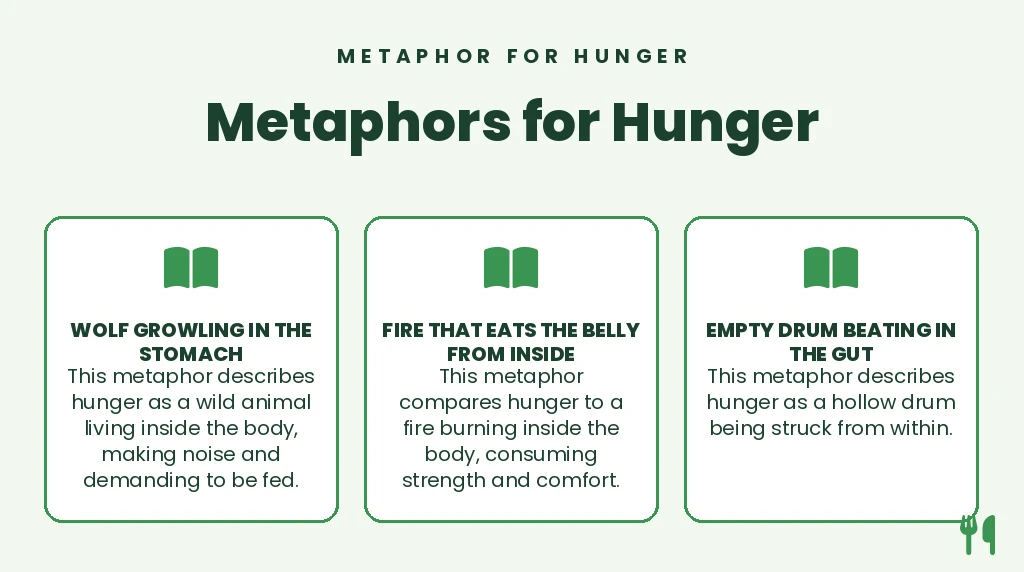
- Hunger is a wolf growling in the stomach.
- Hunger is a fire that eats the belly from inside.
- Hunger is an empty drum beating in the gut.
- Hunger is a beggar knocking at the body’s door.
- Hunger is a tide that pulls you toward the table.
- A craving is a hook set in the mind.
- Hunger is a clock that ticks louder at noon.
- Hunger is a hole that only bread can fill.
- Hunger is a storm gathering over an empty table.
- Appetite is a dog waiting by the kitchen door.
- Hunger is a drumbeat the whole body hears.
- Hunger is a desert growing inside the stomach.
- A craving is a song you cannot stop humming.
- Hunger is a landlord demanding rent in food.
- Hunger is a shadow that lengthens before dinner.
- Hunger is a magnet and every kitchen is iron.
- Hunger is a child tugging at your sleeve.
- Hunger is a furnace asking for more coal.
- A craving is a wave that keeps returning to shore.
- Hunger is an empty chair pulled up to every table.
Metaphors for Hunger and Their Meanings
Every metaphor below gets the same treatment: the meaning, why it works, an alternative phrasing, and three examples from real writing. Read straight through if you like. Or jump around and grab the images that fit.
1. Hunger Is a Wolf Growling in the Stomach
Meaning
Picture an animal living inside you. It growls. It paces. It wants feeding, now. That’s the sound of a rumbling stomach, yes, but also the danger underneath: ignore appetite long and it stops asking politely.
Why It Works
Wolves carry wildness and threat in almost every reader’s imagination, and pack hunger too. So the behavior makes instant sense. Hungry people, like hungry animals, get irritable. They get hard to reason with.
Alternative Expression
Or shorten it: “a beast in the belly,” says the same with less detail.
Examples in Writing
Formal Example: By the third day of the march, hunger was a wolf growling in the stomach of every soldier.
Casual Example: Ignore lunch and hunger is a wolf growling in the stomach by three o’clock.
Creative Example: Hunger was a wolf growling in the stomach, and the smell of bread made it pace.
2. Hunger Is a Fire That Eats the Belly from Inside
Meaning
Think of a fire burning inside the body. Not a cozy one. It eats strength, it eats comfort, and it leaves that burning, hollow ache behind, the kind that spreads into headache and weakness.
Why It Works
Fire has to be fed or put out. There’s no third option, and that urgency is the point. It fits the body, too, since we literally burn fuel to live.
Alternative Expression
Or try “a slow fire in the gut,” for the burn with less drama.
Examples in Writing
Formal Example: In the besieged quarter, hunger was a fire that eats the belly from inside, sparing no household.
Casual Example: Hunger is a fire that eats the belly from inside. Sandwich. Now.
Creative Example: Hunger was a fire that eats the belly from inside, and the cook held the only water.
3. Hunger Is an Empty Drum Beating in the Gut
Meaning
A hollow drum, struck from inside. Boom. Boom. Nobody else can hear it, but you can’t miss it, and the image rests on two things: how empty you feel, and that rhythmic announcing.
Why It Works
You don’t really see a drumbeat. You hear it, you feel it in your chest, which is exactly how a rumbling stomach behaves. A drum also warns people. Something’s coming.
Alternative Expression
Shorter still: “a hollow drum,” keeps only the emptiness.
Examples in Writing
Formal Example: Hunger is an empty drum beating in the gut, audible in every pause of the negotiation.
Casual Example: My stomach’s an empty drum beating in the gut, feed it before the meeting.
Creative Example: Hunger was an empty drum beating in the gut, and the whole march kept its time.
4. Hunger Is a Beggar Knocking at the Body’s Door
Meaning
Knock, knock. A poor beggar stands at the door, asking for whatever you can spare. Early on he’s polite. Give it time, though, and he won’t leave, which is exactly how gentle, growing hunger behaves.
Why It Works
A beggar brings need and dignity together, plus repetition: knock, wait, knock again. That combination invites sympathy instead of fear. Perfect for writing about poverty and patience.
Alternative Expression
Try “a polite debt collector,” to keep the knocking and add obligation.
Examples in Writing
Formal Example: Hunger is a beggar knocking at the body’s door, patient in the morning, insistent by night.
Casual Example: Hunger is a beggar knocking at the body’s door, and it knocks louder every hour.
Creative Example: Hunger was a beggar knocking at the body’s door, and pride kept pretending nobody was home.
5. Hunger Is a Tide That Pulls You toward the Table
Meaning
Like a tide, it comes in on schedule. It pulls everything toward shore, here toward food, then it ebbs away after a meal. And it always returns. Always. That rhythm is the point.
Why It Works
Nobody argues with a tide. It’s natural and predictable, and it doesn’t care what you planned. That takes the shame out of appetite: drifting toward the table is physics, not weakness. Good for health and everyday writing.
Alternative Expression
Smaller and more domestic: “a current toward the kitchen,”.
Examples in Writing
Formal Example: By noon, hunger is a tide that pulls you toward the table, and resistance feels ceremonial.
Casual Example: Hunger is a tide that pulls you toward the table. Resistance is adorable but pointless.
Creative Example: Hunger was a tide that pulls you toward the table, and the whole crew drifted gratefully shoreward.
6. A Craving Is a Hook Set in the Mind
Meaning
A hook catches in the mind and won’t let go. Chocolate, coffee, one specific thing: once the hook sets, every passing thought snags on it and gets pulled right back to the same object.
Why It Works
Hooks are small. They’re sharp. And they’re built to hold fast, which is precisely a craving’s grip on you. No wonder willpower feels physical. Something really is pulling.
Alternative Expression
Fresher, with the sharpness kept: “a fishhook of desire,”.
Examples in Writing
Formal Example: For the dieter, a craving is a hook set in the mind, baited daily by the bakery window.
Casual Example: A craving is a hook set in the mind. Mine says cheesecake, hourly.
Creative Example: A craving was a hook set in the mind, and every thought she caught wore the smell of oranges.
7. Hunger Is a Clock That Ticks Louder at Noon
Meaning
Your body keeps time, and this clock gets louder as lunch approaches. Tick. Tick. TICK. It’s the routine hunger of workers, students, and anyone whose day runs on a schedule.
Why It Works
Clocks are about habit and shared time. Whole offices get hungry together. And the rising volume does work here: a mild signal, repeated often enough, stops being a signal and becomes a command.
Alternative Expression
Plainer and more mechanical, “an internal alarm,” works too.
Examples in Writing
Formal Example: Hunger is a clock that ticks louder at noon, and the workshop empties within minutes of the bell.
Casual Example: Hunger is a clock that ticks louder at noon, mine’s basically shouting by twelve-fifteen.
Creative Example: Hunger was a clock that ticks louder at noon, and the schoolmaster surrendered to its hands.
8. Hunger Is a Hole That Only Bread Can Fill
Meaning
No decoration here. Just a hole, a gap inside the body that food has to fill. It’s plain, physical, honest: an image for writing that prefers hard truth to pretty language.
Why It Works
Everyone understands a hole. Everyone understands filling one. That simplicity is the strength of it, and the bluntness carries real dignity in poverty writing, where fancy language can feel like a lie.
Alternative Expression
Softer and more playful: “an empty pocket in the body,”.
Examples in Writing
Formal Example: For the displaced families, hunger is a hole that only bread can fill, and bread is rationed.
Casual Example: Hunger is a hole that only bread can fill. Toast is a valid life strategy.
Creative Example: Hunger was a hole that only bread can fill, and the baker’s son carried the key.
9. Hunger Is a Storm Gathering over an Empty Table
Meaning
Dark weather builds over a table with nothing on it. You can see the clouds coming. This one suits want, failed harvests, and families watching trouble gather right there over their own kitchens.
Why It Works
Storms bring dread because the damage hasn’t happened yet, but it’s coming. Set that storm over an empty table and the threat turns domestic. Immediate. Disaster, scheduled for dinner.
Alternative Expression
Quieter and sadder, there’s also “clouds over the kitchen,”.
Examples in Writing
Formal Example: After the drought, hunger was a storm gathering over an empty table in every village of the valley.
Casual Example: Hunger is a storm gathering over an empty table when payday is still a week away.
Creative Example: Hunger was a storm gathering over an empty table, and grandmother lit a candle against it.
10. Appetite Is a Dog Waiting by the Kitchen Door
Meaning
Meet hunger’s friendlier cousin. A loyal dog waits by the door, hopeful, well behaved, ears up. He’s asking for dinner, not demanding it, and that patience is the whole difference.
Why It Works
Who can dislike a waiting dog? He’s patient, he’s expressive, and he softens appetite into something charming. Set him beside the wolf and you can grade appetite precisely: dog at dinner time, wolf when it’s desperate.
Alternative Expression
Or lose the animal, keep the manners: “a hopeful guest,”.
Examples in Writing
Formal Example: In the farmhouse, appetite is a dog waiting by the kitchen door, rewarded punctually at six.
Casual Example: Appetite is a dog waiting by the kitchen door. Mine brought its own bowl.
Creative Example: Appetite was a dog waiting by the kitchen door, and the whole house loved its patience.
11. Hunger Is a Drumbeat the Whole Body Hears
Meaning
The beat isn’t just in your stomach. Your whole body hears it and obeys it. Hands slow down. Thoughts narrow. Moods drop. Every system you have marches to the same empty rhythm.
Why It Works
Drumbeats organize people. Armies march to them, dancers move to them, and hunger organizes a body in the same way. It shows hunger leaking outward, into temper, into focus, into strength.
Alternative Expression
More poetic and less martial, there’s “the body’s empty rhythm,”.
Examples in Writing
Formal Example: In the final week of the siege, hunger was a drumbeat the whole body hears, slowing every task.
Casual Example: Hunger is a drumbeat the whole body hears, even my patience is marching to it.
Creative Example: Hunger was a drumbeat the whole body hears, and the dancers missed their steps one by one.
12. Hunger Is a Desert Growing Inside the Stomach
Meaning
Dry, empty land, spreading inside you. That’s severe hunger, where a dry mouth and an empty stomach become a whole landscape you have to cross.
Why It Works
Deserts mean absence. Distance. Survival. So a private discomfort suddenly gains epic scale, and there’s a bonus: the image links hunger to thirst, because real hunger almost always brings thirst with it.
Alternative Expression
Wider than desert: “a dry country within,”.
Examples in Writing
Formal Example: After two days without supply, hunger was a desert growing inside the stomach of every scout.
Casual Example: Hunger is a desert growing inside the stomach. Send water. And sandwiches.
Creative Example: Hunger was a desert growing inside the stomach, and the smell of rain on bread was its mirage.
13. A Craving Is a Song You Cannot Stop Humming
Meaning
You know that tune you can’t get out of your head? A craving works like that. It’s playful, it’s repetitive, it’s oddly cheerful, and it returns the second your mind goes quiet.
Why It Works
Everyone knows an earworm. Everyone has suffered the friendly tyranny of one, so readers get this instantly. Use it for treats, habits, and small luxuries, not survival hunger, and the tone stays comic.
Alternative Expression
Trade music for touch: “an itch in the imagination,”.
Examples in Writing
Formal Example: For the retired smoker, a craving is a song you cannot stop humming, fainter each year.
Casual Example: A craving is a song you cannot stop humming. Today’s track: garlic bread.
Creative Example: A craving was a song you cannot stop humming, and the bakery played it on every corner.
14. Hunger Is a Landlord Demanding Rent in Food
Meaning
Pay up. The landlord collects on schedule, and he accepts exactly one currency: food. For anyone with a working life, that nails appetite’s recurring, unavoidable character in a single joke.
Why It Works
Rent means deadlines, and consequences if you don’t pay: headaches, the shakes, a short temper. The humor in that obligation is why modern voices love it for writing about bodies and budgets.
Alternative Expression
Drier but pointed: “a bill that arrives three times a day,”.
Examples in Writing
Formal Example: Hunger is a landlord demanding rent in food, and the body pays promptly or loses energy.
Casual Example: Hunger is a landlord demanding rent in food, and mine collects three times daily.
Creative Example: Hunger was a landlord demanding rent in food, and the students paid him in noodles and apologies.
15. Hunger Is a Shadow That Lengthens before Dinner
Meaning
As the day leans toward evening, the shadow stretches. So does hunger. It looms larger over your mood, your patience, and every conversation you try to have before dinner.
Why It Works
Shadows grow quietly. Predictably. Sound familiar? That’s afternoon hunger exactly, and the image stays subtle and visual, which suits reflective writing where hunger should influence a scene without swallowing it whole.
Alternative Expression
Tie it to the hour: “evening’s long shadow,”.
Examples in Writing
Formal Example: In the office, hunger is a shadow that lengthens before dinner, darkening tempers by five o’clock.
Casual Example: Hunger is a shadow that lengthens before dinner, I get grumpier as it grows.
Creative Example: Hunger was a shadow that lengthens before dinner, and the children’s questions grew shorter with it.
16. Hunger Is a Magnet and Every Kitchen Is Iron
Meaning
You don’t decide to drift toward the bakery. You’re pulled. Hunger works like a magnet here, and kitchens, bakeries, and markets are the iron, capturing how hungry people drift after food smells without choosing to.
Why It Works
Magnetism is invisible, constant, and much stronger than it looks. Sound like appetite? It should. The image manages to be playful and scientific at once, at home in markets, festivals, and city streets.
Alternative Expression
Prefer direction? Try “a compass that points to bread,”.
Examples in Writing
Formal Example: At the fair, hunger is a magnet and every kitchen is iron; the crowds obey the law happily.
Casual Example: Hunger is a magnet and every kitchen is iron. I never stood a chance near that bakery.
Creative Example: Hunger was a magnet and every kitchen is iron, and the night watchman orbited the bakery until dawn.
17. Hunger Is a Child Tugging at Your Sleeve
Meaning
Tug. Tug again. A small child pulls at your sleeve, and no, he isn’t dangerous. But he’s persistent and honest, and after a while? Ignoring him becomes nearly impossible.
Why It Works
Everyone knows that tug: gentle, repeated, impossible to refuse in the end. So mild hunger and caregiving scenes wear it beautifully, and appetite comes across as sympathetic rather than threatening.
Alternative Expression
Without the child: “a small voice asking again,”.
Examples in Writing
Formal Example: During the long hearing, hunger was a child tugging at your sleeve, polite and utterly relentless.
Casual Example: Hunger is a child tugging at your sleeve. Fine. Snack. You win.
Creative Example: Hunger was a child tugging at your sleeve, and the queen finally shared her own bread with it.
18. Hunger Is a Furnace Asking for More Coal
Meaning
Stoke it or it goes out. The hungry body is a furnace here, and food is the coal that keeps it working, which fits physical labor, sport, and teenagers, anywhere food is fuel.
Why It Works
A furnace turns fuel into visible work. That makes eating feel purposeful instead of greedy, and it honors big appetites that were honestly earned. Coaches reach for this image. So do parents.
Alternative Expression
The modern version: “an engine low on fuel,”.
Examples in Writing
Formal Example: For the harvest crew, hunger is a furnace asking for more coal, and the noon meal is sacred.
Casual Example: Teenagers: hunger is a furnace asking for more coal, and the fridge is the coal shed.
Creative Example: Hunger was a furnace asking for more coal, and the rowers fed it bread, cheese, and songs.
19. A Craving Is a Wave That Keeps Returning to Shore
Meaning
It rises. It breaks. It slips back, and then, sure enough, it returns. A craving behaves like a wave that way, sometimes weaker, sometimes stronger, but the rhythm itself is what matters.
Why It Works
You can’t fight the sea. You can learn its timing, though, and waves teach exactly that patience. Dieters, meditators, and people in recovery all use this image: a way to survive a craving without obeying it.
Alternative Expression
Slower and larger: “a tide of wanting,”.
Examples in Writing
Formal Example: Therapists note that a craving is a wave that keeps returning to shore, cresting near twenty minutes.
Casual Example: A craving is a wave that keeps returning to shore. Ride it out; it always retreats.
Creative Example: A craving was a wave that keeps returning to shore, and she stood in it, unbowed, counting.
20. Hunger Is an Empty Chair Pulled up to Every Table
Meaning
Picture the chair, pulled up to every table, even rich ones, with nobody in it. That empty seat stands for people who have nothing, which is why writers use it for inequality, charity, memory, and gratitude.
Why It Works
An empty chair needs no explaining. Everyone knows it from family life, and it lands quietly, like an accusation. Statistics become a seat at your own table. No wonder speeches keep returning to it.
Alternative Expression
Make it a person: “an uninvited guest at every feast,”.
Examples in Writing
Formal Example: For the relief workers, hunger is an empty chair pulled up to every table in the capital.
Casual Example: Hunger is an empty chair pulled up to every table. Share the meal; fill the chair.
Creative Example: Hunger was an empty chair pulled up to every table, and the feast ate in silence before it.
Positive Metaphors for Hunger
Hunger isn’t always the villain, though. A healthy appetite celebrates food, work, and life itself, and the six metaphors below show that generous, joyful side.
- Appetite is a welcome guest at the table. It brings gratitude and good company to every meal.
- Hunger is a coach cheering from the sidelines. It pushes the body to refuel and keep achieving.
- Hunger is the sauce that makes plain food royal. It turns simple bread into a feast after honest work.
- Appetite is a garden after rain. It returns fresh, grateful, and ready to enjoy everything.
- Hunger is a compass pointing home. It guides travelers back to family, kitchen, and belonging.
- Appetite is a drumroll before the feast. It builds happy expectation that makes food taste better.
Negative Metaphors for Hunger
Then there’s the cruel side. Writers have documented it for centuries: famine, obsession, plain want. The six metaphors below belong in stories where hunger harms people instead of helping them.
- Hunger is a thief that steals strength first. It takes energy, then focus, then hope, in that order.
- Hunger is a debt that compounds daily. It grows more expensive the longer it goes unpaid.
- Hunger is a bully who knows your address. It returns to the same victims again and again.
- Hunger is acid dissolving dignity. It forces proud people to beg, steal, or surrender.
- Hunger is a famine wearing a small mask. It hides inside single stomachs before it shows in streets.
- Hunger is a chain forged in the belly. It binds every thought and plan to the search for food.
Metaphors for Hunger in Sentences
Below, you’ll see hunger metaphors doing their work inside ordinary sentences, each one paired with the idea it communicates to a reader.
| Example sentence | What it communicates |
|---|---|
| By the second missed meal, hunger was a wolf growling in the stomach of the whole platoon. | Appetite turning dangerous, collective, and hard to control |
| A craving is a hook set in the mind, and the patisserie window set it deeper daily. | Temptation, habit, and the pull of a specific desire |
| Hunger is a tide that pulls you toward the table, and the fishermen never fought it. | Natural rhythm and surrendered resistance |
| For the night nurses, hunger was a child tugging at your sleeve until the break room. | Persistent, sympathetic hunger inside exhausting work |
| Hunger is an empty chair pulled up to every table at the fundraiser, by design. | Conscience, inequality, and a deliberate reminder to give |
| After training, hunger was a furnace asking for more coal, and dinner was enormous. | Earned appetite and food as honest fuel |
How to Use Metaphors for Hunger Naturally
Start with severity: how bad is it? A child tugging at a sleeve fits a missed snack, a tide fits everyday appetite, and you’ll want a wolf or a desert for danger and desperation. Readers calibrate instantly, because animal images threaten, household images sympathize, and landscape images make hunger epic.
Remember that hunger is rarely only about food. Characters hunger for love, justice, home, revenge, or rest, and the same metaphors will carry those meanings if your context is clear. Name the real object once, a letter, a person, a country, and then let the food image do the emotional work.
Ground it in the body: rumbling, dizziness, irritability, the pull toward smells. One accurate physical detail convinces readers faster than three comparisons do. And in revision, check the match between image and facts. A wolf after one skipped lunch won’t worry anyone. It’ll get a laugh.
Metaphor vs. Simile: What Is the Difference?
Put simply, a metaphor describes one thing as if it were another, while a simile makes the same comparison openly, with like or as. Hunger is a wolf: metaphor. Hunger is like a wolf: simile. The metaphor is shorter and bolder, since it never admits a comparison is happening.
Neither one is automatically better. Metaphors suit strong statements and dramatic moments. Similes feel lighter, more conversational, and they sit naturally in dialogue or gentle description. Most skilled writers move between the two and pick whichever keeps the sentence natural and the image clear.
See it here. Metaphor: “Hunger was a landlord demanding rent in food, and the body paid in bread.” Simile: “Hunger was like a landlord demanding rent in food, patient but impossible to refuse.” Same idea, both times. The metaphor lands harder.
Common Mistakes When Writing Hunger Metaphors
- Confusing hunger with cravings: Hunger is the body’s need for food in general, while a craving targets one specific thing. Calling a chocolate craving starvation makes writing less accurate and less dramatic where it counts.
- Making every hungry character a wolf: The growling wolf is powerful but familiar, and repeating it flattens your story. Grade your animals and images: dog for appetite, child for mild hunger, wolf only for real desperation.
- Ignoring hunger’s effect on the mind: Real hunger changes temper, honesty, memory, and courage, not just stomachs. A metaphor that only rumbles misses how hunger rewrites a character’s decisions.
- Romanticizing real starvation: Famine is not poetic to the people living it, and decorative metaphors can feel cruel in serious contexts. In journalism and memoir, choose plain images and let facts carry the weight.
- Stacking food metaphors together: A wolf in a furnace by a desert sea confuses every picture at once. Pick one governing image per scene and let real details do the supporting work.
Frequently Asked Questions
What is a good metaphor for hunger?
Match the image to the hunger’s strength: a child tugging at a sleeve for mild hunger, a tide for daily appetite, a wolf in the stomach for desperation. Pick one image, place it where the scene needs force, and let the sentences after it support it instead of adding rivals.
How do you describe hunger in writing?
Start with the body, in plain words. Rumbling. Emptiness. A dizzy spell, a short temper. Then choose one metaphor that gathers that into a single picture: a beggar, a landlord, an empty drum. Each can organize a paragraph.
What does hunger symbolize in literature?
In literature, hunger stands for desire at its rawest: for food, but also for love, power, freedom, or home. Strip away comfort and you learn what a character truly values, which is why hunger drives quests, crimes, sacrifices, and revolutions in story after story.
Can a hunger metaphor be positive?
Yes, absolutely. When appetite signals health and zest, hunger turns positive: a coach, a compass pointing home, the sauce that makes plain food royal. Writers use it that way for athletes, workers, growing children, and hungry students everywhere.
What is the difference between a hunger metaphor and a simile?
A metaphor states it flatly: hunger is a wolf. A simile keeps the comparison open with like or as: hunger is like a wolf. The sound changes. Metaphors come across bolder and more poetic, similes clearer and lighter, and good descriptive writing mixes both.
Conclusion
Hunger speaks in a hundred voices: a wolf, a beggar, a tide, a child at your sleeve. The metaphor you choose tells readers exactly how hunger feels, so match the image to the intensity and back it with honest body details. Your scenes will convince. For the feeling hunger so often travels with, our collection of metaphors for pain is the natural next stop.
Keep this list nearby next time a character skips a meal, crosses a famine, or just dreams of dinner. When the hunger is really for love, justice, or home, our guide to metaphors for emotions will help you name it. One honest metaphor, well chosen, will feed your writing longer than a dozen borrowed ones.