Picture this: just before the sun appears, everything goes still, as if the world is holding its breath. Dawn is a door opening in the wall of night, and through it come color, birdsong, and the feeling that life is starting again. Nothing else feels like it. Writers get a natural symbol of hope, mercy, and new beginnings.
Beginnings are everywhere in human stories, aren’t they? Recoveries, reconciliations, discoveries, second chances. That’s why dawn metaphors matter: a sunrise lets you show renewal without preaching, since readers already feel that lift of first light in their own bodies. Got a turning point in a novel? A speech about fresh starts? Dawn’s your oldest ally.
Here are twenty original metaphors for dawn, each with its meaning, why it works, an alternative expression, and formal, casual, and creative examples. You’ll also get positive and negative metaphors and ready-made sentences. Plus tips. Students, novelists, poets, and speakers should all find something usable.
Quick Metaphors for Dawn
If you need a strong dawn image quickly, start with this list of twenty metaphors, then read on for the meaning and examples behind each one.
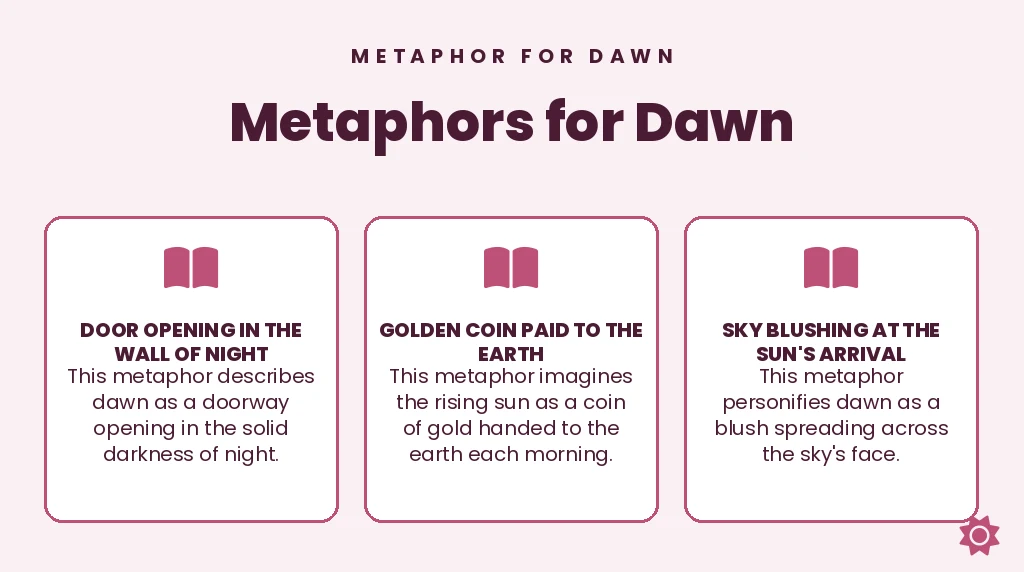
- Dawn is a door opening in the wall of night.
- The sunrise is a golden coin paid to the earth.
- Dawn is the sky blushing at the sun’s arrival.
- The dawn is a painter spilling pink across the sky.
- Dawn is a fresh page in the book of the day.
- The first light is a key turning in the lock of night.
- Dawn is a whisper that wakes the world gently.
- The sunrise is a flower opening in the east.
- Dawn is the horizon catching fire slowly.
- The dawn chorus is an orchestra tuning before the show.
- Dawn is a blanket of gold pulled over the fields.
- The morning sun is a baby opening its eyes.
- Dawn is a bridge between dreams and daylight.
- The sunrise is a promise the sky renews every day.
- Dawn is ink of light writing on a dark page.
- The first rays are fingers lifting the curtain of night.
- Dawn is a seed of light planted in darkness.
- The sunrise is a flag of colors raised over the hills.
- Dawn is the world taking its first breath.
- The dawn sky is a pearl turning pink in the light.
Metaphors for Dawn and Their Meanings
Each metaphor below is unpacked in the same way: what it means, why it works, another way to say it, and three examples showing it in real writing. Read in order or jump to the images that fit your purpose.
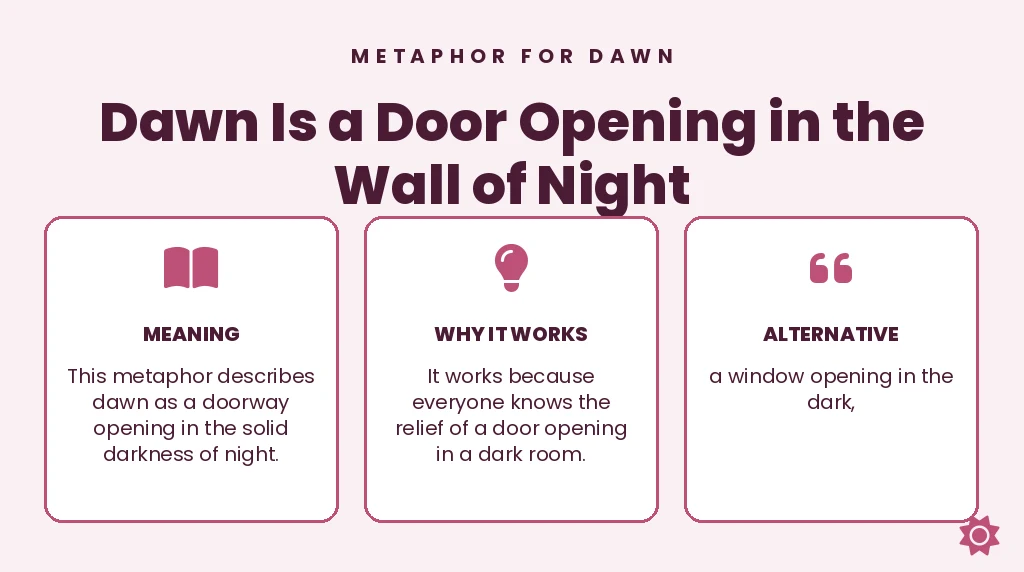
1. Dawn Is a Door Opening in the Wall of Night
Meaning
Night feels solid here, walled up with no way through. A doorway swings open in it, and light, sound, and life pour through, turning a closed world open.
Why It Works
Think of a door opening in a dark room. That relief? Readers know it instantly. Dawn becomes an invitation and an escape at once, perfect for rescue and recovery stories.
Alternative Expression
A close alternative is “a window opening in the dark,” smaller and more domestic.
Examples in Writing
Formal Example: For the refugees, dawn was a door opening in the wall of night, and they walked through it together.
Casual Example: Finally, dawn, a door opening in the wall of night after that endless shift.
Creative Example: Dawn was a door opening in the wall of night, and the whole valley stepped through, blinking.
2. The Sunrise Is a Golden Coin Paid to the Earth

Meaning
Each morning, the rising sun hands the earth a coin of solid gold. Daylight stops being weather and becomes wealth instead: wages, a gift, payment that settles the bill for the night’s darkness.
Why It Works
Money talks, even in a metaphor. We link it to value, exchange, and reward, so morning feels earned, not given, and that quality suits work and harvest themes, where light pays the farmer.
Alternative Expression
Writers also say “the sun’s daily wage,” keeping the payment idea in fewer words.
Examples in Writing
Formal Example: The sunrise is a golden coin paid to the earth, and the fields spend it by evening.
Casual Example: Look at that sunrise, a golden coin paid to the earth, free of charge.
Creative Example: The sunrise was a golden coin paid to the earth, and the river kept it shining all day.
3. Dawn Is the Sky Blushing at the Sun’s Arrival

Meaning
Pink spreads over the sky the way a blush spreads over a face. It’s shyness, youth, even love, as if the sky were greeting a beloved guest.
Why It Works
A blush gives the game away. You can’t fake one, and it never lasts, so the sky suddenly feels human. That gentleness is romantic through and through, ideal for love scenes, weddings, and tender beginnings.
Alternative Expression
A similar image is “the sky’s first blush,” compact and slightly more poetic.
Examples in Writing
Formal Example: Dawn is the sky blushing at the sun’s arrival, pink deepening to rose over the harbour.
Casual Example: The sky is blushing at the sun’s arrival, total romance-novel weather.
Creative Example: Dawn was the sky blushing at the sun’s arrival, and the sea pretended not to notice.
4. The Dawn Is a Painter Spilling Pink across the Sky
Meaning
Picture an artist at work, spreading pink, orange, and gold over a dark canvas. The color doesn’t arrive at once. It comes in strokes and washes.
Why It Works
Painting implies intention and skill, so a daily event becomes a performance worth watching. And spilling? That little mess keeps it playful.
Alternative Expression
Another version is “an artist with a wet brush,” stressing the soft blending of colors.
Examples in Writing
Formal Example: The dawn is a painter spilling pink across the sky, signing the horizon in gold.
Casual Example: The dawn is a painter spilling pink across the sky again, no two mornings alike.
Creative Example: The dawn was a painter spilling pink across the sky, and the clouds were her favorite canvas.
5. Dawn Is a Fresh Page in the Book of the Day
Meaning
Every dawn turns a blank page in a book that’s still being written. Yesterday’s mistakes stay on earlier pages. This one’s clean. Nothing’s written yet, and the choices are open.
Why It Works
Everyone knows a clean page. It gives you hope and scares you a little, since you might spoil it. No wonder it suits resolutions, forgiveness, and fresh starts, especially for writers.
Alternative Expression
A close alternative is “a blank page at sunrise,” simpler and equally hopeful.
Examples in Writing
Formal Example: For the convalescent, each dawn is a fresh page in the book of the day, unmarked by pain.
Casual Example: Bad yesterday? Dawn is a fresh page in the book of the day. Write better.
Creative Example: Dawn was a fresh page in the book of the day, and the lark held the pen.
6. The First Light Is a Key Turning in the Lock of Night
Meaning
First light turns like a key in a lock. Night’s the locked room, even a prison, and dawn is the small, precise movement that clicks it open and sets everything free.
Why It Works
Unlocking is quiet work. One click, and everything changes, which builds anticipation into a tiny sound. Reach for it in releases, revelations, or freedom arriving at daybreak.
Alternative Expression
Writers also say “the click of morning’s key,” focusing on the sound and the moment.
Examples in Writing
Formal Example: The first light is a key turning in the lock of night, and the prisoners heard it gratefully.
Casual Example: That first light is a key turning in the lock of night, we’re free, shift’s over.
Creative Example: The first light was a key turning in the lock of night, and every bird was a released prisoner.
7. Dawn Is a Whisper That Wakes the World Gently
Meaning
No alarm here. Dawn comes in as a whisper, light creeping up gradually while sounds start one by one, and the world wakes the way a child does, to a parent’s voice close by.
Why It Works
Whispers mean closeness. They mean care. So dawn feels kind, never violent, and that softness belongs in gentle scenes, sickrooms, nurseries, and quiet countryside, anywhere a harsh sunrise would wreck the mood.
Alternative Expression
A similar image is “morning’s soft voice,” keeping the sound but dropping the whisper.
Examples in Writing
Formal Example: In the hospice garden, dawn is a whisper that wakes the world gently, and no one fears it.
Casual Example: Dawn here is a whisper that wakes the world gently, no alarms, just birds.
Creative Example: Dawn was a whisper that wakes the world gently, and the mountains answered by glowing.
8. The Sunrise Is a Flower Opening in the East
Meaning
In the east, a flower is opening. Petals of light unfold layer by layer, and the spreading glow suggests growth and beauty that won’t be rushed.
Why It Works
Flowers run on their own clock: spring, patience, natural timing, all true of sunrise. Petals open gradually. So does light across a landscape, which keeps the pretty image honest.
Alternative Expression
Another gentle option is “a rose opening over the hills,” naming the flower outright.
Examples in Writing
Formal Example: The sunrise is a flower opening in the east, petal by petal of light over the fields.
Casual Example: The sunrise is a flower opening in the east, worth the early alarm.
Creative Example: The sunrise was a flower opening in the east, and the bees of light came out to work.
9. Dawn Is the Horizon Catching Fire Slowly
Meaning
Along the edge of the horizon, a slow fire is catching. Reds and oranges climb upward like flames, only there’s no smoke, no destruction, just color spreading higher.
Why It Works
Fire brings drama with it: danger, transformation, heat. But that one word, slowly, changes everything, and dawn’s fire stays beautiful instead of threatening. It’s the tension that makes the image stick.
Alternative Expression
Writers also say “a gentle fire on the world’s edge,” softening the drama further.
Examples in Writing
Formal Example: Dawn is the horizon catching fire slowly, and the watchers warmed their plans at it.
Casual Example: Dawn is the horizon catching fire slowly, best show on earth, free daily.
Creative Example: Dawn was the horizon catching fire slowly, and the frost surrendered field by field.
10. The Dawn Chorus Is an Orchestra Tuning before the Show
Meaning
Listen first, and you’ll hear an orchestra tuning up. That’s the dawn chorus here: chirps and calls overlapping in disorder, each bird finding its note before the day’s performance begins.
Why It Works
Tuning is pure promise. Nothing’s started yet, but you can hear that everything’s about to, and listeners feel flattered just for noticing. Try it around theatres, schools, and waking cities.
Alternative Expression
A close alternative is “a choir warming up,” friendlier and more human.
Examples in Writing
Formal Example: The dawn chorus is an orchestra tuning before the show, each hedge contributing its instruments.
Casual Example: The dawn chorus is an orchestra tuning before the show out there, loud rehearsal.
Creative Example: The dawn chorus was an orchestra tuning before the show, and the sun was the late conductor.
11. Dawn Is a Blanket of Gold Pulled over the Fields
Meaning
First light settles over farmland the way you’d draw a golden blanket across a bed. It covers everything, warms everything, and after a cold night that coverage reads as pure kindness.
Why It Works
Blankets mean sleep, safety, someone looking after you. That’s the opposite of the night they’ve just replaced, so there’s a paradox at work: a blanket that wakes you up. Readers smile. The gold helps.
Alternative Expression
Another warm option is “a quilt of light,” stressing the patched pattern over fields.
Examples in Writing
Formal Example: By six, dawn is a blanket of gold pulled over the fields, and the frost withdraws to the hedges.
Casual Example: Dawn is a blanket of gold pulled over the fields out here. Stunning.
Creative Example: Dawn was a blanket of gold pulled over the fields, and the scarecrow slept in, forgiven.
12. The Morning Sun Is a Baby Opening Its Eyes
Meaning
The rising sun becomes an infant opening its eyes for the very first time. The light’s new, soft, full of wonder. For a moment, the whole world feels young again.
Why It Works
Babies are beginnings in their purest form, innocence included. It stays tender rather than grand, and it suits childhood, parenthood, recovery, and any life that’s starting over.
Alternative Expression
A similar image is “the day’s first yawn,” keeping the baby but adding sleepiness.
Examples in Writing
Formal Example: In the valley, the morning sun is a baby opening its eyes, mild and unhurried.
Casual Example: The morning sun is a baby opening its eyes, give it a minute to wake up.
Creative Example: The morning sun was a baby opening its eyes, and the whole world cooed back at it.
13. Dawn Is a Bridge between Dreams and Daylight
Meaning
You’re standing on a bridge at dawn, with sleep and dreams behind you and work and waking life ahead. Cross slowly. For a few minutes you belong fully to neither side, and that’s the point.
Why It Works
Waking is a crossing. Bridges are built for crossings, and they honor those odd minutes when dreams still feel real, which suits reflective, literary writing.
Alternative Expression
A close alternative is “a ferry between sleep and waking,” slower and more dreamlike.
Examples in Writing
Formal Example: Dawn is a bridge between dreams and daylight, and the night staff cross it in silence.
Casual Example: Half asleep still, dawn is a bridge between dreams and daylight, and I’m mid-crossing.
Creative Example: Dawn was a bridge between dreams and daylight, and she carried one dream across in her pocket.
14. The Sunrise Is a Promise the Sky Renews Every Day
Meaning
Every sunrise keeps a promise. The sky makes it and, day after day, it holds: darkness won’t last, and light will come back. A physical event turns into a statement about trust and endurance.
Why It Works
Promises test character. Who makes them? Who keeps them when it’s hard? A promise kept every day becomes the strongest comfort there is, which suits grief writing, faith, and perseverance.
Alternative Expression
Writers also say “morning’s daily vow,” shorter and slightly more solemn.
Examples in Writing
Formal Example: For the besieged town, the sunrise is a promise the sky renews every day, and morale renewed with it.
Casual Example: The sunrise is a promise the sky renews every day. It has never once broken it.
Creative Example: The sunrise was a promise the sky renews every day, and the old lighthouse believed it completely.
15. Dawn Is Ink of Light Writing on a Dark Page
Meaning
Bright ink is writing across the dark page of night. Watch the shadows shrink, like words being edited out, while the new day inscribes itself over the old darkness.
Why It Works
Writing carries meaning and intention, so dawn stops looking like an accident and starts reading like a message. Authors and readers enjoy that flattery. It suits essays on creativity and revelation.
Alternative Expression
A related phrasing is “light writing its first draft,” stressing the day’s unfinished quality.
Examples in Writing
Formal Example: Dawn is ink of light writing on a dark page, and by seven the first chapter is legible.
Casual Example: Dawn is ink of light writing on a dark page, today’s story starts now.
Creative Example: Dawn was ink of light writing on a dark page, and the stars were yesterday’s deleted words.
16. The First Rays Are Fingers Lifting the Curtain of Night
Meaning
Fingers are lifting a curtain, one sunbeam at a time. Behind it, the day waits, staged and ready. The unveiling doesn’t happen all at once. It goes strip by strip, slowly.
Why It Works
Curtains mean theatres, secrets, reveals. Add fingers, though, and the action turns human and careful, not grand. Use it for performances, unveilings, and scenes where truth is about to show.
Alternative Expression
Another version is “hands drawing back the dark,” plainer but equally gentle.
Examples in Writing
Formal Example: The first rays are fingers lifting the curtain of night over the sleeping port.
Casual Example: The first rays are fingers lifting the curtain of night, show’s starting.
Creative Example: The first rays were fingers lifting the curtain of night, and the valley applauded in birdsong.
17. Dawn Is a Seed of Light Planted in Darkness
Meaning
Someone has sown a tiny seed of light in dark soil. It looks like nothing at first. Look again in an hour, and everything bright in the day has grown out of it.
Why It Works
Seeds teach patience and faith in growth you can’t see yet, lessons dawn carries naturally. That’s why the image fits beginnings that look tiny: a first step, a small hope, a quiet decision.
Alternative Expression
A close alternative is “a spark with a future,” keeping the smallness but adding risk.
Examples in Writing
Formal Example: In the winter village, dawn is a seed of light planted in darkness, slow to show its crop.
Casual Example: Dawn is a seed of light planted in darkness, give it an hour, it grows fast.
Creative Example: Dawn was a seed of light planted in darkness, and by breakfast it had become a garden.
18. The Sunrise Is a Flag of Colors Raised over the Hills
Meaning
Above the hills, a flag of colors is going up the pole. Its message is plain: day has taken command. With that comes ceremony, pride, and a clear note of victory.
Why It Works
Flags announce things. Identity, territory, news: the whole landscape learns it all at once. No wonder the image belongs with celebrations and liberations.
Alternative Expression
A similar image is “the day’s banner,” shorter and slightly more formal.
Examples in Writing
Formal Example: The sunrise is a flag of colors raised over the hills, and the valley salutes it with mist.
Casual Example: The sunrise is a flag of colors raised over the hills. Team day wins again.
Creative Example: The sunrise was a flag of colors raised over the hills, and the night surrendered without conditions.
19. Dawn Is the World Taking Its First Breath
Meaning
The living world wakes and takes its first breath. Air moves, birds stir, and everything that slept begins again on that one quiet inhalation, as if the day had lungs.
Why It Works
Breathing is life at its most basic, and every reader does it without thinking. That pulls dawn down from astronomy into the body, close and intimate, suiting health and recovery writing.
Alternative Expression
Another gentle option is “the earth’s first sigh,” sadder and more tired than a breath.
Examples in Writing
Formal Example: In the high pastures, dawn is the world taking its first breath, cold and clean.
Casual Example: Dawn is the world taking its first breath. Step outside and take one with it.
Creative Example: Dawn was the world taking its first breath, and every leaf trembled at being alive.
20. The Dawn Sky Is a Pearl Turning Pink in the Light
Meaning
Hold the pale dawn sky up to the light and it behaves like a pearl, slowly turning pink. It catches that delicate, luminous moment before sunrise brings stronger colors.
Why It Works
Pearls don’t shout. They suggest quiet luxury and patience, beauty formed slowly in darkness, so the effect stays refined, not loud. Save it for elegant description and romantic scenes.
Alternative Expression
Writers also say “a shell opening on light,” keeping the sea-born delicacy.
Examples in Writing
Formal Example: Before the sun itself appears, the dawn sky is a pearl turning pink in the light.
Casual Example: The dawn sky is a pearl turning pink in the light this morning. Gorgeous.
Creative Example: The dawn sky was a pearl turning pink in the light, and the sea wore it proudly.
Positive Metaphors for Dawn
Dawn is one of the most naturally positive subjects in language, tied to hope, healing, and fresh starts. The six metaphors below lean into that brightness.
- Dawn is a second chance delivered daily. It gives every reader a fresh start without conditions.
- Dawn is a nurse making her morning rounds. It brings quiet care to everything that suffered overnight.
- Dawn is a letter of good news at the door. It arrives with relief after a long, anxious wait.
- Dawn is the world’s daily forgiveness. It wipes the slate of yesterday’s failures clean.
- Dawn is a key that fits every lock. It opens prisons, sickrooms, and sleepless minds alike.
- Dawn is a gardener checking on her seedlings. It returns faithfully to everything young and growing.
Negative Metaphors for Dawn
Dawn is not always welcome: it can end dreams, expose secrets, and drag the unwilling back to work. These six metaphors show morning’s unwelcome side.
- Dawn is an alarm that cannot be snoozed. It drags the exhausted back to duty without mercy.
- Dawn is an inspector arriving unannounced. It exposes every crack, stain, and unfinished job.
- Dawn is a thief who steals the night. It takes away darkness, rest, and hiding places.
- Dawn is a Monday wearing golden clothes. It dresses obligation in colors too pretty to trust.
- Dawn is a curtain rising on an unready actor. It forces performers to begin before they feel prepared.
- Dawn is a debt collector at the window. It demands the energy the night was supposed to restore.
Metaphors for Dawn in Sentences
The sentences below show dawn metaphors working inside ordinary prose, each matched with the idea it communicates to a reader.
| Example sentence | What it communicates |
|---|---|
| Dawn was a door opening in the wall of night, and the marchers stepped through it free. | Release, hope, and the end of a long ordeal |
| The sunrise is a golden coin paid to the earth, spent by the farmers before noon. | Reward, honest work, and the value of daylight |
| Dawn is the horizon catching fire slowly, and the frost gives up field by field. | Gradual transformation and the retreat of cold |
| She treated each dawn as a fresh page in the book of the day, refusing to reread yesterday. | Forgiveness of oneself and determination to start over |
| The first light is a key turning in the lock of night for the night-shift nurses. | Relief, freedom, and the end of a hard duty |
| Dawn is a seed of light planted in darkness; by spring the whole valley believed it. | Small beginnings growing into visible change |
How to Use Metaphors for Dawn Naturally
Start with what your beginning means, then pick the image to match. Need an escape or a release? A door, a key, and a bridge will do that work, while a fresh page and a seed suit resolutions and quiet growth. Romantic scene? Reach for the blush or the pearl. Triumphant one? Raise the flag of colors.
Keep the volume honest. Dawn’s a quiet event, so handle violent images with care: a horizon catching fire can carry real drama, but a sickroom needs something softer, a whisper or a nurse making rounds. Let the intensity climb with the light itself. Faintest first. Boldest at full sunrise.
Put the metaphor where it can work hardest: at a turning point. A chapter opening, a decision, a reunion, a recovery: one image there can rename the scene as a beginning. Then revise ruthlessly. If an image only decorates, cut it. Keep the ones that change how readers feel about what follows.
Metaphor vs. Simile: What Is the Difference?
Here’s the short version. A metaphor treats one thing as if it were another, while a simile makes the same comparison openly, with like or as. Dawn is a door: that’s a metaphor. Dawn is like a door opening: that’s a simile. See the difference? The metaphor never admits it’s comparing anything, so it’s shorter and bolder.
Neither wins by default. Metaphors suit strong statements and dramatic moments, while similes feel lighter, more conversational, better for dialogue or gentle description. Good writers move between them, choosing whichever keeps the sentence natural and the image clear.
Try it side by side and you’ll hear it. Metaphor: “Dawn was a seed of light planted in darkness, and by noon it had become a harvest.” Simile: “Dawn was like a seed of light planted in darkness, growing stronger every hour.” Same idea. The metaphor hits harder.
Common Mistakes When Writing Dawn Metaphors
- Making every dawn a rebirth: Calling every sunrise a symbol of new life becomes a cliché readers skim past. Save rebirth for scenes that truly turn a story, and describe ordinary mornings more plainly.
- Mixing dawn with full daylight: Dawn is brief, pale, and in-between; midday is bright, hot, and certain. A metaphor built on harsh glare will clash with the soft minutes you are describing.
- Forgetting the sounds of morning: Dawn is heard as much as seen: birds, traffic, kettles, calls to prayer. A metaphor that includes sound, like the tuning orchestra, will feel truer than color alone.
- Overloading the first paragraph: Chapter openings tempt writers to stack three sunrises at once. Choose one dawn image for the opening and let the scene supply the rest.
- Ignoring season and place: A northern winter dawn arrives late and stays pale; a tropical dawn is fast and vivid. Check how dawn behaves in your setting before choosing colors.
Frequently Asked Questions
What is a good metaphor for dawn?
The best one fits the beginning you’re describing. Writing about release? Use a door opening. Resolutions? Try a fresh page, or a seed of light if the hope’s still small. Pick one clear image, set it at the turning point, and let the sentences back it up instead of competing with it.
How do you describe dawn in writing?
Start with what’s actually there, in plain words: shifting colors, first sounds, cold air, light getting stronger. Then choose one metaphor to pull it all into a single picture. A painter can do it. So can a whisper or a bridge. Each organizes the paragraph around itself.
What does dawn symbolize in literature?
In literature, dawn usually stands for hope, renewal, innocence, and truth coming into the open. A character who survives a dark night, literal or emotional, meets morning changed, so dawns appear at rescues, recoveries, and confessions. Dawn can mean youth, too. It’s the day’s childhood.
Can a dawn metaphor be negative?
Yes, absolutely. When morning isn’t welcome, dawn turns unwelcome too: an alarm you can’t snooze, an inspector picking out every flaw, a thief making off with the night. Writers reach for those versions for exhaustion, dread of work, and secrets that daylight threatens to expose.
What is the difference between a dawn metaphor and a simile?
A metaphor just says it outright: dawn is a fresh page. A simile keeps the comparison visible with like or as: dawn is like a fresh page. Hear the shift? Metaphors sound bolder, more poetic. Similes sound clearer, lighter. Good writing doesn’t pick a side; it mixes both.
Conclusion
Dawn makes the argument every morning: darkness doesn’t get the final word. Picture it as a door opening, a seed of light, or a sky renewing its promise, and one honest metaphor can turn an ordinary morning into a beginning. Want the season dawn announces most beautifully? Our collection of metaphors for spring picks up that same story of renewal.
Keep this set close next time a scene needs to begin again, and choose the image that fits your character’s hope. Does your story have to pass through darkness first? Our guide to metaphors for the night will help you write the hours before the light. Stick with single, clear comparisons. One honest metaphor warms writing longer than a dozen borrowed ones.