Step into a garden in June and it starts talking immediately. It’s a library where the books bloom, shelf after shelf of living colour, and a poem the earth recites very, very slowly. Few places pack so many moods into so little ground.
Plain description just lists plants. Accurate, and dead. A metaphor shows what a garden does instead: it teaches, heals, remembers, and sometimes fights back. The right image reveals the gardener too. Every garden reflects the hands that tend it.
Here are twenty original metaphors for a garden, from a treasure chest of flowers to a battlefield of weeds. Each comes with a meaning, an alternative, and examples, plus positive and negative shades, and sentences ready to drop into your own writing.
Quick Metaphors for Garden
If you need a fresh image fast, start with this list of twenty garden metaphors.
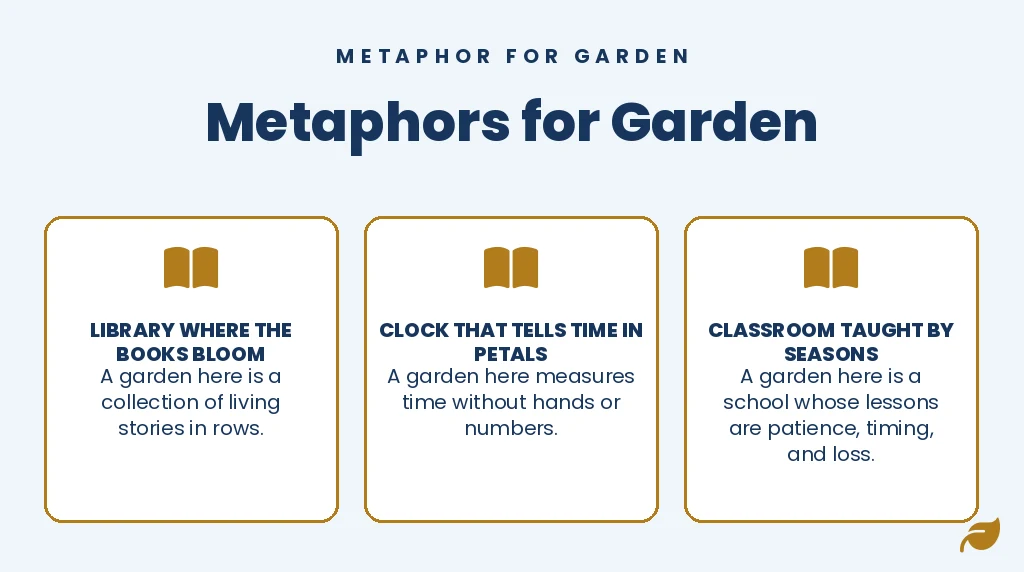
- Garden is a library where the books bloom.
- Garden is a clock that tells time in petals.
- Garden is a classroom taught by seasons.
- Garden is a pharmacy with green shelves.
- Garden is a blank page written each spring.
- Garden is a savings account paid back in tomatoes.
- Garden is a quilt stitched from a hundred green patches.
- Garden is an orchestra tuning itself to the sun.
- Garden is a promise the soil keeps slowly.
- Garden is a battlefield where weeds never surrender.
- Garden is a sponge drinking the storm.
- Garden is a table set for bees and butterflies.
- Garden is a diary written in leaves.
- Garden is a mirror of the gardener’s patience.
- Garden is a small country ruled by the weather.
- Garden is a treasure chest that opens one flower at a time.
- Garden is a workshop where old hands stay young.
- Garden is a poem the earth recites slowly.
- Garden is a net that catches the rain.
- Garden is a cradle rocked by the wind.
Metaphors for Garden and Their Meanings
Each metaphor below comes with an explanation, why it works, an alternative, and three examples, from a window box to an estate. Borrow the ones that fit your ground, and adapt the rest freely.
1. Garden Is a Library Where the Books Bloom

Meaning
Rows of living stories. Every plant is a volume with its own season for opening, and the gardener reads them like shelves, a few pages per visit.
Why It Works
Libraries mean stored beauty and quiet knowledge, and a planted space holds both. It suits thoughtful gardeners, and scenes where nature feels collected rather than wild.
Alternative Expression
Or shelf it as “an anthology edited by the seasons,” the same gathered stories, reprinted every year.
Examples in Writing
Formal Example: For the retired professor, the garden was a library where the books bloom, read every morning among the roses.
Casual Example: Mom treats her garden like a library. Every bed has its own shelf, and nobody is allowed to dog-ear the tulips.
Creative Example: The blind monk tended a library where the books bloom, reading the garden by scent and teaching novices to listen.
2. Garden Is a Clock That Tells Time in Petals

Meaning
No hands. No numbers. This garden tells time in buds, blossoms, and falling petals, marking the year’s hours more honestly than any machine on the wall.
Why It Works
Clocks mean rhythm, and passing time. A garden keeps both faithfully, which makes this perfect for reflective writing about ageing, seasons, and lives planned around planting.
Alternative Expression
Or simply “a calendar written in green,” the same slow schedule, turned one leaf at a time.
Examples in Writing
Formal Example: The old gardener owned no watch; his garden was a clock that tells time in petals, and he was never late for spring.
Casual Example: I don’t check the date anymore. The garden clock says it all: tulips mean April, tomatoes mean July.
Creative Example: In the walled city, the exiled queen planted a clock of petals, counting her captivity in blossoms.
3. Garden Is a Classroom Taught by Seasons
Meaning
School, but nobody sits at a desk. The lessons are patience, timing, and loss, the teachers are seasons, and every student learns the same way: by waiting and watching.
Why It Works
Classrooms mean instruction. Growth. Gardening delivers both without saying a word, so it fits parents, mentors, and memoirs where a plot of earth educates somebody.
Alternative Expression
There’s also “a patient teacher with dirt under its nails,” the same lessons, taught by doing.
Examples in Writing
Formal Example: The community garden became a classroom taught by seasons, and the city’s children learned biology with their hands in the soil.
Casual Example: Dad says the garden is his classroom. Lesson one was humility, taught by peppers that refused to grow.
Creative Example: The orphanage garden was a classroom taught by seasons, and the children who weeded it graduated fluent in hope.
4. Garden Is a Pharmacy With Green Shelves
Meaning
Remedies, growing in the open air. Herbs, roots, and leaves wait on their green shelves, ready to heal a headache or calm a house down.
Why It Works
Pharmacies mean help and relief. A herb garden quietly offers the same, which suits healers, village scenes, and our oldest medicine of all: plants.
Alternative Expression
Or open “a medicine cabinet open to the sky,” the same remedies, stored in sunlight instead of bottles.
Examples in Writing
Formal Example: The village healer kept no shop; her garden was a pharmacy with green shelves, and patients knocked at the gate.
Casual Example: Headache? Grandma skips the drugstore and heads to her pharmacy with green shelves. Mint tea fixes almost everything.
Creative Example: After the war, the nurse planted a pharmacy with green shelves, prescribing roses for grief and lavender for fear.
5. Garden Is a Blank Page Written Each Spring
Meaning
Every year, a fresh sheet. Winter wipes the garden clean, spring hands the gardener a pen made of seeds, and the story starts again from the top.
Why It Works
A blank page is beginnings plus risk, and that’s exactly what planting feels like in March. Writers, new homeowners, anyone starting over in spring.
Alternative Expression
Alternatively, “a letter the gardener writes to summer,” the same yearly message, sealed with flowers.
Examples in Writing
Formal Example: Each March, the estate garden was a blank page written each spring, and the head gardener composed it bed by bed.
Casual Example: Our yard right now is a total blank page. By May, if my plans survive, it will be a whole novel.
Creative Example: The poet bought the ruined plot, a blank page written each spring, the only manuscript he still believed in.
6. Garden Is a Savings Account Paid Back in Tomatoes
Meaning
Money, stored in the earth and paid back with interest. Every seed is a small deposit. Every harvest is a withdrawal the whole family celebrates.
Why It Works
Savings mean patience, rewarded. That’s the whole economics of a vegetable patch, so it fits practical gardeners, wartime stories, and families counting wealth in jars and baskets.
Alternative Expression
Or bank on “a pantry that pays you back,” the same honest profit, stored in soil instead of shelves.
Examples in Writing
Formal Example: For the immigrant family, the garden was a savings account paid back in tomatoes, and August was their richest month.
Casual Example: Best investment I ever made: a garden. It’s literally a savings account that pays back in tomatoes and zucchini.
Creative Example: The miser buried his fortune in a savings account paid back in tomatoes, and died the village’s richest man.
7. Garden Is a Quilt Stitched From a Hundred Green Patches
Meaning
Think handmade. A blanket of small pieces, each bed a patch of colour and texture, all of them stitched to their neighbours by narrow paths.
Why It Works
Quilts mean home. Thrift. Grandmotherly care. The image warms a garden instantly, which makes it right for cottage scenes and plots built patch by patch.
Alternative Expression
It doubles as “a patchwork flag planted by one family,” the same stitched colours, waving in vegetables.
Examples in Writing
Formal Example: From the hill, the allotments formed a quilt of green patches, every square a different family’s story.
Casual Example: Our community garden looks like a quilt in drone photos: one square of corn, one of roses, one of total weed chaos.
Creative Example: The widow sewed her sorrow into a quilt stitched from green patches, and by autumn the village slept under its colors.
8. Garden Is an Orchestra Tuning Itself to the Sun
Meaning
Performers, warming up for the sun. Every plant rises at its cue, tall stems and small bells together, and the only conductor is the light itself.
Why It Works
An orchestra is harmony built from different voices. So is a healthy garden. Grand estates, dawn scenes, nature performing in order: that’s the territory.
Alternative Expression
Or listen to “a choir that sings in colors,” the same many-voiced harmony, performed for the eyes.
Examples in Writing
Formal Example: At dawn the botanical garden was an orchestra tuning to the sun, the first bees arriving like an audience.
Casual Example: Early morning, the garden is a full orchestra tuning up: birds, bees, and one very confident rooster next door.
Creative Example: The deaf composer planted an orchestra that tunes itself to the sun, and conducted it daily from his window, hearing perfectly.
9. Garden Is a Promise the Soil Keeps Slowly
Meaning
A vow, exchanged between a person and the earth. The gardener plants in faith. The soil answers slowly, weeks later, but it keeps its word.
Why It Works
A promise is trust stretched across time, and gardening has exactly that shape. Love stories, memorial gardens, planting as an act of faith.
Alternative Expression
Simpler still: “a handshake with the future,” the same agreement, sealed with a seed pressed into soil.
Examples in Writing
Formal Example: The wedding garden was a promise the soil keeps slowly, planted by the couple on their first morning as newlyweds.
Casual Example: Every seed packet is basically a promise the soil keeps slowly. Some of mine keep it better than others, honestly.
Creative Example: On the prison island, the gardener planted promises the soil keeps slowly, trusting flowers to outlast walls.
10. Garden Is a Battlefield Where Weeds Never Surrender
Meaning
Contested ground. The gardener advances with a hoe and a watering can; the weeds counterattack overnight, and no victory, however sweet, is ever final.
Why It Works
Battlefields mean struggle, strategy, stubborn enemies. Anyone who weeds will nod. It suits funny memoirs, determined characters, and gardens with mock-epic energy.
Alternative Expression
Or slow it down into “a chess match against the weather,” the same long contest, played one move per week.
Examples in Writing
Formal Example: The memoir describes the allotment as a battlefield where weeds never surrender, and its author as a general armed with patience.
Casual Example: My garden is a full battlefield where weeds never surrender. I win June. They win August. We have an arrangement.
Creative Example: In the siege year, the kitchen garden became a battlefield where weeds never surrender, and the cook defended every carrot.
11. Garden Is a Sponge Drinking the Storm
Meaning
Thirsty ground that swallows weather whole. It drinks the storm down into its roots, stores the water in the dark, and pays it back slowly.
Why It Works
Sponges absorb and store quietly, which is a garden’s hidden job description. Rainy climates, drought stories, resilience after hard weather: it covers them all.
Alternative Expression
Or call it “a reservoir wearing flowers,” the same stored water, dressed for the summer.
Examples in Writing
Formal Example: After the floods, the terraced garden proved a sponge drinking the storm, and the hillside below stayed miraculously dry.
Casual Example: Three days of rain and the garden just drank it all. Total sponge. The lawn is jealous.
Creative Example: The desert monastery survived because its garden was a sponge drinking the storm, hoarding heaven’s brief visits.
12. Garden Is a Table Set for Bees and Butterflies
Meaning
A feast, laid out for small winged guests. The flowers are dishes served in sequence, and the whole summer becomes one long, buzzing banquet.
Why It Works
A set table means welcome. Generosity. Calling the garden a host instead of a display changes everything, which suits ecological writing and children’s stories.
Alternative Expression
Hungrier version: “a restaurant where the bees never pay,” the same open feast, reviewed in honey.
Examples in Writing
Formal Example: The conservation report calls the wildflower meadow a table set for bees and butterflies, feeding hundreds of species until frost.
Casual Example: I plant for the bees, honestly. The garden is their table, and I just enjoy watching the dinner rush.
Creative Example: The beekeeper saint set a table for bees and butterflies across the valley, and heaven, they say, sent dessert.
13. Garden Is a Diary Written in Leaves
Meaning
A private journal, written without a drop of ink. Each bed records a season of somebody’s life: hopes planted, losses composted, joys flowered.
Why It Works
Diaries mean memory and honesty, and old gardens genuinely hold both. Memoirs, homecomings, characters reading their own past in hedges and paths.
Alternative Expression
Or keep “an autobiography pruned once a year,” the same recorded life, edited with shears.
Examples in Writing
Formal Example: The poet’s garden was a diary written in leaves, and biographers still walk it to date her happiest years.
Casual Example: That corner rose bush? Planted the year my daughter was born. The garden is basically my diary, just leafier.
Creative Example: The exiled king kept a diary written in leaves, paper being forbidden, smuggling his memories out in blossoms.
14. Garden Is a Mirror of the Gardener’s Patience
Meaning
This garden doesn’t flatter its owner. It reflects them: patient hands grow ordered beds, restless ones get jungles and beautiful unfinished corners.
Why It Works
Mirrors tell the truth without flattery, which is precisely why a neglected garden embarrasses its owner. Character studies. Inner lives, showing outdoors.
Alternative Expression
Kinder phrasing: “a portrait painted in perennials,” the same likeness, composed a little more kindly.
Examples in Writing
Formal Example: The biography notes that the general’s garden was a mirror of the gardener’s patience: exact rows, early mornings, no weed forgiven.
Casual Example: My garden is a mirror of my patience, which is to say: half tidy, half chaos, all good intentions.
Creative Example: The witch’s garden was a mirror of the gardener’s patience, blooming politely for guests and growing fangs after dark.
15. Garden Is a Small Country Ruled by the Weather
Meaning
A tiny nation, complete with borders, laws, and its own weather. The gardener rules gently enough. But everyone knows the weather is the real government.
Why It Works
Countries mean order, territory, power. Handing a backyard that scale is playful and grand at once, right for humorous essays and devoted gardeners.
Alternative Expression
Or shrink it to “a kingdom the size of a backyard,” the same small sovereignty, defended against slugs.
Examples in Writing
Formal Example: The essayist calls his acre a small country ruled by the weather, with himself as its humble, mud-booted prime minister.
Casual Example: Welcome to my small country. Population: me, two cats, and roughly a million aphids we are at war with.
Creative Example: Behind the embassy wall lay a small country ruled by weather, its ambassador growing tomatoes, refusing treaties with winter.
16. Garden Is a Treasure Chest That Opens One Flower at a Time
Meaning
Riches in a box, opened gradually. No single day reveals everything; instead, each week lifts the lid a little further on some new flower.
Why It Works
Treasure is value hidden, then discovered. Buds work the same way, all suspense. Children’s wonder, patient gardeners, beauty arriving in instalments.
Alternative Expression
Or open “a jewelry box the earth opens daily,” the same slow reveal, set with living gems.
Examples in Writing
Formal Example: For the children, the spring garden was a treasure chest that opens one flower at a time, checked every morning before school.
Casual Example: April in my garden is a treasure chest opening slowly. One new flower a day, like the world’s best advent calendar.
Creative Example: The dragon guarded no gold; her treasure chest opened one flower at a time, wealth counted in petals.
17. Garden Is a Workshop Where Old Hands Stay Young
Meaning
A workplace where old hands refuse to retire. The tools are worn smooth, the routines exact, and the labour itself turns out to be the product.
Why It Works
Workshops mean craft and dignity in work. Few images honour elderly gardeners better. Retirement stories, grandfathers, staying useful, staying alive.
Alternative Expression
Or sweat in “a gym where the equipment is alive,” the same daily exercise, with far better scenery.
Examples in Writing
Formal Example: The documentary portrays the ninety-year-old’s garden as a workshop where old hands stay young, filmed across one growing year.
Casual Example: Retirement did not slow Grandpa down. His garden workshop opens at six every morning, and the tomatoes respect the schedule.
Creative Example: The retired clockmaker built a workshop where old hands stay young, trading gears for seedlings and still keeping perfect time.
18. Garden Is a Poem the Earth Recites Slowly
Meaning
Verse, composed in colour and scent rather than words. Paths for line breaks, beds for stanzas, and the whole piece is read on foot.
Why It Works
Poems compress beauty into form. Great gardens feel exactly like that, so this suits artistic gardeners and any writing that treats nature as deliberate art.
Alternative Expression
Or hum “a song the earth hums in green,” the same slow music, performed without a singer.
Examples in Writing
Formal Example: The critic praised the estate garden as a poem the earth recites slowly, best read at walking pace in June’s last light.
Casual Example: I am not poetic, but sunset in that garden? It is a poem, and even I can read that one.
Creative Example: The mute gardener wrote a poem the earth recites slowly, and pilgrims came from three countries to read it.
19. Garden Is a Net That Catches the Rain
Meaning
A wide net spread under the sky. It gathers whatever the weather sends, rain, sunlight, drifting seeds, and wastes almost none of it.
Why It Works
Nets mean gathering, and gratitude for whatever turns up. It’s a humble lens. Dry climates, thrifty gardeners, people who receive nature’s gifts well.
Alternative Expression
Or raise “open hands held up to the sky,” the same patient receiving, grateful for rain.
Examples in Writing
Formal Example: The desert farm’s garden was a net that catches the rain, designed over decades to lose not a single storm.
Casual Example: Everything in my yard is positioned to catch rain. The whole garden is basically a net with tomatoes in it.
Creative Example: The sky-priests kept a net that catches the rain, reading the future in whatever clouds surrendered.
20. Garden Is a Cradle Rocked by the Wind
Meaning
Young life, rocked and sheltered. Seedlings sway like infants in a cradle while fences, shade, and constant attention keep the weather off them.
Why It Works
Cradles mean tenderness and beginnings, and they lend the garden a gentle, maternal warmth. Spring scenes, new parents, fragile things being protected.
Alternative Expression
Or rock “a nursery with the roof taken off,” the same tender shelter, open to the rain.
Examples in Writing
Formal Example: In spring, the community plot is a cradle rocked by the wind, full of seedlings too young to face weather alone.
Casual Example: I check the seedlings like babies in a cradle. The wind rocks them; I do the worrying.
Creative Example: The giantess kept a cradle rocked by the wind, and in it she raised forests like sons.
Positive Metaphors for Garden
A loved garden gives more than it takes, feeding bodies, eyes, and whole neighborhoods. These six metaphors describe a garden at its most generous and alive.
- A garden is a grandmother with her arms always open. It feeds whoever visits and sends everyone home carrying something.
- A garden is a fountain that pours without a pump. It keeps giving color, scent, and shade all season long.
- A garden is a choir singing in slow motion. It blends a hundred different lives into one peaceful harmony.
- A garden is a savings of sunlight for the street. It stores summer’s brightness and shares it with every passerby.
- A garden is a hospital where tired minds recover. It treats stress and sorrow with green, quiet medicine.
- A garden is a letter of thanks written to the earth. It repays soil and rain with beauty every year.
Negative Metaphors for Garden
A garden can also sadden, overwhelm, or quietly accuse its owner. These six metaphors describe gardens neglected, overgrown, or loved far too late.
- A garden is a promise nobody kept. It shows exactly how long hope can survive without water or care.
- A garden is a jungle with a fence around it. It reminds the owner who truly rules the land.
- A garden is a debt collected by weeds. It charges interest in thorns for every week of neglect.
- A garden is a graveyard of good intentions. It buries every unplanted seed beneath a stone of excuses.
- A garden is a mirror in a dusty room. It still reflects the gardener, but only failure shows clearly.
- A garden is a clock with its hands torn off. It loses the seasons entirely and blooms at random, or never.
Metaphors for Garden in Sentences
Here are six of this article’s garden images inside real sentences, with a note on what each one communicates to the reader.
| Example sentence | What it communicates |
|---|---|
| After her retirement, the garden became a library where the books bloom, and she visited it daily. | A peaceful hobby that rewards quiet attention. |
| His whole life ran by the garden, a clock that tells time in petals, not by the factory whistle. | A life organized by seasons instead of schedules. |
| The refugee family treated their plot as a savings account paid back in tomatoes. | Gardening as survival, patience, and practical hope. |
| Left alone for one summer, the garden turned into a battlefield where weeds never surrender. | Neglect measured by how fast nature fights back. |
| To the children, the spring garden was a treasure chest that opens one flower at a time. | Wonder arriving slowly, in daily discoveries. |
| Her garden was a diary written in leaves, recording twenty years of the family’s life. | A garden as memory and personal history. |
How to Use Metaphors for Garden Naturally
Ask what the garden does in your scene, and choose from there. Does it teach? Then it’s the classroom, or the diary. Does it feed and heal? Reach for the pharmacy. The metaphor should name the garden’s job, not merely admire its beauty.
Scale matters just as much. A window box can’t carry a whole country; an estate can, easily. Small plots suit the cradle and the poem. Big, hard-worked land earns the battlefield and the workshop.
And grow the image out of the scene’s own soil: real plants, real tools, real weather. A library garden needs rows like shelves. A battlefield garden needs weeds advancing. One grounded image will outlast a whole bouquet of comparisons.
Metaphor vs. Simile: What Is the Difference?
A metaphor skips comparison and goes straight to identity: a garden is a library where the books bloom. The claim is total, the reader steps inside it, and that boldness can anchor a whole scene.
A simile keeps its gloves on. It compares, using like or as: the garden spread out like a library. Clearer, gentler, quicker. Neither form is stronger by nature; the only question is how deeply you want the image to root.
Put the pair side by side. As a metaphor: “The garden was a clock that tells time in petals.” As a simile: “The garden marked the year like a clock telling time in petals.” Same clock. But the metaphor plants it in the soil, while the simile hangs it on the fence.
Common Mistakes When Writing Garden Metaphors
- Praising beauty without meaning: Calling every garden a paradise or a jewel says nothing at all. Choose a metaphor that explains what this garden does, teaches, or costs its gardener.
- Mixing seasons in one image: Snowdrops and ripe tomatoes in the same sentence confuse the reader’s inner calendar. Gardens live by timing, so your metaphors must respect the season on the page.
- Forgetting the gardener: A garden metaphor with no human hands feels like a screensaver. Let the gardener plant, weed, or worry inside the image so the scene stays alive.
- Using war images for a peaceful plot: A battlefield metaphor will frighten a gentle cottage scene. Save struggle imagery for gardens genuinely fought over or neglected.
- Overloading with flower names: Listing twenty species inside one metaphor buries the picture under a seed catalog. Name one or two plants vividly and let them stand for the whole garden.
Frequently Asked Questions
What is a good metaphor for a garden?
Name what the garden does, and you’re most of the way there. A library where the books bloom suits a peaceful, ordered garden. A battlefield where weeds never surrender fits a neglected one. A classroom taught by seasons works for any garden that teaches patience. Match the image to the garden’s role in your scene.
How do you describe a garden in creative writing?
Describe the garden by its work and its keeper, not just its colours. What grows? What struggles? What is the gardener hoping for? Then pick one strong metaphor, a diary, a promise, a small country, and make the details prove it: soil, weather, and tools, line after line.
What does a garden symbolize in literature?
Gardens symbolise growth and patience in literature, and the meeting point where human order negotiates with wild nature. They also stand for memory, healing, paradise lost and paradise regained. Notice, too, that a garden’s condition usually mirrors its keeper’s inner life. That’s why writers keep returning to gardens when characters change slowly.
What are some metaphors for a neglected garden?
Neglect brings out the darker images: a promise nobody kept, a debt collected by weeds, a jungle with a fence around it. Notice what they blame. Not the plants, but time and absence. Want a gentler tone? Try a clock with its hands torn off, a garden that’s simply lost track of its seasons.
How is a garden metaphor different from a simile?
A metaphor states the identity directly: the garden is a poem the earth recites slowly. A simile compares instead, with like or as: the garden unfolded like a poem. The metaphor is bolder and lets the image run the whole scene. The simile stays lighter and quicker, better for a passing comparison inside a busy paragraph.
Conclusion
A garden is never just plants in rows: it’s a library, a clock, a promise, and a diary at once. These twenty metaphors give you a garden for every mood, from the pharmacy’s healing to the battlefield’s cheerful war. When your scene moves outdoors in spring, the fresh images collected for spring grow naturally beside these.
So choose the metaphor that matches your gardener’s heart. Plant it early, and let soil and season prove it true. When everything blooms, the language writers use for roses will help you name the finest flowers. One honest image, patiently tended, is all a garden scene needs.