If someone sends you “GTS” in a text message, they might be telling you to go to sleep. However, the meaning of this three-letter abbreviation can change depending on the conversation. In casual texting, GTS commonly means “Go To Sleep,” especially when friends chat late at night or joke about someone staying awake too long. In other situations, it can refer to “Google That Sh*t” or “Good Times.”
Understanding the GTS meaning in text is easier when you look at the message around it. A friend who says “Bro, it’s 2 AM. GTS 😂” probably wants you to get some rest. Someone replying “GTS” to a simple question might be suggesting that you search for the answer yourself. The same letters can communicate different things, so context matters.
This guide explains what GTS means in texting, how people use it on social media, how to respond naturally, and how it differs from abbreviations such as GN and GTG. You’ll also find realistic text conversations to help you understand the meaning without guessing.
What Does GTS Mean in Text?
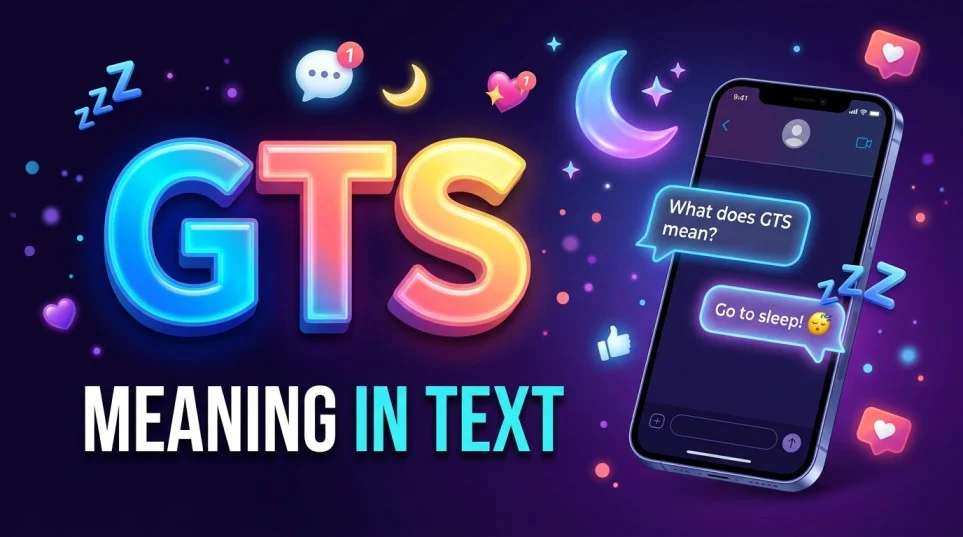
GTS usually means “Go To Sleep” in casual text messages. People use it to tell someone to get some rest, stop staying awake, or end a late-night conversation. Friends may use it playfully, while someone who cares about your well-being might use it as a gentle reminder to sleep.
For example:
Person A: “I’ve been watching videos for five hours. I can’t stop 😭”
Person B: “GTS already lol.”
In this conversation, GTS means “Go To Sleep.” The second person is joking about the first person’s late-night habits while encouraging them to rest.
However, GTS doesn’t always communicate the same intention. In some online conversations, it can mean “Google That Sh*t,” a blunt way to tell someone to search for information. It may also mean “Good Times” when someone discusses memories or enjoyable experiences.
Here are the main interpretations to remember:
| GTS meaning | How people use it | Example |
|---|---|---|
| Go To Sleep | Telling someone to get some rest | “It’s late. GTS!” |
| Going To Sleep | Informally describing a plan to sleep | “I’m exhausted, GTS now.” |
| Google That Sh*t | Telling someone to look up an answer | “You can GTS if you need the details.” |
| Good Times | Referring to enjoyable experiences or memories | “Those were GTS with the crew.” |
The table includes possible interpretations, not equally common definitions. “Go To Sleep” is the most useful meaning to consider first in ordinary bedtime conversations. The other interpretations depend more heavily on the subject and tone of the discussion.
Another important detail is that GTS doesn’t have one official meaning across every messaging app. Texting slang develops through everyday conversations, online communities, and personal habits. Some people use an abbreviation differently from others.
When the message doesn’t provide enough clues, asking the sender what they mean is perfectly reasonable.
GTS Meaning in Texting and Chat
Texting slang makes conversations faster. Instead of typing an entire sentence, people shorten familiar expressions into a few letters. GTS fits this pattern because it can communicate a simple instruction or idea without requiring a long explanation.
However, the abbreviation’s meaning depends on how the sender uses it. Let’s look at the most relevant interpretations.
GTS Means Go To Sleep
The phrase “Go To Sleep” is the primary interpretation to understand when you encounter GTS in a late-night conversation.
Friends often send it when someone complains about being tired, stays online too late, or continues chatting despite having an early morning ahead.
For example:
You: “I have an exam at 8 AM and I’m still scrolling.”
Friend: “GTS RIGHT NOW 😭”
Your friend is telling you to put your phone down and sleep. The capital letters emphasize the message, while the crying emoji can make the instruction feel humorous rather than angry.
People may use this version of GTS in several situations:
- When a friend stays awake too late.
- When someone needs rest before school or work.
- When a conversation has continued late into the night.
- When someone keeps complaining about feeling tired.
- When friends jokingly tell each other to stop scrolling.
- When a person wants to encourage someone to take a break.
The tone can change from one conversation to another. A close friend might say “GTS lol” as a joke, while a concerned family member might use the same abbreviation because they want you to rest.
The surrounding words help explain the intention.
For example, “GTS 😂 you look exhausted” sounds playful and caring. On the other hand, “GTS and stop messaging me” may sound irritated because the sender clearly wants the conversation to end.
The abbreviation itself doesn’t tell you everything. You need to consider the relationship and the full message.
GTS Can Mean Going To Sleep
Some people also use GTS informally to communicate that they’re heading to bed. In this case, the intended idea is close to “going to sleep.”
For example:
Friend: “Are you still awake?”
You: “Nah, GTS now. Talk tomorrow.”
The intended message is that you’re going to sleep and won’t continue chatting for the night.
This usage is understandable in casual conversation, but it isn’t a universally fixed expansion of GTS. The more established phrase behind the abbreviation is “Go To Sleep.” People sometimes adapt slang to fit the message they want to send.
If you want to make your meaning completely clear, you can write:
- “I’m going to sleep now.”
- “I’m heading to bed.”
- “I’m going to bed. Talk tomorrow.”
- “I’m off to sleep. Goodnight!”
These alternatives work well when the other person might not recognize GTS.
The distinction is simple: “Go To Sleep” tells someone else to sleep, while “Going To Sleep” describes your own plan. In informal texting, the same three letters may be used for either idea.
GTS Can Mean Google That Sh*t
Another possible GTS slang meaning is “Google That Sh*t.” People use this expression to tell someone to search online for an answer instead of asking them directly.
This interpretation often appears in conversations about general knowledge, instructions, definitions, or questions that a quick search could answer.
Consider this example:
Person A: “What time does the movie start?”
Person B: “GTS. The schedule is online.”
Here, the second person is suggesting that the first person look up the information.
The expression can sound blunt because it implies that the answer is easy to find. Depending on the relationship, the sender may be joking, expressing impatience, or refusing to explain something.
For instance:
Person A: “What does this abbreviation mean?”
Person B: “GTS 😂”
The laughing emoji might suggest playful teasing. Without it, the same response could feel dismissive.
Keep in mind that this expansion includes profanity in its common form. It’s informal and may be unsuitable for professional conversations or messages to people you don’t know well.
If you want to suggest a search without sounding rude, try these alternatives:
- “You can look that up online.”
- “A quick search should help.”
- “Try searching for the answer.”
- “I think there’s a guide online that explains it.”
Also, don’t assume this meaning simply because someone sends GTS. If the conversation involves bedtime, “Go To Sleep” is a much more natural interpretation.
GTS Can Mean Good Times
In certain social contexts, GTS may stand for “Good Times.” This interpretation is more dependent on the conversation than the sleep-related meaning.
Someone might use it while talking about a memorable vacation, a fun party, a school reunion, or a day spent with friends.
For example:
Friend: “Found these old pictures from our beach trip.”
You: “GTS with you guys ❤️”
The intended message is that those experiences were enjoyable.
However, the phrase “Good Times” is often written out in full or expressed through other casual wording. GTS isn’t a universally recognized replacement for it in every conversation.
The context offers the strongest clue. If the message mentions old photographs, shared experiences, or a fun event, “Good Times” may fit. If someone is talking about being exhausted at midnight, “Go To Sleep” is much more likely.
Avoid treating every possible expansion as equally common. An abbreviation can have several meanings without people using each one with the same frequency.
GTS Meaning in Messages: Real Examples
Definitions are helpful, but actual conversations make texting slang much easier to understand. The examples below show how GTS can work in different situations.
These are illustrative conversations rather than quotations from specific people. They demonstrate plausible uses, and the intended meaning still depends on the context.
Example: A Friend Tells You to Sleep
Alex: “I have to wake up in four hours.”
Jordan: “Then why are you still online?”
Alex: “One more video.”
Jordan: “GTS 😂”
Meaning: Jordan is telling Alex to go to sleep. The laughing emoji makes the message sound playful.
Example: Someone Is Complaining About Being Tired
Mia: “I literally can’t keep my eyes open.”
Sam: “GTS, girl. Get some rest.”
Meaning: Sam encourages Mia to stop chatting and sleep. The extra sentence confirms the abbreviation’s meaning.
Example: A Conversation Ends for the Night
Chris: “I’ll tell you the rest of the story tomorrow.”
Taylor: “Okay, GTS. Goodnight!”
Meaning: Taylor uses GTS as a sleep-related instruction while ending the conversation.
Example: Someone Is Staying Up Before an Exam
You: “I haven’t studied enough, so I’m staying awake all night.”
Friend: “GTS for a few hours. You’ll need rest too.”
Meaning: The friend recommends sleeping rather than continuing to study without a break.
Example: Someone Suggests an Online Search
Person A: “Where can I find the application form?”
Person B: “GTS. It’s probably on the official website.”
Meaning: The sender is telling the other person to search online. Depending on their relationship, the response may sound blunt.
Example: Friends Remember a Fun Trip
Person A: “That road trip was unforgettable.”
Person B: “GTS with the whole group!”
Meaning: In this context, GTS may refer to “Good Times.” The memory-related subject supports this interpretation.
Example: A Confusing One-Word Message
You: “I can’t believe we stayed up all night talking.”
Friend: “GTS lol.”
Meaning: The friend probably means “Go To Sleep,” but the exact intention depends on the conversation. They may be teasing you, suggesting rest, or ending the discussion.
Example: Someone Uses GTS Without Enough Context
Person A: “GTS.”
Person B: “Wait, do you mean go to sleep?”
Meaning: The second person asks for clarification because the abbreviation alone doesn’t provide enough information.
These examples reveal a useful pattern: the words around GTS usually matter more than the abbreviation itself. Look at the topic, timing, and tone before deciding what the sender intended.
How to Use GTS in a Sentence
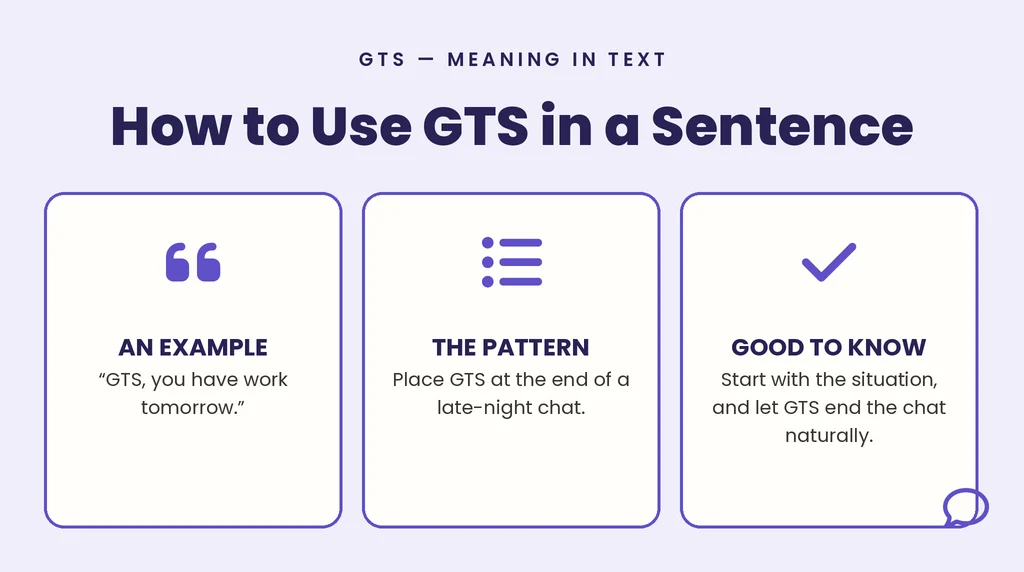
If you want to use GTS naturally, start with the situation rather than trying to force the abbreviation into every conversation.
The sleep-related meaning works best when the other person is tired, staying awake too late, or preparing to end the conversation.
Using GTS to Tell Someone to Sleep
You can place GTS at the beginning or end of a casual message.
Examples:
- “GTS, you have work tomorrow.”
- “It’s almost 3 AM. GTS already!”
- “You’ve been awake all night. GTS 😭”
- “Girl, GTS and get some rest.”
- “GTS bro, we’ll finish this tomorrow.”
- “You sound exhausted. GTS for a while.”
These messages sound natural in informal conversations between people who understand the abbreviation.
Using GTS When Ending a Conversation
You can also use GTS while telling someone that you’re going to bed, provided your meaning is clear.
Examples:
- “I’m exhausted, GTS now.”
- “GTS, talk to you tomorrow.”
- “Okay, I’m GTS. Goodnight!”
- “Long day today. GTS for me.”
- “I’m heading off now. GTS!”
Some of these expressions are more personal or informal than others. Because GTS doesn’t always mean “Going To Sleep,” a sentence such as “I’m heading to bed now” is clearer when you’re unsure if the recipient knows the slang.
Using GTS in a Playful Message
Among close friends, people often add emojis, exaggeration, or humor to make the message feel less serious.
Examples:
- “GTS before your phone becomes part of your hand 😂”
- “Bro, GTS. The sun is about to come up.”
- “GTS bestie, your alarm is going to destroy you tomorrow.”
- “You’ve watched the same video ten times. GTS 😭”
These examples work because the humor comes from the situation. The abbreviation simply shortens the instruction.
When Not to Use GTS
GTS isn’t ideal for every audience or setting. Avoid relying on it when:
- You’re sending a formal work email.
- You’re messaging someone unfamiliar with texting slang.
- You’re discussing an important or sensitive issue.
- You need to communicate a clear instruction.
- The recipient might misunderstand the intended meaning.
For example, “Please go to sleep early tonight” is clearer than “GTS” when you’re speaking to someone who doesn’t regularly use internet slang.
The goal isn’t to use as many abbreviations as possible. It’s to communicate naturally and make sure the other person understands you.
GTS Meaning on Snapchat
The GTS meaning on Snapchat depends on the conversation, just as it does in ordinary text messages. Snapchat users communicate through direct messages, group chats, and short exchanges, so informal abbreviations can fit naturally into these conversations.
If someone sends GTS after you’ve been chatting late at night, they probably mean “Go To Sleep.”
For example:
You: “I said I’d sleep an hour ago but I’m still here.”
Friend: “GTS 😂”
Your friend is joking about your inability to end the conversation and encouraging you to get some rest.
GTS can also appear in conversations that have nothing to do with bedtime. Someone might use the search-related meaning when responding to a question. In a discussion about old pictures or shared experiences, the sender might intend “Good Times.”
The platform doesn’t determine the definition on its own.
How to Interpret GTS on Snapchat
Pay attention to these clues:
- Late-night messages: The sleep-related meaning is likely.
- A question that could be searched online: The sender may intend the search-related meaning.
- A conversation about memories: “Good Times” may fit.
- Emojis and additional words: These can help reveal the sender’s tone.
Don’t assume that GTS is a secret Snapchat code or that it always carries a romantic meaning. It’s an abbreviation whose interpretation depends on the exchange.
If a Snapchat friend sends only “GTS” and you can’t work out the meaning, a simple “What do you mean?” is enough.
GTS Meaning on TikTok
The GTS meaning on TikTok can also vary with the subject of a comment or conversation. People encounter internet slang in video comments, private messages, and exchanges with friends.
For example, someone might comment on a late-night video:
“It’s 4 AM. GTS 😭”
In that situation, the person is probably telling someone to go to sleep.
However, a conversation about a funny memory or a shared experience could support a different interpretation. The surrounding words are more useful than the platform’s name.
GTS in TikTok Comments
When reading GTS in a TikTok comment, consider the content that prompted the response.
If a creator posts about staying awake all night, the sleep-related meaning makes sense. If the discussion concerns a question, the search-related interpretation might fit better.
A few practical clues can help:
- Read the full comment rather than focusing on three letters.
- Look at the video topic.
- Consider the previous replies.
- Check for wording that mentions sleep, searching, or memories.
- Avoid assigning a romantic or insulting meaning without supporting context.
GTS isn’t automatically a compliment, an insult, or a sign of attraction. Its meaning depends on how the person uses it.
GTS Meaning on Instagram
On Instagram, people may encounter GTS in direct messages, comments, group conversations, or captions. The abbreviation follows the same general patterns as other informal digital communication.
Suppose someone sends you a message at midnight:
“GTS, you have an early shift tomorrow.”
The intended meaning is clear: they want you to go to sleep.
Now consider a different conversation:
You: “I found our pictures from the concert last year.”
Friend: “GTS ❤️”
Here, the sender may mean “Good Times” because the conversation centers on a shared memory.
Understanding GTS in Instagram DMs
Direct messages often contain personal context that helps explain abbreviations. A message from a close friend may sound different from the same letters sent by someone you barely know.
Before interpreting GTS, consider:
- What you were discussing.
- What the person said immediately before it.
- The sender’s usual texting style.
- Any emojis or extra words.
- The tone of the conversation.
Don’t read too much into the abbreviation by itself. For instance, GTS doesn’t automatically mean someone wants to stop talking to you permanently. It may simply be a casual reminder to sleep.
Likewise, GTS isn’t inherently romantic. The rest of the conversation provides the information needed to interpret the message.
GTS Meaning on WhatsApp and Other Messaging Apps
The same general explanation applies to WhatsApp, iMessage, Messenger, Discord, and other messaging services.
These platforms support everyday conversations where people shorten familiar expressions to save time. GTS may appear in a private chat, a group discussion, or a late-night exchange.
For example:
Group member: “Guys, I have to wake up at 6 AM.”
Friend: “Then GTS 😂”
The meaning is “Go To Sleep.”
In a different group, someone might use the abbreviation to suggest searching for an answer. A discussion about an old vacation could support the “Good Times” interpretation.
There isn’t a universal rule that assigns a different definition to each app.
| Platform | Likely context for GTS | How to interpret it |
|---|---|---|
| Snapchat | Late-night direct messages | Often Go To Sleep |
| TikTok | Comments and casual exchanges | Depends on the video and discussion |
| DMs, comments, and shared memories | Check the message’s subject | |
| Private and group chats | Read the surrounding messages | |
| iMessage | Everyday conversations | Consider the sender’s wording |
| Discord | Casual online chats | Use the conversation topic as a clue |
This table describes possible usage patterns rather than platform-specific rules. People use slang differently, and not every user recognizes every abbreviation.
How to Reply to GTS in a Text Message
Your response should match the meaning and tone of the original message. You don’t need a clever comeback every time someone uses slang. A short, natural answer is usually enough.
How to Reply When GTS Means Go To Sleep
If a friend tells you to sleep, you can agree, joke around, or tell them you’ll go to bed soon.
| Your situation | Possible reply |
|---|---|
| You’re ready to sleep | “Okay, goodnight!” |
| You’re joking with a friend | “Fineee 😂” |
| You need a few more minutes | “In five minutes, I promise.” |
| You want to continue tomorrow | “Okay, talk tomorrow!” |
| Your friend is also staying awake | “You first lol.” |
| You’re genuinely exhausted | “You’re right. I’m going to bed.” |
These responses work because they acknowledge the message without making the exchange unnecessarily complicated.
For instance, if a friend says “GTS, you have work tomorrow,” replying “You’re right, goodnight!” communicates your intention clearly.
If you’re close friends who enjoy teasing each other, “You first 😂” may feel more natural.
How to Reply When GTS Means Google That Sh*t
If someone uses GTS to tell you to search for an answer, your response depends on their tone.
If they’re joking, you can respond casually:
- “Haha, fair enough.”
- “I was asking you, though 😂”
- “Okay, Google it is.”
- “I wanted your opinion, not a search result.”
If their response sounds dismissive, you don’t have to turn the conversation into an argument. You can simply look up the information or explain why you asked them.
For example:
You: “Do you know how this feature works?”
Friend: “GTS.”
You: “I wanted your experience with it, but I’ll look it up.”
This reply makes your intention clear without escalating the exchange.
How to Reply When GTS Means Good Times
If the conversation concerns a shared memory, respond in a way that matches the positive tone.
Examples include:
- “Those really were the best days!”
- “We need to do that again.”
- “I miss those moments ❤️”
- “Let’s plan another trip soon.”
- “That day was unforgettable.”
These replies fit a nostalgic conversation better than a response about bedtime.
How to Reply When You Don’t Understand GTS
Sometimes the sender provides no context. Rather than choosing a meaning at random, ask a short question.
You could say:
- “What do you mean by GTS?”
- “Do you mean go to sleep?”
- “Wait, which meaning?”
- “I’m not familiar with that abbreviation.”
Asking for clarification is especially useful if the message seems serious or if the sender uses slang you haven’t seen before.
The best GTS text reply is the one that fits the actual conversation. You don’t need to memorize every possible expansion to respond naturally.
GTS vs. GN vs. GTG: What’s the Difference?

GTS, GN, and GTG may appear in the same conversations, but they communicate different ideas.
GTS commonly refers to going to sleep. GN stands for “Good Night,” while GTG usually means “Got To Go.”
These abbreviations aren’t interchangeable.
| Abbreviation | Full form | Main purpose | Example |
|---|---|---|---|
| GTS | Go To Sleep | Tells someone to sleep | “It’s late. GTS!” |
| GN | Good Night | Offers a nighttime greeting or sign-off | “GN, sleep well!” |
| GTG | Got To Go | Says someone needs to leave | “GTG, my ride is here.” |
| TTYL | Talk To You Later | Suggests talking again later | “I’m busy now. TTYL.” |
| BRB | Be Right Back | Signals a temporary absence | “BRB, grabbing water.” |
GTS vs. GN
The difference between GTS and GN is straightforward.
GTS is generally an instruction to sleep, while GN is a greeting or sign-off.
For example:
“GTS, you have an early morning tomorrow.”
This tells someone to get some rest.
“GN, hope you sleep well.”
This wishes the person a good night.
You can use both in the same conversation:
Friend A: “I’m finally going to bed.”
Friend B: “Good! GTS and GN 😂”
The message tells the friend to sleep and then offers a goodnight greeting.
GTS vs. GTG
GTS and GTG differ in purpose.
GTS commonly relates to sleeping, while GTG means “Got To Go.” Someone might use GTG when leaving work, ending a conversation, or heading somewhere.
For example:
“GTG, my meeting is starting.”
The person needs to leave or stop chatting.
“GTS, you’ve been awake all night.”
The person is being told to sleep.
Although both abbreviations can appear near the end of a conversation, they don’t mean the same thing.
GTS vs. TTYL
TTYL stands for “Talk To You Later.” People use it to end a conversation while suggesting they’ll speak again.
For example:
“I’m heading out now. TTYL!”
GTS may also appear near the end of a conversation, but its main sleep-related meaning adds a different intention.
Someone might write:
“GTS now. TTYL tomorrow.”
This means the person should go to sleep and the conversation can continue the next day.
Understanding these differences helps you interpret short messages without mixing up their meanings.
Does GTS Mean Something Different From a Girl or Guy?
The GTS meaning from a girl or guy is generally the same as its meaning in other casual conversations. The abbreviation doesn’t have a separate definition based on the sender’s gender.
A girl might text “GTS” to a friend who is staying awake too late. A guy might send the same message to someone who has an early morning. In both cases, the intended meaning could be “Go To Sleep.”
For example:
Person A: “I’m still watching movies even though I have work tomorrow.”
Person B: “GTS 😭”
The message encourages the person to sleep. Nothing in the abbreviation itself makes it romantic or gender-specific.
Does GTS Mean Someone Likes You?
Not on its own.
If someone sends GTS during a late-night conversation, they may simply be encouraging you to rest. They might also be joking about your sleeping habits or trying to end the conversation for the night.
To understand their intention, consider the broader exchange.
- Do they regularly joke with you?
- Are they responding to something you said about being tired?
- Did they mention that you need rest?
- Are they ending a conversation that has gone on for hours?
- Do their other messages provide clearer clues about their feelings?
Even these clues don’t prove romantic interest. They help explain the conversation but can’t establish someone’s feelings with certainty.
The safest interpretation is the simplest one supported by the message. If someone says “GTS, you have work tomorrow,” take it as a sleep-related message unless the wider conversation suggests otherwise.
Is GTS Rude or Friendly?
GTS can sound friendly, playful, impatient, or dismissive. The abbreviation doesn’t automatically communicate a particular emotion.
Its tone depends on the wording, the situation, and the relationship between the people texting.
When GTS Sounds Friendly
A friend may use GTS because they know you’ve been awake too long.
For example:
“GTS bestie. You need your beauty sleep 😂”
The message is casual and affectionate. The extra wording and emoji make it feel playful.
A family member might also send GTS as a simple reminder to rest before a busy day.
When GTS Sounds Playful
Close friends sometimes exaggerate their messages for humor.
For example:
“GTS RIGHT NOW. The birds are literally waking up 😭”
The sender isn’t necessarily angry. They’re joking about how late the conversation has continued.
Capital letters and emojis can signal humor, although neither guarantees that the message is friendly.
When GTS Sounds Rude
GTS may feel dismissive when someone uses the search-related interpretation to shut down a question.
For example:
You: “Can you explain how this works?”
Them: “GTS. It’s not that hard.”
The wording suggests impatience. The person isn’t simply providing an answer; they’re implying that you should find it yourself.
Likewise, “GTS and stop bothering me” can sound harsh because the sender directly expresses irritation.
How to Judge the Tone Correctly
Before deciding that GTS is rude, look at the full exchange.
Ask yourself:
- Did the sender include an explanation?
- Are you close enough to joke with each other?
- Does the message fit the topic?
- Is the sender responding to something frustrating?
- Does the wording show care, humor, or impatience?
A short abbreviation can feel abrupt because it leaves out the tone of voice you’d hear in a spoken conversation.
If the message genuinely bothers you, you can ask what the person meant instead of assuming the worst.
When Should You Use GTS?
GTS works best in casual conversations where both people understand texting slang.
You might use it when a friend is staying awake too late, when you’re joking about someone’s sleep schedule, or when the conversation naturally involves getting some rest.
Good Situations for Using GTS
Consider using GTS when:
- You’re chatting with a friend who understands the abbreviation.
- Someone keeps saying they’re tired but refuses to go to bed.
- You want to end a late-night exchange playfully.
- You’re teasing a close friend about staying online.
- The context makes the sleep-related meaning obvious.
For example:
“It’s midnight and you have a 7 AM class. GTS!”
This message makes sense because the situation clearly relates to sleep.
Situations Where You Should Avoid GTS
Avoid the abbreviation when clarity matters more than brevity.
For example, a manager telling an employee to “GTS” could confuse them or sound unprofessional. A formal message should state the intended meaning directly.
Choose a clearer expression in these situations:
- Workplace emails.
- Formal announcements.
- Messages to clients or customers.
- Conversations with people unfamiliar with slang.
- Serious discussions where a joke might be misunderstood.
Instead of “GTS,” you could write “Please get some rest” or “I’m going to bed now.”
If you intend the search-related meaning, avoid the profanity-based phrase in professional settings. “You can find the information online” is more appropriate.
The guiding principle is simple: use slang when it helps the conversation, not when it makes the message harder to understand.
Can GTS Have More Than One Meaning?
Yes. GTS can have multiple interpretations, and this is common with abbreviations used in digital communication.
People often shorten phrases because they are familiar with the expressions and expect the recipient to understand them. However, different communities may use the same letters for different purposes.
The most relevant interpretations for ordinary online conversations include “Go To Sleep,” “Going To Sleep” as an informal contextual use, “Google That Sh*t,” and “Good Times.”
These meanings differ in how naturally they fit particular situations.
| Conversation topic | Possible interpretation | Why it fits |
|---|---|---|
| Staying awake too late | Go To Sleep | The message concerns bedtime |
| Ending a late-night chat | Go To Sleep or an informal reference to going to sleep | The conversation is winding down |
| Asking a searchable question | Google That Sh*t | The sender suggests looking up information |
| Remembering a fun event | Good Times | The discussion centers on enjoyable memories |
Not every expansion deserves equal attention. A phrase may be possible without being common in everyday texting.
You should also avoid assuming that a definition found in one online community applies everywhere. Slang changes with age groups, social circles, and personal habits.
When you encounter an unfamiliar abbreviation, the most reliable approach is to read the full message and identify the interpretation that best fits the conversation.
Is GTS an Acronym, Abbreviation, or Slang?
GTS is commonly described as a texting abbreviation or initialism. People use its letters as a shortened form of a longer expression.
In everyday conversation, you may hear people call it an acronym, but there is a small linguistic distinction.
An acronym is generally formed from the initial letters of a phrase and pronounced as a word, such as NASA. An initialism uses initial letters that people pronounce individually, such as FBI. An abbreviation is a broader term for a shortened form of a word or phrase.
GTS is typically read as the individual letters G, T, and S rather than as one spoken word. For that reason, initialism is a more precise linguistic label.
However, most readers searching for GTS don’t need to memorize these technical distinctions. In ordinary texting, calling it an abbreviation or slang term is perfectly understandable.
How GTS Fits Into Internet Slang
Internet slang includes shortened expressions, informal spellings, abbreviations, and phrases that become popular through digital communication.
Examples include:
- LOL: Laughing out loud.
- BRB: Be right back.
- GTG: Got to go.
- GN: Good night.
- TTYL: Talk to you later.
- GTS: Commonly go to sleep.
People use these expressions because they can communicate familiar ideas quickly. They also create a casual tone that fits conversations with friends.
However, slang isn’t a universal code. Someone who regularly chats online may understand GTS immediately, while another person may never have seen it.
That difference explains why context and clear communication remain important even in short messages.
How Context Determines the Meaning of GTS
Understanding GTS is a simple example of how people interpret language. Readers don’t always rely on the dictionary meaning of individual words. They also use the surrounding conversation to work out what the sender intends.
This process is known as contextual interpretation.
For example, consider these two messages:
“It’s nearly 3 AM. GTS.”
“Remember our road trip? GTS!”
The first message points toward “Go To Sleep.” The second may point toward “Good Times” because the conversation concerns a memory.
The letters remain the same, but the surrounding information changes the likely interpretation.
The Role of Conversation History
The previous message can be more informative than the abbreviation itself.
If someone has been discussing an early morning shift, GTS probably relates to sleep. If they have been asking about a topic they could search online, the search-related meaning becomes more plausible.
Conversation history helps people understand shortened language because it supplies information that the message leaves unstated.
The Role of Tone
Tone also influences interpretation.
Consider the difference between:
“GTS 😂”
and:
“GTS. I’m serious.”
The first may be playful, while the second sounds more direct. Neither message establishes the meaning with complete certainty, but the extra cues help the reader interpret the sender’s intention.
Emojis, punctuation, capitalization, and additional words can all provide useful clues.
Why Misunderstandings Happen
Misunderstandings occur when the sender assumes the recipient knows an abbreviation that isn’t familiar to them.
A person who regularly uses GTS to mean “Go To Sleep” may not realize that another person interprets it differently.
The sender may also omit details because the conversation feels obvious to them.
If you receive a confusing message, don’t feel pressured to guess. A short clarification can prevent a longer misunderstanding.
Common Mistakes People Make When Interpreting GTS
Although GTS is a short abbreviation, a few common mistakes can lead to incorrect interpretations.
Assuming GTS Always Means Go To Sleep
“Go To Sleep” is the primary meaning to consider in ordinary bedtime conversations, but it isn’t the only possible interpretation.
A message about searching for information may support the search-related meaning. A nostalgic conversation may support “Good Times.”
The surrounding words should guide your interpretation.
Assuming GTS Means Good Night
GTS and GN serve different purposes.
GTS commonly tells someone to sleep. GN means “Good Night” and functions as a nighttime greeting or sign-off.
A person can use both in one message, but they aren’t interchangeable.
Treating GTS as a Romantic Signal
Someone telling you to sleep doesn’t automatically mean they have romantic feelings.
They may be joking, looking out for you, or simply ending a conversation.
Consider the full relationship rather than interpreting three letters as proof of attraction.
Assuming Every Platform Uses GTS Differently
GTS doesn’t have a separate universal definition on Snapchat, TikTok, Instagram, or WhatsApp.
The same abbreviation can appear on multiple platforms with similar contextual meanings. Users and communities may develop their own habits, but those habits don’t establish a rule for everyone.
Ignoring the Sender’s Tone
A message can be friendly, impatient, or sarcastic even when the abbreviation stays the same.
Look at the full wording and the relationship between the people involved. Avoid treating the abbreviation alone as a complete statement of someone’s feelings.
Overcomplicating a Simple Message
Not every abbreviation has a hidden meaning.
If a friend texts “GTS, you have work tomorrow,” the simplest interpretation is usually the best one. There’s no need to search for a complicated explanation when the context already makes the message clear.
Frequently Asked Questions
What does GTS mean in text messages?
GTS commonly means “Go To Sleep” in casual text messages. People use it when someone stays awake too late or needs rest. In some contexts, it can mean “Google That Sh*t” or “Good Times.”
What does GTS stand for in texting?
The primary expansion to recognize is “Go To Sleep.” Other possible interpretations depend on the conversation, including a search-related expression and “Good Times.”
What does GTS mean when someone texts you?
When someone texts you GTS, check the surrounding messages. If you’re discussing sleep or chatting late at night, they probably mean “Go To Sleep.” If the conversation concerns a question or a shared memory, another interpretation may fit.
What does GTS mean from a girl?
GTS doesn’t have a special meaning based on the sender’s gender. A girl may use it to tell someone to sleep, joke about staying awake too late, or communicate another context-dependent meaning.
What does GTS mean from a guy?
The meaning is generally the same when a guy sends it. In a late-night conversation, it commonly means “Go To Sleep.” The abbreviation alone doesn’t prove that the sender is flirting, annoyed, or romantically interested.
What does GTS mean on Snapchat?
On Snapchat, GTS commonly refers to “Go To Sleep” in bedtime-related conversations. However, the intended meaning depends on the message, and the platform doesn’t guarantee a particular definition.
What does GTS mean on TikTok?
GTS may appear in TikTok comments or casual conversations. If the discussion involves someone staying awake late, it likely means “Go To Sleep.” Other meanings are possible when the subject supports them.
What does GTS mean on Instagram?
On Instagram, GTS can appear in direct messages, comments, and informal conversations. The sleep-related interpretation is useful in late-night exchanges, while a discussion about memories may support “Good Times.”
Does GTS mean Go To Sleep or Going To Sleep?
“Go To Sleep” is the primary expansion. Some people use GTS informally to communicate that they’re going to sleep, but this is a context-dependent use rather than a universally fixed definition.
Is GTS the same as GN?
No. GTS commonly means “Go To Sleep,” while GN means “Good Night.” GTS tells someone to sleep, whereas GN is a greeting or sign-off.
What is the difference between GTS and GTG?
GTS usually relates to sleep. GTG stands for “Got To Go” and tells someone that the sender needs to leave or stop chatting.
Is GTS rude?
Not necessarily. GTS can sound caring or playful when a friend encourages you to rest. It may feel dismissive when someone uses the search-related meaning to shut down a question. The full conversation determines the tone.
How do you respond to GTS in a text?
If someone means “Go To Sleep,” you can reply, “Okay, goodnight!” or “In a minute 😂.” If you’re unsure what they mean, ask, “What do you mean by GTS?”
Is GTS an acronym or slang?
GTS is commonly described as a texting abbreviation or slang term. More precisely, it functions as an initialism because people usually pronounce the individual letters rather than reading them as one word.
What does GTS mean at the end of a conversation?
At the end of a late-night conversation, GTS usually means “Go To Sleep” or signals that sleep is the next step. However, the sender’s wording and the preceding messages provide the best clues.
Final Thoughts
The GTS meaning in text is usually “Go To Sleep,” particularly when friends discuss being tired, staying awake late, or ending a conversation for the night. It’s a quick, informal way to tell someone to get some rest.
However, GTS can have other meanings in specific contexts. “Google That Sh*t” may appear when someone suggests searching for an answer, while “Good Times” may fit a conversation about enjoyable memories. These interpretations aren’t equally common, so don’t assume every expansion is equally likely.
Remember that GTS isn’t inherently rude, romantic, or friendly. The sender’s wording, the conversation topic, and your relationship all help establish the intended meaning.
When you receive GTS, read the surrounding messages before responding. If the meaning remains unclear, simply ask. A quick question is often better than a confident guess.