Have you ever received a text that says “ISTG, I’m telling the truth” and wondered what those four letters really mean? You’re not alone. Internet slang changes quickly, and even a short abbreviation can carry several emotions depending on who’s using it and what’s happening in the conversation.
ISTG stands for “I Swear to God.” People use it in text messages, social media comments, and online chats to emphasize honesty, express frustration, show surprise, or make a statement sound more serious. Sometimes it signals genuine annoyance. Other times, it’s simply a playful way to react to something funny or unbelievable.
Understanding the ISTG meaning in text requires more than memorizing its full form. The surrounding words, punctuation, emojis, and relationship between the people chatting all help reveal the intended tone. This guide explains the abbreviation, explores realistic examples, compares it with similar slang, and shows you how to use or respond to it naturally.
What Does ISTG Mean in Text?
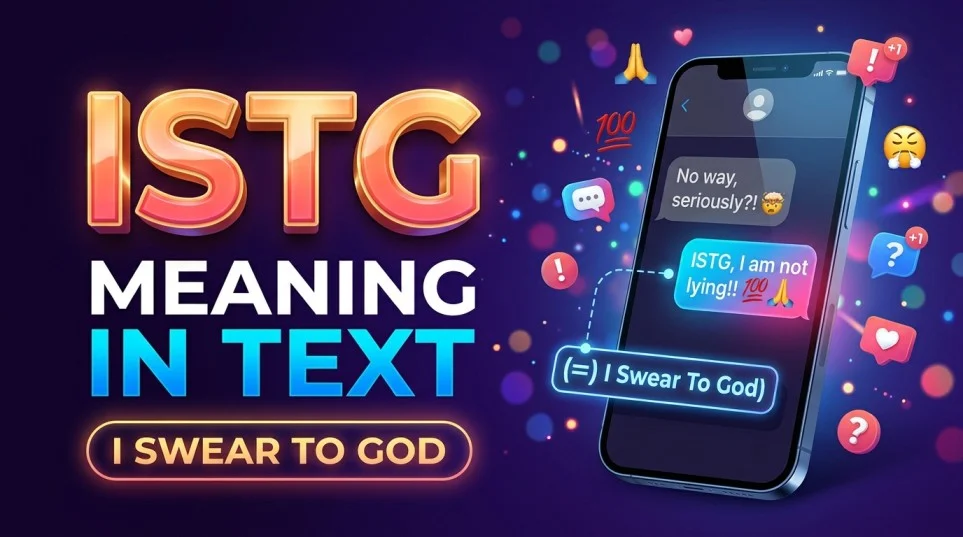
ISTG means “I Swear to God.” It’s a common texting abbreviation that people use to emphasize what they’re saying. Depending on the situation, it can communicate honesty, frustration, surprise, disbelief, or a strong promise.
For example:
“ISTG, I didn’t eat your leftovers.”
In this message, the sender uses ISTG to stress that they’re telling the truth. They may feel accused and want the other person to believe them.
Now consider a different example:
“ISTG, this traffic is never going to end.”
Here, the sender isn’t necessarily making a promise or swearing about a factual claim. They’re expressing frustration and exaggerating how bad the traffic feels.
The same abbreviation can communicate different emotions because ISTG adds emphasis rather than one fixed emotional meaning.
What Does ISTG Stand For?
Each letter in ISTG represents part of the phrase “I Swear to God.”
| Letter | Word | Meaning |
|---|---|---|
| I | I | The person making the statement |
| S | Swear | To make a strong claim or solemn assertion |
| T | To | Connects the expression |
| G | God | Refers to God in the original phrase |
The complete expression is an established phrase in English. ISTG simply shortens it for quick digital communication.
People often type the abbreviation because it’s faster than writing the full phrase. It also fits naturally into casual messages, where short expressions and acronyms are common.
What Is the ISTG Definition in Simple English?
In simple English, ISTG means “I’m serious,” “I promise,” or “I’m telling the truth,” depending on context.
These alternatives aren’t exact replacements in every situation. Instead, they help explain what the sender wants to communicate.
Consider these examples:
- “ISTG, I left your keys on the table.” Meaning: I’m telling the truth.
- “ISTG, I’ll call you after class.” Meaning: I promise I’ll call.
- “ISTG, that movie was amazing.” Meaning: I’m emphasizing how much I liked it.
- “ISTG, stop making that noise.” Meaning: I’m getting annoyed.
- “ISTG, you scared me!” Meaning: I’m reacting strongly to something surprising.
Notice how the emotional meaning changes while the abbreviation stays the same.
Is ISTG an Acronym or an Abbreviation?
ISTG is commonly described as a texting abbreviation or initialism. More precisely, it’s an initialism because people form it from the first letters of a phrase and generally read the letters individually rather than pronouncing them as one word.
In everyday articles about texting slang, you’ll also see it called an acronym. That broader usage is common, although initialism is the more precise linguistic term.
You don’t need to worry about the technical distinction when using ISTG in a message. Both terms can help readers understand how the expression works.
Why Do People Use ISTG in Text Messages?
People use ISTG because ordinary statements don’t always communicate how strongly they feel. A simple “I’m telling the truth” might sound neutral, while “ISTG, I’m telling the truth” adds urgency and emotional weight.
The abbreviation also fits the fast pace of digital conversations. Instead of typing a long explanation, someone can add ISTG to show that a statement matters to them.
Here are the most common reasons people use it.
To Emphasize Honesty
Imagine your friend thinks you canceled your plans on purpose. You want to explain that your car wouldn’t start, but they aren’t convinced.
You might text:
“ISTG, my car wouldn’t start. I wasn’t making excuses.”
The abbreviation emphasizes sincerity. It signals that you want the other person to take your explanation seriously.
However, using ISTG doesn’t prove that someone is telling the truth. It’s simply a way to express confidence in a statement.
To Express Frustration or Annoyance
Sometimes people use ISTG when they’re tired of dealing with the same problem.
For example:
“ISTG, my laptop freezes every time I open this file.”
The sender is probably frustrated with the laptop rather than angry at the person receiving the message.
Another example:
“ISTG, I’ve explained this three times already.”
This version can sound more confrontational because it suggests the sender has lost patience.
The difference matters. When ISTG appears in a complaint directed at another person, it can sound sharper than when someone complains about a broken device or a difficult situation.
To Show Surprise or Disbelief
ISTG can also introduce a reaction to something unexpected.
For example:
“ISTG, that was the funniest thing I’ve seen all week.”
Or:
“ISTG, he actually showed up wearing that outfit.”
The sender uses the phrase to make the reaction more dramatic. Depending on the situation, the tone could be excited, amused, shocked, or disapproving.
To Make a Promise
When someone wants to reassure another person, ISTG can make a promise sound more emphatic.
“ISTG, I’ll return your book tomorrow.”
This communicates a strong intention to follow through. Still, the abbreviation doesn’t guarantee that the promise will be kept.
In a serious situation, a direct statement such as “I promise I’ll return it tomorrow” may sound more thoughtful and reliable.
To Make a Joke or Exaggerate
ISTG often appears in humorous messages where the sender wants to exaggerate an everyday experience.
“ISTG, my alarm clock is my biggest enemy.”
Nobody is claiming that an alarm clock is literally an enemy. The phrase adds dramatic emphasis to a familiar annoyance.
Similarly:
“ISTG, this dog has more attitude than the entire family.”
The sender is using exaggeration to make the observation funnier. An emoji or laughing response may make that playful tone even clearer.
ISTG Meaning in Different Contexts
The easiest way to understand ISTG is to examine the entire message rather than the abbreviation alone. A few surrounding words can completely change how it sounds.
| Context | Example | Likely meaning |
|---|---|---|
| Honesty | “ISTG, I didn’t touch it.” | I’m telling the truth. |
| Frustration | “ISTG, this printer hates me.” | I’m extremely annoyed. |
| Surprise | “ISTG, you won the whole thing?” | I can hardly believe it. |
| Excitement | “ISTG, that concert was incredible!” | I’m emphasizing how great it was. |
| Promise | “ISTG, I’ll be there by six.” | I’m making a strong commitment. |
| Humor | “ISTG, Mondays should be illegal.” | I’m joking about disliking Mondays. |
| Disagreement | “ISTG, that’s not what I said.” | I’m strongly defending my position. |
| Relief | “ISTG, I thought I’d lost my wallet.” | I’m emphasizing how worried I was. |
These interpretations are common conversational possibilities, not rigid rules. Two people can use the same sentence differently because their relationships, personalities, and previous conversations differ.
ISTG When Someone Is Angry
When someone uses ISTG during an argument, the phrase often adds intensity to their words.
Consider this exchange:
Alex: You told everyone what I said.
Jordan: ISTG, I didn’t tell anyone.
Jordan is emphasizing the denial. Depending on the previous conversation, the message might reflect genuine hurt, defensiveness, or anger.
Now compare it with:
“ISTG, this game keeps crashing right before I win.”
Here, the frustration is directed at the game rather than another person.
To interpret the tone accurately, look at what the sender is reacting to. A complaint about a situation usually feels different from a forceful denial during an argument.
If the message seems tense, avoid assuming that the sender wants to fight. A calm question such as “What happened?” can help clarify the situation.
ISTG in Friendly Conversations
Among friends, ISTG can sound relaxed, funny, or affectionate.
For example:
Mia: I ate the whole pizza by myself.
Sam: ISTG, you were supposed to save me a slice 😂
Sam is probably teasing Mia rather than expressing serious anger.
Friends often rely on shared jokes and familiar habits to communicate tone. A phrase that sounds harsh between strangers may feel completely ordinary between close friends.
Still, friendship doesn’t make every message harmless. If someone repeatedly uses ISTG while expressing genuine frustration, it’s worth paying attention to the actual words rather than assuming they’re joking.
ISTG in Romantic Messages
ISTG can appear in conversations between romantic partners, people who are dating, or people who are getting to know each other.
For example:
“ISTG, talking to you makes my day better.”
Here, the sender emphasizes a positive feeling. The expression adds enthusiasm but doesn’t automatically make the message romantic.
Consider another message:
“ISTG, I wasn’t ignoring you. I fell asleep.”
This version emphasizes an explanation. The sender may want to reassure their partner or clear up a misunderstanding.
ISTG can therefore appear in affectionate messages, disagreements, apologies, and ordinary conversations. The abbreviation itself doesn’t reveal how deeply someone feels or whether they’re romantically interested. The rest of the conversation provides better clues.
ISTG in Group Chats
Group chats often move quickly, with several people responding to the same joke, story, or disagreement.
In these conversations, ISTG can serve as a quick reaction:
- “ISTG, you guys are impossible 😂”
- “ISTG, nobody told me the meeting moved.”
- “ISTG, that final score is unbelievable.”
- “ISTG, someone needs to explain what just happened.”
The first message might be playful. The second sounds frustrated. The third communicates surprise, while the fourth asks for clarification with strong emphasis.
Because several people may read the message at once, punctuation and wording can affect how everyone interprets it. A joking message without context might seem more serious than the sender intended.
ISTG in Memes and Online Comments
Internet memes often use exaggerated language to make familiar situations more entertaining. ISTG works well in this format because it communicates a strong reaction in only four letters.
Examples include:
“ISTG, my phone battery drops from 20% to 1% in two seconds.”
“ISTG, the main character has absolutely no common sense.”
“ISTG, every time I clean my room, it gets messy again.”
These statements usually express frustration or amusement. The exaggerated wording signals that the writer wants readers to recognize a shared experience.
In online comments, ISTG may also introduce an emphatic opinion:
“ISTG, this is the best scene in the entire series.”
The writer wants to make their enthusiasm clear. Readers may agree, disagree, or respond with their own exaggerated reactions.
ISTG Meaning on Snapchat, TikTok, Instagram, and WhatsApp
The ISTG meaning on social media generally remains “I Swear to God.” The platform doesn’t change the abbreviation’s basic definition, but the type of conversation can influence its tone.
A private message between close friends may feel different from a public comment under a video. The audience and subject matter matter more than the app itself.
What Does ISTG Mean on Snapchat?
On Snapchat, people may use ISTG in direct messages, replies to snaps, and casual conversations with friends.
Examples:
- “ISTG, that snap made me laugh so hard.”
- “ISTG, I sent you the picture already.”
- “ISTG, you look completely different with that haircut.”
- “ISTG, I thought you were coming today.”
The first example expresses amusement. The second emphasizes a claim, while the third could be a compliment or a joke depending on the relationship. The final message may communicate surprise or disappointment.
Snapchat messages often depend on shared context. If someone sends only “ISTG” after seeing a picture or reading a message, you may need the preceding exchange to understand the intended meaning.
For instance, after a friend shares an embarrassing photo, “ISTG 😂” could mean the sender finds it hilarious. After an argument, the same letters might introduce a serious complaint.
What Does ISTG Mean on TikTok?
TikTok users may write ISTG in video comments, captions, replies, and messages about content they find funny, frustrating, surprising, or impressive.
Examples include:
- “ISTG, this trend is everywhere.”
- “ISTG, the ending caught me completely off guard.”
- “ISTG, this creator never misses.”
- “ISTG, I watched this ten times.”
In these examples, the abbreviation adds emphasis to the user’s reaction. The comment may be enthusiastic, critical, or humorous.
TikTok humor often relies on exaggeration and shared references. A dramatic statement about a small inconvenience may be intended as comedy rather than a literal complaint.
However, the platform doesn’t give ISTG a separate official meaning. A viewer should interpret the full comment and the surrounding discussion instead of assuming that every use is positive or negative.
What Does ISTG Mean on Instagram?
On Instagram, ISTG appears naturally in direct messages, comments, Stories, and reactions to posts.
For example:
“ISTG, this photo came out better than I expected.”
This expresses excitement or satisfaction.
Another example:
“ISTG, you post the best food pictures.”
Here, the sender emphasizes a compliment.
A different message may sound less friendly:
“ISTG, you keep changing the plans at the last minute.”
This communicates annoyance about repeated behavior.
Instagram conversations can be public or private, so the same expression may serve different purposes. A playful comment among friends isn’t necessarily equivalent to a serious message about a disagreement.
What Does ISTG Mean on WhatsApp?
On WhatsApp, ISTG may appear in individual chats, family groups, class groups, and conversations with coworkers or friends.
Examples:
- “ISTG, I left the keys near the door.”
- “ISTG, the bus is running late again.”
- “ISTG, I’ll send the assignment tonight.”
- “ISTG, that family group never stays quiet.”
The abbreviation is especially easy to use when people want to respond quickly without typing a complete sentence.
Still, casual language isn’t appropriate for every WhatsApp conversation. If you’re messaging a teacher, client, manager, or someone you don’t know well, writing “I promise” or “I’m telling the truth” may communicate your meaning more clearly.
Does ISTG Mean Something Different on Each Platform?
No. The core expansion stays the same across Snapchat, TikTok, Instagram, and WhatsApp.
The apparent differences usually come from the context.
| Platform | Common setting | Possible tone |
|---|---|---|
| Snapchat | Messages and snap replies | Casual, playful, frustrated |
| TikTok | Comments and video reactions | Humorous, enthusiastic, critical |
| DMs, Stories, and comments | Friendly, complimentary, serious | |
| Personal and group chats | Practical, emotional, conversational | |
| Gaming chats | Team messages and live reactions | Frustrated, excited, emphatic |
These are examples of typical contexts, not exclusive platform rules. Any of these tones can occur on any of the platforms listed.
What Does ISTG Mean From a Girl or Guy?
When someone texts you ISTG, it’s natural to wonder why they chose that phrase. You might even question whether it means something different when a girl or a guy uses it.
The short answer is that ISTG has the same basic meaning regardless of the sender’s gender. It stands for “I Swear to God.” The sender may be expressing honesty, frustration, surprise, humor, or excitement.
What changes is the situation, not the definition.
What Does ISTG Mean From a Girl in a Text?
If a girl sends you ISTG, she might be emphasizing something she believes, reacting to a funny situation, or expressing annoyance.
For example:
“ISTG, I didn’t know you were coming.”
She may genuinely be surprised. The message doesn’t necessarily suggest anger or disappointment.
Another example:
“ISTG, you’re so funny 😂”
This is likely a playful compliment. She may be laughing at something you said or simply emphasizing how amusing she finds you.
Consider a third example:
“ISTG, I’ve been waiting for you for an hour.”
This sounds frustrated because the message refers to a delay and a long wait.
To understand what she means, consider three things:
- The actual words: Is she making a claim, giving a compliment, or complaining?
- The conversation before it: Did something funny happen, or are you discussing a serious issue?
- Her usual communication style: Does she regularly use dramatic slang, or does she normally write more formally?
These clues provide more useful information than the abbreviation alone.
What Does ISTG Mean From a Guy in a Message?
A guy may use ISTG to emphasize a statement, express disbelief, or react to something that bothers him.
For example:
“ISTG, that was the best match I’ve ever played.”
This sounds enthusiastic. The sender is emphasizing how much he enjoyed the match.
Another example:
“ISTG, I wasn’t trying to ignore you.”
Here, he may be explaining his behavior and trying to reassure the other person.
Or he might write:
“ISTG, stop sending me spoilers.”
This sounds irritated, although the seriousness depends on the relationship and the conversation.
As with anyone else, a guy’s use of ISTG doesn’t automatically indicate attraction, anger, or dishonesty. Read the message as a whole before drawing conclusions.
Does ISTG Mean Someone Is Flirting With You?
No, ISTG isn’t inherently a flirting term. It can appear in flirtatious messages, but the abbreviation itself doesn’t communicate romantic interest.
Compare these examples:
| Message | Likely interpretation |
|---|---|
| “ISTG, you’re making me laugh so much.” | Friendly or flirtatious, depending on context |
| “ISTG, you look amazing tonight.” | A compliment that may be flirtatious |
| “ISTG, I didn’t see your message.” | An explanation |
| “ISTG, stop teasing me 😂” | Playful or mildly annoyed |
| “ISTG, you never listen to me.” | Frustration or conflict |
A compliment, teasing, or warm conversation may suggest flirting when considered alongside other behavior. However, one abbreviation can’t establish someone’s intentions.
If you’re unsure, pay attention to the broader pattern of communication. Consistent interest, thoughtful questions, and the way someone treats you provide better clues than a single text.
What Does ISTG Mean in a Relationship?
In a relationship, ISTG can help emphasize a promise, explain a misunderstanding, or express a strong emotion.
For example:
“ISTG, I wasn’t talking to anyone else.”
This is a forceful denial. The sender may be trying to reassure their partner, especially if the conversation involves trust.
Another example:
“ISTG, you make even the worst days better.”
This sounds affectionate and emphasizes a positive feeling.
However, a strong expression doesn’t automatically resolve a disagreement. If trust is an issue, consistent actions and honest communication matter more than emphatic wording.
In a serious relationship conversation, it’s often better to explain what happened clearly rather than relying on ISTG to convince the other person.
How to Reply When Someone Texts ISTG
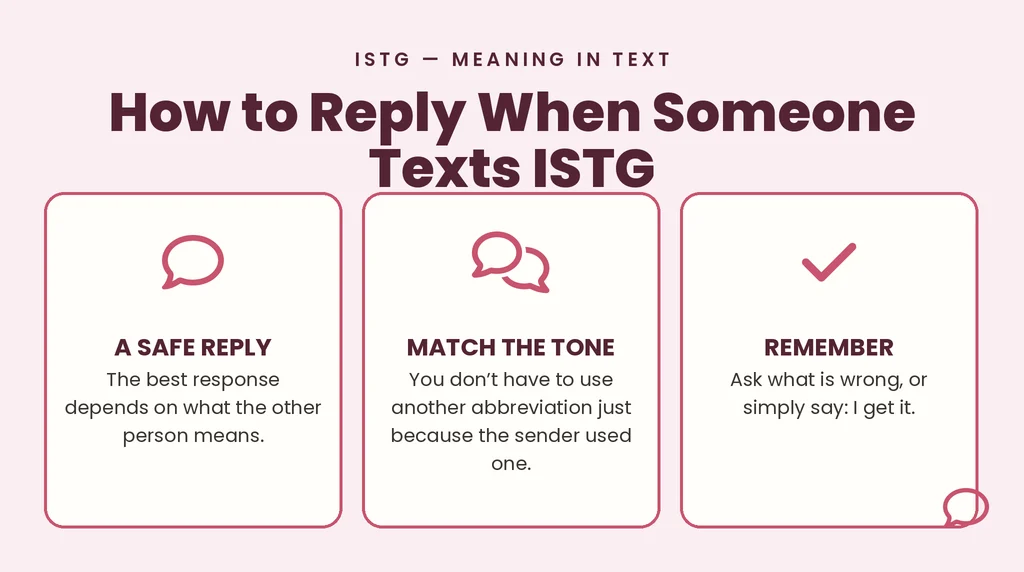
The best response depends on what the other person means. Sometimes you can reply with a joke. Other times, a calm question or direct answer makes more sense.
You don’t have to use another abbreviation just because the sender used one.
How to Reply to ISTG When Someone Is Being Serious
Suppose someone writes:
“ISTG, I didn’t tell anyone your secret.”
If the conversation is serious, a thoughtful response is usually better than sarcasm.
Possible replies include:
- “Okay, I hear you.”
- “Thanks for explaining.”
- “I want to believe you. Can we talk about what happened?”
- “I understand. Let’s clear this up.”
- “All right, I appreciate you being honest with me.”
Choose a reply that reflects what you actually feel. You don’t need to pretend you believe something if you’re still uncertain.
How to Reply When Someone Uses ISTG as a Joke
If the sender is clearly joking, a playful response can keep the conversation flowing.
Example:
Friend: ISTG, my dog thinks he’s the owner of this house.
You: He probably pays more attention to the bills than you do 😂
Other natural responses include:
- “Honestly, I believe it.”
- “That’s actually hilarious.”
- “Your dog runs the whole place.”
- “I’m not even surprised anymore.”
- “Please tell me there’s a picture.”
Humor works best when you understand the joke and know the other person is comfortable with that style of conversation.
How to Reply When Someone Is Frustrated
If someone says:
“ISTG, this assignment is impossible.”
They may want to vent rather than receive a lecture about time management.
You could respond:
- “What’s giving you the most trouble?”
- “I get it. This assignment looks rough.”
- “Want to work through it together?”
- “Take a break for a minute. Then we can try again.”
- “Which part is causing the problem?”
These replies acknowledge the emotion and open the door to a useful conversation.
If the frustration is directed at you, focus on understanding the complaint before responding defensively.
For example, if someone says, “ISTG, you never tell me when plans change,” you might reply, “You’re right that I should have told you sooner. I’m sorry.”
A direct response can do more to repair a misunderstanding than arguing about the abbreviation.
How to Reply When Someone Uses ISTG to Make a Promise
Suppose your friend texts:
“ISTG, I’ll bring your notes tomorrow.”
You could respond:
- “Thanks, I appreciate it.”
- “Sounds good!”
- “Perfect. I’ll see you tomorrow.”
- “Okay, I’ll remind you in the morning 😂”
- “Great, I really need them.”
If the promise concerns something important, you can acknowledge it without treating the abbreviation as a guarantee.
For example, if the notes are needed for an exam, it makes sense to arrange a backup plan if missing them would create a problem.
How to Reply to a One-Word ISTG Message
A standalone “ISTG” can be confusing because the sender hasn’t explained what they’re reacting to.
Your response should depend on the preceding exchange.
| Previous situation | Possible reply |
|---|---|
| You shared a funny story | “What happened next? 😂” |
| You made a surprising claim | “I know, it’s wild.” |
| You disagreed about something | “Which part do you mean?” |
| The sender seems upset | “Are you okay? What happened?” |
| You made a joke | “You know I’m kidding, right?” |
| The context is unclear | “Wait, what do you mean?” |
If you genuinely don’t understand, ask. Guessing the sender’s mood can create unnecessary confusion.
ISTG Examples in Texting and Everyday Conversation
Examples make the ISTG meaning easier to understand because they show how the abbreviation works in natural sentences.
The following examples cover common situations, from casual chats to promises and disagreements.
Everyday ISTG Text Examples
Example: Talking about school
“ISTG, that math test was harder than the homework.”
Meaning: The sender is emphasizing how difficult the test felt.
Example: Making plans
“ISTG, I’ll be there in ten minutes.”
Meaning: The sender is strongly emphasizing their intention to arrive soon.
Example: Talking about food
“ISTG, this burger is the best thing I’ve eaten all week.”
Meaning: The sender is emphasizing how much they enjoyed the burger.
Example: Losing something
“ISTG, I just had my headphones five minutes ago.”
Meaning: The sender is expressing frustration or disbelief about losing the headphones.
Example: Watching a movie
“ISTG, I did not expect that ending.”
Meaning: The ending genuinely surprised the sender, or they want to emphasize how unexpected it was.
Funny ISTG Examples
Humor is one of the easiest ways to recognize ISTG’s role as an intensifier.
- “ISTG, my bed gets ten times more comfortable when I need to get up.”
- “ISTG, my phone knows when I’m about to fall asleep and starts ringing.”
- “ISTG, I clean my room just to mess it up again.”
- “ISTG, my pet has a better social life than I do.”
- “ISTG, the weekend lasts approximately twelve minutes.”
- “ISTG, I open the fridge like something new is going to appear.”
- “ISTG, my brain remembers every embarrassing thing I’ve done since 2012.”
These examples use exaggeration for comic effect. Nobody expects the statements to be literal descriptions of reality.
ISTG Examples in Serious Conversations
ISTG can also appear when someone wants to emphasize a claim that matters to them.
Example: Clearing up a misunderstanding
Taylor: Did you tell Morgan about the surprise?
Casey: ISTG, I didn’t tell anyone.
Taylor: Okay. I just wanted to check.
Here, ISTG emphasizes Casey’s denial.
Example: Explaining a delay
Avery: Why aren’t you here yet?
Riley: ISTG, the train stopped between stations.
Avery: All right. Let me know when it starts moving.
The phrase adds emphasis to Riley’s explanation. It doesn’t necessarily mean Riley is angry.
Example: Making a commitment
Jamie: Can you send me the document before noon?
Alex: ISTG, I’ll send it before the meeting.
Alex is emphasizing a commitment. In a professional situation, however, a straightforward “Yes, I’ll send it before the meeting” would usually sound more appropriate.
ISTG in a Friendly Conversation
Maya: I accidentally wore two different shoes to class.
Lena: ISTG, how did nobody notice? 😂
Maya’s mistake is the subject of the conversation. Lena’s response expresses amusement and surprise.
A similar exchange could involve a shared memory:
Chris: Remember when we got lost trying to find that restaurant?
Jordan: ISTG, we walked in circles for an hour.
The phrase emphasizes how ridiculous the experience felt in hindsight.
ISTG in an Argument
Sam: You said you’d call me back.
Lee: ISTG, I got caught up at work and forgot.
Sam: I wish you’d just let me know next time.
Lee uses ISTG to emphasize the explanation. Sam responds by describing what they need going forward.
Notice that the conversation can remain constructive even when the abbreviation appears in a tense exchange. The important part is how both people address the issue.
ISTG in a Text Message With Emojis
Emojis often provide clues about the intended tone, although they don’t guarantee how a message will be received.
| Message | Possible tone |
|---|---|
| “ISTG 😂” | Amusement or playful disbelief |
| “ISTG 😭” | Exaggerated frustration, laughter, or emotional overwhelm |
| “ISTG 🙄” | Annoyance or disbelief |
| “ISTG ❤️” | Emphasis within an affectionate exchange |
| “ISTG 😤” | Frustration or determination |
| “ISTG 😳” | Surprise or embarrassment |
The same emoji can have different meanings across conversations. For example, a crying emoji can represent sadness, laughter, or mock despair.
Use the surrounding text to decide which interpretation fits best.
ISTG vs. Similar Texting Abbreviations
ISTG belongs to a larger group of informal expressions that people use to emphasize honesty, seriousness, or emotion. Some have overlapping meanings, but they aren’t interchangeable in every sentence.
Understanding the differences helps you choose the right expression.
ISTG vs. FR
FR means “for real.” People use it to express agreement, sincerity, or disbelief.
Examples:
- ISTG, this movie is incredible.
- FR, this movie is incredible.
The first sentence emphasizes the speaker’s strong reaction. The second can communicate a sincere opinion or invite agreement.
Consider another exchange:
Friend A: This homework is exhausting.
Friend B: FR.
Here, FR means something like “I agree” or “That’s true.” ISTG wouldn’t serve exactly the same function without changing the sentence.
ISTG vs. NGL
NGL stands for “not gonna lie.” It commonly introduces an honest opinion or a candid admission.
For example:
“NGL, I didn’t enjoy the movie.”
The speaker presents an honest opinion, perhaps one that differs from what others expect.
Compare that with:
“ISTG, I didn’t enjoy the movie.”
This sounds more emphatic. The speaker is stressing the strength of the claim rather than simply introducing an honest opinion.
The difference is subtle, but it matters in conversation.
ISTG vs. TBH
TBH means “to be honest.” It often introduces an opinion or personal feeling.
Example:
“TBH, I prefer the older version.”
The sender is giving a candid preference.
Now compare:
“ISTG, the older version was better.”
This places stronger emphasis on the opinion. Depending on the context, it may sound passionate, frustrated, or insistent.
TBH often signals openness, while ISTG tends to intensify the statement.
ISTG vs. OMG
OMG stands for “Oh My God.” People commonly use it to express surprise, excitement, disbelief, or alarm.
For example:
“OMG, you won!”
This communicates surprise or excitement.
By comparison:
“ISTG, you actually won!”
This can express disbelief while emphasizing the speaker’s reaction.
Although both expressions contain a reference to God, they have different conversational functions. OMG is usually an exclamation, while ISTG often emphasizes a claim or strong reaction.
ISTG vs. ONG
ONG commonly stands for “On God.” In informal online communication, it can emphasize sincerity or agreement.
For example:
“ONG, that was the best concert ever.”
The sender is strongly emphasizing their opinion.
Compare:
“ISTG, that was the best concert ever.”
Both messages express a strong reaction. However, ONG and ISTG come from different expressions and may carry slightly different conversational styles depending on the speaker and community.
Neither abbreviation has exactly the same tone in every situation.
ISTG vs. “I Swear”
“I swear” is the shorter, unabridged phrase from which the longer expression “I swear to God” is formed.
For example:
- “I swear, I didn’t take it.”
- “ISTG, I didn’t take it.”
Both can emphasize honesty. The second is more typical of casual digital shorthand, while the first works in both speech and writing.
“I swear” can also sound serious or confrontational depending on the words that follow it.
ISTG vs. “No Cap”
“No cap” is informal slang meaning roughly “no lie” or “I’m being genuine.”
Example:
“No cap, that was the best meal I’ve had all month.”
The sender emphasizes that the opinion is sincere.
Now compare:
“ISTG, that was the best meal I’ve had all month.”
The overall message is similar, but ISTG can sound more emotionally intense or dramatic.
ISTG vs. “Deadass”
“Deadass” is informal slang used to emphasize seriousness, truth, or a strong opinion. Its exact tone depends on the speaker and context.
For example:
“I’m deadass serious about this.”
This directly emphasizes seriousness.
By contrast:
“ISTG, I’m serious about this.”
Both stress the speaker’s sincerity, but ISTG includes the original religious expression.
Deadass is highly casual and may sound inappropriate in formal settings. ISTG is also informal and deserves similar caution in professional communication.
Quick Comparison of ISTG and Related Slang
| Expression | Full form or meaning | Main conversational purpose |
|---|---|---|
| ISTG | I Swear to God | Strong emphasis, sincerity, or emotion |
| FR | For Real | Agreement, sincerity, or disbelief |
| NGL | Not Gonna Lie | Introducing a candid statement |
| TBH | To Be Honest | Sharing an honest opinion |
| OMG | Oh My God | Surprise, excitement, or alarm |
| ONG | On God | Emphasis or sincerity |
| No cap | No lie; genuinely | Emphasizing truth |
| Deadass | Seriously; genuinely | Strong emphasis |
| I promise | A direct assurance | Expressing commitment |
| Literally | In the exact sense, or as an informal intensifier | Emphasizing a statement |
The best choice depends on what you want to communicate. If you’re making a promise, “I promise” may be clearer. If you’re agreeing with a friend, FR might fit better. You’re emphasizing a strong reaction, ISTG may feel more natural.
Is ISTG a Bad Word? Is It Rude or Offensive?
ISTG is generally considered informal slang rather than a conventional swear word. However, its full form contains the word “swear” and refers to God, so some people may find it inappropriate or offensive.
Whether ISTG is rude depends on the wording, audience, and situation. The abbreviation isn’t automatically insulting, but it can sound aggressive when someone uses it during an argument.
Is ISTG Considered Profanity?
The word swear has several meanings in English. It can refer to making a solemn promise, but it can also refer to using offensive language.
In “I Swear to God,” the phrase usually emphasizes the seriousness of a statement. It doesn’t automatically function as an insult or a conventional curse word.
Nevertheless, people have different beliefs and communication preferences. Some consider casual references to God disrespectful, especially when someone uses the phrase carelessly or repeatedly.
If you don’t know how the recipient feels about religious expressions, a neutral alternative is often the safer choice.
When Can ISTG Sound Rude?
ISTG may sound rude when someone uses it to express impatience, dismiss another person’s concerns, or emphasize an angry accusation.
Consider these examples:
- “ISTG, how many times do I have to explain this?”
- “ISTG, you’re not listening to anything I say.”
- “ISTG, stop asking me the same question.”
Each message can sound confrontational because the wording suggests irritation.
Compare them with:
- “ISTG, that was the funniest video ever.”
- “ISTG, I thought I lost my phone.”
- “ISTG, this cake tastes amazing.”
These messages can communicate humor, surprise, or excitement without insulting anyone.
The difference lies in the surrounding words and the emotional situation, not the abbreviation alone.
Is ISTG Appropriate for Work or School?
ISTG usually fits casual communication better than formal writing.
You might use it with a close friend from class, but it generally isn’t the best choice in an email to a teacher or a message to a supervisor.
For example, instead of writing:
“ISTG, I sent the assignment yesterday.”
You could write:
“I sent the assignment yesterday. Please let me know if it didn’t come through.”
The second message communicates the information clearly without sounding defensive.
In professional communication, it’s usually better to explain the facts directly. You can express sincerity without relying on slang or emphatic religious language.
Polite Alternatives to ISTG
If you want to communicate the same general idea without using ISTG, choose an expression that fits your purpose.
| What you want to express | Alternative |
|---|---|
| Honesty | “I’m telling the truth.” |
| A promise | “I promise.” |
| Seriousness | “I’m being serious.” |
| Frustration | “This is really frustrating.” |
| Surprise | “I can’t believe that happened.” |
| Excitement | “That was absolutely amazing.” |
| Reassurance | “You can trust me on this.” |
| A strong opinion | “I genuinely believe that.” |
These alternatives make your intention clearer, especially when the conversation involves a serious issue.
How to Use ISTG Correctly in a Sentence

Using ISTG is straightforward once you understand its purpose. It usually appears near the beginning of a sentence, although it can also appear later in a message.
The main goal is to emphasize what you’re saying.
Can ISTG Go at the Beginning of a Sentence?
Yes. Placing ISTG at the beginning is common when you want to emphasize a statement immediately.
Examples:
- “ISTG, I left my wallet at home.”
- “ISTG, that was the longest class ever.”
- “ISTG, you need to watch this movie.”
- “ISTG, I didn’t hear the alarm.”
In these examples, the abbreviation introduces the statement and signals strong emphasis.
A comma often follows ISTG when it introduces a complete sentence. However, casual texting doesn’t always follow formal punctuation rules.
Can ISTG Go at the End of a Sentence?
Yes. People sometimes put ISTG at the end to reinforce a statement or reaction.
Examples:
- “That was the best meal ever, ISTG.”
- “I wasn’t even joking, ISTG.”
- “You have to see this video, ISTG.”
- “I’m so tired right now, ISTG.”
The placement doesn’t create a new definition. It changes the rhythm of the sentence and can make the expression sound like an afterthought or final emphasis.
Does Capitalization Change the ISTG Meaning?
People commonly write ISTG in uppercase, but lowercase istg is also widely understandable in informal messages.
| Version | Typical use |
|---|---|
| ISTG | Standard uppercase abbreviation; may look emphatic |
| istg | Casual lowercase texting |
| Istg | Mixed capitalization |
| I swear to God | Full phrase rather than the abbreviation |
Uppercase ISTG may feel more intense when someone uses it in an otherwise lowercase message. Still, capitalization alone doesn’t prove that the sender is angry.
For example:
“istg that was so funny”
This can sound casual and enthusiastic.
By comparison:
“ISTG, STOP DOING THAT.”
The capital letters and direct command make the second message look much more forceful.
How Do Punctuation and Emojis Affect ISTG?
Punctuation provides additional clues about tone.
Compare these examples:
- “ISTG, that was amazing.” A strong but relatively neutral statement.
- “ISTG!!! That was amazing!” More dramatic excitement.
- “ISTG…” A pause that may suggest frustration, disbelief, or hesitation.
- “ISTG 😂” Likely amusement or playful exaggeration.
- “ISTG 🙄” Possibly annoyance or exasperation.
These interpretations aren’t fixed rules. A person may use several exclamation marks simply because that’s their normal texting style.
The most reliable approach is to consider the complete message and the relationship between the people involved.
Common Mistakes to Avoid When Using ISTG
Although ISTG is easy to type, several mistakes can make a message confusing.
Using it in a formal email: A direct explanation is usually more effective when writing to a manager, teacher, or client.
Assuming it always means anger: ISTG can express humor, excitement, surprise, or sincerity.
Treating it as proof: Someone who writes ISTG may believe their statement strongly, but the abbreviation doesn’t independently establish whether the statement is true.
Using it when a promise needs detail: “ISTG, I’ll do it” doesn’t explain what the person will do or when they’ll finish. A clear commitment is more useful.
Ignoring the recipient’s preferences: Some people dislike religious expressions used casually. Consider your audience before using the phrase.
Overusing it: Adding ISTG to every sentence can weaken its impact and make your messages sound unnecessarily dramatic.
Does ISTG Always Mean “I Swear to God”?
In ordinary texting and internet slang, ISTG most commonly stands for “I Swear to God.” That’s the meaning readers should generally consider first when they encounter it in a casual message.
However, abbreviations can have specialized meanings in particular communities, workplaces, or technical settings. The surrounding context can help resolve any unusual use.
For example, if someone writes:
“ISTG, I’m not making this up.”
The standard interpretation fits naturally because the sender emphasizes sincerity.
If the same four letters appear in a technical document, a private organizational discussion, or a specialized group, it’s sensible to check whether the writer uses a different abbreviation.
Don’t assume an uncommon interpretation without evidence. In everyday social messaging, “I Swear to God” is the most useful starting point.
Why Context Matters When Interpreting ISTG
Knowing the ISTG full form answers only part of the question. Understanding the sender’s intention requires a little more attention.
Three factors are particularly helpful.
Read the Words Around ISTG
The sentence itself often reveals the likely meaning.
Compare:
- “ISTG, I didn’t say that.” This emphasizes a denial.
- “ISTG, this song is perfect.” This emphasizes enthusiasm.
- “ISTG, why does this keep happening?” This suggests frustration.
- “ISTG, that scared me.” This emphasizes a strong reaction.
You don’t need to analyze every message deeply. Usually, the surrounding words provide enough information to understand the basic tone.
Consider the Relationship
Close friends often use exaggerated language without intending offense. Someone you barely know may not have the same shared understanding.
For example, “ISTG, you’re impossible 😂” may be affectionate teasing between friends. In a tense conversation with a colleague, the same words could sound insulting.
The relationship doesn’t change the definition, but it affects how the message is likely to be received.
Don’t Read Too Much Into a Short Message
A message such as “ISTG” can feel ambiguous because it leaves out the actual statement.
The sender might be surprised, annoyed, amused, or reacting to something you said. Without more context, you can’t know for certain.
If the meaning matters, ask a simple question:
- “What happened?”
- “Are you joking or serious?”
- “Wait, what do you mean?”
- “Did something upset you?”
A quick clarification is often better than building an entire interpretation around four letters.
Frequently Asked Questions
What does ISTG stand for in texting?
ISTG stands for “I Swear to God.” People use it in text messages to emphasize honesty, seriousness, frustration, excitement, or disbelief. Its exact tone depends on the surrounding conversation.
What does ISTG mean in a text message?
In a text message, ISTG generally means “I Swear to God.” It can emphasize a claim, strengthen a promise, or express a strong emotional reaction. For example, “ISTG, I didn’t take your phone” emphasizes that the sender is denying something.
What does ISTG mean from a girl?
When a girl texts ISTG, she may be expressing honesty, frustration, excitement, or playful disbelief. The abbreviation doesn’t automatically indicate flirting or romantic interest. The complete message and your relationship provide better clues.
What does ISTG mean from a guy?
When a guy uses ISTG, he generally means “I Swear to God.” He might be emphasizing a statement, reacting to something surprising, or expressing annoyance. The meaning depends on what he’s discussing rather than his gender.
What does ISTG mean on Snapchat?
On Snapchat, ISTG has the same basic meaning: “I Swear to God.” People use it in snaps, direct messages, and casual conversations to express sincerity, humor, frustration, or surprise.
What does ISTG mean on TikTok?
On TikTok, ISTG appears in comments, captions, and reactions to videos. Users may use it to emphasize an opinion, react to something unbelievable, or make a humorous complaint. Its core definition doesn’t change on the platform.
What does ISTG mean on Instagram?
On Instagram, ISTG is commonly used in direct messages, comments, and replies to Stories. It adds emphasis to a statement and can express anything from excitement to annoyance.
Does ISTG mean someone is angry?
No. ISTG doesn’t always mean someone is angry. It can express anger or frustration, but it can also communicate honesty, excitement, humor, or surprise. Look at the complete message before interpreting the sender’s mood.
Is ISTG a bad word or offensive?
ISTG isn’t generally considered a conventional swear word in the same way as many explicit curse words. However, some people consider casual religious expressions inappropriate. Its tone can also become confrontational during arguments.
How do you reply when someone texts ISTG?
Your reply should match the situation. You might say “Okay, I believe you” when someone emphasizes honesty, “What happened?” when they’re frustrated, or “Seriously? 😂” when they’re joking or surprised.
What is the difference between ISTG and FR?
ISTG stands for “I Swear to God” and often emphasizes sincerity or a strong reaction. FR means “For Real” and commonly expresses agreement, authenticity, or disbelief. The two overlap but aren’t interchangeable in every sentence.
What is the difference between ISTG and NGL?
ISTG means “I Swear to God,” while NGL means “Not Gonna Lie.” NGL often introduces an honest opinion or admission. ISTG usually adds stronger emphasis to a statement or emotion.
What does lowercase istg mean?
Lowercase istg means the same thing as uppercase ISTG. The lowercase version often looks more casual in texting, but it doesn’t have a separate definition.
Is ISTG appropriate for professional communication?
ISTG is generally better suited to informal conversations with friends. In professional messages, alternatives such as “I promise,” “I’m being serious,” or “I’m telling the truth” usually sound clearer and more appropriate.
Can ISTG be used jokingly?
Yes. People often use ISTG for humorous exaggeration, playful complaints, and dramatic reactions. For example, “ISTG, my cat owns this house” is usually a joke rather than a literal statement.
Does ISTG mean “On God”?
No. ISTG stands for “I Swear to God,” while ONG commonly stands for “On God.” Both expressions can emphasize sincerity or strong feelings, but they come from different phrases and may carry slightly different tones.
Conclusion
The ISTG meaning in text is “I Swear to God.” It’s a common informal expression used to emphasize honesty, express frustration, show surprise, or make a statement sound more serious. You may encounter it on Snapchat, TikTok, Instagram, WhatsApp, and in everyday text conversations.
The key is to understand the context. ISTG can sound playful between friends, reassuring in a promise, or confrontational during an argument. It doesn’t automatically mean someone is angry, flirting, or telling the truth.
When you see ISTG in a message, read the words around it before deciding what the sender means. And when you use it yourself, make sure the tone suits the conversation. A little context goes a long way in digital communication.