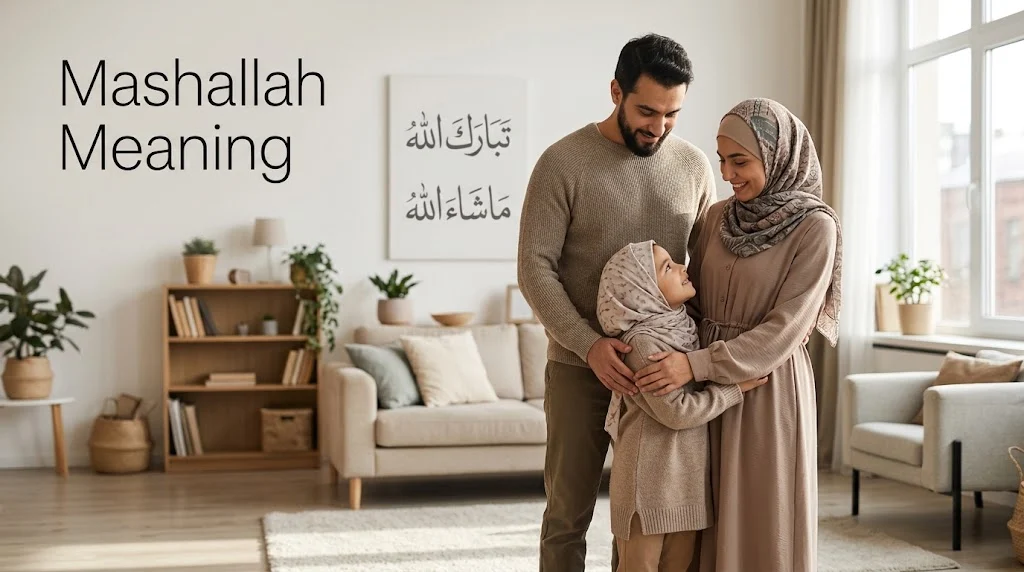
Sometimes, a single word can carry admiration, gratitude, and faith at the same time. Mashallah is one of those expressions. You may hear it when someone praises a beautiful child, celebrates good news, admires an achievement, or notices something wonderful.
But what does Mashallah actually mean?
The phrase comes from Arabic and is commonly understood as “what God has willed” or “what Allah has willed.” It is traditionally used to express appreciation for something good while acknowledging that it exists by God’s will. Its use is especially common in Muslim communities, though its meaning and everyday usage can vary across cultures and languages.
In this guide, you’ll learn the Mashallah meaning, its Arabic origin, full form, pronunciation, common uses, and examples. You’ll also see how the expression differs from related phrases such as Alhamdulillah and Inshallah. The goal is to give you a clear, accurate, and practical understanding of the term.
Definition & Meaning
Mashallah (ما شاء الله) is an Arabic expression that means “what Allah has willed” or “what God has willed.”
It is commonly said when admiring or acknowledging something positive, beautiful, impressive, or fortunate. For example, someone might say Mashallah after seeing a beautiful baby, hearing about someone’s achievement, or admiring a new home.
The expression reflects the idea that the good thing being admired exists according to Allah’s will.
Simple Meaning
Mashallah = What Allah has willed / What God has willed.
Arabic
ما شاء الله
Transliteration
Mā shā’ Allāh
Full Form and Meaning
Mashallah does not have a “full form” in the acronym sense because it is an Arabic phrase rather than an abbreviation.
The Arabic phrase ما شاء الله (Mā shā’ Allāh) can be understood word by word as:
- Mā (ما) = what / that which
- Shā’a (شاء) = willed / desired
- Allah (الله) = Allah / God
So, the literal sense is:
“What Allah has willed.”
In everyday English, it is often explained as “God has willed it” or “What God has willed.”
What Does Mashallah Mean?
The Arabic phrase ما شاء الله (Mā shā’a Allāh) can be understood literally as:
- Mā = what / that which
- Shā’a = willed
- Allāh = Allah
So the basic meaning is:
“What Allah has willed.”
In everyday English, people may understand it as:
“This is what Allah has willed.”
or:
“What Allah has willed has happened.”
The exact English wording can vary because a short Arabic expression can carry a broader meaning in context.
The Qur’anic wording in Surah Al-Kahf 18:39 includes the longer phrase “Mā shā’a Allāh, lā quwwata illā billāh”. The Quranic Arabic Corpus breaks the phrase down grammatically as mā (“what”), shā’a (“wills”), and Allah.
The deeper idea behind the phrase
Mashallah is not simply a decorative religious phrase.
When someone says it after admiring a blessing, the expression can communicate recognition that the blessing is ultimately connected to Allah’s will rather than being solely a person’s own achievement or possession.
For example:
“Mashallah, your daughter has grown so much.”
The speaker is expressing admiration while acknowledging Allah’s will and blessing.
“Mashallah, you finished your degree.”
Here, the phrase can combine happiness, admiration, and recognition of the blessing associated with the achievement.
Mashallah Meaning in Islam
In Islamic usage, Mashallah is associated with recognizing Allah’s will when observing something good or admirable.
The clearest Qur’anic reference is Surah Al-Kahf 18:39. The verse describes a conversation involving a man who possesses a flourishing garden. He is reminded that, when entering his garden, he should have said:
Mā shā’a Allāh, lā quwwata illā billāh.
Translations vary, but the central idea is that the garden and its blessings exist by Allah’s will and that there is no power except through Allah.
This context gives the expression an important dimension: gratitude and humility in the presence of a blessing.
It is not only about saying something positive about another person.
It can also remind the speaker that possessions, beauty, success, wealth, family, and other blessings are not entirely the result of human power.
Is Mashallah in the Quran?
Yes. The expression “Mā shā’a Allāh” appears in Surah Al-Kahf, verse 39, within the longer phrase:
مَا شَاءَ اللَّهُ لَا قُوَّةَ إِلَّا بِاللَّهِ
The verse specifically presents the phrase in the context of entering and admiring a garden.
A useful distinction is important here: the Qur’an contains the expression in this particular verse and context, but modern everyday usage can be broader. Muslims commonly use Mashallah in conversations when expressing admiration for blessings and good things.
When Should You Say Mashallah?
There is no need to make the expression complicated.
People commonly say Mashallah when they see or hear about something good that they admire.
Examples include:
- Seeing a beautiful baby
- Complimenting someone’s home
- Praising a person’s achievement
- Seeing someone’s artwork
- Hearing good news about someone’s success
- Admiring someone’s garden
- Seeing a beautiful natural scene
- Complimenting a family
- Appreciating someone’s hard work
- Seeing an impressive accomplishment
Everyday examples
A friend buys a new house:
“Mashallah, your new home looks beautiful.”
Someone shows you their newborn baby:
“Mashallah, what a beautiful baby.”
Your friend graduates:
“Mashallah, congratulations on your graduation.”
Someone completes a difficult project:
“Mashallah, you worked really hard on this.”
The expression fits naturally when admiration is connected with appreciation for a blessing.
Why Do Muslims Say Mashallah When Complimenting Someone?
One important reason is the Islamic idea of recognizing Allah’s role in blessings.
A compliment can focus entirely on the person:
“You have beautiful children.”
Adding Mashallah places the compliment in a religious context:
“Mashallah, you have beautiful children.”
The second expression still communicates admiration, but it also acknowledges Allah’s will.
This is one reason Mashallah is particularly common around things people consider valuable or blessed, such as children, marriage, family, health, accomplishments, homes, and prosperity.
Does Mashallah Mean “Beautiful”?
Not exactly.
This is a common misunderstanding.
Mashallah does not literally mean “beautiful,” “amazing,” or “wonderful.”
Those are possible feelings expressed by the person using the phrase, but the actual Arabic expression refers to what Allah has willed.
For example:
“Mashallah, your garden is beautiful.”
Here, “beautiful” describes the garden.
“Mashallah” adds recognition of Allah’s will.
Understanding this distinction makes the phrase easier to use correctly.
Mashallah and Admiration
Mashallah can be used when admiration is the main emotional response.
Imagine someone shows you a photograph of a beautiful sunset.
You might say:
“Mashallah, what a beautiful view.”
The first part is the religious expression. The second part explains your reaction.
The same structure works for many situations:
“Mashallah, your painting is beautiful.”
“Mashallah, your children have grown so much.”
“Mashallah, that’s an impressive achievement.”
“Mashallah, your garden is thriving.”
The phrase does not replace the compliment. It adds a religious dimension to it.
Does Mashallah Protect Against the Evil Eye?
This question needs some care.
In many Muslim communities, Mashallah is associated with avoiding envy or the evil eye when admiring a blessing. Some traditional Islamic discussions connect saying “Mā shā’a Allāh, lā quwwata illā billāh” with acknowledging Allah’s will when seeing something pleasing.
However, it is better not to reduce Mashallah to a simple formula meaning “this prevents the evil eye.”
The Qur’anic passage itself places the phrase in a broader context of recognizing Allah’s will and power.
So a more accurate explanation is:
Mashallah is an expression of recognition of Allah’s will and appreciation of a blessing. In some Muslim traditions and everyday practices, it is also associated with protection from envy or the evil eye.
That distinction keeps the explanation grounded in the religious context rather than presenting a single cultural practice as the entire meaning.
How Do You Pronounce Mashallah?
A common English pronunciation is:
Mashallah: maa-shaa-Allah
You may also see it written as:
- Masha Allah
- Ma Sha Allah
- Ma Shaa Allah
- Masha’Allah
- Mashaa Allah
- MashaAllah
- Mashallah
Arabic:
ما شاء الله
The spelling varies because Arabic words are being represented with English letters. The underlying Arabic phrase remains the same.
How to Write Mashallah in Arabic
The standard Arabic spelling is:
ما شاء الله
The words are:
ما + شاء + الله
Transliterated:
Mā shā’a Allāh
In casual English writing, Mashallah is one of the most common spellings.
For search purposes, people may use many different spellings, but they generally refer to the same expression.
What Is the Difference Between Mashallah and Inshallah?
Mashallah and Inshallah are both widely used Arabic Islamic expressions, but they serve different purposes.
| Expression | Arabic | Basic meaning | Common use |
|---|---|---|---|
| Mashallah | ما شاء الله | What Allah has willed | Admiring or acknowledging something that exists or has happened |
| Inshallah | إن شاء الله | If Allah wills | Talking about something hoped or planned for the future |
| Alhamdulillah | الحمد لله | Praise belongs to Allah | Expressing praise and gratitude to Allah |
| Subhanallah | سبحان الله | Glory be to Allah | Expressing wonder, awe, or recognition of Allah’s perfection |
Example
Your friend tells you:
“I bought a new house.”
You might say:
“Mashallah, your house is beautiful.”
Your friend says:
“I will move next month.”
You might say:
“Inshallah, everything goes smoothly.”
The difference is largely about present recognition versus future intention.
Mashallah vs Alhamdulillah
These expressions can sometimes appear together, but they are not interchangeable.
Mashallah commonly highlights something admired or recognized as a blessing under Allah’s will.
Alhamdulillah means “Praise be to Allah” and is commonly used to express gratitude and praise.
For example:
“Mashallah, you got the job!”
This emphasizes admiration for the good news.
“Alhamdulillah, I got the job.”
This emphasizes gratitude to Allah for the good news.
A person can naturally use both:
“Mashallah, you got the job. Alhamdulillah!”
The exact choice depends on what the speaker wants to emphasize.
Mashallah vs Subhanallah
Subhanallah is another Arabic expression used in Muslim speech.
It literally conveys the idea of declaring Allah free from imperfection or glorifying Him.
In everyday conversation, it can express amazement, awe, or reflection.
For example:
“Subhanallah, look at those mountains.”
A person might say:
“Mashallah, your garden looks beautiful.”
The first expression can emphasize wonder or glorification of Allah.
The second can emphasize admiration of a blessing and recognition of Allah’s will.
There can be overlap in real conversation, so context matters.
Can You Say Mashallah About Yourself?
Yes, people may use the expression when talking about their own blessings or accomplishments.
For example:
“Mashallah, my children are doing well.”
“Mashallah, we finally finished the house.”
“Mashallah, the garden has grown beautifully this year.”
The Qur’anic passage in Al-Kahf itself connects the expression with a person’s own garden, making the idea of recognizing Allah’s will in one’s own blessings especially relevant.
The important idea is not simply who owns the blessing. It is the recognition that the blessing ultimately exists by Allah’s will.
Can You Say Mashallah to Someone Else?
Yes.
This is perhaps one of the most familiar everyday uses.
You can say:
“Mashallah, your baby is beautiful.”
“Mashallah, you’ve done really well.”
“Mashallah, your home looks lovely.”
“Mashallah, your son has grown so tall.”
“Mashallah, that’s a wonderful achievement.”
The expression can make an ordinary compliment sound more explicitly connected to Islamic faith.
How Do You Respond to Mashallah?
There is no single universal response that must be used every time someone says Mashallah.
Depending on the situation, a person might respond with:
- Alhamdulillah
- JazakAllahu khairan
- Thank you
- Allahumma barik
- A simple smile or acknowledgment
For example:
Person A: “Mashallah, your new home is beautiful.”
Person B: “Alhamdulillah, thank you.”
Or:
Person A: “Mashallah, you did an amazing job.”
Person B: “JazakAllahu khairan.”
The appropriate response can depend on the relationship, setting, and personal religious practice.
What Does “Allahumma Barik” Have to Do With Mashallah?
You may sometimes hear:
Allahumma barik
اللهم بارك
This means approximately:
“O Allah, bless [it/him/her].”
It is related to the broader idea of asking Allah to bless something or someone.
For example:
“Mashallah, Allahumma barik.”
Someone may use both expressions together when admiring a person or blessing.
They are not identical phrases.
Mashallah recognizes Allah’s will.
Allahumma barik is a supplication asking Allah for blessing.
That difference is useful when explaining the expressions to someone learning Islamic vocabulary.
Common Examples of Mashallah in Everyday English
Here are natural examples across different situations.
| Situation | Example |
|---|---|
| New baby | “Mashallah, your baby is beautiful.” |
| New home | “Mashallah, your new house looks amazing.” |
| Graduation | “Mashallah, congratulations on graduating.” |
| Academic success | “Mashallah, you got excellent results.” |
| Artwork | “Mashallah, this painting is beautiful.” |
| Business | “Mashallah, your business has grown so much.” |
| Family | “Mashallah, your family looks happy.” |
| Garden | “Mashallah, your garden is full of flowers.” |
| Achievement | “Mashallah, you completed a difficult goal.” |
| Nature | “Mashallah, look at that beautiful landscape.” |
These examples show an important point: Mashallah works naturally with things that inspire admiration or appreciation.
Common Misunderstandings About Mashallah
1. “Mashallah” simply means “beautiful”
Not exactly.
Its core meaning relates to what Allah has willed. “Beautiful” describes the thing being admired, not the literal meaning of Mashallah.
2. Mashallah is only used for other people
No. It can also be used when recognizing one’s own blessings.
3. Mashallah and Inshallah mean the same thing
They do not.
Mashallah is commonly associated with acknowledging something present or already observed.
Inshallah is commonly used when referring to something intended or hoped for in the future.
4. Every compliment must include Mashallah
That is too broad.
Mashallah is an Islamic expression used in particular contexts. It should not be treated as a mandatory word that has to follow every compliment.
5. Mashallah is only an Arabic word
It is an Arabic expression, but its use extends far beyond Arabic-speaking communities. Muslims around the world use it in different languages and cultural settings.
Mashallah Meaning in Urdu
In Urdu, Mashallah is commonly written:
ماشاءاللہ
It is often understood along the lines of:
“اللہ نے جیسا چاہا”
or in a more contextual sense:
“یہ اللہ کی مشیت سے ہے”
In everyday Pakistani and South Asian Muslim speech, Mashallah is frequently used when admiring children, homes, achievements, beauty, family, wealth, or other blessings.
For example:
ماشاءاللہ، آپ کا گھر بہت خوبصورت ہے۔
In English:
“Mashallah, your home is very beautiful.”
The cultural use can sometimes include an association with avoiding envy or the evil eye, but the core religious idea remains recognition of Allah’s will.
Is Mashallah a Compliment?
It can be part of a compliment, but it is not itself simply a synonym for “compliment.”
Compare:
“Your daughter is beautiful.”
with:
“Mashallah, your daughter is beautiful.”
The second sentence contains the same basic compliment but adds an Islamic expression recognizing Allah’s will.
This is why Mashallah can feel natural in conversations about blessings.
Why Mashallah Matters Beyond Translation
A literal translation gives only part of the picture.
The cultural meaning matters too.
Someone saying:
“Mashallah, you have a beautiful family.”
is doing more than translating three Arabic words into English.
The expression can communicate admiration, gratitude, humility, faith, and recognition of divine will within a single short phrase.
That is one reason expressions like Mashallah remain common across Muslim communities even when everyday conversations happen mostly in English, Urdu, Hindi, Turkish, Persian, or other languages.
Frequently Asked Questions
What is the Mashallah meaning?
Mashallah means “What Allah has willed.” It is commonly used when admiring or acknowledging something good or blessed while recognizing Allah’s will.
What does Mashallah mean in Islam?
In Islamic usage, Mashallah expresses recognition of Allah’s will in something that is admired or observed. The phrase appears in Surah Al-Kahf 18:39 in the longer expression “Mā shā’a Allāh, lā quwwata illā billāh.”
When should you say Mashallah?
It can be said when admiring a blessing, achievement, person, possession, family, natural scene, or another good thing. For example, “Mashallah, your new home is beautiful.”
Is Mashallah in the Quran?
Yes. Mā shā’a Allāh appears in Qur’an 18:39, as part of the phrase “Mā shā’a Allāh, lā quwwata illā billāh.”
What is the difference between Mashallah and Inshallah?
Mashallah is commonly used when acknowledging or admiring something that exists or has happened. Inshallah means “if Allah wills” and is commonly used when discussing a hoped-for or planned future event.
What is the difference between Mashallah and Alhamdulillah?
Mashallah commonly expresses recognition of Allah’s will in something admired or observed. Alhamdulillah means “Praise be to Allah” and is commonly used to express gratitude and praise.
Can you say Mashallah about yourself?
Yes. A person can say Mashallah when recognizing their own blessings or accomplishments. The Qur’anic example in Al-Kahf 18:39 itself involves a person’s garden.
How do you spell Mashallah in Arabic?
The Arabic spelling is ما شاء الله. Common English spellings include Mashallah, Masha Allah, Ma Sha Allah, Masha’Allah, and MashaAllah.
Does Mashallah mean protection from the evil eye?
Mashallah is traditionally associated in some Muslim contexts with acknowledging Allah’s will when admiring a blessing, and some traditional interpretations connect the phrase with protection from envy or the evil eye. The Qur’anic context itself emphasizes Allah’s will and power, so reducing the expression to an “evil eye protection phrase” misses part of its meaning.
What can you say after someone says Mashallah?
There is no single required response for every situation. Depending on context, someone might say Alhamdulillah, JazakAllahu khairan, Allahumma barik, or simply thank the person.
Final Takeaway
The simplest way to remember Mashallah meaning is:
Mashallah means “What Allah has willed.”
It is commonly used when admiring something good while recognizing Allah’s will and the blessing behind it. Its Qur’anic appearance in Surah Al-Kahf 18:39 gives the expression an important foundation in Islamic thought.
It is also useful to remember what Mashallah does not mean. It does not literally mean “beautiful,” “amazing,” or “congratulations.” Those ideas can be part of the context in which someone says it, but the central meaning is connected to Allah’s will.
That small distinction makes the phrase much easier to understand and use naturally.