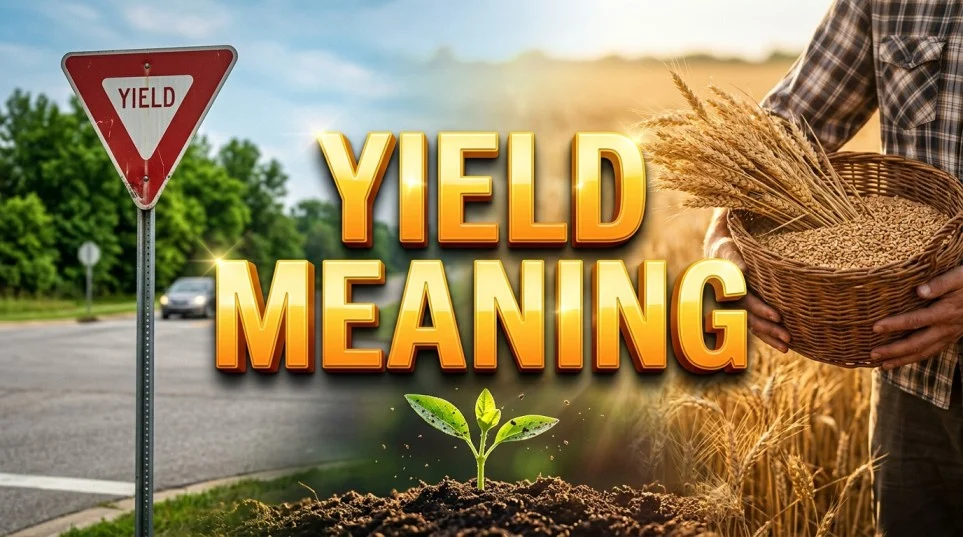
The word yield can describe a driver letting another car pass, a farmer harvesting crops, or an investor earning money. At first, these situations seem unrelated. Yet they share one important idea: yield means giving way, giving in, or producing something, depending on the context.
In everyday English, to yield can mean allowing someone to go first, accepting that you cannot continue resisting, or producing a result. As a noun, yield often refers to the amount something produces, such as a farm’s harvest or an investment’s income. The surrounding words usually make the intended meaning clear.
Understanding the different uses of yield helps you read road signs correctly, follow financial discussions, understand news about agriculture, and communicate more precisely. This guide explains each meaning in simple English, with practical examples and tips for choosing the right interpretation.
What Does Yield Mean?
Yield means to give way, surrender, or produce something. Its exact meaning depends on the situation in which it appears.
For example:
- Give way: The driver slowed down to yield to pedestrians.
- Give in: She refused to yield to pressure from her colleagues.
- Produce: The farm yields enough vegetables to supply several local shops.
- Generate income: The investment yields a steady annual return.
Notice that the word does not mean the same thing in every sentence. A driver who yields lets someone else proceed. A person who yields to pressure stops resisting. A farm that yields vegetables produces something.
The easiest way to understand yield is to look at the action or result described in the sentence.
Yield Definition and Parts of Speech
The word yield functions as both a verb and a noun.
| Part of speech | Definition | Example |
|---|---|---|
| Verb | To give way or allow someone to proceed | Drivers must yield to pedestrians. |
| Verb | To surrender or stop resisting | He would not yield to threats. |
| Verb | To produce or generate something | The experiment yielded useful results. |
| Noun | The amount produced | The farm’s wheat yield increased. |
| Noun | The income or return generated by an investment | The bond offers a stated annual yield. |
Yield as a Verb
A verb describes an action. When you yield, you may allow someone to go first, stop resisting, or produce a result.
Examples:
- The car yielded to the ambulance.
- After a long discussion, the manager yielded to the team’s request.
- The research yielded unexpected findings.
- These trees yield fruit every summer.
Yield as a Noun
A noun names something. In this case, yield commonly describes the quantity produced or the income generated by an investment.
Examples:
- This year’s crop yield was higher than last year’s.
- The investment has a projected annual yield of 5%.
- The recipe produces a yield of 12 cookies.
A useful clue is the word’s position in the sentence. In “The farm yields corn,” it describes an action. In “The corn yield increased,” it identifies the amount produced.
Yield Meaning in Simple English
In simple English, yield has three common meanings:
- Let someone go first: Give another person or vehicle the right to proceed.
- Give in: Stop resisting an argument, demand, or pressure.
- Produce: Create or generate something.
Consider these everyday situations:
At a crossing: A driver sees someone crossing the road and slows down to let them pass.
During a disagreement: Two friends argue about a decision. One eventually accepts the other’s suggestion.
In a garden: A tomato plant produces more tomatoes than it did last season.
All three situations can involve the word yield, but the surrounding details determine its meaning.
Yield Meaning in a Sentence
Seeing the word in context is one of the easiest ways to understand it. Here are examples from different situations.
| Sentence | Meaning of yield |
|---|---|
| Drivers should yield to people crossing the street. | Allow others to proceed |
| The athlete refused to yield to pressure. | Stop resisting |
| The garden yields fresh tomatoes each summer. | Produces |
| The study yielded surprising results. | Produced findings |
| The bond has an annual yield of 4%. | Generates a stated investment return |
| The recipe has a yield of eight servings. | Produces eight servings |
| The metal yielded under extreme pressure. | Bent or gave way under force |
How to Identify the Correct Meaning
Ask yourself three quick questions:
- Is someone allowing another person to go first?
- Is someone giving up resistance or control?
- Is something being produced or generated?
If none of these meanings fits, consider the technical context. For example, a programming language may use yield to describe returning a value while preserving a function’s execution state.
What Does Yield Mean in Driving?
In driving, yield means allowing another road user to proceed when the applicable traffic rules require you to give way.
A yield sign tells drivers to slow down, assess approaching traffic, and give priority to vehicles or other road users who have the right of way. Depending on road conditions and local rules, a driver may need to stop completely.
For example, imagine you are approaching a busy roundabout. Another vehicle is already circulating inside it. A yield sign at your entrance may require you to wait until it is safe and lawful to enter.
What Should You Do at a Yield Sign?
- Reduce your speed as you approach the sign.
- Look for vehicles, pedestrians, cyclists, and other road users.
- Give way to those who have priority under the applicable rules.
- Stop if necessary to avoid a collision or comply with the law.
- Proceed only when it is safe and permitted.
A yield sign does not mean you must always stop. It means you must give way when required.
Traffic rules differ by country, so drivers should follow local road laws and official driving guidance. Never assume that another driver will yield simply because you expect them to.
Yield Sign vs. Stop Sign
| Feature | Yield sign | Stop sign |
|---|---|---|
| Main instruction | Give way when required | Come to a complete stop |
| Must you always stop? | Not necessarily | Yes, subject to local law |
| Main action | Assess traffic and allow priority users to proceed | Stop, check, then proceed when safe |
| Common purpose | Manage merging traffic and intersections | Require a definite stop at a controlled location |
The key difference is that a yield sign requires you to give way, while a stop sign requires a complete stop.
What Does Yield to Someone Mean?
To yield to someone means to give that person the right to proceed, accept their request, or stop resisting them. The meaning depends on the situation.
Examples:
- In traffic: The driver yielded to the pedestrian.
- In a discussion: He yielded to his colleague’s suggestion.
- Under pressure: She refused to yield to intimidation.
- In a competition: The team would not yield to its opponents.
The phrase can describe a sensible decision or an unwilling surrender.
For instance, yielding to a pedestrian is often a responsible driving action. Yielding to unfair pressure, by contrast, may mean abandoning a position you believe is right.
Is Yielding the Same as Giving Up?
Not always.
Giving up often suggests abandoning a goal or effort. Yielding can mean temporarily making room for someone else, accepting a reasonable request, or changing your position after considering the facts.
For example, a team leader may yield to a colleague’s better proposal without giving up responsibility for the project. In that case, yielding is a decision to cooperate, not a sign of failure.
Yield Meaning in Finance and Investing
In finance, yield generally refers to the income an investment generates relative to its price or value, usually expressed as a percentage.
Investors may discuss yield when comparing bonds, dividend-paying stocks, savings products, or other income-producing assets. The exact calculation depends on the investment.
For example, suppose an investment costs $1,000 and generates $50 in annual income. Its income yield based on that purchase price is:
[
\text{Yield}=\frac{\text{Annual Income}}{\text{Investment Price}}\times100
]
[
\text{Yield}=\frac{$50}{$1,000}\times100=5%
]
The investment generates annual income equal to 5% of its purchase price under these assumptions.
What Is Annual Yield?
Annual yield expresses investment income over a one-year period, often as a percentage. However, different financial products calculate and report yield differently.
For example, a bond may have a coupon rate based on its face value, while its current yield compares annual coupon payments with its current market price. Its yield to maturity also considers the bond’s price, payments, and remaining term, assuming the relevant payments and repayment occur as expected.
These figures are related, but they are not interchangeable.
Yield vs. Return
Yield and return are connected, but they describe different aspects of an investment.
| Term | What it measures | Example |
|---|---|---|
| Yield | Income relative to a specified investment price or value | A bond’s annual coupon payments compared with its market price |
| Total return | Overall gain or loss, including income and changes in investment value | Dividends plus a stock’s price increase or decrease |
Imagine you buy a stock for $100 and receive $4 in dividends during the year. If its price rises to $110, your dividend yield based on the original purchase price is 4%, while your total return is 14%, ignoring taxes, fees, and any reinvestment.
If the stock price falls instead, dividend income may still be received, but the overall return could be negative.
Important: A higher yield does not automatically mean a better or safer investment. It may reflect greater risk, a falling market price, or other factors. Investors should examine the underlying asset, fees, payment terms, and potential losses rather than comparing yield alone.
Yield Meaning in Agriculture
In agriculture, yield means the amount of a crop produced during a particular period or harvest.
Farmers and agricultural researchers use crop yield to assess production, compare growing methods, estimate food supplies, and evaluate farming performance.
For example:
- A wheat field yields 3 tonnes per hectare.
- Better irrigation increases the farm’s rice yield.
- Drought reduces the yield of corn crops.
- A farmer compares this season’s apple yield with last year’s harvest.
Crop yield can be measured in kilograms, tonnes, bushels, or other units per area of land. The appropriate unit depends on the crop and the agricultural reporting system.
What Affects Crop Yield?
Several factors can influence how much a field produces:
- Weather: Temperature, rainfall, drought, and extreme weather can affect plant growth.
- Soil quality: Nutrient availability, drainage, and soil structure influence crop development.
- Water management: Too little water can restrict growth, while excessive water may damage roots.
- Pests and diseases: Infestations and infections can reduce harvest quantities.
- Farming practices: Planting density, crop selection, fertilizer use, and harvest timing may affect results.
A higher crop yield means more produce under the measurement being used. It does not automatically mean greater profit, since production costs and selling prices also matter.
Yield Meaning in Science and Everyday Work
In science and general use, yield often means the result or quantity produced by a process.
Examples include:
- Chemistry: A reaction yields a particular quantity of a substance.
- Research: An investigation yields new evidence.
- Manufacturing: A production line yields 500 finished units per shift.
- Cooking: A recipe yields 10 portions.
- Business: A marketing campaign yields 200 qualified leads.
In these contexts, yield helps describe an outcome rather than the act of giving way.
Scientists may distinguish between theoretical yield, the amount predicted by a calculation, and actual yield, the amount obtained in an experiment. In a chemical reaction, actual yield is often lower than theoretical yield because reactions may not go to completion and material can be lost during handling.
This distinction shows why the word is useful: it can describe not just what a process creates, but how much it creates compared with expectations.
Yield Meaning in Programming
In programming, yield is a keyword in some languages that allows a function to produce a value while preserving enough of its execution state to continue later.
In Python, for example, a function containing yield can produce values one at a time instead of building and returning an entire sequence at once. Such a function is commonly called a generator function.
Example in Python:
def count_up_to_three():
    yield 1
    yield 2
    yield 3

for number in count_up_to_three():
    print(number)
The function produces the values 1, 2, and 3 as the loop requests them.
This approach can be useful when processing large amounts of data because values can be generated as needed instead of storing the complete sequence in memory.
The exact behavior of yield depends on the programming language. Its meaning in Python should not be assumed to apply identically to every language that uses the keyword.
Yield Synonyms and Antonyms
A synonym is a word with a similar meaning. An antonym expresses an opposite or contrasting idea. Since yield has several meanings, the best alternative depends on the sentence.
Yield Synonyms
| Synonym | Best used when yield means |
|---|---|
| Give way | Allowing someone to proceed |
| Surrender | Giving up a position or control |
| Relent | Becoming less resistant |
| Concede | Accepting a point or decision |
| Submit | Giving in to authority or pressure |
| Produce | Creating or generating something |
| Generate | Bringing about a result |
| Output | Producing an amount or result |
Examples:
- “The driver yielded” can become “The driver gave way.”
- “The study yielded results” can become “The study produced results.”
- “She yielded after the discussion” can become “She relented after the discussion.”
Yield Antonyms
| Antonym | Contrasting meaning |
|---|---|
| Resist | Refuse to give in |
| Oppose | Act against something |
| Withstand | Remain firm under pressure |
| Retain | Keep possession or control |
| Withhold | Refuse to give or provide |
| Consume | Use up rather than produce, in some contexts |
These are context-dependent opposites, not perfect replacements in every sentence. For example, resist is a natural opposite of yield to pressure, while consume may contrast with produce in a particular discussion about resources.
Common Mistakes When Using Yield
The word is easy to recognize once you understand its main meanings, but several mistakes can cause confusion.
1. Assuming Yield Always Means Surrender
Incorrect assumption: “The farm yielded 2 tonnes of rice” means the farm surrendered rice.
Correct meaning: The farm produced 2 tonnes of rice.
2. Assuming a Yield Sign Always Requires a Full Stop
A yield sign requires drivers to give way when necessary. It does not automatically require a complete stop in every situation. Follow local traffic rules and stop when needed for safety or compliance.
3. Treating Yield and Return as Identical
In investing, yield usually focuses on income relative to a stated price or value. Total return can also include gains or losses in market value.
4. Using a Synonym Without Checking the Context
“Produce,” “surrender,” and “give way” are not interchangeable in every sentence. Choose a replacement that preserves the intended meaning.
5. Ignoring the Word’s Grammar
Compare these sentences:
- “The factory yields 100 products a day.” Here, yields is a verb.
- “The factory’s yield is 100 products a day.” Here, yield is a noun.
Recognizing the grammatical role can help you interpret the sentence more quickly.
Frequently Asked Questions
1. What does yield mean in simple English?
Yield means to give way, stop resisting, or produce something. For example, a driver yields to another road user, while a farm yields crops.
2. What does yield mean in a sentence?
In “The experiment yielded useful results,” yielded means produced. In “The driver yielded at the intersection,” it means gave way.
3. What does a yield sign mean?
A yield sign tells drivers to give priority to other road users when required. Drivers should slow down, assess traffic, and stop if necessary.
4. What does yield to someone mean?
It means allowing someone to proceed or accepting their request, argument, or authority. The intended meaning depends on the situation.
5. What is the opposite of yield?
Possible opposites include resist, oppose, and withstand when yield means giving in. When yield means produce, a contrasting word depends on the context.
6. What does yield mean in finance?
In finance, yield generally describes investment income relative to a specified price or value, often as a percentage. Its calculation varies by investment type.
7. What does crop yield mean?
Crop yield is the amount of agricultural produce harvested from a field or a defined area of land during a growing period.
8. Is yield a noun or a verb?
Yield can be both. As a verb, it can mean give way or produce. As a noun, it can refer to the amount produced or the income generated by an investment.
9. What is the difference between yield and return?
Yield generally measures income relative to an investment’s price or value. Total return includes income and changes in the investment’s value, so it gives a broader picture of performance.
10. What does yield mean in programming?
In languages such as Python, yield allows a function to produce values incrementally while preserving its state so execution can continue later.
Conclusion
Understanding the meaning of yield becomes easier when you pay attention to the context. It can mean giving way in traffic, giving in to pressure, or producing something such as crops, research results, or investment income. In finance, yield helps describe the income an investment generates, while in programming, it can refer to producing values one at a time. Learning these different uses will help you understand the word in everyday conversations, professional discussions, and written content. When you come across yield, look at the surrounding words to identify its intended meaning and use it confidently in your own sentences.