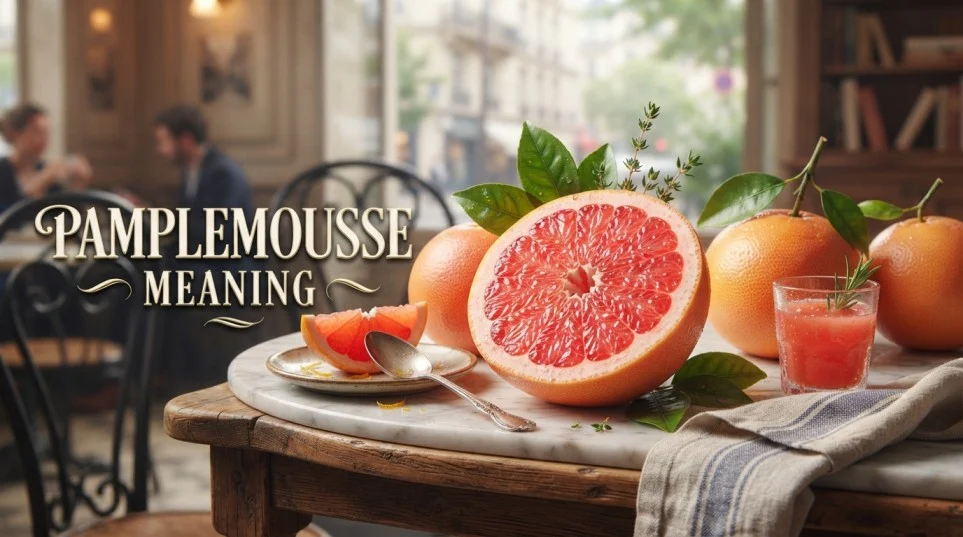
Ever come across the word pamplemousse meaning and wonder why it sounds so much more intriguing than an ordinary fruit name? This unusual French word refers to grapefruit, but its story, pronunciation, cultural use, and connection to food make it far more interesting than a simple dictionary definition. You may have seen “pamplemousse” on a drink menu, perfume label, recipe, or social media post without knowing exactly what it means.
In this guide, we’ll explore the pamplemousse meaning in clear, simple language, including its English translation, pronunciation, origin, and how native French speakers use it. You’ll also discover why this word has developed a distinctive charm in modern food, beauty, and lifestyle culture. By the end, you’ll know exactly what pamplemousse means and how to use it naturally.
What Does Pamplemousse Mean?
Pamplemousse means “grapefruit” in English.
It is a French noun used for the grapefruit fruit. If someone says un pamplemousse in French, they are talking about a grapefruit.
| French | English |
|---|---|
| pamplemousse | grapefruit |
| un pamplemousse | a grapefruit |
| des pamplemousses | grapefruits |
For example:
J’aime le pamplemousse.
I like grapefruit.
The word can appear in everyday conversations about breakfast, fruit, juice, cooking, shopping, and food.
Quick Meaning
- Word: pamplemousse
- Language: French
- English meaning: grapefruit
- Word type: noun
- Plural: pamplemousses
- Pronunciation: roughly pahm-pluh-moos
- Related category: citrus fruit
Pamplemousse in English
The most direct pamplemousse English meaning is grapefruit.
This is important because people sometimes assume that pamplemousse means pomelo. The two fruits are closely related, and the words can be confusing, but modern French usage generally uses pamplemousse for grapefruit.
In English, grapefruit is the familiar name for the citrus fruit often eaten at breakfast or used in juices and salads.
So if you are translating:
pamplemousse → grapefruit
is the straightforward translation.
What Is a Pamplemousse?
A pamplemousse is a citrus fruit with a rounded shape, thick peel, and juicy interior. Depending on the variety, its flesh may be pale yellow, pink, or reddish.
Its flavor is one of its most recognizable features. Grapefruit can taste:
- Sweet
- Tart
- Juicy
- Slightly bitter
- Refreshing
That bitterness is one reason grapefruit tastes noticeably different from oranges.
You might encounter pamplemousse in:
- Fresh fruit dishes
- Breakfast plates
- Fruit salads
- Juices
- Cocktails and mocktails
- Desserts
- French recipes
- Food packaging
- Restaurant menus
How to Pronounce Pamplemousse
The pamplemousse pronunciation can look intimidating if you are not familiar with French.
A simple English-friendly approximation is:
pahm-pluh-moos
The exact French pronunciation is more nuanced, especially because French vowel sounds do not always have direct English equivalents.
The final “s” is generally not pronounced.
If you are learning French, listening to a native speaker say the word is more useful than trying to force it into an English pronunciation pattern.
Pronunciation Breakdown
You can think of the word in three rough parts:
pam + ple + mousse
The last part, mousse, sounds roughly like “moose,” although the French pronunciation is not identical to the English animal name.
Pamplemousse vs. Grapefruit
The difference is mainly language, not meaning.
Pamplemousse is the French word.
Grapefruit is the English word.
| Term | Language | Meaning |
|---|---|---|
| pamplemousse | French | grapefruit |
| grapefruit | English | pamplemousse |
| pamplemousse rose | French | pink grapefruit |
| jus de pamplemousse | French | grapefruit juice |
So if you see jus de pamplemousse on a French menu, you can understand it as grapefruit juice.
Pamplemousse vs. Pomelo: Are They the Same?
This is where things become more interesting.
Grapefruit and pomelo are closely related citrus fruits, but they are not simply two names for exactly the same fruit.
The pomelo is generally larger and has a thick rind. Grapefruit is a separate citrus fruit that has a historical connection to pomelo through citrus hybridization.
The confusion also comes from language and historical naming. In different regions and historical periods, names for grapefruit and related citrus fruits have overlapped.
For everyday French vocabulary, however, pamplemousse is the word you will normally encounter for grapefruit.
If you are translating a modern French sentence, translating pamplemousse as grapefruit is the practical choice.
Pamplemousse Meaning in Different Contexts
The basic meaning stays the same, but the word can appear in several contexts.
1. Food
You might see pamplemousse when talking about fruit.
Example:
J’ai acheté un pamplemousse.
I bought a grapefruit.
2. Drinks
The word is also common when discussing juice.
Example:
Je voudrais du jus de pamplemousse.
I would like some grapefruit juice.
3. Recipes
French recipes may use pamplemousse in salads, desserts, sauces, or drinks.
Example:
Salade de pamplemousse et d’avocat
Grapefruit and avocado salad
4. Menus
A French restaurant menu may use pamplemousse as an ingredient.
For example:
Tartare de saumon au pamplemousse
can refer to salmon tartare served with grapefruit.
5. Fragrance and Beauty
You may also encounter pamplemousse in perfume and skincare descriptions.
Here, the word still refers to grapefruit, but it often describes a fresh, citrusy scent profile.
That is why pamplemousse can sound more sophisticated or unusual when used in product names.
Pamplemousse Example Sentences
Seeing the word in real sentences makes its meaning much easier to remember.
Simple Examples
French:
Le pamplemousse est sur la table.
English:
The grapefruit is on the table.
French:
Elle mange un pamplemousse au petit-déjeuner.
English:
She eats a grapefruit for breakfast.
French:
J’aime le goût du pamplemousse.
English:
I like the taste of grapefruit.
French:
Le jus de pamplemousse est frais.
English:
The grapefruit juice is fresh.
More Natural Examples
French:
Cette salade contient du pamplemousse, de l’avocat et des crevettes.
English:
This salad contains grapefruit, avocado, and shrimp.
French:
Le parfum possède une note fraîche de pamplemousse.
English:
The fragrance has a fresh grapefruit note.
These examples show something useful: pamplemousse is not a slang term or hidden expression. It is an ordinary French noun for grapefruit.
Useful French Phrases With Pamplemousse
If you are learning French, a few combinations are worth remembering.
| French phrase | English meaning |
|---|---|
| un pamplemousse | a grapefruit |
| des pamplemousses | grapefruits |
| jus de pamplemousse | grapefruit juice |
| salade de pamplemousse | grapefruit salad |
| pamplemousse rose | pink grapefruit |
| goût de pamplemousse | grapefruit flavor |
| zeste de pamplemousse | grapefruit zest |
| quartier de pamplemousse | grapefruit segment |
These phrases are often more useful for language learners than memorizing the isolated word.
What Does Pamplemousse Literally Mean?
If you are looking for a deeper pamplemousse definition, the word does not work like an English descriptive phrase that can be easily broken into modern French words.
Its history is connected to names used for citrus fruits and to the movement of these fruits and their names across languages and regions.
The French pamplemousse is related historically to the Dutch term pompelmoes, a name associated with the pomelo. The history of citrus naming is complicated because grapefruit, pomelo, and other citrus varieties have been cultivated, transported, crossed, and renamed across different regions.
This is one reason the word can feel unusual to English speakers.
Pamplemousse Etymology and Origin
The etymology of pamplemousse is particularly interesting because it reflects the international history of citrus fruit.
The French term is generally traced through forms related to Dutch pompelmoes, which referred to the pomelo. The word then entered French usage.
Grapefruit itself has a more complicated botanical history. It is generally understood to have developed from citrus varieties cultivated in the Caribbean, with pomelo playing an important role in its ancestry.
So the word’s history and the fruit’s biological history are connected, but they are not exactly the same story.
That distinction matters: the origin of the word “pamplemousse” is not simply the same thing as the origin of the grapefruit fruit.
Is Pamplemousse a French Word?
Yes.
Pamplemousse is a French word for grapefruit.
If you are reading French and encounter the word by itself, the most useful first translation is:
pamplemousse = grapefruit
French uses grammatical gender with nouns, so you will commonly see:
un pamplemousse
The plural form is:
des pamplemousses
The change is straightforward: an s is added to the written plural, although the final s is not normally pronounced.
Is Pamplemousse a Fancy Word?
Not really.
It may look fancy to English speakers, but for French speakers it is simply the normal word for grapefruit.
This is an important distinction.
When a French word appears in an English product name, restaurant menu, perfume, or brand, it can take on a stylish or sophisticated feeling. That does not mean the original French word itself is formal or poetic.
For a French speaker, ordering un pamplemousse is no more unusual than an English speaker asking for a grapefruit.
Why Does “Pamplemousse” Sound So Different From “Grapefruit”?
Because the two languages developed completely different names for the fruit.
English uses grapefruit, a compound word.
French uses pamplemousse, which comes through a different linguistic history involving earlier names for related citrus fruit.
This is a good example of why direct translation cannot always be predicted from the English word.
You cannot look at pamplemousse and logically construct “grapefruit” from its individual sounds. It has to be learned as vocabulary.
Pamplemousse in French Culture and Everyday Language
Fruit vocabulary can tell you something interesting about how languages work.
Words like pomme for apple, orange for orange, citron for lemon, and pamplemousse for grapefruit are ordinary parts of French food vocabulary.
But pamplemousse has also found a place beyond simple grocery shopping. It can appear in:
- French-inspired product names
- Perfume descriptions
- Restaurant menus
- Culinary writing
- Travel content
- Food photography
- Cocktail menus
- Lifestyle branding
In these contexts, the word can carry a distinctly French visual or culinary association while still retaining its literal meaning.
Common Mistakes About Pamplemousse
Mistake 1: Thinking it means pomelo
The words are historically connected, and the fruits are related, but pamplemousse is generally translated as grapefruit in modern French.
Mistake 2: Pronouncing the final “s”
The final s in pamplemousse is normally silent.
Mistake 3: Assuming it is slang
It is not slang. It is an ordinary French noun.
Mistake 4: Thinking it describes a flavor only
Pamplemousse specifically refers to the fruit. In a perfume or food description, it can also appear as a flavor or scent note because grapefruit is being used as the reference.
Mistake 5: Translating every context literally
If a product says pamplemousse, the best English wording may depend on what is being described. A food item may say “grapefruit,” while a fragrance description may use “grapefruit notes.”
Pamplemousse Synonyms and Related Words
Strict synonyms are limited because pamplemousse is the standard French name for grapefruit.
However, these related terms can help you understand the vocabulary around it:
- Grapefruit
- Pink grapefruit
- Citrus fruit
- Pomelo
- Citrus
- Grapefruit juice
- Grapefruit zest
- Grapefruit flavor
- Grapefruit scent
- Citrus aroma
Keep in mind that pomelo is a related fruit, not simply a perfect English synonym for pamplemousse.
How to Remember Pamplemousse
If you are learning French, try connecting the word to an image rather than memorizing the spelling alone.
Picture a bright pink grapefruit sitting on a breakfast table.
Then connect:
pamplemousse → grapefruit → citrus → French
You can also learn the word through a useful phrase:
jus de pamplemousse = grapefruit juice
Learning the word inside a phrase gives you a stronger memory than memorizing a dictionary definition alone.
Pamplemousse Meaning at a Glance
| Question | Answer |
|---|---|
| What does pamplemousse mean? | Grapefruit |
| What language is pamplemousse? | French |
| What is pamplemousse in English? | Grapefruit |
| Is pamplemousse a fruit? | Yes |
| Is pamplemousse slang? | No |
| How is it pronounced? | Roughly “pahm-pluh-moos” |
| Is the final s pronounced? | Usually no |
| What is the plural? | pamplemousses |
| Is pamplemousse the same as pomelo? | No, they are related citrus fruits |
| What is jus de pamplemousse? | Grapefruit juice |
Frequently Asked Questions
What does pamplemousse mean in English?
Pamplemousse means “grapefruit” in English. It is the standard French word used for this citrus fruit.
Is pamplemousse French for grapefruit?
Yes. Pamplemousse is French for grapefruit. You may see it in French recipes, menus, grocery contexts, and descriptions of food or fragrances.
How do you pronounce pamplemousse?
A rough English approximation is “pahm-pluh-moos.” The exact French pronunciation has sounds that do not map perfectly onto English.
Is pamplemousse the same as grapefruit?
In modern everyday French, pamplemousse generally refers to grapefruit. The word has a more complicated historical relationship with related citrus names, which is why pomelo can sometimes cause confusion.
What is pamplemousse rose?
Pamplemousse rose means pink grapefruit in French. It refers to grapefruit varieties with pink or reddish flesh.
What does jus de pamplemousse mean?
Jus de pamplemousse means grapefruit juice.
Is pamplemousse a slang word?
No. Pamplemousse is a standard French noun, not internet slang or an informal abbreviation.
What is the plural of pamplemousse?
The written plural is pamplemousses. Like many French plural forms ending in s, the final written s is generally silent.
Why is grapefruit called pamplemousse in French?
The French word has a historical connection to earlier citrus names, particularly Dutch forms related to pompelmoes. The history of citrus names is complicated by the close relationship between grapefruit and other citrus fruits.
Final Takeaway
The meaning of pamplemousse is simple once you know it: it is the French word for grapefruit.
The word becomes more interesting when you look beyond the translation. Its pronunciation, history, relationship with pomelo, and use in food and fragrance show how a simple fruit name can carry a surprisingly rich linguistic story.
So the next time you see pamplemousse on a French menu or product label, you can read it confidently: grapefruit.