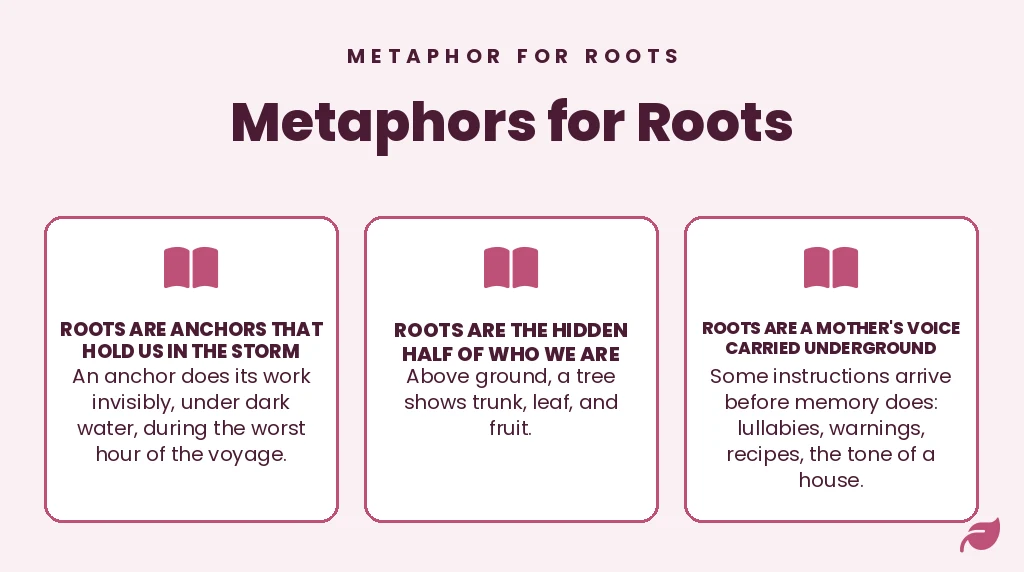
A tree can lose every leaf it owns and still not be finished, because roots are anchors that hold us in the storm, gripping soil nobody sees. People work the same way. Roots are the hidden half of who we are, the part that decides whether we stand or scatter when the weather turns.
Roots give writers a language for belonging: family, homeland, childhood, faith, every force that feeds a person from underneath. The image carries weight in both directions, since roots can nourish a life or hold it painfully in place, and honest writing uses both truths.
Below are twenty original metaphors for roots, each with its meaning, a note on why it works, an alternative phrasing, and three short examples. You will also find brighter and darker variations, ready-made sentences, and usage tips. Students, writers, and speakers can take any of them straight into their own work.
Quick Metaphors for Roots
Short on time? Here is the full set in one quick list.
- Roots are anchors that hold us in the storm.
- Roots are the hidden half of who we are.
- Roots are a mother’s voice carried underground.
- Roots are memory stored in the dark.
- Roots are fingers gripping the earth.
- Roots are a well that never runs dry.
- Roots are old roads leading home.
- Roots are the foundation beneath the house of life.
- Roots are quiet promises kept in winter.
- Roots are a library buried in the soil.
- Roots are chains that feed instead of bind.
- Roots are the past drinking from tomorrow’s rain.
- Roots are a compass pointing back to where we began.
- Roots are stitches sewing us to our land.
- Roots are silent teachers beneath the noise.
- Roots are a river running underground.
- Roots are the bones of the tree.
- Roots are stories told without words.
- Roots are a blanket woven from generations.
- Roots are the reason the tree can dance in the wind.
Metaphors for Roots and Their Meanings
Each metaphor below comes with its meaning, a note on why it lands, and fresh examples. Read in order, or jump straight to the image your piece needs.
1. Roots Are Anchors That Hold Us in the Storm
Meaning
An anchor does its work invisibly, under dark water, during the worst hour of the voyage. Roots make the same promise to a person: when jobs, health, or luck start dragging, something below holds.
Why It Works
Storms test everything eventually, so the image needs no explanation. Readers have all felt the drag of a bad season and the relief of not drifting.
Alternative Expression
You can also say “a grip the weather cannot loosen.”
Examples in Writing
Formal Example: During the bank collapse, the family’s roots were anchors that held them in the storm of debt and rumor.
Casual Example: My roots are anchors in the storm. Village, cousins, church suppers: they keep me from floating off.
Creative Example: The lighthouse oak bent double each winter and straightened each spring, its anchor paid out deep in the hill.
2. Roots Are the Hidden Half of Who We Are
Meaning
Above ground, a tree shows trunk, leaf, and fruit. Below ground sits an equal architecture nobody applauds. Roots name our own unseen half: upbringing, wounds, habits of love, everything quietly deciding what shows.
Why It Works
The symmetry is satisfying and a little humbling. Readers like being reminded that the visible person is only half the evidence, in themselves and in everyone they judge.
Alternative Expression
A similar phrasing is “the underground biography.”
Examples in Writing
Formal Example: The novelist insisted her characters’ roots were the hidden half of who they are, written long before the plot begins.
Casual Example: He seems confident, but roots are the hidden half of who we are. His grandmother raised that man.
Creative Example: The garden kept its real autobiography underground, where the worms read it by touch.
3. Roots Are a Mother’s Voice Carried Underground
Meaning
Some instructions arrive before memory does: lullabies, warnings, recipes, the tone of a house. Roots carry a mother’s voice the same way, sound traveling through dark ground into everything that grows later.
Why It Works
Voice is intimate in a way advice on paper never is. The image explains why grown adults still hear a parent clearly decades after the house went quiet.
Alternative Expression
Writers also phrase it as “an echo fed through the soil.”
Examples in Writing
Formal Example: In the memoir, her roots were a mother’s voice carried underground, surfacing in every kitchen she ever cooked in.
Casual Example: My roots are basically my mother’s voice carried underground. I hear her every time I oversalt.
Creative Example: The sapling leaned toward the sound below the soil, where her voice still watered the dark.
4. Roots Are Memory Stored in the Dark
Meaning
Roots keep what the branches forget. Rings record drought years the leaves never mention, and people likewise store childhood summers, old addresses, and first languages in a dark archive beneath daily thought.
Why It Works
Storage is a humble, believable job, which keeps the metaphor grounded. Readers trust an image that admits remembering is slow, buried work rather than instant replay.
Alternative Expression
You might also write “an archive with no lights.”
Examples in Writing
Formal Example: For the diaspora community, roots are memory stored in the dark, preserved in recipes and half remembered songs.
Casual Example: Smell of rain on dust and I am eight again. Roots: memory stored in the dark, apparently.
Creative Example: The old elm kept the flood year filed underground, in a ring of wood no axe had ever read.
5. Roots Are Fingers Gripping the Earth
Meaning
Look at roots on a riverbank and the resemblance is hard to unsee: knuckles, tendons, a grip. The metaphor gives the earth a handhold and the tree a decision, to stay, made daily.
Why It Works
Hands are the body’s most expressive tools, so borrowing them makes roots feel active rather than passive. Staying becomes work, not default, which dignifies anyone who has chosen to remain.
Alternative Expression
The same grip appears as “a handshake the tree never releases.”
Examples in Writing
Formal Example: On the eroded cliff, the pines survive because their roots are fingers gripping the earth above the falling path.
Casual Example: My grandfather’s roots were fingers gripping the earth. Fifty years, same farm, floods and all.
Creative Example: The hillside held its breath as the roots tightened their fingers, knuckle by knuckle, against the sliding rain.
6. Roots Are a Well That Never Runs Dry
Meaning
A deep well serves a village through droughts that empty every pond. Roots work as that reserve inside a person: family, faith, or place, drawn on in the driest seasons of a life.
Why It Works
Everyone eventually meets a dry season, so the promise of a hidden reserve lands personally. The image also explains why rooted people panic less in public.
Alternative Expression
A plainer version is “a reserve under the house.”
Examples in Writing
Formal Example: Through three years of unemployment, his roots were a well that never ran dry, drawn on quietly by the whole street.
Casual Example: Her faith is a well that never runs dry. Bad news barely dents her.
Creative Example: The desert fig drank from a well no surface had seen, and fruited while the dunes argued about rain.
7. Roots Are Old Roads Leading Home
Meaning
Old roads do not appear on new maps, yet feet remember them. Roots function as those private routes: the way back to a grandmother’s kitchen, a first language, a version of yourself that still fits.
Why It Works
Homecoming is one of the oldest stories humans tell, so the road image arrives preloaded with feeling. Readers supply their own village, street, or doorstep instantly.
Alternative Expression
You can phrase it as “a footpath the heart remembers.”
Examples in Writing
Formal Example: For returning emigrants, roots are old roads leading home, followed by accent and appetite long before luggage.
Casual Example: That bakery smell is one of my old roads leading home. Two turns and I am ten.
Creative Example: The salmon of the family, she followed the old road uphill through three countries of weather, home smelling of rain.
8. Roots Are the Foundation Beneath the House of Life
Meaning
Nobody photographs a foundation, yet every wall votes on its quality daily. Roots play that role for a person: the early years and loyalties under everything built later, visible only when cracks appear.
Why It Works
Houses give the image engineering credibility. Readers understand settling, cracking, and underpinning, so the metaphor can discuss childhood or community without turning misty.
Alternative Expression
Writers sometimes say “the footings of a life.”
Examples in Writing
Formal Example: The counselor described early attachment as roots, the foundation beneath the house of life, best repaired before adding floors.
Casual Example: Therapy is basically checking the foundation beneath the house of life. Cheaper before the walls crack.
Creative Example: The house of her life leaned gently left, and all her money went, wisely, into the dark ground beneath it.
9. Roots Are Quiet Promises Kept in Winter
Meaning
Winter looks like abandonment above ground: bare branches, frozen soil, silence. Underground, roots keep working and keep faith with spring. The metaphor praises loyalty that continues without an audience.
Why It Works
The seasonal contrast does the persuading. Readers who have waited through a barren stretch, grief, illness, a slow career, recognize the discipline of staying alive quietly.
Alternative Expression
The same patience appears as “a vow the cold cannot cancel.”
Examples in Writing
Formal Example: The orchard’s roots are quiet promises kept in winter, honored each April in blossom the frost never sees coming.
Casual Example: Long distance friendships are quiet promises kept in winter. No calls for months, still solid.
Creative Example: Under the snow, the roots whispered their one word to each other, patient as monks: wait.
10. Roots Are a Library Buried in the Soil
Meaning
A library stores what a community cannot afford to lose. Roots store a family’s equivalent: names, remedies, warnings, jokes, the correct way to bury and to plant, catalogued in the dark.
Why It Works
Libraries command respect across cultures, so the comparison upgrades roots from mere origin to living reference desk. It suits elders especially well, and readers know it.
Alternative Expression
A similar phrasing is “an archive that feeds the tree.”
Examples in Writing
Formal Example: The anthropologist called the elders roots, a library buried in the soil, lost volume by volume as languages fade.
Casual Example: Ask Uncle Rahman anything about 1970. Roots are a library buried in the soil around here.
Creative Example: Each root tip turned a page of deep earth, reading the wet chapters the rain had written.
11. Roots Are Chains That Feed Instead of Bind
Meaning
Chains usually imprison. Roots reverse the insult: they hold a person in one place precisely so that place can feed them. The metaphor faces the ambivalence of belonging head on, grateful and restless at once.
Why It Works
Most adults feel both pulls, loyalty and wanderlust, sometimes in the same hour. An image that admits the tension earns more trust than one that only praises home.
Alternative Expression
You may also write “a rope that waters what it holds.”
Examples in Writing
Formal Example: The poet described her village roots as chains that feed instead of bind, resented in youth and defended in age.
Casual Example: Family business roots: chains that feed instead of bind. I complain every Friday, deposit every Saturday.
Creative Example: The vine wore its chain like a necklace of green iron, drinking through every link.
12. Roots Are the Past Drinking From Tomorrow’s Rain
Meaning
Roots reverse the usual direction of time. The oldest part of the tree feeds on weather that has not happened yet, which is a fair picture of heritage: ancestors sustained by hopes they aimed at us.
Why It Works
The time twist makes readers pause, and the pause is the point. It suits speeches about legacy, where the past and future must be shown holding hands.
Alternative Expression
The same hope appears as “yesterday, drinking from next spring.”
Examples in Writing
Formal Example: The founder called the endowment our roots, the past drinking from tomorrow’s rain, funding students not yet born.
Casual Example: Planting trees at my age is roots logic: the past drinking from tomorrow’s rain. I will never sit in that shade.
Creative Example: Deep under the drought, the old roots tasted a rain that existed, so far, only in the sky’s intentions.
13. Roots Are a Compass Pointing Back to Where We Began
Meaning
A compass needle always knows one direction. Roots give people a similar instrument, except theirs points backward: toward the place, people, and values that set their true north in the first place.
Why It Works
Navigation is a trusted everyday skill, so the image travels well. It also explains homesickness as measurement rather than weakness, which many readers find a relief.
Alternative Expression
A plainer version reads “a needle tuned to home.”
Examples in Writing
Formal Example: Abroad for thirty years, the surgeon’s roots remained a compass pointing back to where she began, guiding every return.
Casual Example: My roots are a compass pointing back. Great career here, but the needle never stops trembling north.
Creative Example: The compass in her chest had one letter on its face, worn smooth by a lifetime of checking.
14. Roots Are Stitches Sewing Us to Our Land
Meaning
A stitch joins two pieces of cloth so they move as one. Roots join a person to a place the same way, seam by seam: births, burials, harvests, until separating the two tears both.
Why It Works
Sewing is patient, domestic, and repairable, three qualities migration stories need. The image also honors the mostly invisible labor, often women’s, that keeps families attached.
Alternative Expression
Writers also say “a seam between person and place.”
Examples in Writing
Formal Example: In the valley, roots are stitches sewing families to the land, each generation’s graves tightening the seam.
Casual Example: Thirty years abroad and the stitches hold. Roots sewing us to our land do not care about passports.
Creative Example: The needle of the roots went in at her christening and came out at her wedding, same soil, finer thread.
15. Roots Are Silent Teachers Beneath the Noise
Meaning
The loudest lessons get the credit, but the lasting ones arrive quietly from below: a grandfather’s patience, a street’s manners, a kitchen’s rules. Roots teach without lectures, by supplying the same example daily.
Why It Works
Readers distrust being lectured, so a teacher who works in silence feels credible. The image also flatters elders and hometowns without turning them into statues.
Alternative Expression
The same idea appears as “lessons delivered by water and soil.”
Examples in Writing
Formal Example: The headmaster called the village’s roots silent teachers beneath the noise, shaping graduates long before examinations did.
Casual Example: Nobody lectured us about honesty. Roots are silent teachers beneath the noise; we just watched the grown ups.
Creative Example: Beneath the market’s shouting, the roots taught their slow curriculum: hold on, share water, wait for spring.
16. Roots Are a River Running Underground
Meaning
Some rivers vanish into limestone and travel for miles in darkness before rising in a spring. Roots move a person’s sustenance the same way: unseen for years, then surfacing as strength at exactly the right address.
Why It Works
Hidden rivers are real and a little magical, a combination readers enjoy. The image suits faith, ancestry, and any influence that skips the surface entirely.
Alternative Expression
You can phrase it as “a current running beneath the floor of a life.”
Examples in Writing
Formal Example: Her charity work drew on roots like a river running underground, rising without warning in other people’s emergencies.
Casual Example: Where did that calm come from? Roots. A river running underground, apparently.
Creative Example: The family fortune in kindness traveled dark for two generations, then rose, clear and cold, in the granddaughter’s hands.
17. Roots Are the Bones of the Tree
Meaning
Strip a tree of bark, leaf, and fruit and the shape that remains underground would still declare what it was. Roots are that skeleton: the structure identity keeps even when every decoration is gone.
Why It Works
Bones suggest both strength and mortality, a useful double note. The image suits writing about aging, where the surface changes daily and the structure quietly persists.
Alternative Expression
A similar phrasing is “the skeleton that drinks.”
Examples in Writing
Formal Example: Botanists exposed by the storm, the roots, bones of the tree, showed a century of drought and repair.
Casual Example: Move countries and the accent softens. Roots are the bones, though. Those do not remodel.
Creative Example: The skeleton under the orchard dreamed in rings, each bone remembering a summer of apples.
18. Roots Are Stories Told Without Words
Meaning
A root system records floods, fires, and fat years in pure shape, no sentences anywhere. Families do the same: the real history lives in gestures, recipes, and silences long before anyone writes a memoir.
Why It Works
The paradox, stories without words, hooks attention fast. It also validates readers whose families never explained themselves, only demonstrated, dinner by dinner.
Alternative Expression
Writers sometimes say “a memoir written in wood.”
Examples in Writing
Formal Example: The historian treated the vineyard’s roots as stories told without words, evidence older than the parish registers.
Casual Example: Our roots are stories told without words. Nobody explains the feud; the seating chart at weddings does.
Creative Example: The ancient hedge narrated itself root by root, a saga for worms, patient and unabridged.
19. Roots Are a Blanket Woven From Generations
Meaning
A blanket made by many hands carries each maker’s pattern into one warmth. Roots wrap a person the same way: grandparents’ sacrifices, parents’ warnings, a whole ancestry of small protections, worn daily and rarely noticed.
Why It Works
Blankets mean childhood safety to almost everyone, so the image warms instantly. It also credits ancestors with practical love rather than abstract pride.
Alternative Expression
The same warmth appears as “a quilt of ancestors.”
Examples in Writing
Formal Example: At the citizenship ceremony, the speaker called heritage roots, a blanket woven from generations, carried into a new country.
Casual Example: Moving out, I missed the blanket woven from generations most. Nobody here pre worries about me.
Creative Example: She wrapped the child in the old blanket, squares of a wedding dress, a uniform, a curtain, until the pattern held.
20. Roots Are the Reason the Tree Can Dance in the Wind
Meaning
A tree that cannot bend will snap, and a tree without roots cannot bend safely. The metaphor completes the circle: deep roots are not the opposite of movement. They are what makes joyful movement possible.
Why It Works
The ending surprises readers who filed roots under stillness and duty. It reframes heritage as the permission slip for freedom, a hopeful note to build conclusions on.
Alternative Expression
You might also write “anchored, therefore free to sway.”
Examples in Writing
Formal Example: The choreographer’s memoir argues that discipline and roots are the reason the tree can dance in the wind, onstage and off.
Casual Example: Strong roots are the reason the tree can dance in the wind. Same with people. Settled folks play best.
Creative Example: All October the orchard danced, reckless and golden, because a hundred years of roots held the floor.
Positive Metaphors for Roots
Roots carry some of the warmest meanings in the language. These six images keep the mood grateful and steady.
- Roots are a kitchen light left on for travelers. It turns heritage into welcome and guidance.
- Roots are a pantry stocked by ancestors. It suggests help prepared long before you needed it.
- Roots are a choir singing under the floor. It makes background support feel alive and joyful.
- Roots are a savings of summers. It frames the past as wealth you can spend in winter.
- Roots are a bridge built backward into love. It pictures heritage as connection, not weight.
- Roots are warm hands under cold soil. It gives the past a gentle, living touch.
Negative Metaphors for Roots
Belonging has a shadow side, and honest writing should visit it. The six images below darken roots for heavier scenes.
- Roots are a cage buried too deep to see. It warns that belonging can quietly become confinement.
- Roots are old debts written in soil. It suggests obligations inherited without consent.
- Roots are a flood that will not drain. It captures a past that drowns new growth.
- Roots are knots in the spine. It turns heritage into pain carried in the body.
- Roots are a verdict handed down before birth. It complains that origins can limit a whole life unfairly.
- Roots are weeds in somebody else’s garden. It describes feeling unwanted in a place you did not choose.
Metaphors for Roots in Sentences
The table below puts six of the metaphors to work in finished sentences, with a short note on what each one tells the reader.
| Example sentence | What it communicates |
|---|---|
| When the factory closed, her roots were the reason the tree could dance in the wind; she retrained at forty. | Deep foundations allowing bold change. |
| His roots are a library buried in the soil, and every grandchild borrows from it. | Elders as living stores of knowledge. |
| The marriage struggled because his roots were chains that fed instead of bind. | Belonging that both sustains and confines. |
| Three generations on, the family’s roots remain a compass pointing back to a village none of them has seen. | Heritage guiding identity from a distance. |
| She treated her childhood roots as a well that never runs dry, drawing courage in every crisis. | Origins used as a reserve of strength. |
| The memoir opens with roots as fingers gripping the earth: one farm, five droughts, no surrender. | Stubborn attachment to land and home. |
How to Use Metaphors for Roots Naturally
Match the root to the relationship. Family pieces lean on the blanket woven from generations or the mother’s voice carried underground. Place based writing suits old roads leading home and stitches sewing us to our land. Identity essays can hold the hidden half of who we are up to the light.
Balance the weight. Roots turn solemn fast, so give the reader air: a dancing tree after a paragraph about anchors, a river running underground after heavy talk of foundations. Solemnity in small doses reads as depth. Solemnity by the bucket reads as a lecture.
When revising, ask what your roots are doing in the scene: feeding, holding, teaching, or trapping. Each job suggests its own image from this list. Delete any root that does no job at all. A working metaphor, like a working root, should be quietly carrying water somewhere.
Metaphor vs. Simile: What Is the Difference?
A metaphor identifies the thing outright: her roots were a well that never ran dry. A simile compares with a safety rail: her confidence ran deep, like roots under a house. The metaphor claims identity. The simile claims resemblance, which sounds humbler and sometimes more believable.
Choose by voice. A grandmother narrating family history can state metaphors as plain fact, because to her they are. A journalist profiling strangers may prefer similes, which keep a respectful distance from other people’s inner lives. The grammar is small; the manners are not.
Same idea, two outfits. Metaphor: “His roots were old roads leading home.” Simile: “His memories pulled him like old roads leading home.” The road survives both versions. The metaphor simply moves the traveler inside the picture.
Common Mistakes When Writing Root Metaphors
- Pretending roots are only positive: readers who feel trapped by family or hometown will stop trusting you. Admit the chains and the cages, and your praise of anchors will sound earned.
- Mixing root images mid paragraph: an anchor that is also a library and a blanket in three sentences tangles the reader. One root system per scene is plenty.
- Making roots sound like destiny: origins explain a person; they should not sentence them. Leave room in the sentence for choice, weather, and luck, or the metaphor turns into a cage of your own making.
- Ignoring the underground half: roots work because they are hidden. If your image behaves like a billboard, it has lost the quiet, buried quality that made it trustworthy.
- Using roots as decoration on unrelated topics: a paragraph about tax policy does not need a family tree. Save the image for belonging, memory, and identity, where its water actually reaches.
Frequently Asked Questions
What is a good metaphor for roots?
A good root metaphor depends on your subject. For family, try a blanket woven from generations. Personal strength, use a well that never runs dry or anchors that hold in the storm. For homelands, old roads leading home rarely fails. Choose the image that matches what your roots do in the piece: feed, hold, teach, or trap.
What do roots symbolize in literature?
In literature, roots usually symbolize origins, belonging, heritage, and the hidden forces that shape a character. They can stand for family, homeland, faith, or childhood, and they often carry a double meaning: nourishment and confinement at once. That tension is useful, because most characters feel both gratitude and restlessness toward where they began.
How do I write about feeling rootless?
Describe the missing machinery. A tree in a pot, a compass with no needle, a house resting on sand: each image shows what absence of roots feels like. Then contrast it with one remembered root, a voice, a recipe, a street, so the loss has a shape. Readers understand rootlessness fastest when something specific is gone.
What is the difference between roots as a metaphor and roots as a symbol?
A metaphor borrows roots for one comparison: her roots were a compass. A symbol lets roots stand for a whole theme across a work, returning in chapter after chapter until they mean belonging itself. Short pieces usually need only the metaphor. Novels and memoirs can grow the symbol slowly, the way real roots grow, underground and over years.
Can roots be a negative metaphor?
Yes, and honest writing needs the negative versions. Roots can be chains, cages, old debts, or a verdict handed down before birth, describing families and hometowns that confine instead of feed. Using one shadowed image among brighter ones keeps the piece believable, because most readers feel both gratitude and friction toward their own origins.
Conclusion
Roots remind us that nothing tall grows from nothing. The visible life, career, character, courage, is the smaller half of the story, and the buried half deserves good sentences too. If family is the soil your piece grows in, you will find more material in these metaphors for family.
Keep your roots working: feeding, holding, teaching. Let them stay a little mysterious, the way real roots are. And when you want the wider landscape your tree stands in, browse these metaphors for nature for the world above and below the ground.