You knock once. Nobody answers. The past is a closed door, and the past is a river that has flowed on while you stood watching from the bank. Most of us know that feeling. A school hallway. A kitchen that smelled of Sunday lunch. Yesterday sits close and far away at the same time, and plain words often fail to hold it.
Metaphors give yesterday a shape you can actually see. Instead of saying a memory feels distant or heavy, you can show a shadow, an anchor, or a garden gate, and a reader feels the weight at once. One strong image can carry regret, gratitude, relief, or longing in a single line.
Below you will find twenty original metaphors for the past, each unpacked with its meaning, the reason it lands, a softer alternative, and three examples in formal, casual, and creative writing. After that come positive and negative sets, ready made sentences, and practical tips. Students can borrow the patterns, writers can adapt them for memoirs, and speakers can use them in talks.
Quick Metaphors for Past
Here is the full set at a glance, ready to scan before the deeper notes below.
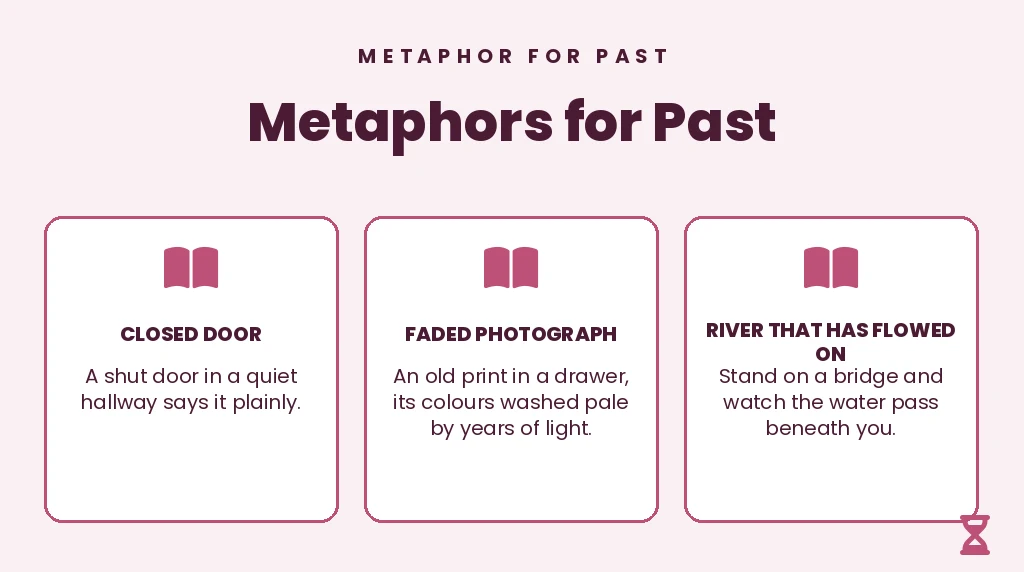
- The past is a closed door.
- The past is a faded photograph.
- The past is a river that has flowed on.
- The past is an echo in an empty room.
- The past is a shadow at sunset.
- The past is an anchor holding the ship.
- The past is a garden we no longer tend.
- The past is a road in the rearview mirror.
- The past is a book with a marked page.
- The past is autumn leaves underfoot.
- The past is a train that has left the station.
- The past is a footprint washed by the tide.
- The past is a house we have moved out of.
- The past is a song we still hum.
- The past is old ink on yellowed paper.
- The past is a bridge we have already crossed.
- The past is a box of letters in the attic.
- The past is a lesson written on a chalkboard.
- The past is a distant hill behind us.
- The past is a seed that grew into today.
Metaphors for Past and Their Meanings
Each metaphor below looks at yesterday from a different angle, because the past can feel finished, tender, heavy, or useful. Keep the images that fit your tone.
1. The Past Is a Closed Door
Meaning
A shut door in a quiet hallway says it plainly. What happened before is finished, and you cannot walk back into that room or that year.
Why It Works
Everyone has faced a door that would not open. The image carries finality without cruelty, suiting goodbyes and finished chapters.
Alternative Expression
For a gentler tone, try “that chapter has ended” instead.
Examples in Writing
Formal Example: In her farewell address, the principal said the past is a closed door and urged graduates to face the corridor ahead.
Casual Example: I miss that old job sometimes, but the past is a closed door, so I stopped rattling the handle.
Creative Example: He faced the past, a closed door with peeling paint, slipped the key into his pocket, and walked away.
2. The Past Is a Faded Photograph
Meaning
An old print in a drawer, its colours washed pale by years of light. The faces remain, but the sharp detail has softened, much like memory itself.
Why It Works
Photographs sit in nearly every family home, so the image feels personal at once. Fading suggests loss without disappearance, suiting tender memories of childhood and old friends.
Alternative Expression
A close cousin is “a memory worn soft at the edges.”
Examples in Writing
Formal Example: For the historian, the past is a faded photograph, clear enough to study yet too worn to reveal every detail.
Casual Example: Grandma at the beach, hair everywhere. The past is a faded photograph, but her laugh still comes through.
Creative Example: The past is a faded photograph between cookbook pages, two children grinning through a summer that lost its colour, not its warmth.
3. The Past Is a River That Has Flowed On
Meaning
Stand on a bridge and watch the water pass beneath you. That stretch is gone downstream in seconds, and it will never flow past that bridge again.
Why It Works
Moving water gives the past motion rather than stillness. Change feels natural here, which helps when writing about growing up.
Alternative Expression
You might also write “time has carried it downstream.”
Examples in Writing
Formal Example: The report noted that the past is a river that has flowed on, and the town must plan for today.
Casual Example: We cannot recreate those college nights. The past is a river that has flowed on, and we have changed.
Creative Example: The past is a river that has flowed on, carrying paper boats, lost gloves, and every word she never sent.
4. The Past Is an Echo in an Empty Room
Meaning
Shout in an empty hall and your voice returns thinner and stranger. Old events come back like that, repeated in memory but changed by distance.
Why It Works
Most people know sound fading in a bare room. The echo suits writing about grief and unfinished conversations.
Alternative Expression
A similar phrasing is “a voice that still rings in the walls.”
Examples in Writing
Formal Example: In the empty factory, the past is an echo in an empty room, recalling voices that once filled the floor.
Casual Example: I walked past our old classroom and heard the past, an echo in an empty room, all jokes and chalk dust.
Creative Example: The past is an echo in an empty room, calling her name in her father’s voice long after the house sold.
5. The Past Is a Shadow at Sunset
Meaning
Late light stretches your shadow long across the pavement, attached yet thin. Yesterday follows us that way, still connected to who we are but no longer solid.
Why It Works
Sunset brings a calm, reflective mood readers settle into quickly. A shadow suggests presence without substance, perfect for memories that shape our mood but hold no real power.
Alternative Expression
Try “yesterday trailing behind us like long light” for a softer touch.
Examples in Writing
Formal Example: The memoir closes by suggesting the past is a shadow at sunset, long and visible, yet fading before a new day.
Casual Example: The past is a shadow at sunset. It follows me, sure, but it gets thinner every day.
Creative Example: The past is a shadow at sunset, stretching across the harbour stones, touching everything and holding nothing.
6. The Past Is an Anchor Holding the Ship
Meaning
A heavy iron anchor digs into the seabed and the ship stays put. Old guilt, habits, and loyalties can hold a person in one place the same way.
Why It Works
Weight is something the body understands. The anchor makes an invisible problem physical, showing how yesterday can stop progress without any visible chain.
Alternative Expression
A plainer option is “old days keeping us in one place.”
Examples in Writing
Formal Example: The counsellor warned that the past is an anchor holding the ship when old blame blocks a fresh start.
Casual Example: The past is an anchor holding the ship for him. One old mistake keeps him from moving abroad.
Creative Example: The past is an anchor holding the ship in a grey harbour, while open water shines beyond the wall.
7. The Past Is a Garden We No Longer Tend
Meaning
Picture a garden gate hanging open, roses tangled, paths half hidden by weeds. Old friendships, hobbies, and homes often end up exactly like that garden.
Why It Works
Gardens grow through care and seasons, so the image shows neglect without blame. It suits gentle writing about drifting apart.
Alternative Expression
You could say “a place love has stopped visiting” instead.
Examples in Writing
Formal Example: Returning after twenty years, she found the past is a garden we no longer tend, its paths overgrown yet familiar.
Casual Example: Our old group chat is dead now. The past is a garden we no longer tend. Nobody waters it.
Creative Example: The past is a garden we no longer tend, where apple trees drop fruit for wasps and gates swing loose.
8. The Past Is a Road in the Rearview Mirror
Meaning
Glance up while driving and the road behind fills a small rectangle of glass, shrinking with every mile. Yesterday belongs there while life keeps moving forward.
Why It Works
Everyone knows the mirror is for quick glances, not the whole journey. That built in common sense suits speeches and any writing about moving forward with care.
Alternative Expression
A shorter form is “the road already travelled.”
Examples in Writing
Formal Example: The chief executive reminded staff that the past is a road in the rearview mirror, useful for guidance, not a destination.
Casual Example: Keep your eyes forward, love. The past is a road in the rearview mirror, and the drive goes on.
Creative Example: The past is a road in the rearview mirror, dust and diners and one red barn shrinking into blue distance.
9. The Past Is a Book With a Marked Page
Meaning
Every reader has folded one corner of a page they cannot forget. Our minds do the same with certain days, returning to that spot again and again.
Why It Works
Books make the past feel ordered, with chapters we can revisit in memory. The marked page explains why one moment stands out.
Alternative Expression
Try “a day the memory keeps bookmarked” for a single standout event.
Examples in Writing
Formal Example: For many veterans, the past is a book with a marked page, one date memory returns to with unusual clarity.
Casual Example: Ask him about the cup final and watch his face. The past is a book with a marked page there.
Creative Example: The past is a book with a marked page, dog eared and tear spotted, read again each winter by lamplight.
10. The Past Is Autumn Leaves Underfoot
Meaning
Crisp leaves crunch on the path, bright for a few weeks, then soft and part of the soil. Finished seasons of life behave the same way, quietly feeding whatever grows next.
Why It Works
Autumn is beautiful and a little sad at once, matching how most people view their earlier years. Fallen leaves also suggest renewal, since they nourish the ground.
Alternative Expression
A gentle swap is “seasons that have already turned.”
Examples in Writing
Formal Example: The essayist wrote that the past is autumn leaves underfoot for the village, beautiful in memory and feeding new growth.
Casual Example: School feels so far away now. The past is autumn leaves underfoot, crunchy, pretty, and definitely finished.
Creative Example: The past is autumn leaves underfoot on the lane home, red and gold giving way to rich dark earth.
11. The Past Is a Train That Has Left the Station
Meaning
Steam, noise, then an empty platform and rails shining into the distance. A missed chance or finished stage of life feels just like that departure.
Why It Works
Stations run on timing, making the image perfect for moments that cannot be rescheduled. It suits missed offers and late apologies.
Alternative Expression
You can also write “that moment has already departed.”
Examples in Writing
Formal Example: The minister accepted that the past is a train that has left the station and turned debate toward future policy.
Casual Example: I should have applied last spring. The past is a train that has left the station, so I look ahead.
Creative Example: The past is a train that has left the station, its red tail light shrinking while she holds an unsent letter.
12. The Past Is a Footprint Washed by the Tide
Meaning
Walk on wet sand and look back. Your prints stay clear for a minute, then a wave slides in and the sand turns smooth again.
Why It Works
Footprints prove someone was really there, while the tide proves nothing must stay marked forever. The seaside setting keeps the mood light, even when the idea is serious.
Alternative Expression
A similar image is “marks the sea has already smoothed away.”
Examples in Writing
Formal Example: Time has shown the scandal is a footprint washed by the tide, noted in records but no longer shaping debate.
Casual Example: That awkward speech I gave? The past is a footprint washed by the tide. Nobody remembers it except me.
Creative Example: The past is a footprint washed by the tide, a brief signature on morning sand the generous sea takes back.
13. The Past Is a House We Have Moved Out Of
Meaning
Boxes taped. Keys handed over. One last look at empty rooms where birthdays and ordinary Tuesdays happened. Earlier stages of life feel like that house, familiar and no longer ours.
Why It Works
Moving house is deeply emotional, so readers bring their own memories at once. Rooms suggest different periods of a life.
Alternative Expression
Try “rooms we no longer live in” for a shorter, softer version.
Examples in Writing
Formal Example: In the novel, the past is a house we have moved out of, revisited in memory but never again occupied.
Casual Example: Driving past my student flat felt odd. The past is a house we have moved out of, curtains changed, strangers inside.
Creative Example: The past is a house we have moved out of, its windows dark, its rooms still whispering our names at dusk.
14. The Past Is a Song We Still Hum
Meaning
A tune from years ago slips out while you wash dishes, uninvited and oddly welcome. Certain memories return that easily, carried by habit rather than effort.
Why It Works
Music sticks in the mind like nothing else, and humming is ordinary, warm, and slightly private. The image suits fond memories that surface during daily routines.
Alternative Expression
You might write “an old tune the heart refuses to forget.”
Examples in Writing
Formal Example: The speech closed by noting the past is a song we still hum, a shared tune binding generations together.
Casual Example: Every road trip, Dad starts singing that old hit. The past is a song we still hum in this family.
Creative Example: The past is a song we still hum in the supermarket queue, half forgotten verses rising like steam outside.
15. The Past Is Old Ink on Yellowed Paper
Meaning
Open a grandparent’s diary: the ink has browned, the pages smell faintly of dust. The words stay readable, yet those days belong to another age.
Why It Works
Paper and ink give the past texture, smell, and age in a single picture. It fits historical writing, family research, and stories built around discovered letters.
Alternative Expression
A close alternative is “words left behind on aging pages.”
Examples in Writing
Formal Example: In the archive, the past is old ink on yellowed paper, fragile to handle yet stubbornly clear to close readers.
Casual Example: I found Mum’s old recipe book, notes fading fast. The past is old ink on yellowed paper in our drawer.
Creative Example: The past is old ink on yellowed paper, love letters browning at the folds, still speaking across sixty silent years.
16. The Past Is a Bridge We Have Already Crossed
Meaning
A bridge joins two banks, and once you reach the far side, the crossing has done its job. Hard periods carry us from who we were to who we are.
Why It Works
Crossing suggests effort, courage, and a clear before and after, which readers find encouraging. The bridge honours the struggle without trapping anyone inside it.
Alternative Expression
Try “ground we crossed to get here” for a plain, grounded version.
Examples in Writing
Formal Example: The charity director said the past is a bridge we have already crossed, linking early hardship to today’s services.
Casual Example: Those broke early years built us. The past is a bridge we have already crossed, and I am not crossing back.
Creative Example: The past is a bridge we have already crossed, rope and timber swaying over dark water we no longer fear.
17. The Past Is a Box of Letters in the Attic
Meaning
Above the ceiling sits a box tied with string, full of handwriting from people young or long gone. We rarely open it, yet never throw it away.
Why It Works
An attic suggests storage rather than loss, giving the image a tender, private feel. Letters carry real voices, so it suits family secrets and grandparents’ lives.
Alternative Expression
A softer option is “keepsakes stored above our everyday lives.”
Examples in Writing
Formal Example: For the biographer, the past is a box of letters in the attic, evidence waiting patiently above modern noise.
Casual Example: We found Dad’s army letters yesterday. The past is a box of letters in the attic in our house.
Creative Example: The past is a box of letters in the attic, string bitten by mice, ink still declaring love bravely.
18. The Past Is a Lesson Written on a Chalkboard
Meaning
Chalk dust. A board full of sums, dates, and one underlined sentence the teacher wanted remembered. Our mistakes and wins leave instruction behind in much the same way.
Why It Works
Schoolrooms are shared ground for almost every reader, so the image feels fair and familiar. A chalkboard also hints that lessons can be wiped away once learned.
Alternative Expression
You could write “experience left its notes for us” instead.
Examples in Writing
Formal Example: The review concluded that the past is a lesson written on a chalkboard, and wise leaders study it first.
Casual Example: Losing that contract taught me plenty. The past is a lesson written on a chalkboard, and I took notes.
Creative Example: The past is a lesson written on a chalkboard in sunlit dust, one line underlined twice: be kinder, earlier.
19. The Past Is a Distant Hill Behind Us
Meaning
Walk far enough and the hill you climbed at dawn becomes a blue shape on the horizon. Big events shrink that way as life carries us forward.
Why It Works
Distance changes size, and every walker knows that truth in their legs. The hill gives scale to suffering or joy that once felt enormous, which comforts readers.
Alternative Expression
Try “high ground now far behind us” when relief is the focus.
Examples in Writing
Formal Example: A decade on, the crisis is a distant hill behind us, the speaker said, still visible but no longer frightening.
Casual Example: Exams felt like the end of everything then. Now the past is a distant hill behind us, and we laugh.
Creative Example: The past is a distant hill behind us, blue in evening haze, where two figures once shared an orange.
20. The Past Is a Seed That Grew Into Today
Meaning
A seed disappears into soil, splits, and becomes something far larger than itself. Our present lives grow out of earlier choices and kindnesses in that hidden way.
Why It Works
Growth makes the past feel alive and useful, not finished and gone. The seed explains cause and effect softly, and ends the set on hope.
Alternative Expression
A warm alternative is “roots feeding the tree we are now.”
Examples in Writing
Formal Example: The founder reflected that the past is a seed that grew into today, crediting early setbacks for the company’s patience.
Casual Example: Those Saturday lessons with Grandad made me. The past is a seed that grew into today, honestly.
Creative Example: The past is a seed that grew into today, a plum stone in dark soil becoming branches, blossom, and shade.
Positive Metaphors for Past
Not every look backwards has to hurt. Many people glance at earlier years with gratitude, for the lessons, the laughter, and the people who shaped them. The six fresh metaphors below keep that warm angle.
- The past is a lantern lighting the path ahead. It turns old experience into clear guidance for new choices.
- The past is a toolbox full of hard won lessons. It gives you something practical to reach for in a crisis.
- The past is a friendly teacher at your shoulder. It offers quiet advice without raising its voice.
- The past is a treasure chest of small good moments. It stores joy you can open and enjoy again.
- The past is a warm kitchen full of familiar smells. It comforts you with belonging and family warmth.
- The past is solid ground under your feet. It steadies every step you take into the future.
Negative Metaphors for Past
Sometimes yesterday refuses to stay politely behind us. It drags, it aches, it blocks the door. The six fresh metaphors below carry that heavier weight.
- The past is a heavy chain around your ankle. It makes every fresh start slow and painful.
- The past is a storm cloud that will not move. It keeps ordinary days grey and tense.
- The past is a locked room with no key. It traps you with questions nobody can answer.
- The past is a thorn that never worked loose. It causes a small sharp pain again and again.
- The past is a cold wind through a broken window. It finds you at night and steals your rest.
- The past is quicksand for your plans. It pulls bright ideas down before they can grow.
Metaphors for Past in Sentences
A metaphor earns its place inside a real sentence. The examples below drop six main images into natural lines, with a plain explanation beside each one.
| Example sentence | What it communicates |
|---|---|
| For the retired captain, the past is an anchor holding the ship, close to the harbour water. | Old habits and loyalty keep him in one place. |
| She told the class that the past is a lesson written on a chalkboard, and every mistake deserves a second look. | Earlier errors are teaching material, not a source of shame. |
| The past is a song we still hum in this house when family gathers in winter. | Shared memories return easily and warmly at family moments. |
| He accepted that the past is a train that has left the station, and booked a course for spring instead. | A missed chance is gone, so he takes a practical next step. |
| The past is a garden we no longer tend at the old farm, though roses still bloom each June. | A neglected place can still hold beauty after people move on. |
| Watching her children, she felt the past is a seed that grew into today. | Small early efforts grew into a full, rewarding present life. |
How to Use Metaphors for Past Naturally
Start with the feeling, not the image. Ask what yesterday should feel like in this piece: comforting, finished, heavy, instructive, or strangely close. A farewell speech might call for a closed door, while a family memoir suits a song we still hum. Formal writing prefers quiet pictures; creative writing can stretch further.
Match the intensity to the moment. A small regret does not need quicksand or chains, and a deep loss deserves more than a faded photograph. Place your metaphor where it will do real work. One strong image beats five weak ones scattered everywhere.
Revise with a cold eye. Read the paragraph aloud and listen for clutter: two metaphors fighting in one sentence, or an image stretched past its limit. Cut the weaker one. Keep surrounding sentences plain, because contrast makes figurative language shine.
Metaphor vs. Simile: What Is the Difference?
A metaphor makes a direct claim. It says one thing is another thing, with no safety net, so the past becomes a closed door, a river, or a seed. That boldness gives metaphors their power. The reader accepts the picture whole, instantly.
A simile takes the gentler road. It compares two things openly using like or as, so the past is described as being like a door. Similes feel clearer and more cautious, which suits teaching and younger readers. Neither tool is better in general; the right choice depends on your tone.
Here is the same idea both ways. As a metaphor: the past is a footprint washed by the tide. As a simile: the past fades like a footprint washed by the tide. The metaphor sounds settled and final. The simile sounds softer. Try both aloud, and keep the one matching your tone.
Common Mistakes When Writing Past Metaphors
- Mixing too many images: Calling the past a door, a river, and a train in one sentence confuses readers. Pick one picture per idea.
- Choosing the wrong weight: A tiny embarrassment does not need chains or quicksand. Match the size of the image to the size of the feeling.
- Explaining the picture to death: Long explanations drain the life from a good metaphor. Trust the reader.
- Repeating tired phrases: Lines seen a hundred times slide past without effect. Fresh images like a chalkboard or an attic box stay in the mind.
- Forcing metaphors everywhere: A metaphor in every paragraph feels strained. Plain sentences give figurative ones room to stand out.
Frequently Asked Questions
What is a metaphor for the past?
A metaphor for the past describes yesterday through a picture, such as a closed door, a faded photograph, or a river that has flowed on. Each image highlights one feeling about earlier times, like finality, tenderness, or steady change. Writers choose the picture that matches their point, then let readers feel the meaning quickly.
What are some positive metaphors for the past?
Positive metaphors present earlier times as helpful, warm, or full of gifts. A lantern lighting the path ahead suggests guidance, while a seed that grew into today suggests growth from small beginnings. A toolbox of lessons and solid ground under your feet frame the past as support rather than weight, suiting grateful, hopeful writing.
What are negative metaphors for the past examples?
Negative metaphors show earlier times holding someone back or causing pain. A heavy chain around your ankle suggests being trapped, and an anchor holding the ship suggests stalled progress. A locked room, a cold wind, and quicksand for your plans stress damage or delay. Writers use these images for regret, trauma, or warnings about old mistakes.
How can I use metaphors for the past in my writing?
Start by naming the feeling you want readers to share, such as relief, longing, gratitude, or regret. Then pick one image that carries that feeling and place it where the point matters most, often near the opening or closing lines. Keep the picture clear, use it sparingly, and let surrounding sentences stay plain and simple.
What is the difference between a metaphor and a simile for the past?
A metaphor states that one thing is another thing, so the past becomes a closed door in a single bold claim. A simile keeps the two ideas separate and compares them with like or as, so the past feels like a closed door. Metaphors sound firmer and more poetic, while similes sound gentler and clearer for learners.
Conclusion
Yesterday will always be part of the story. The trick is giving it the right shape on the page, a door, a river, a seed, or a song, so readers feel exactly what those years mean to you. If you enjoyed this set, keep exploring with our guide to metaphors for time, which covers hours, seasons, and whole lifetimes in vivid pictures.
Pick one metaphor from this list and use it this week, in an essay, a journal, or a letter. Small practice beats long study. And when you are ready to explore remembering itself, our collection of metaphors for memory is the natural next read. The past may be finished, but how you write about it is up to you.