A nightmare doesn’t knock politely. It builds a prison with no visible walls out of your own sleep and hires your own fears as guards. Or it’s a letter from your deepest fear, written in your own handwriting. Nothing is more personal than the terror we write against ourselves, nightly.
Retell a bad dream plainly and watch people’s eyes glaze over, because the plot was never the point. The power is in the images: the house that betrays you, the courtroom that convicts you, the phone you must not answer. A strong metaphor moves the dream’s feeling out of the sleeper and into the reader’s chest, where it belongs.
Here are twenty original metaphors for nightmares, from a wolf pack in the mind to a tax paid in the dark. Each comes with its meaning, why it works, an alternative, and examples, plus positive and negative shades, and sentences ready to use.
Quick Metaphors for Nightmares
If you need a vivid image for a bad dream quickly, start with this list of twenty nightmare metaphors.
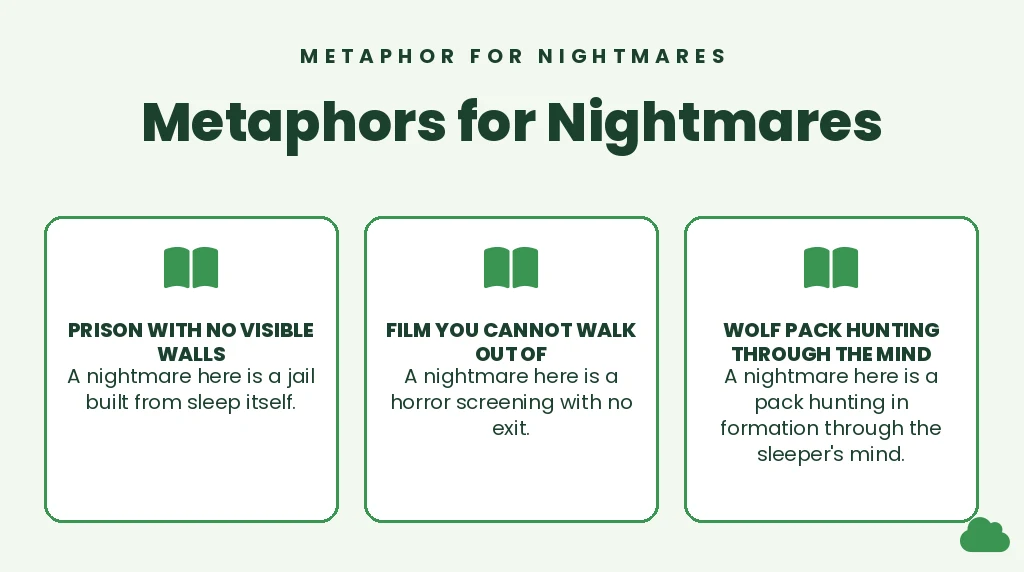
- A nightmare is a prison with no visible walls.
- A nightmare is a film you cannot walk out of.
- A nightmare is a wolf pack hunting through the mind.
- A nightmare is a house that rearranges its rooms.
- A nightmare is a letter from your deepest fear.
- A nightmare is a flood rising inside a locked room.
- A nightmare is a puppet show with the dreamer as the puppet.
- A nightmare is a mirror maze with something behind you.
- A nightmare is a storm that follows only you.
- A nightmare is a debt collector knocking at 3 A.M.
- A nightmare is a roller coaster with no safety bar.
- A nightmare is a shadow that learns your name.
- A nightmare is a fire alarm in a building with no exits.
- A nightmare is a courtroom where you are always guilty.
- A nightmare is quicksand disguised as a meadow.
- A nightmare is a phone call from a number you fear.
- A nightmare is a chess game against an opponent who cheats.
- A nightmare is a well with hands reaching up.
- A nightmare is a play where everyone knows your lines but you.
- A nightmare is a tax the mind pays in the dark.
Metaphors for Nightmares and Their Meanings
Each metaphor below comes with an explanation, why it works, an alternative, and three examples, from a child’s terror to a courtroom of guilt. They range from trapping to haunting, so you can match the dream to any character.
1. A Nightmare Is a Prison With No Visible Walls
Meaning
A jail, built out of sleep itself. The prisoner runs, shouts at doors that aren’t there, and hits walls made of pure dreaming.
Why It Works
Prisons mean helplessness, and a sentence. That’s a nightmare’s core terror: it ends when it chooses, not when you beg. Trauma writing, claustrophobic scenes.
Alternative Expression
Or serve time in “a cage whose key is morning,” the same locked night, opened only by waking.
Examples in Writing
Formal Example: The memoir describes the recurring nightmare as a prison with no visible walls, from which only the alarm clock could parole him.
Casual Example: My exam nightmare is a total prison. I am running down corridors that apparently belong to a school in another dimension.
Creative Example: The dream-jailer locks each sinner in a prison with no visible walls and feeds them their own memories.
2. A Nightmare Is a Film You Cannot Walk Out Of
Meaning
A horror screening with no exit signs. You watch the worst scenes your mind can cut together, and there’s no pausing, no looking away.
Why It Works
Films mean watching without power, which is the strange truth of dreaming: you observe your own terror. Modern writing, movie-like dreams.
Alternative Expression
Or channel “a broadcast tuned to your fears,” the same unwanted show, playing on every channel.
Examples in Writing
Formal Example: For the veteran, the nightmare was a film he could not walk out of, shown nightly in a cinema of one.
Casual Example: Brain, please. A film I cannot walk out of, starring my teeth falling out, again? Pick a new genre.
Creative Example: The demon projectionist screens a film you cannot walk out of, charging admission in hours of sleep.
3. A Nightmare Is a Wolf Pack Hunting Through the Mind
Meaning
A pack, hunting in formation through your head. One fear drives you toward the next, the way wolves turn a deer, patiently, taking turns.
Why It Works
Wolf packs coordinate. There’s no safe direction, which matches dreams where every escape route hides a fresh terror. Wild, survival-themed nightmares.
Alternative Expression
Or run from “a hunt where the forest itself helps the hunters,” the same closing circle of fear.
Examples in Writing
Formal Example: The trauma study describes her nightmares as a wolf pack hunting through the mind, each fear flushing her toward the next.
Casual Example: My nightmares hunt in packs. Miss one scary thing, and three more are waiting politely behind it.
Creative Example: In the border forests of sleep, a nightmare is a wolf pack hunting through the mind of the moon’s lost child.
4. A Nightmare Is a House That Rearranges Its Rooms
Meaning
Home, except it won’t stay mapped. Rooms move. Stairs end at walls. The house becomes a stranger that happens to wear your address.
Why It Works
Houses mean safety and memory, so a house betraying its owner cuts twice as deep. Domestic horror. Homes turned uncanny.
Alternative Expression
Or trust “a map that redraws itself nightly,” the same shifting ground, trusted and treacherous at once.
Examples in Writing
Formal Example: In the novel, the nightmare is a house that rearranges its rooms, and the heroine ages ten years finding one door.
Casual Example: Dream house again, except it rearranged everything. The bathroom was in the garden. The garden was somehow in the fridge.
Creative Example: The witch’s cottage is a house that rearranges its rooms, digesting guests slowly through its corridors.
5. A Nightmare Is a Letter From Your Deepest Fear
Meaning
Personal mail from the buried part of you. It arrives uninvited, written in your own handwriting, saying exactly what you refuse to read while awake.
Why It Works
Letters are addressed. They make the nightmare feel sent to you specifically, not random, which suits confessional writing and dreams begging interpretation.
Alternative Expression
Or hear “a whisper your own shadow delivers,” the same unwelcome message, impossible to return to sender.
Examples in Writing
Formal Example: The therapist suggested treating the nightmare as a letter from her deepest fear, and at last she opened it in daylight.
Casual Example: Apparently my nightmare was a letter from my deepest fear. It was mostly about deadlines, which is honestly rude.
Creative Example: At the bottom of the sea of sleep floats a letter from your deepest fear, sealed with black wax.
6. A Nightmare Is a Flood Rising Inside a Locked Room
Meaning
Water, rising in a sealed space. Panic climbs inch by inch, the exits turn out to be imaginary, and breath becomes a small, shrinking budget.
Why It Works
Floods rise steadily and don’t negotiate. That matches nightmares that tighten instead of jump. Anxiety dreams. Slow, inevitable terror.
Alternative Expression
Or drown in “a tide locked indoors with you,” the same climbing water, indifferent to pleading.
Examples in Writing
Formal Example: The patient’s nightmare was a flood rising inside a locked room, a perfect image, the doctor wrote, of unmanaged panic.
Casual Example: My stress dreams are that flood in the locked room. The water is made of emails. It is rising professionally.
Creative Example: The drowned city dreams a flood rising inside a locked room, and its bells toll slowly underwater.
7. A Nightmare Is a Puppet Show With the Dreamer as the Puppet
Meaning
A stage where invisible hands move your body for you. You run or fall on strings while the real you watches from inside, helpless.
Why It Works
Puppets mean stolen control, the exact sensation of dream logic driving your body. Sleep paralysis. Possession tales.
Alternative Expression
Or dance in “a dance choreographed by strangers,” the same borrowed body, moving to music you never chose.
Examples in Writing
Formal Example: After the accident, his nightmares became a puppet show with the dreamer as the puppet, and therapy slowly cut the strings.
Casual Example: In my nightmare I was a puppet giving a presentation. Something else had the strings and zero preparation.
Creative Example: The carnival of night stages a puppet show nightly, and the puppets, poor souls, are all former dreamers.
8. A Nightmare Is a Mirror Maze With Something Behind You
Meaning
A fairground labyrinth of reflections, with something else inside it. Every turn multiplies the false exits, and the footsteps behind you never quite match yours.
Why It Works
Mirror mazes confuse and pursue at the same time, a perfect dread engine. Thrillers. Dreams of being chased by yourself.
Alternative Expression
Or get lost in “a corridor of a thousand wrong doors,” the same multiplied confusion, with something counting your steps.
Examples in Writing
Formal Example: The thriller opens inside a nightmare built as a mirror maze with something behind you, and readers feel hunted for chapters.
Casual Example: My nightmare was a mirror maze, something was behind me, and every reflection of me was making worse decisions.
Creative Example: The funhouse at the fair of the dead is a mirror maze with something behind you, collecting reflections as tickets.
9. A Nightmare Is a Storm That Follows Only You
Meaning
Weather with a grudge. Everyone else stands in calm air while you’re rained on, followed around corners by your own private storm.
Why It Works
A personal storm means targeted misfortune, isolation, dreams where the world is fine and only you’re doomed. Depression writing. Dark comedy.
Alternative Expression
Or check “a cloud with your name on its list,” the same private weather, punctual and petty.
Examples in Writing
Formal Example: The memoir’s nightmare is a storm that follows only you, a precise image of grief in a room full of the cheerful.
Casual Example: Classic me nightmare: a storm that follows only me, while everyone else is having a picnic in the sunshine.
Creative Example: The weather witch brews a storm that follows only you, seasoning it with every umbrella you ever lost.
10. A Nightmare Is a Debt Collector Knocking at 3 A.M.
Meaning
An official of dread, calling in old emotional debts. Guilt and unfinished business knock after midnight, itemised, and impossible to reschedule.
Why It Works
Debt collectors drag the past into the present demanding payment, which is what most adult nightmares are really about. Guilt. Bureaucratic horror.
Alternative Expression
Or pay “a bill from the years you skipped,” the same old account, arriving with interest.
Examples in Writing
Formal Example: The widower’s recurring nightmare was a debt collector knocking at 3 A.M., demanding payment for every unsaid goodbye.
Casual Example: My nightmare debt collector knocks at 3 A.M. with a full invoice of embarrassing moments since 2009.
Creative Example: In the ledger city, the debt collector of nightmares knocks at 3 A.M., and even kings hide under their beds.
11. A Nightmare Is a Roller Coaster With No Safety Bar
Meaning
A thrill ride with the safety stripped out. The car climbs toward something unthinkable, and you, barless, can only sit there and watch it come.
Why It Works
Coasters mean speed and lost control; removing the bar removes the fun and keeps the physics. Panic dreams. Risk with no protection.
Alternative Expression
Or ride “a lift with a broken cable,” the same helpless plunge, waited for in silence.
Examples in Writing
Formal Example: The essay calls adolescence a roller coaster, but the nightmare version has no safety bar, and the comparison holds.
Casual Example: My anxiety dreams are a roller coaster with no safety bar and a conductor who keeps saying “nearly there.”
Creative Example: The carnival at the world’s end runs a roller coaster with no safety bar, and the queue stretches into yesterday.
12. A Nightmare Is a Shadow That Learns Your Name
Meaning
It starts as a shape. Then it gets personal: night by night it learns you better, until the terror isn’t pursuit anymore. It’s being known.
Why It Works
A shadow learning your name upgrades vague dread into intimate dread, horror’s scariest promotion. Recurring nightmares. Hauntings.
Alternative Expression
Or be studied by “a stranger memorizing your face,” the same growing familiarity, studied in the dark.
Examples in Writing
Formal Example: Across the novel’s dreams, the nightmare is a shadow that learns your name, and by the last chapter it speaks it aloud.
Casual Example: Recurring nightmare update: the shadow knows my name now. We are basically colleagues. I hate this job.
Creative Example: The thing in the cellar began as a shadow that learns your name and graduated, one night, to answering for you.
13. A Nightmare Is a Fire Alarm in a Building With No Exits
Meaning
An emergency signal in a building designed wrong. The sirens scream fire, but every corridor dead-ends, and every door turns out to be painted on.
Why It Works
Alarms supply the urgency; sealed exits supply the futility. Together: pure helpless panic. Workplace horror. School dreams.
Alternative Expression
Or just “a scream with nowhere to run,” the same emergency, echoing in a locked box.
Examples in Writing
Formal Example: The burnout memoir describes a recurring nightmare, a fire alarm in a building with no exits, as her mind’s honest annual report.
Casual Example: Work nightmare again: fire alarm, no exits, and my manager scheduling a meeting about the fire.
Creative Example: The asylum of embers keeps a fire alarm in a building with no exits, rung by the patients’ own hearts.
14. A Nightmare Is a Courtroom Where You Are Always Guilty
Meaning
A trial where the verdict was decided before you arrived. Everyone speaks in your voice, and nobody ever reads the charge aloud.
Why It Works
Courtrooms mean judgment and exposure. Rig one, and you get pure guilt with no appeal. Shame, conscience, the perpetually evaluated.
Alternative Expression
Or face “a mirror that hands down sentences,” the same self-judgment, robed and merciless.
Examples in Writing
Formal Example: The confession describes his nightmare as a courtroom where you are always guilty, and waking felt like a pardon.
Casual Example: Guilt brain held court again last night. I was guilty, the charge was vibes, and the judge was my mother.
Creative Example: In the underworld’s assizes sits a courtroom where you are always guilty, and the jury is everyone you disappointed.
15. A Nightmare Is Quicksand Disguised as a Meadow
Meaning
Beauty that swallows. You walk into a sunny field, smiling, and every step down is gentle, pleasant, and impossible to reverse.
Why It Works
Quicksand is slow betrayal by ground that looked solid, and the meadow makes it crueller. Addiction writing. Temptation tales.
Alternative Expression
Or descend “a staircase that only goes down,” the same soft descent, polite at every step.
Examples in Writing
Formal Example: The recovery memoir calls addiction a nightmare built as quicksand disguised as a meadow, entered in sunshine, understood too late.
Casual Example: My nap turned into quicksand disguised as a meadow. Pretty flowers, zero escape, classic trap, ten out of ten.
Creative Example: The siren’s pasture is quicksand disguised as a meadow, and its flowers bloom in the shapes of lost travelers.
16. A Nightmare Is a Phone Call From a Number You Fear
Meaning
A ringing phone carrying the one voice, or the one piece of news, you dread most. Answering isn’t optional. The conversation is worse than the ringing.
Why It Works
Phones mean contact you can’t escape, and a feared caller personalises dread instantly. Contemporary horror. Grief dreams.
Alternative Expression
Or feel “a knock from inside the pocket,” the same summons, vibrating against the ribs.
Examples in Writing
Formal Example: The short story’s nightmare is a phone call from a number you fear, ringing on a table in an empty childhood kitchen.
Casual Example: Dream phone rang, number I fear, and dream-me answered it. Woke up annoyed at both of us.
Creative Example: The switchboard of the dead routes one call nightly: a phone call from a number you fear, charged to your sleep.
17. A Nightmare Is a Chess Game Against an Opponent Who Cheats
Meaning
A match against an opponent who moves twice, rewrites the rules, and smiles while doing it. You play brilliantly. You lose anyway.
Why It Works
Chess is strategy and intellect, so a cheating opponent mocks your best tool: thinking itself. Control fears. Perfectionists.
Alternative Expression
Or enter “a race where the finish line runs away,” the same rigged contest, refereed by the opponent.
Examples in Writing
Formal Example: The chess champion’s nightmare is a game against an opponent who cheats, and she wakes exhausted, mid-defeat, every tournament week.
Casual Example: My nightmare opponent cheats at chess, moves my pieces, then offers me a rematch. Absolutely not, sir.
Creative Example: In the gaming hell of the abyss, every chess game is rigged, and the losers’ dreams are the house’s winnings.
18. A Nightmare Is a Well With Hands Reaching Up
Meaning
A deep, dark shaft that isn’t empty. Something down there wants company, and its reaching hands turn a fall into being pulled.
Why It Works
Wells hold depth and the buried past; hands make that depth actively hungry. Folk horror. Childhood terrors.
Alternative Expression
Or peer into “a grave that has not given up,” the same dark depth, still reaching for the living.
Examples in Writing
Formal Example: The village tale centers on a nightmare, a well with hands reaching up, retold every winter to keep children from the fields.
Casual Example: Dreamt of a well with hands reaching up. My subconscious has officially run out of subtlety.
Creative Example: Behind the sleeping village yawns a well with hands reaching up, waving, the shepherd swears, exactly like neighbors.
19. A Nightmare Is a Play Where Everyone Knows Your Lines but You
Meaning
A stage where the performance started without its lead. Every actor knows the lines perfectly. You stand there, lit, unprepared, and blank.
Why It Works
Stages mean exposure, and forgotten lines are dream life’s classic shame script. Performers. The chronically unprepared.
Alternative Expression
Or sit “an exam written in a language you invented,” the same public blankness, graded by the audience.
Examples in Writing
Formal Example: The actor’s memoir opens with a nightmare, a play where everyone knows your lines but you, recurring before every premiere.
Casual Example: The play nightmare returned. Everyone knew my lines. I did not know the play. Five stars, would panic again.
Creative Example: The theatre of the moon stages a play where everyone knows your lines but you, and the audience is last year’s selves.
20. A Nightmare Is a Tax the Mind Pays in the Dark
Meaning
The price sleep charges some minds for a peaceful day. All that composure you kept until bedtime gets audited after midnight, and paid for in terror.
Why It Works
Taxes are unavoidable dues, which turns a nightmare from an accident into a system. Burnout writing. Dark humour.
Alternative Expression
Or pay “rent collected by the dark,” the same nightly payment, demanded whether the day was kind or not.
Examples in Writing
Formal Example: The essay proposes the nightmare as a tax the mind pays in the dark, levied on everyone who smiled too bravely by day.
Casual Example: Fine, apparently nightmares are just the tax on being a functional adult. I would like a refund and a rebate.
Creative Example: The exchequer of night levies a tax the mind pays in the dark, and its collectors wear the faces of old teachers.
Positive Metaphors for Nightmares
Nightmares are not pure enemies. Some protect, rehearse, or release what the day suppressed. These six metaphors describe the nightmare’s useful side.
- A nightmare is a fire drill run by the mind. It rehearses your fears so the real alarm finds you ready.
- A nightmare is a pressure valve on the heart. It vents the day’s steam before the boiler of sleep bursts.
- A nightmare is a guard dog dreaming on duty. It barks at shadows so you can rest behind its noise.
- A nightmare is a letter of warning from tomorrow. It posts your fears early so you can prepare for them.
- A nightmare is a sparring partner for courage. It lets you practice fear safely in a ring made of sleep.
- A nightmare is a storm that waters the garden of the mind. It terrifies the night and leaves the morning clearer.
Negative Metaphors for Nightmares
Most nightmares, though, earn their name: they trap, hunt, and exhaust. These six metaphors describe nightmares at their cruelest.
- A nightmare is a thief that steals tomorrow’s energy. It ransacks the night and leaves the day to pay.
- A nightmare is a rehearsal for a funeral. It dresses your loved ones in black and makes you watch.
- A nightmare is a bully who knows your schedule. It waits at the same corner every single night.
- A nightmare is a splinter buried in sleep. It turns every comfortable position into a small, sharp reminder.
- A nightmare is a flood that damages nothing but rest. It leaves the sleeper soaked, shaken, and quietly exhausted.
- A nightmare is a song you hate on endless repeat. It plays your worst chorus until morning mercifully skips it.
Metaphors for Nightmares in Sentences
Here are six of this article’s nightmare images inside real sentences, with a note on what each one communicates.
| Example sentence | What it communicates |
|---|---|
| During the trial, the lawyer’s nightmare was a courtroom where you are always guilty, and she woke rehearsing defenses. | Guilt and the fear of judgment. |
| His childhood nightmare, a well with hands reaching up, returned whenever he visited the village. | Old, buried fears resurfacing. |
| The pilot described her recurring nightmare as a roller coaster with no safety bar, flown blind. | Loss of control at dangerous speed. |
| After the breakup, his nightmare became a house that rearranges its rooms, always hiding the door to her old study. | A familiar world turned strange by loss. |
| The comedian jokes that her nightmare is a phone call from a number you fear, and the audience laughs in recognition. | Dread of one specific person or news. |
| In the poem, the nightmare is a shadow that learns your name, whispered first by the wind. | Fear becoming personal and close. |
How to Use Metaphors for Nightmares Naturally
Before you metaphor a nightmare, name its mechanism. Trapping, chasing, exposing, accusing? Traps want prisons, floods, courtrooms; chases want wolf packs and storms; exposure wants stages and mirrors. Let the mechanism pick the image.
Keep one foot in the sleeper’s body. A nightmare metaphor lands hardest beside a racing heart, a kicked-off blanket, a hand reaching for the light. Physical detail proves the dream happened to somebody, and readers believe the terror.
And let waking interpret the dream. One sentence of daylight, a therapist’s question, a lover’s joke, frames the whole metaphor. Nightmare writing that never wakes up exhausts people; a crack of morning makes the darkness readable.
Metaphor vs. Simile: What Is the Difference?
A metaphor makes the nightmare identical to its image: the nightmare was a courtroom where you are always guilty. The verdict and the dread belong to the dream itself, and the reader serves the sentence alongside the dreamer, until waking grants the pardon.
A simile keeps the comparison at arm’s length: the nightmare chased him like a wolf pack. Vivid, quick, ideal for a passing mention. But for a nightmare haunting a whole novel, the metaphor works harder.
Compare them directly. As a metaphor: “Her nightmare was a flood rising inside a locked room.” As a simile: “Her nightmare rose like a flood in a locked room.” The metaphor seals the exits. The simile at least lets the reader watch from higher ground.
Common Mistakes When Writing Nightmare Metaphors
- Stacking five horrors at once: A nightmare with wolves, floods, and a courtroom in one paragraph becomes noise. Real nightmares obsess over one terror, so give your metaphor a single, focused dread.
- Forgetting the dreamer’s helplessness: If your character fights the nightmare easily, the image lies. Nightmares work because control is gone, so keep doors locked, bars missing, and exits imaginary until waking.
- Making the nightmare random: A nightmare disconnected from the dreamer’s life is just decoration. Tie it to a fear, a guilt, or a memory your character carries, and the metaphor gains a pulse.
- Over-explaining the symbol: Announcing what every element means turns a nightmare into a lecture. Offer one light interpretation, perhaps, and let the images accuse each other in the dark.
- No waking contrast: All night and no morning flattens the effect. The ordinary world, tea, daylight, a familiar voice, is what proves how dark the dream was, so always include the return.
Frequently Asked Questions
What is a good metaphor for a nightmare?
Name the dream’s mechanism, and the metaphor follows. Trapped? A prison with no visible walls. Hunted? A wolf pack. Ashamed? A courtroom where you are always guilty. Match the image to how the dream behaves, then anchor it in the sleeper’s body and their reaction on waking.
How do writers describe nightmares in stories?
Writers build nightmares from one governing image, physical detail, and a sharp return to waking. They reach for metaphors of pursuit, confinement, and exposure, show the racing heart or the tangled sheets, then cut to ordinary morning light. The contrast is what makes readers feel it.
What do nightmares symbolize?
Nightmares usually symbolise whatever the waking mind avoids: unprocessed fear, guilt, grief, pressure. A chasing dream suggests avoidance. A trapped one, helplessness. An accusation dream points at conscience. And in real life, a nightmare is often just the brain rehearsing threats, doing its job badly lit.
What is the difference between a nightmare and a night terror?
A nightmare is a vivid, story-like bad dream in REM sleep that you usually remember on waking. A night terror happens in deep non-REM sleep, mostly in children: the sleeper may scream or sit up, yet recall nothing later. These metaphors fit remembered nightmares. Night terrors are a storm without a witness.
How can I write about my own nightmare?
Start with the single image that frightened you most, not the whole plot. Find its metaphor: a house rearranging its rooms, a debt collector at 3 A.M. Add what your body did. Then describe waking up. And keep the dream’s strange logic intact, because that illogic is the most believable part of any nightmare.
Conclusion
A nightmare is the mind at its most theatrical: a prison, a courtroom, a wolf pack, and a letter, all staged in the dark. The metaphors in this article give that theatre its scenery, from quicksand meadows to cheating chess games. For the gentler side of the same country, the images gathered for dreams make a natural next visit.
Choose the metaphor that matches your dreamer’s deepest pressure, anchor it in the body, and always let morning in at the end. When the waking fear behind the dream needs its own language, the collection devoted to fear will help you name it plainly. Write honestly, and readers will recognise their own nightmares.