Every person you’ve ever been still lives somewhere inside you, kept by memory: a river flowing backward while life rushes the other way. Some days it returns as a photograph fading at the edges. Other days it arrives whole, in color, with voices. Writing it well means finding images equal to both.
“She remembered her childhood.” “He could not forget.” Both say almost nothing about how remembering feels. A metaphor gives memory weight, texture, weather, geography. Now readers travel into a character’s past instead of merely hearing it exists, and nostalgia, grief, and gratitude turn visible.
Here are twenty original metaphors for memory, each with its meaning, why it works, an alternative phrasing, and examples in formal, casual, and creative writing. You’ll also find positive and negative sets, a sentence table, common mistakes, and frequent questions. For students, novelists, poets, and memoir writers.
Quick Metaphors for Memory
Here is the complete list at a glance, before we walk through each one.
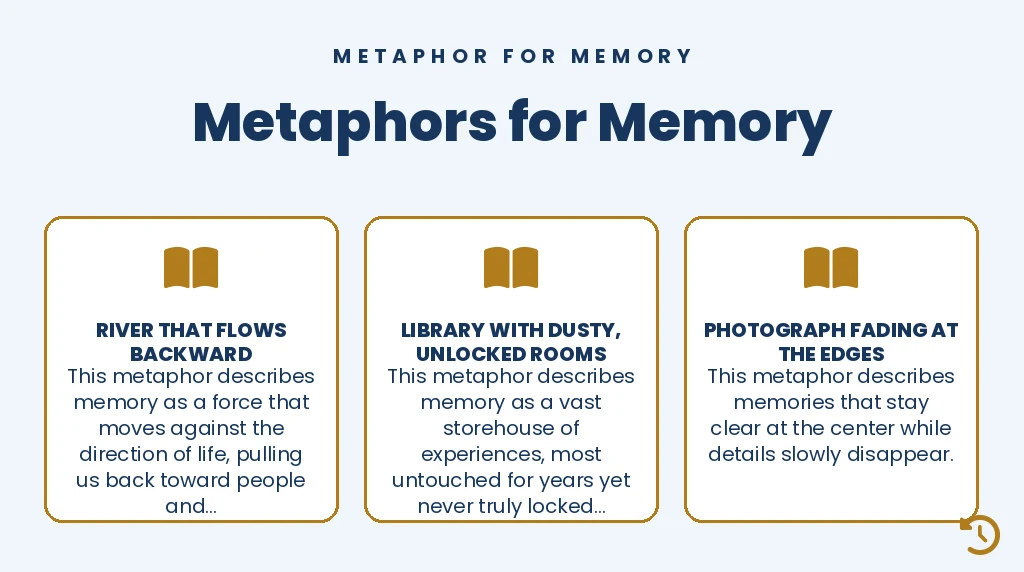
- Memory is a river that flows backward.
- Memory is a library with dusty, unlocked rooms.
- Memory is a photograph fading at the edges.
- Memory is a garden where old flowers keep blooming.
- Memory is a suitcase we carry everywhere.
- Memory is a mirror covered in gentle fog.
- Memory is a song the heart refuses to forget.
- Memory is a lighthouse flashing across the years.
- Memory is a tapestry with a few loose threads.
- Memory is a snow globe shaken by small moments.
- Memory is a museum only one person can visit.
- Memory is a train returning to stations long closed.
- Memory is a key that fits doors we thought were sealed.
- Memory is an echo answering from a distant hill.
- Memory is a patchwork quilt stitched from ordinary days.
- Memory is a candle that grief cannot blow out.
- Memory is a map with a few roads missing.
- Memory is a tide that keeps returning to the shore.
- Memory is a treasury guarded by the heart.
- Memory is a bridge between who we were and who we are.
Metaphors for Memory and Their Meanings
Below, every metaphor is explained with its meaning, why it works, a fresh alternative, and three examples. Take the ones that feel like your own past.
1. Memory Is a River That Flows Backward
Meaning
Life runs one way. Memory runs the other. It moves against the current of the years, pulling us back toward people and places we left behind: the natural image for reflection, homecomings, looking back.
Why It Works
Real rivers never flow backward, and that impossibility does the emotional work: remembering feels like defying time itself. The current also admits something true. We’re carried by memory more than we steer it.
Alternative Expression
Or run it uphill: “Memory is a tide running uphill toward childhood.”
Examples in Writing
Formal Example: In the memoir’s opening, memory is a river that flows backward, returning the author to a village the maps had forgotten.
Casual Example: One old song and suddenly memory is a river that flows backward, and I’m fifteen again.
Creative Example: Memory is a river that flows backward, and she waded into it barefoot, against the whole current of her life.
2. Memory Is a Library With Dusty, Unlocked Rooms
Meaning
Picture a vast storehouse: room after room of experience, most untouched for years, none truly locked away. That’s this memory, built for aging minds, family history, and the shock of sudden recall.
Why It Works
The dust admits neglect. The unlocked doors promise access. Any smell or song can swing open a room we forgot we owned, and that mix of loss and availability feels exactly like remembering does.
Alternative Expression
Or move it to the attic: “Memory is an attic where nothing was ever thrown away.”
Examples in Writing
Formal Example: The historian called the witness’s memory a library with dusty, unlocked rooms, accurate in chambers unvisited for fifty years.
Casual Example: Ask Grandpa about 1975 and watch memory become a library with dusty, unlocked rooms.
Creative Example: Memory is a library with dusty, unlocked rooms, and grief walks its corridors at night without a lamp.
3. Memory Is a Photograph Fading at the Edges
Meaning
The center stays clear. The edges go first. These are memories whose details slowly dissolve while the heart of them holds: old friendships, childhood scenes, faces of people we loved and lost.
Why It Works
Everyone has watched a photograph fade unevenly, the middle staying bright longest. Real forgetting damages us the same way. We keep the emotional center. We lose the edges. In that order.
Alternative Expression
Here’s the painting version: “Memory is a painting the sun keeps kissing lighter.”
Examples in Writing
Formal Example: The essay described his mother’s face as memory’s photograph fading at the edges, her laugh intact, her features softening.
Casual Example: I remember the trip, but the names are gone; memory is a photograph fading at the edges.
Creative Example: Memory is a photograph fading at the edges, and she holds it to the light like a negotiator every year.
4. Memory Is a Garden Where Old Flowers Keep Blooming
Meaning
Some pasts keep blooming. This is memory as a living place where old joys flower again on schedule, made for happy nostalgia, beloved traditions, the comfort of revisiting good years.
Why It Works
Flowers return by season without being replanted, and certain memories do too, arriving by holiday, scent, or anniversary. A garden implies tending as well: the memories we visit most bloom brightest.
Alternative Expression
Or plant an orchard: “Memory is an orchard that fruits in every season of life.”
Examples in Writing
Formal Example: For the retired teacher, memory was a garden where old flowers keep blooming, each class returning in its own color.
Casual Example: Every December, memory turns into a garden where old flowers keep blooming at our table.
Creative Example: Memory is a garden where old flowers keep blooming, and she walks it nightly, watering names.
5. Memory Is a Suitcase We Carry Everywhere
Meaning
We carry it into every new place, job, and relationship. Memory as baggage, quietly unpacking itself wherever we settle. Migrants know this one. Travelers too. Anyone whose past refuses to stay behind.
Why It Works
A suitcase is packed by us, yet its weight surprises us, and both things are true of memory. What we carry was once chosen. Even if we’d pack very differently now.
Alternative Expression
Another way to pack it: “Memory is a backpack whose straps we forget we’re wearing.”
Examples in Writing
Formal Example: The refugee’s testimony showed memory as a suitcase we carry everywhere, opened at every border of a new life.
Casual Example: New city, same old stories; memory is a suitcase we carry everywhere, apparently.
Creative Example: Memory is a suitcase we carry everywhere, and hers rattled with seashells, tickets, and one unsent letter.
6. Memory Is a Mirror Covered in Gentle Fog
Meaning
It shows us the past, and ourselves in it, but never clearly. Memory behind gentle fog suits self-reflection, disputed family stories, and the pasts we partly invent while remembering them.
Why It Works
A fogged mirror still reflects. It just softens and blurs every outline, which is precisely how honest memory behaves. And “gentle” keeps the image kind: this fog protects as much as it hides.
Alternative Expression
Or breathe on a window: “Memory is a window breathed on by time.”
Examples in Writing
Formal Example: The autobiographer warned readers that memory is a mirror covered in gentle fog, faithful in outline, generous in detail.
Casual Example: Ask three siblings about one holiday and you’ll see memory is a mirror covered in gentle fog.
Creative Example: Memory is a mirror covered in gentle fog, and she wipes it with her sleeve every time she misses him.
7. Memory Is a Song the Heart Refuses to Forget
Meaning
You can’t delete a song on command. These memories are carried as melody: emotional, repetitive, stubborn. First loves live here, childhood homes too, and the tunes that ambush us in supermarkets decades later.
Why It Works
Songs lodge in the mind without permission and come back with their feelings attached. Giving the remembering to the heart adds loyalty, as if love itself refused to do the forgetting.
Alternative Expression
Here’s the chorus version: “Memory is a chorus that follows us from room to room.”
Examples in Writing
Formal Example: In the eulogy, her laughter was called memory’s song the heart refuses to forget, still playing in every room of the house.
Casual Example: That wedding dance? Memory is a song the heart refuses to forget, and it still makes me tear up.
Creative Example: Memory is a song the heart refuses to forget, and his name was its chorus, returning without asking.
8. Memory Is a Lighthouse Flashing Across the Years
Meaning
It returns at intervals, bright and guiding, however much time passes: a parent’s advice at the right second, a narrow escape, a first success flashing across the years.
Why It Works
A lighthouse flashes on a rhythm, visible across great distances, keeping travelers safe. Guiding memories behave identically. They come back on schedule, whenever the waters around us get dark.
Alternative Expression
Or blink it like a star: “Memory is a star that blinks through decades of cloud.”
Examples in Writing
Formal Example: Her father’s warning became memory’s lighthouse flashing across the years, consulted at every risky crossroads.
Casual Example: Every time I’m tempted to quit, that one afternoon is a lighthouse flashing across the years.
Creative Example: Memory is a lighthouse flashing across the years, and she steers her whole life by its slow, patient beam.
9. Memory Is a Tapestry With a Few Loose Threads
Meaning
The story mostly holds together. Mostly. A few gaps, a few tangles, details that unravel when you pull them: that’s this memory, right for family histories and any past retold a hundred times.
Why It Works
Thousands of threads make one woven picture, so a single loose strand can’t destroy it. That balance, wholeness with damage running through it, matches memory better than any image of total loss.
Alternative Expression
Try the sweater instead: “Memory is a sweater snagged on the years.”
Examples in Writing
Formal Example: The biography treated the family’s past as a tapestry with a few loose threads, most of the pattern verifiable, some of it legend.
Casual Example: Grandma’s version of events is a tapestry with a few loose threads, but we love it anyway.
Creative Example: Memory is a tapestry with a few loose threads, and her brother tugs one every Christmas just to watch the pattern move.
10. Memory Is a Snow Globe Shaken by Small Moments
Meaning
Shake it and a whole world swirls. Tiny triggers stir up a preserved past all at once: reunions, old neighborhoods, keepsakes that release a flurry.
Why It Works
A snow globe holds a complete miniature scene, still until shaken, then briefly swirling with life. A smell or a street corner does the same to a dormant decade. Seconds, and it’s snowing indoors.
Alternative Expression
Or seal it under glass: “Memory is a sealed garden under glass, waiting for a tap.”
Examples in Writing
Formal Example: The novelist showed memory as a snow globe shaken by small moments, a single street sign releasing an entire childhood.
Casual Example: The smell of rain on hot pavement shakes my memory like a snow globe every single summer.
Creative Example: Memory is a snow globe shaken by small moments, and the old house key turned her whole past upside down.
11. Memory Is a Museum Only One Person Can Visit
Meaning
Admission: one. Each of us curates exhibits nobody else can fully enter, and that privacy shapes this memory. It suits loneliness, misunderstandings between generations, and the limits of close love.
Why It Works
A museum is organized, labeled, preserved. This one admits a single visitor, forever. That one twist captures both the sadness and the dignity of an inner life.
Alternative Expression
A one-seat cinema works too: “Memory is a cinema with one seat, always occupied by its owner.”
Examples in Writing
Formal Example: The philosopher argued that memory is a museum only one person can visit, which is why testimony always arrives incomplete.
Casual Example: I can describe the house all day, but memory is a museum only one person can visit.
Creative Example: Memory is a museum only one person can visit, and he walks its quiet halls every night before sleep.
12. Memory Is a Train Returning to Stations Long Closed
Meaning
The train still runs, even where the town is gone. This memory revisits places and periods that no longer exist: changed hometowns, finished eras, people we can only meet in the past.
Why It Works
A train follows fixed tracks and stops at stations in order, like memories arriving in sequence whether we booked the journey or not. The closed stations carry the grief, gently.
Alternative Expression
Or catch the bus version: “Memory is a bus that still stops at demolished streets.”
Examples in Writing
Formal Example: The documentary followed the exile’s memory as a train returning to stations long closed, each platform renamed by new rulers.
Casual Example: Driving past my old school, memory becomes a train returning to stations long closed.
Creative Example: Memory is a train returning to stations long closed, and she rides it nightly, waving at platform ghosts.
13. Memory Is a Key That Fits Doors We Thought Were Sealed
Meaning
One detail comes back, and a whole lost period swings open behind it. This memory belongs to therapy breakthroughs, found letters, and conversations that finally unlock a family’s silence.
Why It Works
A key is small, specific, and useless until it meets its exact lock. One name or date works the same way, restoring a thousand scenes at once. The surprise of the fit is the charge.
Alternative Expression
Try the password version: “Memory is a password the heart kept without telling us.”
Examples in Writing
Formal Example: In therapy, a single song became memory’s key that fits doors we thought were sealed, opening the whole summer of 1987.
Casual Example: Finding Mom’s old letters was a key that fits doors we thought were sealed.
Creative Example: Memory is a key that fits doors we thought were sealed, and the attic smell turned it before she could stop it.
14. Memory Is an Echo Answering From a Distant Hill
Meaning
It comes back thinner, later, changed. Memories returning like a voice off a distant hillside, weakened and delayed, suit distant childhood and the stories ancestors handed down.
Why It Works
An echo is unmistakably the original sound, yet thinner, later, altered by distance. The past answers us exactly like that: truly ours, never at full volume.
Alternative Expression
Or listen across a valley: “Memory is a voice returning across a wide valley.”
Examples in Writing
Formal Example: The poet heard his grandfather’s proverbs as memory’s echo answering from a distant hill, fainter each decade, never silent.
Casual Example: I can’t recall her exact words anymore; memory is an echo answering from a distant hill now.
Creative Example: Memory is an echo answering from a distant hill, and she calls her childhood’s name just to hear it return.
15. Memory Is a Patchwork Quilt Stitched From Ordinary Days
Meaning
Not the big events. The ordinary ones, hundreds of them, sewn edge to edge. That’s how a life gets remembered here, and it suits family warmth and long friendships best.
Why It Works
A patchwork quilt is made from scraps, each carrying its own story, and together they give warmth. The image honors small moments and calls memory what it is: handmade, with love.
Alternative Expression
Here’s the blanket version: “Memory is a blanket sewn from yesterday’s shirts.”
Examples in Writing
Formal Example: The oral history presented the village’s memory as a patchwork quilt stitched from ordinary days, no single square telling the whole story.
Casual Example: What do I remember? Mostly small stuff; memory is a patchwork quilt stitched from ordinary days.
Creative Example: Memory is a patchwork quilt stitched from ordinary days, and she sleeps under every summer she has ever had.
16. Memory Is a Candle That Grief Cannot Blow Out
Meaning
Small flame, undefeated. A loved one’s memory persisting through bereavement, fragile and still burning, is what this one holds. Eulogies reach for it. So does any writing about love outliving death.
Why It Works
A candle is the traditional image of remembrance at vigils, so readers arrive carrying their own rituals. Saying grief can’t blow it out turns a fragile flame into quiet defiance.
Alternative Expression
Or keep the pilot light: “Memory is a pilot light burning in the house of the heart.”
Examples in Writing
Formal Example: The eulogy called her memory a candle that grief cannot blow out, still lit in every kitchen she ever blessed.
Casual Example: Ten years on, his jokes still land; memory is a candle that grief cannot blow out.
Creative Example: Memory is a candle that grief cannot blow out, and the whole family shelters its flame with cupped hands.
17. Memory Is a Map With a Few Roads Missing
Meaning
Mostly reliable guidance, some routes simply gone. Memory like a map with roads missing fits aging, and honest witnesses, best.
Why It Works
A map with missing roads is still useful, which keeps the image fair rather than tragic. It also builds a story: the traveler improvises exactly where the record fails.
Alternative Expression
A tired compass also works: “Memory is a compass with a slightly tired needle.”
Examples in Writing
Formal Example: The witness was candid that his memory was a map with a few roads missing, certain of the city, unsure of two streets.
Casual Example: I remember the wedding, not the seating plan; memory is a map with a few roads missing.
Creative Example: Memory is a map with a few roads missing, and she drives the gaps by instinct and starlight.
18. Memory Is a Tide That Keeps Returning to the Shore
Meaning
It withdraws. It returns. On its own schedule, no matter how settled we feel. Memories like a tide suit grief and first loves, any past that revisits us in waves instead of asking permission.
Why It Works
Nobody commands the tide. It leaves, it returns, and it carries things to the shore each time. Absence, then return: a true rhythm of remembering, if ever there was one.
Alternative Expression
Or let the moon pull: “Memory is the moon pulling at the heart’s water.”
Examples in Writing
Formal Example: The grief counselor explained that memory is a tide that keeps returning to the shore, strongest at anniversaries and quiet evenings.
Casual Example: Most days I’m fine, but memory is a tide that keeps returning to the shore.
Creative Example: Memory is a tide that keeps returning to the shore, and it leaves her name in wet sand every morning.
19. Memory Is a Treasury Guarded by the Heart
Meaning
Precious, and guarded like it. These are memories protected with instinctive loyalty, shared only with people who’ve earned them.
Why It Works
A treasury implies value chosen and defended, never random storage. Naming the heart as its guard joins emotion to duty: we protect these memories because we love them.
Alternative Expression
Or lock it in a vault: “Memory is a vault where love keeps its gold.”
Examples in Writing
Formal Example: The heirloom’s story showed memory as a treasury guarded by the heart, opened only at weddings and funerals.
Casual Example: She doesn’t share those years with just anyone; memory is a treasury guarded by the heart.
Creative Example: Memory is a treasury guarded by the heart, and grandchildren are slowly being given the combination.
20. Memory Is a Bridge Between Who We Were and Who We Are
Meaning
One structure, two selves. Memory as the bridge between who we were and who we are suits coming-of-age stories and any reflection on identity.
Why It Works
A bridge joins two banks that would otherwise stay strangers. Memory does that work daily, letting the person we were keep talking to who we’re becoming.
Alternative Expression
Here’s the two-way road: “Memory is a road the self walks in both directions.”
Examples in Writing
Formal Example: The graduation speech called memory a bridge between who we were and who we are, asking students to cross it often.
Casual Example: Looking at old photos, you feel it: memory is a bridge between who we were and who we are.
Creative Example: Memory is a bridge between who we were and who we are, and she crosses it every night with bare feet.
Positive Metaphors for Memory
When the past is a comfort rather than a wound, reach for these warmer images of memory as a gift.
- Memory is a fireplace that warms every winter of life. It lets old joys keep heating the present long after they happened.
- Memory is a recipe box written in a mother’s hand. It preserves flavors, handwriting, and love in the same small cards.
- Memory is a choir that never fully disbands. It can raise a beloved voice again whenever the heart asks.
- Memory is an orchard planted by our younger selves. It feeds us in seasons we never expected to need feeding.
- Memory is a photo album that opens by itself on hard days. It arrives uninvited with exactly the comfort required.
- Memory is a lighthouse keeper who never retires. It keeps the lamps of old lessons lit for every new storm.
Negative Metaphors for Memory
Memory can also imprison, distort, and ambush. These six darker metaphors suit trauma and regret.
- Memory is a debt that collects interest in the dark. It grows heavier the longer we avoid paying attention to it.
- Memory is a room whose door only opens inward. It lets the past out, but never lets the present fully leave.
- Memory is a cracked record repeating the worst verse. It skips the good parts and circles the injury forever.
- Memory is a fog that thickens around the truth. It leaves shapes we recognize and details we can never prove.
- Memory is a chain disguised as a necklace. It looks like heritage and feels like weight.
- Memory is a landlord who raises the rent every year. It charges more and more peace for the same old rooms.
Metaphors for Memory in Sentences
The table below shows six of these metaphors inside complete sentences, with notes on what each communicates.
| Example sentence | What it communicates |
|---|---|
| Her memory was a river that flows backward, carrying her to the village she left at nineteen. | The pull of the past against present life. |
| The old photograph proved that memory is a photograph fading at the edges, clearest where love stood. | Details lost while the emotional center survives. |
| His memory was a museum only one person can visit, and even his wife toured it only by description. | The privacy and loneliness of inner life. |
| A whiff of cinnamon shook her memory, a snow globe shaken by small moments, and childhood swirled up. | Small triggers releasing a whole preserved world. |
| Their shared memory was a patchwork quilt stitched from ordinary days, warmer than any single triumph. | A life built from small moments, not events. |
| Years after the accident, memory remained a candle that grief cannot blow out in their home. | Remembrance persisting through bereavement. |
How to Use Metaphors for Memory Naturally
Choose by the memory’s temperature. Happy nostalgia suits gardens, quilts, and lighthouses; painful or unreliable recall suits fogged mirrors, missing roads, and echoes. Formal memoir can carry museums and treasuries, while everyday speech sounds truer with suitcases and tides.
Let intensity match the moment. A bridge between who we were and who we are is a theme-sized image; spending it on a forgotten phone number wastes it. Save large structures for identity and grief. Small ones, a key, a loose thread, carry everyday forgetting.
Trust one metaphor at a time, and revise around it. If memory is a river in the first line, don’t make it a museum three lines later; readers need one world to stand in. Read it aloud: does the image feel like remembering feels?
Metaphor vs. Simile: What Is the Difference?
A metaphor says memory is something else. A simile says memory is like something else. “Memory is a river that flows backward”: metaphor. “Memory is like a river flowing backward”: simile. The metaphor commits completely, which suits memory’s emotional weight.
Similes suit lighter writing. They sound conversational, help younger readers, and suggest an image without building a scene on it. Many memoirists mix both, saving full metaphors for the memories that define a chapter.
One memory, both forms. Metaphor: “Her memory was a garden where old flowers keep blooming, and every spring her childhood returned in color.” Simile: “Her memory was like a garden, where old flowers bloomed again each spring.” Only the confidence changes.
Common Mistakes When Writing Memory Metaphors
- Making memory perfectly accurate: Real memory fades, edits, and argues with itself. Fogged mirrors and missing roads are more honest than flawless recordings, and readers trust them more.
- Using only sad images: Not every memory is a wound. If every metaphor in a memoir is fog, chains, and storms, the happy years become unbelievable, so balance grief with gardens and quilts.
- Mixing storage images: Calling memory a library, then a suitcase, then a hard drive in one paragraph turns the mind into a junk shop. Pick one storage world and let the details agree.
- Forgetting that memory changes the rememberer: A good metaphor should show the past acting on the present person: a tide returns, a key unlocks, a bridge carries. Static treasure just sits there.
- Overexplaining the image: After “memory is a river that flows backward,” the reader already understands. Explaining the metaphor for three more sentences drains its power, so state it and move on.
Frequently Asked Questions
What is a good metaphor for memory?
It depends on how remembering feels: sweet, painful, or confusing. “Memory is a river that flows backward” suits reflection. “Memory is a garden where old flowers keep blooming” suits nostalgia.
How do you describe memories metaphorically?
Decide what the memory does. Does it return like a tide, unlock like a key, fade like a photograph? Then borrow an object behaving the same way. Add one small action, a snow globe shaken by a smell, and a claim becomes a scene.
What is a metaphor for forgetting?
Forgetting usually gets pictured as loss, erosion, or locked access. Strong options: “memory is a map with a few roads missing,” “memory is a photograph fading at the edges,” and “memory is an echo answering from a distant hill.” Each admits partial loss, not disappearance.
What is a metaphor for nostalgia?
Nostalgia calls for warm, golden, slightly aching images. A garden where old flowers keep blooming, a song the heart refuses to forget, a patchwork quilt stitched from ordinary days: sweetness, all three. If it hurts, add distance: an echo, a closed station.
Why do writers use metaphors for memory?
Memory is invisible, so writers need visible stand-ins for it. One metaphor can show memory storing, fading, returning, hurting, or guiding in a handful of words. It also shows how a character feels about their past, which “he remembered” can never reveal.
Conclusion
Memory is the quiet author behind every story we tell about ourselves, and it deserves images as layered as it is. Rivers, gardens, fogged mirrors, tides: each shows a different way the past stays alive. Because memory and dreaming share the same nighttime territory, you may also enjoy our guide to metaphors for dreams, where the sleeping mind tells its own version of yesterday.
Start with the metaphor that feels most like your own remembering, and let it shape a whole paragraph before you judge it. Ready to set those memories in motion? Continue with metaphors for journey, since every remembered road asks to be traveled again. The past is patient. Give it worthy language.