How do you describe someone whose life, teachings, and sacrifice have shaped the faith of millions? Ordinary descriptions can only go so far. In the Bible, Jesus is presented through powerful images that help people understand his character, mission, and relationship with humanity. He is called the Good Shepherd, the Light of the World, the Bread of Life, and the True Vine. Each metaphor reveals a different aspect of his spiritual significance.
A metaphor for Jesus does more than make religious language beautiful. It turns complex theological ideas into familiar pictures that readers can understand. A shepherd protects his flock, bread sustains life, and light helps people find their way through darkness. These everyday images make biblical teachings easier to remember and reflect upon.
In this article, you will discover 20 meaningful metaphors for Jesus, their biblical foundations, and their deeper interpretations. Whether you are studying Scripture, preparing a sermon, writing a school assignment, or exploring Christian symbolism, these examples will help you understand how figurative language communicates the message of Jesus.
What Is a Metaphor for Jesus?
A metaphor for Jesus is a figurative expression that describes his identity, character, or spiritual role through another person, object, or familiar image. Rather than offering a literal description, it communicates a deeper meaning through comparison.
For example, when Jesus says, “I am the light of the world” in John 8:12, light represents spiritual truth, guidance, and freedom from darkness. Jesus is not literally a lamp or the sun. The image explains how his teachings and presence guide people toward spiritual understanding.
Biblical metaphors appear throughout the Gospels and other books of Scripture. They help readers understand themes such as salvation, compassion, sacrifice, hope, spiritual growth, and eternal life.
Quick List of Metaphors for Jesus
Here are 20 meaningful metaphors associated with Jesus and Christian Scripture.
| Metaphor | Spiritual Meaning | Biblical Reference |
|---|---|---|
| The Good Shepherd | Care and protection | John 10:11 |
| The Light of the World | Truth and guidance | John 8:12 |
| The Bread of Life | Spiritual nourishment | John 6:35 |
| The True Vine | Spiritual connection | John 15:1 |
| The Door | Access to salvation | John 10:9 |
| The Lamb of God | Sacrifice and redemption | John 1:29 |
| The Living Water | Spiritual renewal | John 4:10, 14 |
| The Cornerstone | A firm spiritual foundation | Ephesians 2:20 |
| The Bridegroom | Relationship with God’s people | Matthew 9:15 |
| The Way | The path to the Father | John 14:6 |
| The Resurrection and the Life | Victory over death | John 11:25 |
| The Morning Star | Hope and light | Revelation 22:16 |
| The Rock | Stability and security | 1 Corinthians 10:4 |
| The Sower | The spreading of God’s word | Matthew 13:3, 37 |
| The Foundation | A life built on his teachings | 1 Corinthians 3:11 |
| The King of Kings | Supreme authority | Revelation 19:16 |
| The Servant | Humility and service | Philippians 2:7 |
| The Mediator | Reconciliation between God and humanity | 1 Timothy 2:5 |
| The Physician | Spiritual healing and restoration | Mark 2:17 |
| The Firstfruits | Resurrection and the promise of new life | 1 Corinthians 15:20 |
1. Jesus Is the Good Shepherd
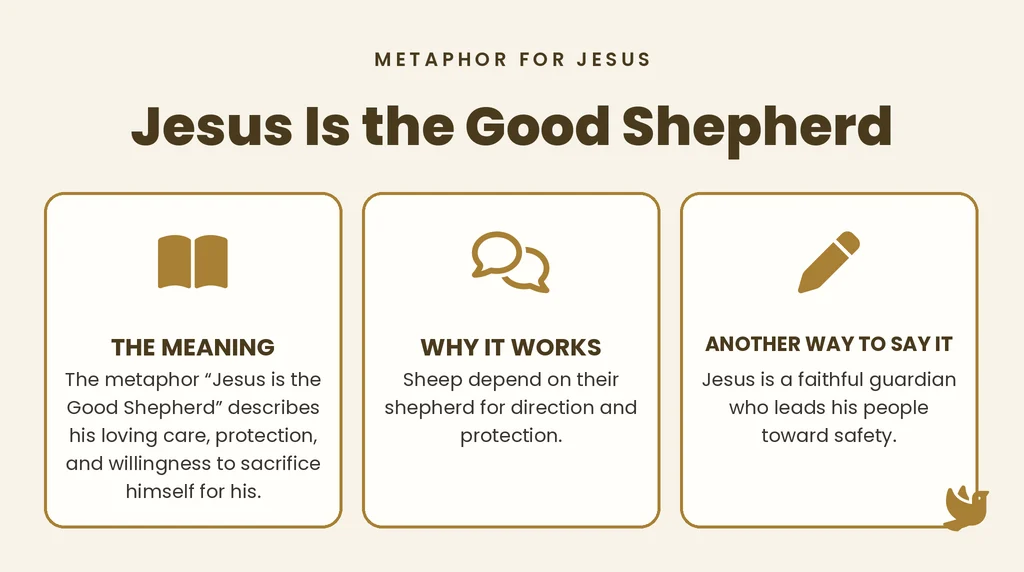
Biblical reference: John 10:11
Meaning
The metaphor “Jesus is the Good Shepherd” describes his loving care, protection, and willingness to sacrifice himself for his followers. A shepherd watches over his sheep, guides them toward safety, and searches for those that wander away.
Why This Metaphor Works
Sheep depend on their shepherd for direction and protection. This familiar relationship helps readers understand the care Jesus offers his followers. The metaphor also emphasizes that his leadership involves personal commitment rather than power alone.
In John 10:11, Jesus describes himself as the Good Shepherd who lays down his life for the sheep.
Alternative Expression
Jesus is a faithful guardian who leads his people toward safety.
Examples in Writing
Formal Example: Jesus is the Good Shepherd who protects his followers and guides them through spiritual uncertainty.
Casual Example: Jesus is like a caring shepherd who never stops looking after his sheep.
Creative Example: Through every valley of fear, the Shepherd walks beside his wandering flock.
2. Jesus Is the Light of the World
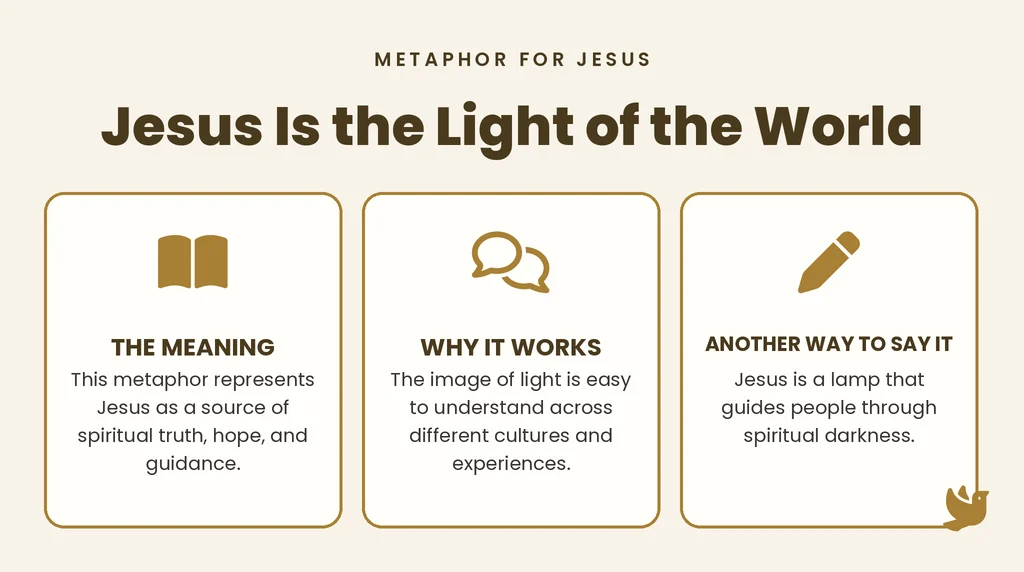
Biblical reference: John 8:12
Meaning
This metaphor represents Jesus as a source of spiritual truth, hope, and guidance. Light allows people to see clearly, while darkness often symbolizes confusion, wrongdoing, or uncertainty.
Why This Metaphor Works
The image of light is easy to understand across different cultures and experiences. A single light can transform a dark room, just as spiritual guidance can change how someone understands life.
In John 8:12, Jesus declares that whoever follows him will not walk in darkness but will have the light of life.
Alternative Expression
Jesus is a lamp that guides people through spiritual darkness.
Examples in Writing
Formal Example: Christians understand Jesus as the Light of the World because his teachings provide spiritual direction and hope.
Casual Example: Jesus is the light that helps me find my way when life feels confusing.
Creative Example: When doubt covered the horizon, his light opened a path through the darkness.
3. Jesus Is the Bread of Life
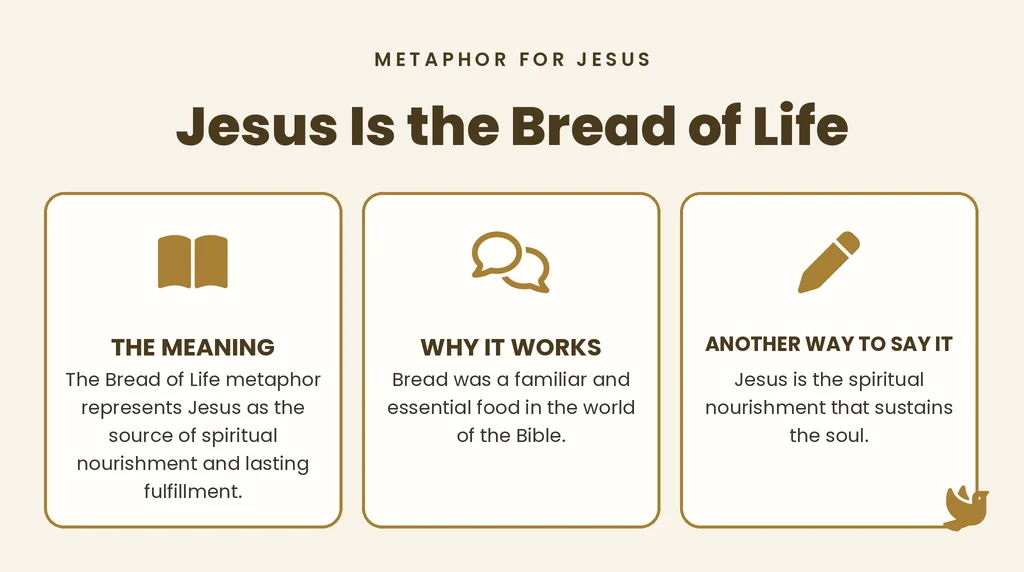
Biblical reference: John 6:35
Meaning
The Bread of Life metaphor represents Jesus as the source of spiritual nourishment and lasting fulfillment. Just as physical bread sustains the body, Jesus offers spiritual life to those who come to him in faith.
Why This Metaphor Works
Bread was a familiar and essential food in the world of the Bible. Using it as an image makes the idea of spiritual dependence practical and understandable.
The metaphor also points beyond temporary satisfaction toward a deeper relationship with God.
Alternative Expression
Jesus is the spiritual nourishment that sustains the soul.
Examples in Writing
Formal Example: The Bread of Life metaphor emphasizes the spiritual nourishment believers find in Jesus.
Casual Example: Jesus gives my soul the nourishment I cannot find in material things alone.
Creative Example: When the heart hungers for meaning, the Bread of Life offers nourishment beyond the world’s table.
4. Jesus Is the True Vine
Biblical reference: John 15:1
Meaning
Jesus as the True Vine represents the essential connection between him and his followers. Just as branches depend on a vine for nourishment, believers depend on their relationship with Jesus for spiritual growth.
Why This Metaphor Works
A vine and its branches provide a clear picture of connection and dependence. A branch separated from its source cannot produce fruit in the same way as one that remains connected.
In John 15, Jesus teaches that remaining in him is essential for bearing spiritual fruit.
Alternative Expression
Jesus is the living source from which spiritual growth develops.
Examples in Writing
Formal Example: The True Vine metaphor illustrates the importance of maintaining a close relationship with Jesus.
Casual Example: Staying connected to Jesus helps me grow in faith and character.
Creative Example: Like a branch reaching toward the sun, my faith grows when it remains connected to the Vine.
5. Jesus Is the Door
Biblical reference: John 10:9
Meaning
The Door metaphor describes Jesus as the way through which people enter into salvation, spiritual security, and a relationship with God.
Why This Metaphor Works
A door marks an entrance from one place into another. It can represent an opportunity, a new beginning, or access to somewhere previously unreachable.
In John 10:9, Jesus says that he is the door and connects this image with entering, finding safety, and finding pasture.
Alternative Expression
Jesus is the entrance to spiritual life and salvation.
Examples in Writing
Formal Example: The Door metaphor presents Jesus as the means through which believers find salvation and spiritual belonging.
Casual Example: Jesus opens the way for me to build a relationship with God.
Creative Example: Before me stood a door of grace, opening toward a life shaped by faith.
6. Jesus Is the Lamb of God
Biblical reference: John 1:29
Meaning
The Lamb of God represents Jesus in connection with sacrifice, redemption, and the removal of sin. John the Baptist uses this title when identifying Jesus in the Gospel of John.
Why This Metaphor Works
The image of a lamb connects with sacrificial imagery found in the Old Testament. Within Christian theology, the metaphor points toward Jesus’ sacrificial death and its significance for humanity.
It also creates a striking contrast between the lamb’s gentleness and the profound importance of his sacrifice.
Alternative Expression
Jesus is the sacrificial offering associated with humanity’s redemption.
Examples in Writing
Formal Example: The Lamb of God is a central Christian image of Jesus’ sacrificial role in redemption.
Casual Example: Christians call Jesus the Lamb of God because his sacrifice is central to their understanding of forgiveness.
Creative Example: The Lamb carried the weight of redemption, turning sacrifice into a message of hope.
7. Jesus Is the Living Water
Biblical reference: John 4:10, 14
Meaning
Living Water represents the spiritual life and lasting renewal Jesus offers. Water sustains physical life, making it a powerful image for the spiritual nourishment people seek.
Why This Metaphor Works
Thirst is a universal human experience. By connecting spiritual fulfillment with water, the metaphor communicates a deep need that material possessions and temporary pleasures cannot fully satisfy.
In John 4, Jesus speaks with a Samaritan woman and describes water that becomes a spring leading to eternal life.
Alternative Expression
Jesus is a spring of spiritual renewal.
Examples in Writing
Formal Example: The Living Water metaphor emphasizes the spiritual renewal offered through Jesus.
Casual Example: Jesus brings peace to the part of me that always feels thirsty for something more.
Creative Example: In the desert of a restless heart, his promise becomes a spring that never runs dry.
8. Jesus Is the Cornerstone
Biblical reference: Ephesians 2:20
Meaning
The Cornerstone metaphor describes Jesus as the essential foundation and reference point of the Christian faith.
Why This Metaphor Works
In construction, a cornerstone helps establish the alignment and stability of a building. The image communicates the importance of building a spiritual life around a dependable foundation.
Ephesians 2:20 describes the household of God as built on the foundation of the apostles and prophets, with Christ Jesus himself as the cornerstone.
Alternative Expression
Jesus is the central stone that holds a spiritual foundation together.
Examples in Writing
Formal Example: Christian teaching presents Jesus as the Cornerstone of the faith and the basis of spiritual unity.
Casual Example: Jesus is the foundation I want to build my life around.
Creative Example: When the walls of certainty tremble, the Cornerstone remains firmly set.
9. Jesus Is the Bridegroom
Biblical reference: Matthew 9:15
Meaning
The Bridegroom metaphor expresses the relationship between Jesus and his people through the imagery of a wedding. It communicates love, commitment, celebration, and a relationship marked by belonging.
Why This Metaphor Works
Marriage provides a familiar image of a covenant relationship. In the Gospels, Jesus uses bridegroom imagery when responding to questions about fasting, presenting his presence as a reason for celebration.
The image also appears in broader biblical descriptions of God’s relationship with his people.
Alternative Expression
Jesus is the promised bridegroom who celebrates his relationship with his people.
Examples in Writing
Formal Example: The Bridegroom metaphor portrays Jesus through the language of covenant, love, and spiritual belonging.
Casual Example: The image of Jesus as the Bridegroom reminds believers that their faith is about a relationship, not just rules.
Creative Example: The Bridegroom arrives with a promise of joy, inviting his people into a lasting bond of love.
10. Jesus Is the Way
Biblical reference: John 14:6
Meaning
The Way metaphor describes Jesus as the path through which people come to the Father. It emphasizes spiritual direction, truth, and access to God.
Why This Metaphor Works
Everyone understands the difference between a road that leads somewhere and one that leaves a traveler lost. This familiar image makes a theological idea easier to grasp.
In John 14:6, Jesus identifies himself as the way, the truth, and the life.
Alternative Expression
Jesus is the path that leads believers toward God.
Examples in Writing
Formal Example: The Way metaphor expresses the Christian belief that Jesus is central to reconciliation with God.
Casual Example: When I feel lost, Jesus’ teachings help me decide which direction to take.
Creative Example: Along the winding roads of life, his words become a path toward truth and peace.
11. Jesus Is the Resurrection and the Life
Biblical reference: John 11:25
Meaning
This metaphor presents Jesus as the source of resurrection hope and eternal life. It connects his identity with the Christian promise that death does not have the final word.
Why This Metaphor Works
Death is one of humanity’s deepest fears, while life represents possibility and renewal. Bringing these ideas together communicates hope in the face of grief and loss.
Jesus uses this declaration while speaking to Martha before raising Lazarus from the dead.
Alternative Expression
Jesus is the source of life beyond the grave.
Examples in Writing
Formal Example: The Resurrection and the Life declaration expresses the Christian hope of victory over death through Jesus.
Casual Example: My faith in Jesus gives me hope even when I face loss.
Creative Example: Where grief closes the door, the promise of resurrection opens a horizon beyond the grave.
12. Jesus Is the Morning Star
Biblical reference: Revelation 22:16
Meaning
The Morning Star represents Jesus through imagery associated with light, hope, and the arrival of a new day.
Why This Metaphor Works
The morning star appears near the end of the night, making it a natural symbol of hope after darkness. It suggests the arrival of something new and the promise of a brighter future.
In Revelation 22:16, Jesus identifies himself as the bright Morning Star.
Alternative Expression
Jesus is the dawn that announces a new beginning.
Examples in Writing
Formal Example: The Morning Star imagery associates Jesus with hope and the promise of God’s coming kingdom.
Casual Example: Jesus reminds me that darkness does not last forever.
Creative Example: Above the fading night, the Morning Star announces that hope is rising.
13. Jesus Is the Rock
Biblical reference: 1 Corinthians 10:4
Meaning
The Rock metaphor represents spiritual strength, dependability, and protection. In 1 Corinthians 10:4, Paul connects the spiritual rock in Israel’s wilderness experience with Christ.
Why This Metaphor Works
A rock suggests something firm that can withstand pressure. The image helps communicate the idea of spiritual security during uncertainty.
Biblical rock imagery has several related uses, so its meaning depends on the passage in which it appears.
Alternative Expression
Jesus is a firm refuge during life’s storms.
Examples in Writing
Formal Example: The Rock metaphor emphasizes the stability and spiritual security associated with Christ.
Casual Example: When everything around me feels uncertain, I look to Jesus as my source of strength.
Creative Example: While the ground of certainty shifts beneath my feet, the Rock remains unmoved.
14. Jesus Is the Sower
Biblical reference: Matthew 13:3, 37
Meaning
The Sower metaphor connects Jesus with the spreading of God’s word. In the parable of the weeds, Jesus explains that the one who sows the good seed is the Son of Man.
Why This Metaphor Works
Planting seeds offers a familiar image of teaching, growth, patience, and future results. Seeds do not all grow in the same conditions, which helps explain why people respond differently to spiritual messages.
The parable of the sower in Matthew 13 also explores the different ways people receive the word.
Alternative Expression
Jesus is the one who plants the seeds of God’s truth.
Examples in Writing
Formal Example: The Sower imagery illustrates how Jesus spreads God’s message and invites spiritual growth.
Casual Example: Jesus plants seeds of truth that people can nurture through faith.
Creative Example: He scattered seeds of truth across human hearts, waiting for faith to give them roots.
15. Jesus Is the Foundation
Biblical reference: 1 Corinthians 3:11
Meaning
The Foundation metaphor describes Jesus as the essential basis on which Christian faith and spiritual life are built.
Why This Metaphor Works
A building cannot remain secure without a sound foundation. Similarly, the metaphor suggests that Christian beliefs and actions should be grounded in Jesus rather than unstable values.
In 1 Corinthians 3:11, Paul writes that no other foundation can be laid besides Jesus Christ.
Alternative Expression
Jesus is the base on which a faithful life is built.
Examples in Writing
Formal Example: The Foundation metaphor emphasizes Christ’s central place in Christian belief and practice.
Casual Example: I want my decisions and values to be built on Jesus’ teachings.
Creative Example: I built my hope on a foundation that storms could shake but never erase.
16. Jesus Is the King of Kings
Biblical reference: Revelation 19:16
Meaning
The title King of Kings expresses Jesus’ supreme authority and sovereignty. It presents him as greater than every earthly ruler or political power.
Why This Metaphor Works
Kings traditionally represent leadership, authority, and power. Describing Jesus as the King of Kings places his authority above all other rulers within the biblical vision of his reign.
Revelation 19:16 uses this title in its depiction of Christ as the victorious heavenly king.
Alternative Expression
Jesus is the sovereign ruler above every earthly authority.
Examples in Writing
Formal Example: The title King of Kings expresses the Christian belief in Christ’s supreme authority.
Casual Example: Christians call Jesus the King of Kings because they believe his authority surpasses every earthly power.
Creative Example: Above every crown that fades, the eternal King reigns in glory.
17. Jesus Is the Servant
Biblical reference: Philippians 2:7
Meaning
The Servant metaphor emphasizes Jesus’ humility and willingness to serve others. Philippians 2 describes Christ taking the form of a servant and humbling himself.
Why This Metaphor Works
People often associate greatness with power and status. The image of Jesus as a servant challenges that assumption by presenting humility and self-giving love as signs of true greatness.
This theme is especially important in Christian teachings about caring for others.
Alternative Expression
Jesus is the humble servant who puts love into action.
Examples in Writing
Formal Example: The Servant imagery highlights humility and self-sacrifice as central themes in Christian discipleship.
Casual Example: Jesus teaches me that serving others can be more meaningful than seeking attention.
Creative Example: The hands that deserved a crown reached first toward those who needed help.
18. Jesus Is the Mediator
Biblical reference: 1 Timothy 2:5
Meaning
The Mediator metaphor describes Jesus as the one who brings reconciliation between God and humanity.
Why This Metaphor Works
A mediator helps resolve a disagreement or restore communication between two parties. The image makes the Christian understanding of reconciliation easier to grasp.
In 1 Timothy 2:5, Christ Jesus is described as the one mediator between God and humanity.
Alternative Expression
Jesus is the bridge of reconciliation between God and people.
Examples in Writing
Formal Example: The Mediator metaphor explains the central role of Jesus in Christian teaching about reconciliation with God.
Casual Example: I understand Jesus as the one who makes reconciliation with God possible.
Creative Example: Across the distance created by sin, the Mediator opens a path toward reconciliation.
19. Jesus Is the Physician
Biblical reference: Mark 2:17
Meaning
The Physician metaphor presents Jesus as someone who responds to spiritual need and calls people toward repentance and restoration.
Why This Metaphor Works
A physician treats people who are ill. Jesus uses this familiar comparison when explaining why he associates with tax collectors and sinners, saying that those who are well have no need of a physician, but those who are sick do.
The metaphor communicates compassion and the need for spiritual healing without suggesting that Jesus’ mission is limited to physical illness.
Alternative Expression
Jesus is the healer who calls wounded hearts toward restoration.
Examples in Writing
Formal Example: The Physician metaphor illustrates Jesus’ compassionate response to people who recognize their spiritual need.
Casual Example: Jesus welcomes people who know they need forgiveness and a fresh start.
Creative Example: He approached wounded souls with compassion, inviting broken lives toward healing and renewal.
20. Jesus Is the Firstfruits
Biblical reference: 1 Corinthians 15:20
Meaning
The Firstfruits metaphor represents Jesus’ resurrection as the beginning and assurance of the future resurrection promised to believers.
Why This Metaphor Works
In biblical agricultural life, firstfruits were the first portion of a harvest, associated with the larger harvest to come. Paul uses this image to explain how Christ’s resurrection relates to the future hope of those who belong to him.
The metaphor therefore communicates both a completed event and a promise of what is to come.
Alternative Expression
Jesus is the first sign of the resurrection harvest to come.
Examples in Writing
Formal Example: The Firstfruits metaphor connects Christ’s resurrection with the Christian hope of future resurrection.
Casual Example: Jesus’ resurrection gives Christians hope that death will not have the final word.
Creative Example: The first bloom of resurrection opened a promise of life beyond the winter of death.
How to Use Metaphors for Jesus in Writing
Metaphors for Jesus can enrich Bible studies, sermons, essays, poetry, devotional writing, and discussions about Christian faith. The key is to choose imagery that supports the point you want to communicate.
1. Match the Metaphor to Your Message
Different metaphors emphasize different aspects of Jesus’ identity.
- Use the Good Shepherd when writing about care, guidance, and protection.
- Use the Light of the World when discussing truth, hope, and spiritual direction.
- Use the Bread of Life when exploring spiritual nourishment and dependence on God.
- Use the Lamb of God when explaining sacrifice and redemption.
- Use the Cornerstone when writing about faith and spiritual foundations.
Choosing the right image makes your explanation more focused and meaningful.
2. Include Biblical Context
When using a metaphor in an essay or Bible study, identify the relevant Scripture passage. Explain who uses the image, what is happening in the passage, and how the metaphor relates to its surrounding message.
For example, the Good Shepherd image in John 10 appears in a discussion about Jesus, his sheep, and his willingness to lay down his life for them. Understanding that context gives the metaphor greater depth.
3. Avoid Treating Every Metaphor as Identical
Each metaphor highlights a particular aspect of Jesus. The Door emphasizes access, the Vine emphasizes connection, and the Physician emphasizes spiritual need and restoration.
These images complement one another, but they are not interchangeable in every context.
4. Use Vivid Language Without Losing Accuracy
Creative language can make biblical ideas more memorable, but it should not distort the meaning of Scripture. When writing poetry or devotional reflections, distinguish your own imaginative descriptions from direct biblical quotations.
This approach keeps the writing expressive while respecting the source material.
Metaphors for Jesus vs. Similes for Jesus
Metaphors and similes both use figurative language, but they express comparisons differently.
A metaphor directly describes one thing in terms of another.
Example: “Jesus is the Light of the World.”
A simile makes a comparison using words such as like or as.
Example: “Jesus’ guidance is like a light shining through darkness.”
The biblical expression “I am the light of the world” is a metaphor because Jesus identifies himself through the image of light. The simile explains a similar idea through an explicit comparison.
Both techniques can help readers understand spiritual themes. Metaphors often create a direct, memorable image, while similes can make the comparison more explanatory.
Why Does the Bible Use Metaphors for Jesus?
Biblical metaphors communicate profound spiritual ideas through familiar experiences. Shepherds, bread, vines, rocks, doors, and light were recognizable images in the world of the biblical writers.
These comparisons help readers connect spiritual teachings with everyday life. A shepherd communicates care, bread suggests nourishment, and a foundation conveys stability. The imagery makes abstract concepts easier to understand and remember.
Metaphors also invite reflection. Readers can explore what each image reveals about Jesus without assuming that a single comparison explains every aspect of his identity.
Taken together, these biblical images present a rich picture of Jesus as guide, source of life, savior, teacher, servant, and king.
Frequently Asked Questions
1. What is a metaphor for Jesus?
A metaphor for Jesus is a biblical or Christian expression that describes his identity or role through symbolic imagery. Examples include the Good Shepherd, the Light of the World, and the Bread of Life.
2. What is the most famous metaphor for Jesus?
The Good Shepherd and the Light of the World are among the best-known biblical images of Jesus. The Bread of Life and the True Vine are also important metaphors in the Gospel of John.
3. Why is Jesus called the Good Shepherd?
Jesus is called the Good Shepherd in John 10:11 because he cares for his followers and lays down his life for them. The metaphor emphasizes protection, guidance, and sacrificial love.
4. Why is Jesus called the Light of the World?
In John 8:12, Jesus calls himself the Light of the World. The image represents spiritual guidance, truth, and the promise of life for those who follow him.
5. What does the Bread of Life mean?
The Bread of Life in John 6:35 represents Jesus as the source of spiritual nourishment and lasting life. The metaphor connects the everyday need for food with a deeper spiritual need.
6. Why is Jesus called the Lamb of God?
John the Baptist calls Jesus the Lamb of God in John 1:29. In Christian theology, the title is associated with Jesus’ sacrifice and the redemption of humanity from sin.
7. What does the True Vine symbolize?
In John 15:1, Jesus identifies himself as the True Vine. His followers are represented as branches, illustrating the importance of remaining connected to him to grow spiritually and bear fruit.
8. Is the Good Shepherd a metaphor or a simile?
The Good Shepherd is a metaphor because Jesus directly identifies himself as the shepherd in John 10:11. A simile would compare Jesus to a shepherd using words such as like or as.
9. Can metaphors for Jesus be used in school essays?
Yes. Biblical metaphors are useful in religious studies, literature assignments, and essays about Christian beliefs. Including relevant Scripture references and explaining their context strengthens an academic discussion.
10. What is the purpose of metaphors for Jesus in the Bible?
Metaphors help communicate Jesus’ spiritual significance through familiar images. They illustrate themes such as love, guidance, salvation, sacrifice, spiritual growth, and hope in ways readers can understand and remember.
Conclusion
Metaphors for Jesus offer a meaningful way to understand the many dimensions of his identity and mission in Christian Scripture. The Good Shepherd reveals his care, the Light of the World points toward spiritual guidance, and the Bread of Life illustrates the nourishment he offers to believers. Other images, including the Lamb of God, the True Vine, and the Cornerstone, communicate sacrifice, connection, and a firm foundation for faith.
These biblical metaphors also demonstrate how figurative language can make complex ideas accessible without reducing their significance. Each image invites readers to look more closely at a particular teaching, relationship, or promise.
Whether you are studying the Bible, preparing a sermon, writing an essay, or exploring Christian symbolism, understanding these comparisons can deepen your appreciation of Scripture. Read each metaphor in its biblical context, reflect on the image it creates, and consider the spiritual truth it communicates. Through these familiar pictures, the message of Jesus becomes easier to explore, remember, and discuss.