Walk the same way to work for a month and you will wear a faint track across the park grass, a shortcut your feet chose without consulting you. That is a habit: a path worn through grass, and then, stranger still, a chain forged link by link, so quietly that you only hear it the day you try to walk somewhere new.
Flat language cannot carry this. Say “he has a bad habit” and nothing in the reader moves. The right metaphor shows what habits actually do: they steer the day like a rudder set once in the morning, they compound like interest in silence, and they outlast every resolution ever shouted in January. Images make the invisible machinery visible.
Below are twenty original metaphors for habits, each with its meaning, a note on why it works, an alternative expression, and examples in formal, casual, and creative writing. You will also find positive and negative variations, ready-made sentences, and answers to common questions. Whether you are writing a health essay, a self improvement post, or a novel about a man trying to change, start here.
Quick Metaphors for Habits
If you need a strong image fast, start with this list of twenty metaphors for habits.
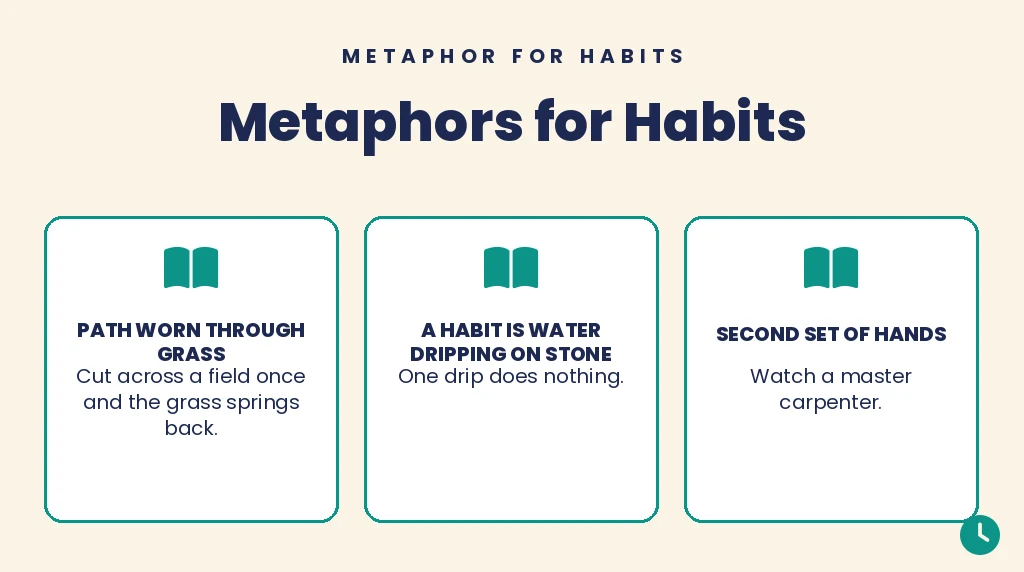
- A habit is a path worn through grass.
- A habit is water dripping on stone.
- A habit is a second set of hands.
- A habit is a train running on fixed rails.
- A habit is a small brick laid every day.
- A habit is a garden you water or weeds you feed.
- A habit is an autopilot you program yourself.
- A habit is a chain forged link by link.
- A habit is a well rehearsed dance.
- A habit is interest compounding in silence.
- A habit is a shadow that follows you home.
- A habit is a key that turns without thinking.
- A habit is a groove in an old record.
- A habit is a seed planted by yesterday.
- A habit is a tide that returns on schedule.
- A habit is a loyal dog trained by repetition.
- A habit is a staircase built one step at a time.
- A habit is a furnace that burns whatever you feed it.
- A habit is a tattoo written from the inside.
- A habit is a rudder set once and steering all day.
Metaphors for Habits and Their Meanings
Now we take them one at a time: what each metaphor means, why it lands, how else you could say it, and how it behaves inside real sentences. Read in order, or jump straight to the images that fit your purpose.
1. A Habit Is a Path Worn Through Grass
Meaning
Cut across a field once and the grass springs back. Cross it daily for a year and there is a bare earth track that everyone uses without thinking.
Why It Works
It works because it makes repetition visible and blameless. Nobody decides to build the path; walking builds it.
Alternative Expression
A similar image calls the habit “a shortcut your feet chose for you.”
Examples in Writing
Formal Example: The review described smoking breaks as a path worn through grass.
Casual Example: My 6 a.m. run is just a path now. I do not decide anymore; my shoes are basically already at the gate.
Creative Example: Across the moor of his character ran one worn path, and every sorrow found its way down it to the same door.
2. A Habit Is Water Dripping on Stone
Meaning
One drip does nothing. A thousand drips a day, for years, drill a hollow into solid rock. Habits work at that scale: a page read nightly, a coin saved daily, a kind word repeated.
Why It Works
It works because it reverses the usual drama of change. No flood, no explosion, just patience with physics.
Alternative Expression
You might also call the habit “a slow chisel made of water.”
Examples in Writing
Formal Example: The academy credits its results to water dripping on stone: fifteen minutes of scales, every day.
Casual Example: It is literally one drip at a time. Ten push-ups with the kettle on. The kettle boils daily.
Creative Example: The drip had hollowed the stone beneath the abbey wall, and the monks read in it a sermon about prayer.
3. A Habit Is a Second Set of Hands
Meaning
Watch a master carpenter. Her hands measure, hold, and cut while her mind is already on the next joint.
Why It Works
It works because it praises automaticity instead of shaming it. Much writing about habits treats them as enemies; this image restores the truth that good routines are staff, not shackles.
Alternative Expression
Another phrasing calls the habit “help that arrives before you ask.”
Examples in Writing
Formal Example: Analysts say elite units rely on a second set of hands: drill so deep that medics work calmly under fire.
Casual Example: Meal prep Sundays are my second set of hands. Future me just opens the fridge.
Creative Example: The old sailor’s hands spliced rope while he slept upright in the storm.
4. A Habit Is a Train Running on Fixed Rails
Meaning
A train is magnificent and completely unfree. It can carry enormous weight at great speed, and it cannot turn left at the next field.
Why It Works
It works because it holds power and rigidity in one picture. Praise and warning arrive together.
Alternative Expression
A close cousin calls the habit “an engine loyal to yesterday’s map.”
Examples in Writing
Formal Example: The audit found the office ran like a train on fixed rails.
Casual Example: My evenings are a train, honestly. Gym, dinner, notes, bed. Derail me.
Creative Example: The regiment moved like a train on rails of drill, superb on the plain.
5. A Habit Is a Small Brick Laid Every Day
Meaning
One brick is a joke of a building. A brick a day is a wall by winter and a house by next year.
Why It Works
It works because it converts patience into arithmetic. Readers stop asking whether one day matters and start asking whether they laid today’s brick.
Alternative Expression
You could also describe the habit as “a wall built by Tuesdays.”
Examples in Writing
Formal Example: The conservatory’s founder called practice a small brick laid every day.
Casual Example: One brick: twenty minutes of Italian with coffee. My wall is currently waist high.
Creative Example: He laid his brick each dawn in the prison yard of his circumstances.
6. A Habit Is a Garden You Water or Weeds You Feed
Meaning
Nothing in a garden is neutral. Every day you water something: the tomatoes or the weeds, the reading or the scrolling, the walk or the worry.
Why It Works
It works because it removes the mystery from outcomes. Readers cannot argue with a garden; results follow feeding, not wishing.
Alternative Expression
A sibling image calls the habit “whatever your watering can believes in.”
Examples in Writing
Formal Example: The clinic’s programme treats addiction as a garden problem: feed the morning walk.
Casual Example: I watered the weeds for years. Two hours of news rage nightly. Now the tomatoes get that water: books.
Creative Example: She inherited a garden of her mother’s angers, and spent her youth learning which roots were hers to pull.
7. A Habit Is an Autopilot You Program Yourself
Meaning
Pilots engage autopilot for the steady middle of a flight, and it flies beautifully, exactly as it was set. Your habits are the same system, except you wrote the settings, often years ago, often half asleep. The plane is not misbehaving.
Why It Works
It works because it moves blame from character to configuration, which is where change actually happens. Readers stop asking what is wrong with them and start asking what their settings say.
Alternative Expression
Another way to say it is “instructions your past self left for your hands.”
Examples in Writing
Formal Example: The therapist reframed the relapse as an autopilot problem: the patient’s settings still routed stress to the bottle.
Casual Example: My autopilot pours cereal at midnight. I did not choose this route.
Creative Example: The autopilot of the empire flew it straight and level into the mountain it had been set to avoid in another century.
8. A Habit Is a Chain Forged Link by Link
Meaning
Nobody wakes up wearing a finished chain. It is built the honest way, one link per repetition, each link too light to notice. Years later the chain can hold a ship, or hold a prisoner, depending on what was being forged.
Why It Works
It works because it makes accumulation physical and slightly frightening. Readers feel the weight adding up link by link, which is the true experience of both addiction and discipline.
Alternative Expression
You might also call the habit “iron you hammered in your sleep.”
Examples in Writing
Formal Example: The magistrate described the fraud as a chain forged link by link.
Casual Example: Good chains exist, by the way. Mine is floss, gym, journal. Three links a day.
Creative Example: Link by link he had forged his chain in the counting house.
9. A Habit Is a Well Rehearsed Dance
Meaning
Dancers do not think about steps in the middle of the turn. The body knows, and knowing looks like grace.
Why It Works
It works because it gives routine its artistry back. A dance also improves with rehearsal and suffers without it, which matches habits exactly.
Alternative Expression
A close variant calls the habit “music your body learned by heart.”
Examples in Writing
Formal Example: Inspectors noted the surgical team moved like a well rehearsed dance.
Casual Example: My kitchen dance: kettle, oats, radio, eggs. My partner steps in.
Creative Example: The servants of the great house danced their invisible dance, and the duke never saw a single step.
10. A Habit Is Interest Compounding in Silence
Meaning
Compound interest makes accountants poetic: small sums, left alone, quietly outgrow heroic one off deposits. Habits obey the same mathematics.
Why It Works
It works because it replaces motivation with mathematics. Readers who doubt their willpower can still trust a curve.
Alternative Expression
Another phrasing calls the habit “a savings account your behaviour keeps funding.”
Examples in Writing
Formal Example: The literacy charity models reading as interest compounding in silence: twenty minutes nightly doubles a child’s vocabulary growth.
Casual Example: One percent better at Spanish, daily. The interest kicked in around month nine.
Creative Example: The abbey’s wealth was interest compounding in silence for six centuries of unremarkable, identical, faithful days.
11. A Habit Is a Shadow That Follows You Home
Meaning
You can outrun a lot of things. Your shadow is not one of them; it crosses borders, enters new houses, and settles into new jobs beside you. Habits travel the same way.
Why It Works
It works because it explains a discouraging experience everyone recognises: the fresh start that wasn’t. Shadows also lengthen and shrink with the light, a fine detail for habits, which swell in dark seasons and thin out when life is bright and watched.
Alternative Expression
A related image calls the habit “the luggage that packs itself.”
Examples in Writing
Formal Example: The relocation study found the shadow followed: executives changed firms and rebuilt the same punishing schedules within months.
Casual Example: Moved countries to escape my night owl life. My shadow unpacked at the new flat.
Creative Example: He fled the valley, the feud, and his father’s name, but his shadow kept its own counsel.
12. A Habit Is a Key That Turns Without Thinking
Meaning
Front door, car, office: your fingers find the right key and turn it before your mind has finished arriving. Habits unlock behaviour the same way, with a cue instead of a key.
Why It Works
It works because it names the trigger, which is where habits are actually governed. Readers learn to hunt for their keys: change the cue and the door stays shut.
Alternative Expression
You could also call the habit “a door your day keeps unlocking.”
Examples in Writing
Formal Example: Researchers found the ward’s hand hygiene turned on a key: the sanitiser moved beside the door.
Casual Example: The bakery smell on my corner is a key. It turns.
Creative Example: The key of the old song turned in him at the harbour.
13. A Habit Is a Groove in an Old Record
Meaning
A vinyl record plays the same song because the needle drops into a groove cut long ago. Minds do this. A mood strikes, the needle drops, and the familiar track plays: the same argument, the same snack, the same late night scroll.
Why It Works
It works because it separates the song from the singer, which helps readers forgive themselves and still change the record. Grooves also explain why effort feels like scratching at first: lifting the needle out takes a deliberate hand, every time, until a new groove is cut.
Alternative Expression
A sibling image calls the habit “a track your needle knows by heart.”
Examples in Writing
Formal Example: The counsellor described rumination as a groove in an old record.
Casual Example: My Sunday groove: lie in, big breakfast, mild panic about Monday. The needle knows. I am learning to lift it.
Creative Example: Whenever the rain came, the groove in the old record of the house played its one song: leaks, buckets.
14. A Habit Is a Seed Planted by Yesterday
Meaning
Today’s behaviour is usually yesterday’s planting. The calm morning was seeded by the phone left downstairs last night; the chaos was seeded by the skipped list.
Why It Works
It works because it stretches cause and effect across days, where habits actually live. Readers start auditing their evenings instead of their mornings, which is often the real fix.
Alternative Expression
Another way to say it is “a crop your past self keeps sending you.”
Examples in Writing
Formal Example: The sleep clinic teaches that rest is a seed planted by yesterday: light, screens.
Casual Example: Yesterday me planted a great seed: gym bag by the door. Today me just harvested it.
Creative Example: The seeds his grandfather planted in anger grew into hedges the whole family still had to climb over to visit.
15. A Habit Is a Tide That Returns on Schedule
Meaning
Tides do not negotiate. They arrive when the moon says, twice a day, whether the beach is ready or not. Some habits run on the same astronomy: the 4 p.m.
Why It Works
It works because it moves the struggle from willpower to scheduling. Readers who keep losing the same battle at the same hour recognise the pattern instantly.
Alternative Expression
A close cousin calls the habit “weather your calendar already knows.”
Examples in Writing
Formal Example: The diabetes programme maps cravings as a tide that returns on schedule.
Casual Example: My 3 p.m. chocolate tide is a law of nature. Now I am simply never near the vending machine when it comes in.
Creative Example: Twice a day the tide of his temper flooded the little house.
16. A Habit Is a Loyal Dog Trained by Repetition
Meaning
A dog learns what gets rewarded, then offers it forever, tail wagging, at the worst possible moments. Habits behave identically. Whatever you fed, attention, snacks, relief, the behaviour returns eagerly and sits by the door.
Why It Works
It works because it replaces shame with training, which is both kinder and more accurate. Readers laugh in recognition, then get the serious point: retraining is possible at any age, but it is done with rewards and patience, not scolding.
Alternative Expression
You might also call the habit “a pet your past keeps feeding.”
Examples in Writing
Formal Example: The behaviour unit treats phone checking as a loyal dog: trained by a thousand small rewards.
Casual Example: My snack habit is a very loyal dog. It sits by the fridge at nine.
Creative Example: The hound of his routine followed him from ship to ship, sleeping under every new hammock.
17. A Habit Is a Staircase Built One Step at a Time
Meaning
Nobody installs a staircase in an afternoon of enthusiasm. It rises step by step, each one plain, level, and slightly boring, until one day you are simply upstairs, wondering when the climb got easy.
Why It Works
It works because it makes progress climbable and inspectable. A missing step is obvious, and so is the fix.
Alternative Expression
Another phrasing calls the habit “steps your future self will thank you for.”
Examples in Writing
Formal Example: The music school’s wall chart calls practice a staircase built one step at a time.
Casual Example: My writing staircase: five hundred words before work. Some steps creak, some are ugly.
Creative Example: Step by step the lighthouse keeper built his staircase of days.
18. A Habit Is a Furnace That Burns Whatever You Feed It
Meaning
A furnace is not fussy. Feed it coal and it heats the house; feed it rubbish and it heats the house with smoke. Habits burn what they are given: news or novels, practice or panic, other people’s lives or your own work.
Why It Works
It works because it focuses attention on inputs, where control actually lives. Readers cannot command their mood directly, but they can choose the morning’s first fuel.
Alternative Expression
A related image calls the habit “a stove that believes your shopping list.”
Examples in Writing
Formal Example: The media study calls attention a furnace that burns whatever you feed it.
Casual Example: My brain furnace gets one chapter of a novel before any headlines now. The house smells noticeably better by noon.
Creative Example: The furnaces of the monastery burned prayer and gossip in equal measure.
19. A Habit Is a Tattoo Written From the Inside
Meaning
A tattoo is a decision the body keeps. Some habits reach that depth: years of repetition ink themselves into posture, reflex, and identity, until the person no longer does the behaviour, they are someone for whom it is natural. Runners wake as runners.
Why It Works
It works because it captures the end point of habit change, identity. Surface habits wash off like pen; deep ones hold like ink, which is why they survive holidays, grief, and bad years.
Alternative Expression
You could also describe the habit as “ink your days keep writing on you.”
Examples in Writing
Formal Example: Coaches aim for a tattoo written from the inside: athletes who train because they are trainers of themselves.
Casual Example: Five years of dawn swims and it is ink now. I do not decide to go to the lake. I am just a person the lake expects.
Creative Example: The war had tattooed its habits on him from the inside.
20. A Habit Is a Rudder Set Once and Steering All Day
Meaning
A sailor sets the rudder in the morning calm and it quietly governs a hundred miles of water. Habits steer the same way.
Why It Works
It works because it gives the morning its proper strategic weight. Tiny angles matter at sea and in schedules, which rescues readers from waiting for dramatic motivation.
Alternative Expression
A sibling image calls the habit “the small angle that decides the coastline.”
Examples in Writing
Formal Example: The productivity study praises a rudder set once: leaders who fix three priorities at dawn report calmer, straighter days.
Casual Example: My rudder is the first ten minutes. Shoes on, bed made, list written.
Creative Example: He set the rudder of his days in a prison cell, prayer before dawn.
Positive Metaphors for Habits
Habits are not destiny when they lean the right way. These positive metaphors present them as staff, savings, and structures that quietly work for their owner.
- A good habit is a quiet savings account. It accepts small daily deposits and pays for emergencies without drama.
- A good habit is a tailwind on a long ride. It does half the work and asks only that you keep pedalling.
- A good habit is a lamp lit before dark. It makes the evening’s decisions easy because somebody prepared at noon.
- A good habit is a strong root under a young tree. It holds the visible growth steady when the weather turns.
- A good habit is a metronome keeping the music honest. It stops the tempo of a busy life from quietly running away.
- A good habit is a faithful horse that knows the way home. It carries you safely on the days you are too tired to steer.
Negative Metaphors for Habits
The same machinery, loaded with the wrong cargo, becomes a slow emergency. These negative metaphors show habits as leaks, cracks, and guests who never leave.
- A bad habit is a leak in the roof. It stains a little more ceiling every rainy season and never once improves.
- A bad habit is a ball and chain polished daily. It gleams with familiarity while it shortens every stride.
- A bad habit is a crack spreading across the windshield. It starts as a star in the corner and ends by owning the whole view.
- A bad habit is a guest who never leaves. It eats at your table, sleeps in your hours, and thanks you by inviting friends.
- A bad habit is termites in the floorboards. It holds parties in the dark and announces itself only when a foot goes through.
- A bad habit is a song you cannot stop humming. It is catchy, it is everywhere, and it is slowly driving the whole house mad.
Metaphors for Habits in Sentences
The table below drops habits metaphors into complete sentences, so you can see how each one behaves in real writing and what it tells the reader.
| Example sentence | What it communicates |
|---|---|
| After a decade, his evening walk had become a path worn through grass, visible in his blood pressure charts. | Repetition turning a small behaviour into the easiest route through a life. |
| The pianist’s scales were water dripping on stone; the stone, eventually, was the audition panel. | Tiny daily practice drilling through a hard obstacle over years. |
| Her phone habit was a loyal dog, fed a thousand times, sitting by the sofa at nine each night. | A behaviour trained by rewards, returning eagerly on schedule. |
| The office ran like a train on fixed rails until the market moved sideways. | Powerful routine that cannot adapt when direction needs to change. |
| He called the memoir a staircase built one step at a time, five hundred words per step. | Steady small units rising into a finished structure. |
| Cravings arrived like a tide that returns on schedule, and she simply planned to be elsewhere. | Predictable urges managed by timing rather than willpower. |
How to Use Metaphors for Habits Naturally
Start by watching what your habits actually do, not what you wish they did. Paths reveal where you truly walk, furnaces report what you truly feed them, and tides confess the hours you are weakest.
Then match the register to the setting. A clinical essay can carry compounding interest, autopilots, and rudders comfortably, while a personal blog does better with dogs, gardens, and worn paths. Formal readers trust systems. Casual readers trust kitchens and pets. The same truth wears different clothes for different rooms, and the metaphor is the clothing.
Finally, ration the imagery. One strong picture, the groove, the chain, the tide, developed over a few sentences, will teach more than a parade of comparisons. Pick the tool the scene needs, put the rest back, and let plain sentences carry the facts.
Metaphor vs. Simile: What Is the Difference?
A metaphor states that one thing is another thing. A simile compares two things instead, using like or as. Write “his habit was a chain” and you have a metaphor, blunt and final. Write “his habit was like a chain” and the simile softens the claim, leaving room for the behaviour to be heavy without being iron.
That difference matters when writing about real people. Metaphors convict; similes describe. A memoir about addiction may need the conviction of chains and furnaces, while a friendly advice column persuades better with gardens and tides. Skilled writers pick the comparison that matches how certain, and how kind, they intend to sound.
Hear the same routine twice. Metaphor: “Her morning run was a rudder set at dawn, steering the whole day.” Simile: “Her morning run was like a rudder set at dawn, steering the whole day.” The picture survives in both, but the metaphor speaks like a witness, the simile like a thoughtful friend.
Common Mistakes When Writing Habits Metaphors
- Describing the habit but not the cue: Chains and grooves sound dramatic, yet change begins at the trigger. If your writing never names the key that turns, the reader learns nothing useful.
- Using only prison imagery: If every habit is a chain, a cage, and a ball, the writing turns hopeless and readers stop believing change is possible. Balance the dark images with paths, seeds, and stairs.
- Mixing machinery at random: A habit that is a train, a furnace, and a tide in one paragraph leaves the reader seasick. One system per scene, developed properly.
- Reaching for worn clichés: “Creature of habit” and “old habits die hard” arrive pre ignored. Fresh images are what make a reader actually see the behaviour.
- Forgetting the timescale: Habits are built by drips and bricks, not floods. Metaphors of sudden explosions misdescribe the process and quietly teach the wrong lesson.
Frequently Asked Questions
What is a good metaphor for a habit?
The path worn through grass is the most complete picture, because it shows formation, ease, and fading in one image: walk daily and the route deepens, stop walking and the grass returns. For building good habits, a small brick laid every day works beautifully. Both honour the real engine of habits, which is repetition at ordinary scale.
What is a metaphor for a bad habit?
A chain forged link by link captures how a bad habit gains its strength: no single link feels heavy, yet the finished chain holds a life still. For the sneaky kind, try termites in the floorboards or a crack spreading across the windshield. Choose by behaviour: chains for dependence, termites for hidden damage, cracks for things spreading quietly.
What is a metaphor for building good habits?
Reach for construction and agriculture. A staircase built one step at a time shows skill rising by plain units, while a seed planted by yesterday explains why tonight’s choices decide tomorrow’s ease. Interest compounding in silence suits anything measurable. These images share one honest promise: the work looks small daily and enormous yearly, which is exactly the truth new habits need.
How do you describe a habit in writing?
Describe the loop, not just the behaviour. Find the cue that turns the key, the routine that runs like a train, and the reward the loyal dog is waiting for, then pick the object that does the same job in the physical world.
What is a metaphor for breaking a habit?
Picture the work accurately: cutting a chain link by link, lifting a needle out of a groove, or letting a path grow over. Each image admits the job is slow and repeated, which protects readers from the fantasy of the single heroic effort. The kindest version is the path: stop walking it, and grass, given time, does the rest.
Conclusion
Habits run most of a life from the back seat, which is why giving them faces matters. Call yours a path, a chain, a furnace, or a tide, and suddenly you can see what you have been feeding and where you have been walking. If you want the widest frame for the subject, these metaphors for life show habits in their largest home: a whole existence, pictured as a journey, a river, and a book.
And because so much of habit is built between nine and five, the collection of metaphor for work images shows routines wearing their office clothes. Choose one honest picture for the habit you most want to change, write it where you will see it daily, and start laying tomorrow’s brick tonight.