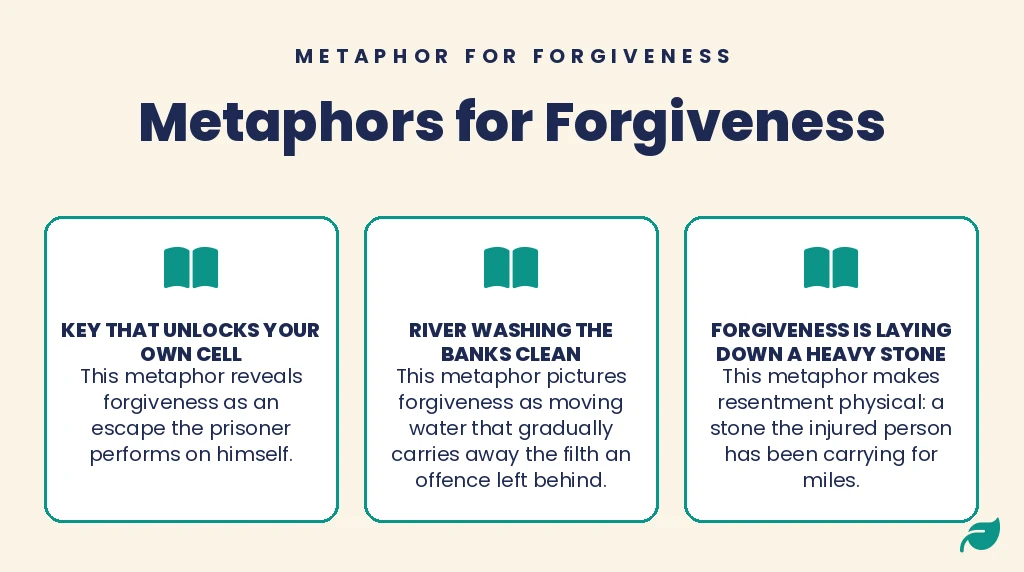
Forgiveness is a key that unlocks your own cell. The hand that turns it has finally tired of rattling the bars. It’s also a heavy stone laid down at the roadside: the road itself doesn’t change, but the traveller walks differently afterward. Few acts cost so much pride. Few purchase so much freedom.
“I forgive you” reports a decision. It hides the work. A metaphor shows the labour inside the act, the weight of it, and the release. The right image also tells your reader what kind of forgiveness this is. Quick or slow? Complete or partial? A gift given freely, or a chain broken link by link?
Here are twenty original metaphors for forgiveness, each with its meaning, why it works, an alternative expression, and examples from formal, casual, and creative writing. Brighter and darker variations follow, plus ready-made sentences, for students, novelists, and speakers on mercy.
Quick Metaphors for Forgiveness
If you need a gentle image fast, start with these twenty metaphors for forgiveness.
- Forgiveness is a key that unlocks your own cell.
- Forgiveness is a river washing the banks clean.
- Forgiveness is laying down a heavy stone.
- Forgiveness is a bridge rebuilt board by board.
- Forgiveness is sunlight melting old ice.
- Forgiveness is a debt torn up and burned.
- Forgiveness is opening a window in a stale room.
- Forgiveness is a garden replanted after fire.
- Forgiveness is a knot patiently untied.
- Forgiveness is dropping the rope in a tug of war.
- Forgiveness is a wound allowed to close.
- Forgiveness is rain on scorched earth.
- Forgiveness is a letter you write but never send.
- Forgiveness is a chain broken link by link.
- Forgiveness is turning the page of a heavy book.
- Forgiveness is a sail raised after the storm.
- Forgiveness is snow melting off a bent branch.
- Forgiveness is a table set again for an old guest.
- Forgiveness is a seed buried instead of a stone thrown.
- Forgiveness is a door left ajar, not wide open.
Metaphors for Forgiveness and Their Meanings
Now let us look at each metaphor closely: what it means, why it works, another way to say it, and examples from real writing. Notice how many images involve release, because forgiveness frees the forgiver first.
1. Forgiveness Is a Key That Unlocks Your Own Cell

Meaning
The prisoner performs his own escape. That’s the turn here: the offender may never apologise, may never even know, yet the person who forgives walks out of a cell that resentment built.
Why It Works
Expectations reverse, and that’s the shock. We assume the offender is the one imprisoned by guilt; discovering the key was in our own pocket all along makes the image impossible to forget.
Alternative Expression
Or, from the prisoner’s side: “a pardon issued by the prisoner.”
Examples in Writing
Formal Example: The bishop called forgiveness a key that unlocks your own cell, urging the congregation to free themselves first.
Casual Example: I forgave him for me, not for him; turned the key, walked out of the cell.
Creative Example: For nine years she rattled the bars at night; then one morning she found the key hanging inside the cell all along, labelled with her name.
2. Forgiveness Is a River Washing the Banks Clean

Meaning
Moving water, doing its slow work. Forgiveness here carries away the filth an offence left behind, gradually. It never denies the dirt was there; it just refuses to let the dirt stay.
Why It Works
Rivers don’t clean in one dramatic splash. They clean slowly, continuously, and readers accept the pace the image sets: forgiveness as a current, not an event.
Alternative Expression
Rain offers a cousin: “rain rinsing dust from a road.”
Examples in Writing
Formal Example: The mediator described the settlement as a river washing the banks clean after years of polluted argument.
Casual Example: We talk every week now; forgiveness is a river, it just kept washing things clean.
Creative Example: Season by season the river worked on the blackened banks, until one spring the first green showed through.
3. Forgiveness Is Laying Down a Heavy Stone
Meaning
Resentment becomes a stone you’ve carried for miles. Forgiveness isn’t throwing it at anyone. It’s setting the stone down, simply that, and walking on lighter.
Why It Works
Everyone knows the ache of carrying weight too long. Notice what doesn’t happen, though: nobody throws anything. Forgiveness stays quiet here, and nothing dramatic occurs except relief.
Alternative Expression
Walkers might call it “a pack set down at the roadside.”
Examples in Writing
Formal Example: In the memoir, forgiving her father is described as laying down a heavy stone carried since childhood.
Casual Example: I finally forgave my ex and slept properly; it was like putting down a heavy stone.
Creative Example: At the crossroads the pilgrim opened his aching fingers, and the stone of his brother’s name stayed behind in the dust.
4. Forgiveness Is a Bridge Rebuilt Board by Board
Meaning
Reconstruction, done slowly and by hand. Trust doesn’t come back because somebody made a speech; it returns the way a bridge does, one tested board at a time.
Why It Works
Rebuilt things are never quite new, and the image is honest about that. Boards also imply effort from both banks, and crossings earned gradually rather than granted.
Alternative Expression
Brickwork suggests “a wall rebuilt with the old bricks.”
Examples in Writing
Formal Example: The diplomats treated reconciliation as a bridge rebuilt board by board, scheduling small exchanges before any summit.
Casual Example: We’re not best friends again, but the bridge is getting rebuilt, board by board.
Creative Example: He brought one board every Sunday, no speeches, no demands, and by winter she could walk halfway across to meet him.
5. Forgiveness Is Sunlight Melting Old Ice
Meaning
A grudge is ice, formed slowly through a cold season of the relationship. Forgiveness is warmth returning. Nothing gets smashed; the frozen thing quietly becomes water again.
Why It Works
Melting can’t be forced, only allowed, which is exactly how feelings thaw. And that word old does quiet work, admitting how long some resentments have sat frozen in place.
Alternative Expression
Warmer weather gives “the first thaw after a hard winter.”
Examples in Writing
Formal Example: The biography describes the sisters’ late reconciliation as sunlight melting old ice, gradual and then suddenly complete.
Casual Example: One honest phone call and twenty years of ice started melting, sunlight doing its work.
Creative Example: The valley kept its grudge frozen since the feud began, but her letter arrived like sunlight, and by spring the river ran between the farms.
6. Forgiveness Is a Debt Torn Up and Burned
Meaning
The offence sits in a ledger, a debt the wronged person has every right to collect. Forgiveness tears up the record itself. After that, collection is impossible, even in memory.
Why It Works
Tearing and burning can’t be undone, unlike a promise to forget. Readers feel the cost in their hands: the forgiver gives up a real claim, one they could have collected.
Alternative Expression
A bookkeeper would write “the ledger closed and the page removed.”
Examples in Writing
Formal Example: The amnesty was praised as a debt torn up and burned, not merely suspended, by the truth commission.
Casual Example: I stopped keeping score of everything he owed me; debt torn up, burned, done.
Creative Example: The moneylender fed the little book to the stove page by page, and the village watched twenty years of debts go up the chimney.
7. Forgiveness Is Opening a Window in a Stale Room
Meaning
Picture a room sealed shut, its air breathed and rebreathed grievances for years. Forgiveness opens the window. Fresh air, light, and suddenly the possibility of staying in the room.
Why It Works
Everyone has felt a stale room change within seconds of a window opening. The gesture’s modesty is the point. Forgiveness can be one small opening, not a grand ceremony.
Alternative Expression
Or picture “curtains drawn back after a long illness.”
Examples in Writing
Formal Example: The counsellor called the apology an opened window in a stale room, crediting it with saving the marriage.
Casual Example: We finally talked honestly and it was like opening a window in a stale room.
Creative Example: The house of their friendship had smelled of old arguments for years; her visit threw the window wide and the curtains moved like flags.
8. Forgiveness Is a Garden Replanted After Fire
Meaning
The fire really happened; something truly burned down. Forgiveness is kneeling in the ash and planting anyway, knowing the new garden will never be the old one.
Why It Works
Replanting is hope without naivety. The image admits the fire happened, fully, and still insists the ground is worth working. Readers respect that honesty.
Alternative Expression
Look closer: “green shoots in blackened soil.”
Examples in Writing
Formal Example: The town’s recovery plan treated reconciliation as a garden replanted after fire, slow, public, and deliberate.
Casual Example: After the huge fight we basically replanted the whole friendship; it’s growing different, but growing.
Creative Example: She walked the black rows with a sack of seed and no guarantees, and her replanted garden fed the village that had shunned her.
9. Forgiveness Is a Knot Patiently Untied
Meaning
Slow finger-work on a tangled grievance. The knot isn’t cut, and it isn’t denied: each loop of blame and hurt gets loosened in order, until the rope runs free.
Why It Works
Untying is frustrating, humble work, and everyone respects it. The image also explains forgiveness’s stop-start rhythm: many attempts, and rushing that only tightens things.
Alternative Expression
Anglers know it as “a tangled line freed loop by loop.”
Examples in Writing
Formal Example: The negotiator compared the talks to a knot patiently untied, warning that scissors would end the relationship entirely.
Casual Example: Therapy helped us untie the knot loop by loop instead of just cutting each other off.
Creative Example: The old sailor worked the knot of the feud with teeth and thumbs all winter, and by spring the rope lay straight.
10. Forgiveness Is Dropping the Rope in a Tug of War
Meaning
A feud is a tug of war, both sides pulling, both sides exhausted. Forgiveness lets go of the rope. The game ends instantly, and the other side’s victory turns meaningless.
Why It Works
Look at the energy a grudge burns, on both ends of the rope. Letting go exposes it. Forgiveness here needs no permission, no agreement, nothing from the opposition at all.
Alternative Expression
Quieter still: “walking off a field nobody owns.”
Examples in Writing
Formal Example: The columnist praised the mayor’s restraint as dropping the rope in a tug of war with the press.
Casual Example: I stopped arguing in the family chat; dropped the rope, let them fall over.
Creative Example: For ten years the brothers pulled; then the elder opened his hands at the fair, and the feud’s rope lay in the dust like a dead snake.
11. Forgiveness Is a Wound Allowed to Close
Meaning
Resentment keeps reopening the injury to check it still hurts. Forgiveness stops doing that. Left alone, the wound does what wounds naturally do: it closes, it scars, it quietens.
Why It Works
Everyone has watched healing happen on their own skin; no instruction manual required. The key word is allowed. The forgiver stops interfering with their own recovery.
Alternative Expression
Healers describe it as “a scar the hand stops touching.”
Examples in Writing
Formal Example: The therapist’s book presents forgiveness as a wound allowed to close, warning against daily inspection of old injuries.
Casual Example: I quit rereading the old messages; the wound finally started closing.
Creative Example: The scar on the kingdom’s border faded year by year, because the new queen forbade the annual ceremony of reopening it.
12. Forgiveness Is Rain on Scorched Earth
Meaning
Everything had dried into hardness and ash. Then forgiveness arrives like first rain. It doesn’t restore the land overnight, but it makes restoration imaginable again.
Why It Works
Scorched earth means total devastation, and rain still comes to it. That’s why hopeless readers believe this image: it promises beginnings, not miracles.
Alternative Expression
Gentler: “the first cloud after a long drought.”
Examples in Writing
Formal Example: Survivors described the apology, arriving after forty years, as rain on scorched earth: late, but life-giving.
Casual Example: My dad’s sorry didn’t fix everything, but it was rain on scorched earth.
Creative Example: When the exiled brother’s letter was read in the square, the old people wept, for it fell on scorched earth like October’s first rain.
13. Forgiveness Is a Letter You Write but Never Send
Meaning
The letter says everything, honestly. Then it goes in a drawer, unsent, because its purpose was never to reach the offender. Forgiveness here is one person’s private work of freedom.
Why It Works
Forgiveness and reconciliation are different things, and this image keeps them separate. An unsent letter proves the act can be complete with no audience, no answer, no reunion.
Alternative Expression
The household version: “a door closed gently from inside.”
Examples in Writing
Formal Example: The grief counsellor recommends the unsent letter, calling forgiveness a letter you write but never send.
Casual Example: I wrote him a four-page letter, forgave everything, and burned it in the sink. Best therapy ever.
Creative Example: The drawer held thirty years of unsent letters; the last lay unsealed, addressed to her sister, ending simply: go in peace.
14. Forgiveness Is a Chain Broken Link by Link
Meaning
A grudge chains the injured person to the offender. Nobody snaps a chain like that in one pull; forgiveness breaks it link by link, memory by memory, year by year.
Why It Works
Slow progress gets honoured here instead of being called failure. Every broken link is a real liberation, and anyone still chained to an old injury recognises the rhythm exactly.
Alternative Expression
Or watch “a rope fraying strand by strand.”
Examples in Writing
Formal Example: The prison chaplain described the men’s recoveries as chains broken link by link over many years.
Casual Example: I’m not fully over it, but the chain’s breaking, link by link, holiday by holiday.
Creative Example: Every spring the blacksmith’s widow struck one link from her gate’s chain, and the village counted her forgiveness by its shortening.
15. Forgiveness Is Turning the Page of a Heavy Book
Meaning
The offence is a chapter read and reread until the spine cracked. Forgiveness doesn’t tear the chapter out. It turns the page and lets the story continue.
Why It Works
Memory gets respect. The heavy chapter stays in the book, which is why readers who fear that forgiving means pretending find this image bearable, even honest.
Alternative Expression
Readers get “a bookmark moved at last.”
Examples in Writing
Formal Example: The autobiography ends not with revenge but with turning the page of a heavy book, its facts retained.
Casual Example: I still remember everything, I just turned the page; that chapter doesn’t run my life anymore.
Creative Example: The librarian had read the same page for a decade; the morning she turned it, light fell across print she had never seen.
16. Forgiveness Is a Sail Raised After the Storm
Meaning
The storm happened. Nobody denies it, nobody forgets it. But the sail goes up again anyway, and the battered boat accepts the wind. Forgiveness, here, is a journey resumed.
Why It Works
Raising a sail is trust in the future, acted out. Readers feel the difference between surviving, which is passive, and sailing again, which is a decision.
Alternative Expression
Dawn offers “an anchor weighed at first light.”
Examples in Writing
Formal Example: The captain’s log, quoted in the inquiry, calls the crew’s reconciliation a sail raised after the storm.
Casual Example: A year after the divorce she started dating again; sail up, after the storm.
Creative Example: The harbour watched in silence as the widow’s boat, storm-battered for a decade, put out at dawn with a new sail shining.
17. Forgiveness Is Snow Melting Off a Bent Branch
Meaning
Snow bends a branch out of its natural shape; so does a grudge. As forgiveness melts the load away, the branch, never broken, rises slowly back toward the light.
Why It Works
You can watch this recovery happen; the branch rises in front of you. What resentment bent, forgiveness straightens, and the winter is never denied along the way.
Alternative Expression
Winter gardeners see “a sapling straightening after the thaw.”
Examples in Writing
Formal Example: The poet describes the old man’s late softening as snow melting off a bent branch, a slow rising.
Casual Example: Since I forgave my brother I literally stand straighter; snow off the branch, I swear.
Creative Example: All winter the orchard’s oldest tree bowed under its white grudge; the morning the snow slid off, it rose creaking toward the sun.
18. Forgiveness Is a Table Set Again for an Old Guest
Meaning
A place is laid again at the table for a guest who had been uninvited from the feast. Reconciliation at its most practical: hospitality resumed, carefully, deliberately.
Why It Works
Belonging gets tested at tables, in ordinary life, over ordinary meals. Laying a place is a small, visible act, and everyone understands the courage it takes after a betrayal.
Alternative Expression
The fireside version: “a chair pulled back to the fire.”
Examples in Writing
Formal Example: The novel closes with forgiveness as a table set again for an old guest, the prodigal uncle.
Casual Example: Mum set a place for Dad this Christmas; table set again for an old guest, nobody said a word.
Creative Example: The innkeeper laid the extra plate without comment, and the traveller who had once robbed her wept into his soup.
19. Forgiveness Is a Seed Buried Instead of a Stone Thrown
Meaning
Two responses to the same grievance sit in one hand: throw it back as a weapon, or bury it as a seed. Forgiveness chooses the second, trading instant revenge for future growth.
Why It Works
Same hand. Same moment. Two futures. The choice is physical and instant to picture, and readers feel how close forgiveness and revenge actually stand to each other.
Alternative Expression
Prophets dreamed of “a sword beaten into a ploughshare.”
Examples in Writing
Formal Example: The peace prize citation praised the activist for burying seeds instead of throwing stones throughout the conflict.
Casual Example: I could have exposed him, but I buried the seed instead; our kids are friends now.
Creative Example: The stone of the insult sat heavy in her apron all the way home; at the garden gate she knelt and planted it.
20. Forgiveness Is a Door Left Ajar, Not Wide Open
Meaning
Honest forgiveness has boundaries. The grudge is released, yes, but trust isn’t instantly restored: the door stands slightly ajar, an invitation with conditions, watched with clear eyes.
Why It Works
Most real forgiveness looks exactly like this: partial, prudent, unfinished. Readers who distrust all-or-nothing advice recognise their own experience here, and they trust the image for it.
Alternative Expression
Road crews would call it “a bridge reopened to foot traffic only.”
Examples in Writing
Formal Example: The sisters’ arrangement was described as a door left ajar, not wide open: contact resumed, finances separate.
Casual Example: I forgave her, but it’s a door left ajar, not wide open; she earns the rest.
Creative Example: The old lighthouse keeper left the cottage door ajar each night, never locked, never wide, in case his son walked the cliff path home.
Positive Metaphors for Forgiveness
Forgiveness has a bright side that deserves its own images: rest, renewal, music resumed, and weight set down. These gentler metaphors suit recovery stories and hopeful endings.
- Forgiveness is morning after a long night shift. It returns the world to you washed and quiet.
- Forgiveness is a field left fallow for a season. It rests the soil so something new can grow.
- Forgiveness is a song picked up at the second verse. It lets the music continue instead of ending badly.
- Forgiveness is a harbour light switched back on. It guides a lost relationship safely toward shore.
- Forgiveness is an old coat finally taken off in spring. It lifts a weight you had forgotten you wore.
- Forgiveness is a library book returned without a fine. It closes the account and frees both reader and shelf.
Negative Metaphors for Forgiveness
Forgiveness can also fail, arrive fake, or be refused altogether, and those failures need their own images. The metaphors below cover resentment that stays, apologies that are only paint, and mercy twisted into control.
- Forgiveness refused is a splinter left under the skin. It festers quietly and poisons the whole hand.
- Forgiveness announced but not meant is paint over rust. It shines for a week, then flakes away.
- Forgiveness with conditions is a leash, not a release. It keeps the offender close and controlled.
- Forgiveness delayed for revenge is a meal eaten cold on purpose. It satisfies nobody and nourishes nothing.
- Forgiveness demanded too early is a bandage on a deep cut. It covers the wound before it has been cleaned.
- Forgiveness forgotten by morning is dew on hot stone. It vanishes before it can soften anything.
Metaphors for Forgiveness in Sentences
The table below drops forgiveness metaphors into complete sentences, so you can hear their tone and borrow the pattern.
| Example sentence | What it communicates |
|---|---|
| Twenty years later, forgiving his brother felt like laying down a heavy stone at last. | Relief after carrying a grudge for a very long time. |
| Their reconciliation was a bridge rebuilt board by board, and it took five patient years. | Trust restored slowly through repeated small efforts. |
| She never sent the letter, but writing it opened a window in a stale room. | Private forgiveness bringing relief without reconciliation. |
| His apology fell on their marriage like rain on scorched earth. | Hope returning to a relationship that seemed destroyed. |
| Forgiving her was a door left ajar, not wide open, and both of them understood why. | Forgiveness given with honest, protective boundaries. |
| At the funeral he finally turned the page of a heavy book. | Choosing to move forward while keeping the memory. |
How to Use Metaphors for Forgiveness Naturally
Start by asking what your scene needs forgiveness to do. Free the forgiver? Reach for the key, the stone, or the dropped rope. Rebuild a relationship? The bridge, the replanted garden, or the table set again. The same act reads very differently depending on which side of it your metaphor stands.
Grade the image to the offence, and to the stage of healing. Early, raw forgiveness suits knots, chains, and ajar doors; they admit the work isn’t finished. Later, settled forgiveness can carry rivers, rain, and raised sails. Readers believe forgiveness that arrives at a believable speed, so let your metaphor keep honest time.
Don’t stack metaphors around an apology scene. One true image, a stone laid down, will outlast a bouquet of pretty ones. Write the plain apology first, add the metaphor where the emotion peaks, and stop. Forgiveness, like the window in the stale room, works by opening one thing at a time.
Metaphor vs. Simile: What Is the Difference?
A metaphor states that one thing is another thing. A simile says it’s like another thing, using like or as. “Forgiveness is a heavy stone laid down” is a metaphor; “forgiving him felt like laying down a heavy stone” is a simile. The metaphor declares. The simile compares.
Forgiveness writing often starts in simile, while the forgiver is still tentative, and matures into metaphor as the decision settles. Treat the two forms as a dial: similes for the first fragile attempts, metaphors for the moment your character, or your argument, finally commits.
Compare the pair. “Letting it go was like opening a window.” Now the metaphor: “Forgiveness opened a window in the stale room of their marriage, and the curtains began to move.” The second version changes the air of the whole house, not just the comparison.
Common Mistakes When Writing Forgiveness Metaphors
- Making forgiveness instant: A lifetime grudge that melts in one sentence feels false. Use slow images, knots and chains, unless the story has earned a sudden change.
- Confusing forgiveness with forgetting: Images that erase the offence entirely, blank pages and wiped slates, ring hollow. The turned page keeps the chapter in the book.
- Preaching through the image: A metaphor that exists only to deliver a moral lecture will sound like a sermon, not a story. Let the picture work quietly.
- Mixing weather systems: Rain, melting snow, and sunlight in one paragraph blur into slush. Choose one climate for your forgiveness and stay in it.
- Forgiving on the victim’s behalf: Narrators who hand out instant forgiveness to other people’s injuries cheapen both. Let the injured party hold the key to their own cell.
Frequently Asked Questions
What is a good metaphor for forgiveness?
Look for release or repair. A key that unlocks your own cell, a heavy stone laid down, a bridge rebuilt board by board: all three qualify. The story decides between them. If forgiveness frees one person, take the key or the stone; if it restores a relationship, take the bridge.
What is the difference between forgiveness and reconciliation?
Forgiveness is internal and one-sided: one person releases the debt, tearing up the record and burning it. Reconciliation is external and two-sided: both people rebuild the bridge and agree to cross it. An unsent letter can complete forgiveness alone. Reconciliation always needs the other person’s honest participation.
How do you describe forgiving someone in writing?
Show the weight first, then the release. The stone carried, the knot worked at, the chain breaking link by link: let the reader feel the cost before the relief arrives. Plain sentences around one strong metaphor beat emotional labels every time.
What is a metaphor for letting go of a grudge?
Dropping something heavy, usually. Laying down a stone, dropping the rope in a tug of war, setting down a pack at the roadside: the images share one truth. The grudge was hurting the carrier most. Release, not revenge, ends the contest.
What are some short metaphors for forgiveness?
A debt torn up. A page turned. Rain on scorched earth, a door left ajar. Brevity like this suits speeches, cards, and story endings, where one image must carry the whole decision. Short forms work best when the picture is concrete and understood at once.
Conclusion
Forgiveness is among the hardest things humans do, and these metaphors honour the difficulty. Keys and chains for the private struggle. Bridges and gardens for the shared repair. Rain and thaw for the healing time completes. Where resentment hardens into bitterness, the road ends at the broken calm explored in our collection of metaphors for peace, peace being what forgiveness is finally for.
Choose the image that matches your scene’s stage of healing, and let it arrive at a believable speed. Behind every act of forgiveness stands a decision to believe people can change, the same ground covered by our guide to metaphors for trust. Lay down the stone. Turn the page. Write the next chapter lighter than the last.