
Picture a tightrope walker, eyes fixed ahead. Then picture a bicycle, wobbling the second it slows. The two pictures disagree, and that’s the point. Balance can look like nerve. It can also look like motion, because standing perfectly still rarely keeps anything upright for long, whether you’re talking about a circus act, a career, or a tired mind at midnight.
Why do writers reach for metaphors here? Because ‘balance’ alone is vague, almost preachy, and nobody feels balanced in the abstract. They feel like a juggler who has found a rhythm. Or a table that stopped wobbling. Give the idea a picture and you can discuss work and rest, ambition and family, speaking up and shutting up, without sounding like a poster in a dentist’s office.
Below are twenty original metaphors for balance, each with its meaning, why it works, an alternative expression, and formal, casual, and creative examples. Positive and negative sets, ready-made sentences, and practical advice follow. Students, essay writers, coaches, and speakers will find images for harmony at its steadiest and most fragile.
Quick Metaphors for Balance
If you need a metaphor in a hurry, start with this quick list of all twenty.
- Balance is a tightrope walked with steady eyes.
- Balance is a scale listening to both sides.
- Balance is a bicycle that stays up by moving.
- Balance is a dancer resting between two beats.
- Balance is a bridge that shares the weight.
- Balance is a seesaw paused at the perfect moment.
- Balance is a chef tasting before adding salt.
- Balance is a sail trimmed to two winds.
- Balance is a tree rooted as deeply as it grows.
- Balance is a pendulum that knows its center.
- Balance is a table standing on even legs.
- Balance is a river between two banks.
- Balance is a juggler breathing in rhythm.
- Balance is a compass needle settling north.
- Balance is a kite held by a patient string.
- Balance is a beam carried across the shoulders.
- Balance is a garden where sun and shade share the beds.
- Balance is a symphony tuned between instruments.
- Balance is a stone stacked on a river rock.
- Balance is a breath taken halfway between two words.
Metaphors for Balance and Their Meanings
Balance wears many costumes below: kitchen, circus, riverbank, and orchestra among them. Read the meanings closely, because each image quietly recommends a different way of staying upright.
1. Balance Is a Tightrope Walked with Steady Eyes

Meaning
High wire, real drop. Balance here is concentration when a mistake costs something, and the walker’s secret isn’t stiffness: it’s focus, eyes forward, arms loose, attention exactly where the next step lands.
Why It Works
You’ve seen the act. That’s why it lands. Nobody needs the stakes explained, so it fits high-pressure jobs, public scrutiny, and seasons where one bad step feels expensive.
Alternative Expression
Or try this: “Balance is a wire crossed without looking down.”
Examples in Writing
Formal Example: The editor described impartial reporting as balance, a tightrope walked with steady eyes above two angry crowds.
Casual Example: Working full-time with twins at home, my balance is a tightrope walked with steady eyes most days.
Creative Example: High above the hushed ring, her balance became a tightrope walked with steady eyes, and the whole tent breathed with her.
2. Balance Is a Scale Listening to Both Sides

Meaning
Fairness, done slowly. A scale has no favourite side picked in advance, and this one listens first: it settles only once both sides have been heard and given full weight.
Why It Works
That word, listening, does a lot. It turns a brass instrument into a judge with ears, fitting mediation, journalism, and friendship, anywhere a decision shouldn’t come before every claim is weighed.
Alternative Expression
Another version: “Balance is a judge who hears the quiet side too.”
Examples in Writing
Formal Example: The ombudsman modelled balance as a scale listening to both sides, publishing corrections with the same prominence as errors.
Casual Example: When my kids fight, I try to be a scale listening to both sides before anyone gets blamed.
Creative Example: In her small office above the market, Justice kept her balance like a scale listening to both sides, patient as brass.
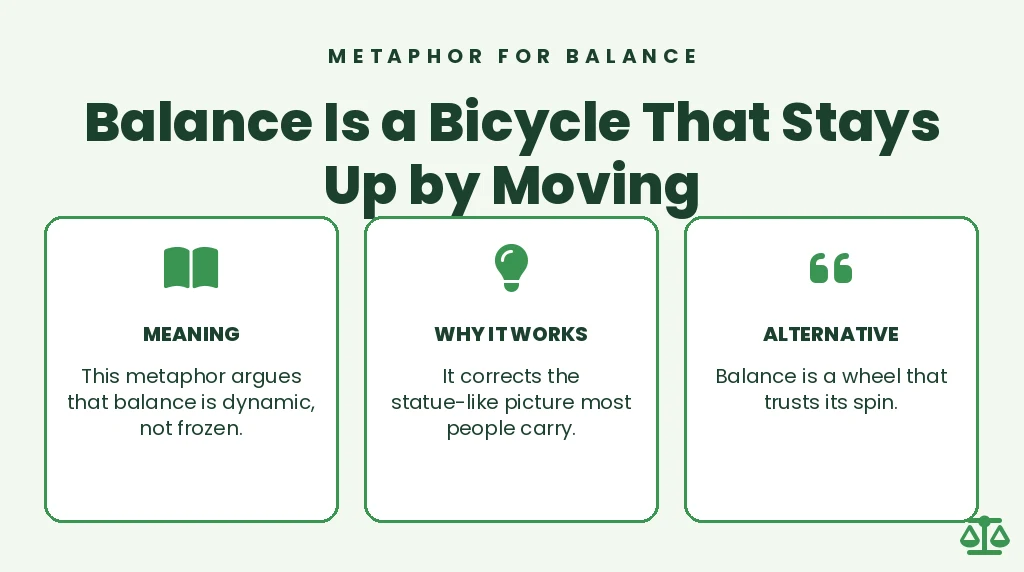
3. Balance Is a Bicycle That Stays Up by Moving
Meaning
Stop moving, fall over. A bicycle makes it bluntly: balance isn’t frozen, it’s dynamic, and a life, company, or recovery stays upright through gentle forward motion and small, unglamorous corrections.
Why It Works
Most of us picture a statue. This corrects that. Anyone who has wobbled at a red light knows the physics in their knees, so the advice sticks without much arguing.
Alternative Expression
Try this instead: “Balance is a wheel that trusts its spin.”
Examples in Writing
Formal Example: The chief executive called recovery balance a bicycle that stays up by moving, urging small decisions over perfect plans.
Casual Example: After my injury I learned balance is a bicycle that stays up by moving, so I walk a little every day.
Creative Example: Through the wobbling first year of the shop, her balance pedalled like a bicycle that stays up by moving, and it did.
4. Balance Is a Dancer Resting Between Two Beats
Meaning
Where’s the balance in a dance? Often in the pause. It sits in that poised gap between movements, and the rest isn’t the opposite of the dance. It’s part of the technique.
Why It Works
Overworked readers, take note. The pause comes without quitting, a real relief, and it suits artists, athletes, and anyone whose week needs a better rhythm, not just less in it.
Alternative Expression
Or, quietly: “Balance is the silence that makes the music.”
Examples in Writing
Formal Example: The choreographer taught balance as a dancer resting between two beats, a stillness the audience feels as control.
Casual Example: I schedule nothing on Sundays now. Balance is a dancer resting between two beats in my week.
Creative Example: On the dark stage, balance hovered like a dancer resting between two beats, one breath before the music resumed.
5. Balance Is a Bridge That Shares the Weight
Meaning
No single pier carries a bridge. That’s the idea. Balance becomes distribution, the load spread across people, habits, or supports so widely that even heavy traffic feels surprisingly light.
Why It Works
Suddenly balance isn’t willpower. It’s teamwork and design. Managers get it, couples get it, and so do communities carrying something heavy without quietly breaking one person’s back.
Alternative Expression
Or phrase it as, “Balance is a table carried by many hands.”
Examples in Writing
Formal Example: The reform built institutional balance as a bridge that shares the weight among courts, press, and parliament.
Casual Example: Since we split the chores properly, our balance is a bridge that shares the weight, and nobody collapses by Friday.
Creative Example: Stone by stone the valley was crossed, and balance stood like a bridge that shares the weight, humming under the carts.
6. Balance Is a Seesaw Paused at the Perfect Moment
Meaning
For a second, nobody wins. Two riders hang level, neither up nor down, in a delighted stillness everyone knows can’t last, and nobody in that moment wants to end.
Why It Works
It’s honest, for a start. Playgrounds don’t do permanence, which suits friendships, negotiations, and marriages where equality isn’t achieved once but renewed, sometimes daily, in small ways.
Alternative Expression
A playful cousin: “Balance is two buckets hanging level.”
Examples in Writing
Formal Example: The mediator sought balance as a seesaw paused at the perfect moment, both parties briefly airborne and equal.
Casual Example: Some evenings work and family sit like a seesaw paused at the perfect moment, and I just enjoy it.
Creative Example: For one golden minute the playground held its breath, balance a seesaw paused at the perfect moment between two laughing girls.
7. Balance Is a Chef Tasting Before Adding Salt
Meaning
Taste first. Then season. A good chef doesn’t dump in salt and hope: he tastes, judges, adds a pinch, tastes again, knowing salt, once in, doesn’t come back out.
Why It Works
Kitchens make wisdom practical. Use it while editing, parenting, or setting policy, anywhere the right amount beats the maximum and you learn by tasting, not by theorising from a distance.
Alternative Expression
Or try: “Balance is a recipe adjusted by the tongue.”
Examples in Writing
Formal Example: The finance minister pursued balance like a chef tasting before adding salt, raising rates a quarter point at a time.
Casual Example: With my toddler’s screen time, balance is a chef tasting before adding salt: a little, check, adjust.
Creative Example: Over the great pot of the family’s fortunes, grandmother kept balance like a chef tasting before adding salt, serene and exact.
8. Balance Is a Sail Trimmed to Two Winds
Meaning
Two winds, one boat. The sailor can’t order either wind around, so balance becomes adjustment between opposing forces, trimming the sail until even contrary weather pushes forward, not sideways.
Why It Works
Adaptability wins over purity here. Think of leaders between markets and mandates, or parents between two children’s different needs on one afternoon. Mixed conditions are the norm.
Alternative Expression
A close image: “Balance is a rudder answering two currents.”
Examples in Writing
Formal Example: The ambassador maintained balance as a sail trimmed to two winds, adjusting weekly between allied capitals.
Casual Example: Freelancing with a newborn, my balance is a sail trimmed to two winds, and somehow we move.
Creative Example: Between the gale of ambition and the gust of grief, she trimmed her balance like a sail to two winds and held her course.
9. Balance Is a Tree Rooted as Deeply as It Grows
Meaning
Grow tall, grow down. For every branch of ambition above ground, this image asks for an equal root below it, of rest, values, or belonging, keeping pace with the growth.
Why It Works
It also explains spectacular falls. We’ve all seen a tree, or career, that shot up without roots, and the warning is simple: proportion matters more than height.
Alternative Expression
Another angle: “Balance is a mast matched by its keel.”
Examples in Writing
Formal Example: The leadership programme teaches balance as a tree rooted as deeply as it grows, pairing promotion with mentoring.
Casual Example: Every new project gets a new day off in my calendar. Balance is a tree rooted as deeply as it grows here.
Creative Example: The oak above the farm kept its balance like a tree rooted as deeply as it grows, and a century of storms filed past.
10. Balance Is a Pendulum That Knows Its Center
Meaning
Swinging isn’t failure. Moods swing, markets swing, energy swings, and balance was never about stopping the swing: it’s knowing your center well enough to trust you’ll return to it.
Why It Works
That reassures people who distrust their own fluctuations. It suits mental health, creative careers, and relationships, anywhere rhythm matters more than stillness and a bad week isn’t a broken life.
Alternative Expression
Related: “Balance is a tide that always returns to shore.”
Examples in Writing
Formal Example: The psychologist described emotional balance as a pendulum that knows its center, swinging widely yet reliably home.
Casual Example: My motivation swings wildly, honestly. Balance is a pendulum that knows its center, so I trust the return.
Creative Example: Through feasts of joy and famines of doubt, his balance swung like a pendulum that knows its center, ticking in the hall of years.
11. Balance Is a Table Standing on Even Legs
Meaning
Think of a table. Health, money, work, and love are its legs, and balance is what happens when they’re even: shorten one, and everything on the surface slowly starts to slide.
Why It Works
It’s domestic, and diagnostic. That helps in life audits, coaching, and honest New Year essays, because the wobble stops being mysterious once you look for the short leg.
Alternative Expression
Or, more simply: “Balance is a stool that trusts all three legs.”
Examples in Writing
Formal Example: The wellness report urges employers to view balance as a table standing on even legs: rest, pay, purpose, and health.
Casual Example: My sleep leg was short for months, and the whole table wobbled. Balance really is even legs.
Creative Example: On the table of her life, set for guests and storms alike, balance stood on even legs at last, and nothing slid.
12. Balance Is a River Between Two Banks
Meaning
Banks aren’t the river’s enemies. They stop it becoming a flood or a swamp, and balance here is energy flowing between firm limits, not energy with nowhere useful to go.
Why It Works
Boundaries come out as gifts. That suits arguments about freedom and discipline, spending and saving, speaking and listening, where firm edges don’t weaken the force. They channel it.
Alternative Expression
A close variant: “Balance is a road kept by its ditches.”
Examples in Writing
Formal Example: The constitution designs liberty as balance, a river between two banks of rights and duties.
Casual Example: My budget works when balance is a river between two banks: payday joy on one side, rent on the other.
Creative Example: Between the green banks of duty and desire, her life ran like a river in balance, swift and clear and deep.
13. Balance Is a Juggler Breathing in Rhythm
Meaning
The balls never stop moving. So what balances a juggler? Breathing does. Practised calm and steady rhythm, with panic kept out of the pattern while obligations stay airborne at once.
Why It Works
Every parent, nurse, and manager recognises it. The image honours skill built by repetition, and makes a forgiving point too: even experts drop things, then pick them up again.
Alternative Expression
Or put it as, “Balance is three oranges and a steady heart.”
Examples in Writing
Formal Example: The operations chief kept departmental balance like a juggler breathing in rhythm, calm precisely because the load was moving.
Casual Example: Three kids, one shop, night classes: my balance is a juggler breathing in rhythm, most of the time.
Creative Example: Above the sawdust, balance spun like a juggler breathing in rhythm, clubs rising and falling like obedient moons.
14. Balance Is a Compass Needle Settling North
Meaning
Shake a compass and watch. The needle trembles, overshoots, corrects, and settles, because finding north is what it’s built to do. Balance is that shaky moment of orientation after disturbance.
Why It Works
Recovery here isn’t heroic. It’s almost mechanical, in the best sense: built in. That suits anyone returning from illness, scandal, or grief who needs to trust their own recalibration.
Alternative Expression
Related: “Balance is a gyroscope remembering upright.”
Examples in Writing
Formal Example: The rehabilitation study described recovery as balance, a compass needle settling north after the shaking stops.
Casual Example: After the breakup I wobbled for months. Balance is a compass needle settling north, and mine finally did.
Creative Example: Trembling over the map of his ruined year, balance swung like a compass needle, slowed, and settled, faithful, on north.
15. Balance Is a Kite Held by a Patient String
Meaning
Too much string, the kite wanders. Too little, it dives. Balance lives in that tension between freedom and restraint, a patient hand letting out and pulling back, negotiating constantly.
Why It Works
For parenting and teaching, it’s the best image here. Honestly. The string is love with judgement in it, and readers feel the altitude and the care at once.
Alternative Expression
Or, in other words: “Balance is a leash loose enough for joy.”
Examples in Writing
Formal Example: The head teacher described discipline as balance, a kite held by a patient string, firm below and free above.
Casual Example: Teenagers, honestly: balance is a kite held by a patient string in this house, one eye on the sky.
Creative Example: High over the spring field, the kite danced, and balance ran down the patient string into her father’s steady hands.
16. Balance Is a Beam Carried Across the Shoulders
Meaning
Picture a beam across the shoulders, a bucket at each end. The two loads oppose each other, yes, but they also steady the walk. Balance is labour shared, not removed.
Why It Works
This honours working lives. Balance isn’t a spa word here, it’s a daily technique, fitting providers, carers, and anyone whose duties don’t cancel out but balance each other.
Alternative Expression
A close image: “Balance is two buckets teaching the back.”
Examples in Writing
Formal Example: The oral history records porters whose balance was a beam carried across the shoulders, loads matched by long practice.
Casual Example: Job on one side, family on the other, my balance is a beam carried across the shoulders, and it works.
Creative Example: Down the mountain path at dawn, balance rode like a beam across her shoulders, water jars level as twin moons.
17. Balance Is a Garden Where Sun and Shade Share the Beds
Meaning
A garden needs both. Sun alone scorches, shade alone starves, and balance here is opposites cooperating: ambition gets its light, rest its cool beds, neither treated as the enemy.
Why It Works
Notice the shift. Balance becomes something cultivated, tended season by season instead of fixed once, which suits teams, diets, and inner lives needing variety more than victory.
Alternative Expression
Another way round it: “Balance is a climate, not a compromise.”
Examples in Writing
Formal Example: The curriculum aims for balance as a garden where sun and shade share the beds, mixing rigor with play in each week.
Casual Example: Our weekends finally mix chores and hammock time. Balance is a garden where sun and shade share the beds.
Creative Example: She planned her days like a garden where sun and shade share the beds, and everything in her began, quietly, to bloom.
18. Balance Is a Symphony Tuned Between Instruments
Meaning
No instrument gets silenced. Each one gets tuned. Balance means many different voices adjusted to one another until their differences stop clashing and start producing the harmony itself.
Why It Works
It suits plural things: families, parliaments, personalities. Balance isn’t sameness here, and sometimes the loudest section needs only the gentlest correction to bring the whole piece together.
Alternative Expression
A musical variant: “Balance is every instrument in the same key.”
Examples in Writing
Formal Example: The conductor described ensemble balance as a symphony tuned between instruments, each section yielding a fraction of volume.
Casual Example: In our house, balance is a symphony tuned between instruments: loud dad, quiet mum, drumming toddler.
Creative Example: Under the old conductor’s hands, the city’s many noises settled into balance, a symphony tuned between instruments at dusk.
19. Balance Is a Stone Stacked on a River Rock
Meaning
You don’t force a stacked stone. You feel for it. Balance is a found point, discovered through patience and fingertips, the spot where the stone agrees to rest.
Why It Works
Meditative, and slightly miraculous. It’s the familiar cairn made thoughtful, suiting mindfulness, craft, and any balance that must be sensed with your hands rather than calculated on paper.
Alternative Expression
Or try: “Balance is an egg standing on end at dawn.”
Examples in Writing
Formal Example: The sculptor taught balance as a stone stacked on a river rock, found by fingertips rather than by force.
Casual Example: My mornings finally work, all five minutes of them. Balance is a stone stacked on a river rock: delicate, doable.
Creative Example: Beside the black river he set stone on stone, and balance stood there trembling, perfect, and entirely unbothered by the current.
20. Balance Is a Breath Taken Halfway Between Two Words
Meaning
Smallest scale, biggest effect. Balance hides in the pause inside a sentence, where a speaker gathers a thought and chooses the next word carefully. Whole arguments get saved there.
Why It Works
Anyone can use it. Anywhere, mid-conversation, mid-email. It fits communication, anger management, and writing itself, because the pause is often the most balanced part of the exchange.
Alternative Expression
One last version: “Balance is the comma that saves the sentence.”
Examples in Writing
Formal Example: The mediator’s whole method was balance, a breath taken halfway between two words, inserted before every reply.
Casual Example: Before answering that email, I use balance: a breath taken halfway between two words. It has saved my job twice.
Creative Example: The old debater smiled, and in the breath between two words his balance gathered, quiet as a cat, before he spoke.
Positive Metaphors for Balance
When balance is working, it feels like music, weather, and good cooking at once. These six images present harmony as something warm and alive.
- Balance is a well-tuned guitar string. It answers a touch with exactly the right note.
- Balance is a harbour where waves settle. It lets busy water rest without stopping the tide.
- Balance is a recipe that needs nothing more. It satisfies without excess in any direction.
- Balance is a warm room with an open window. It mixes comfort with fresh air.
- Balance is a friendship of equals. It gives and receives in honest turns.
- Balance is a sunrise shared between night and day. It belongs fully to neither and blesses both.
Negative Metaphors for Balance
Balance fails in recognisable ways too: rigged, stuck, or one-sided. These six images describe harmony gone wrong.
- Balance is a chair with one short leg. It annoys every single day in small ways.
- Balance is a scale rusted on one side. It calls its bias a verdict.
- Balance is a tightrope in a crosswind. It demands luck as well as skill.
- Balance is a juggler with one ball too many. It turns competence into slow-motion panic.
- Balance is a boat loaded all on one side. It invites the very capsize it fears.
- Balance is a pendulum stuck at the edge. It has forgotten the way home.
Metaphors for Balance in Sentences
Here are six ready-made sentences using balance metaphors, each with a note on what the image communicates.
| Example sentence | What it communicates |
|---|---|
| Her balance was a bicycle that stays up by moving, so she kept making small decisions. | Stability achieved through motion and adjustment. |
| The committee acted as a scale listening to both sides before publishing its findings. | Fairness through patient weighing. |
| After the scandal, his balance returned like a compass needle settling north. | Recovery of orientation after disturbance. |
| Their teamwork became a boat loaded all on one side, and the project capsized. | Imbalance caused by uneven contribution. |
| She parented like a kite held by a patient string, firm and watchful at once. | Freedom balanced with gentle restraint. |
| In the meeting, his balance was a breath taken halfway between two words. | Composure created by a deliberate pause. |
How to Use Metaphors for Balance Naturally
Start with a simple choice. Is the balance you mean stillness, or motion? A burned-out nurse needs the dancer resting between beats; a stuck perfectionist needs the bicycle. The wrong family of images can make good advice land like an accusation.
Then ground it in the body. Pick a scene your reader has lived: tasting soup, wobbling on a bike, stacking stones, trimming a sail. People know balance through shoulders and feet, not definitions, so bodily images persuade where diagrams don’t. One remembered wobble is worth three explanations.
And don’t pile everything in. One governing metaphor, lightly repeated, can hold a whole essay upright, the way one center holds a pendulum. Revise by cutting comparisons until only the steadiest remains.
Metaphor vs. Simile: What Is the Difference?
A metaphor states the identity outright: balance is a bicycle. A simile keeps the comparison at arm’s length with “like” or “as”: balance is like a bicycle. The metaphor sounds like a principle; the simile, like an observation.
Advice writing often prefers the metaphor, because readers came for guidance stated firmly. Reflective essays often prefer the simile, which admits the writer is still wobbling toward the idea. Both are honest; they stand at different distances.
Same idea, both ways. Metaphor: “Balance is a pendulum that knows its center.” Simile: “Her balance was like a pendulum that knows its center.” The first teaches; the second testifies.
Common Mistakes When Writing Balance Metaphors
- Mistake: Picturing balance as perfect stillness. Most real balance moves, swings, and corrects. A frozen image quietly teaches readers to fear any wobble.
- Mistake: Splitting everything exactly in half. Balance is proportion, not arithmetic. A chef adds a pinch of salt, not a kilo, to match a kilo of flour.
- Mistake: Mixing circus, kitchen, and ocean in one paragraph. Competing images make harmony sound chaotic. Let one scene govern each section.
- Mistake: Using balance to mean blandness. A symphony in balance is vivid, not beige. If your metaphor removes all flavour, it describes numbness, not harmony.
- Mistake: Ignoring the cost of imbalance. A short table leg and a one-sided boat give your piece stakes. Without them, balance sounds like a luxury instead of a necessity.
Frequently Asked Questions
What is a good metaphor for balance in life?
“Balance is a bicycle that stays up by moving” is the most useful for modern life, because it replaces the fantasy of a perfectly still schedule with small, constant corrections. For relationships, “Balance is a bridge that shares the weight” reminds readers that no one should carry everything alone.
How do you describe balance in creative writing?
Give balance a body: a juggler breathing in rhythm, a kite on a patient string, a stone stacked on a river rock. Let readers watch it happen, wobble included, and they’ll feel the idea instead of memorising it. One vivid scene outperforms a paragraph of definitions.
What is a metaphor for work-life balance?
“Balance is a garden where sun and shade share the beds” suits work and rest beautifully, because both are necessary and seasonal. “Balance is a beam carried across the shoulders” suits readers whose two loads, job and family, steady each other rather than compete.
What is a negative metaphor for balance?
“Balance is a boat loaded all on one side” is the clearest negative image, because everyone sees the capsize coming. “Balance is a scale rusted on one side” suits unfair systems, where the weighing itself has stopped being honest.
Why do writers use metaphors for balance?
Because balance is invisible until it fails. A metaphor gives it legs, strings, or banks to watch, turning an abstract virtue into a scene readers can test against their own lives. That testability is why these images survive in essays, sermons, and coaching.
Conclusion
Across these twenty images, balance is less a pose than a practice: tasting, trimming, pedalling, pausing. Writers who describe it best rarely reach for grand words; they prefer plain comparisons that stay honest, the kind a reader can test against one ordinary Tuesday.
Try one image in your next essay or conversation and watch whether it steadies the sentence. If your subject is balance expressed through the body itself, spend time with movement turned into meaning, where every pause between beats teaches staying upright. Harmony, it turns out, is mostly paying attention.