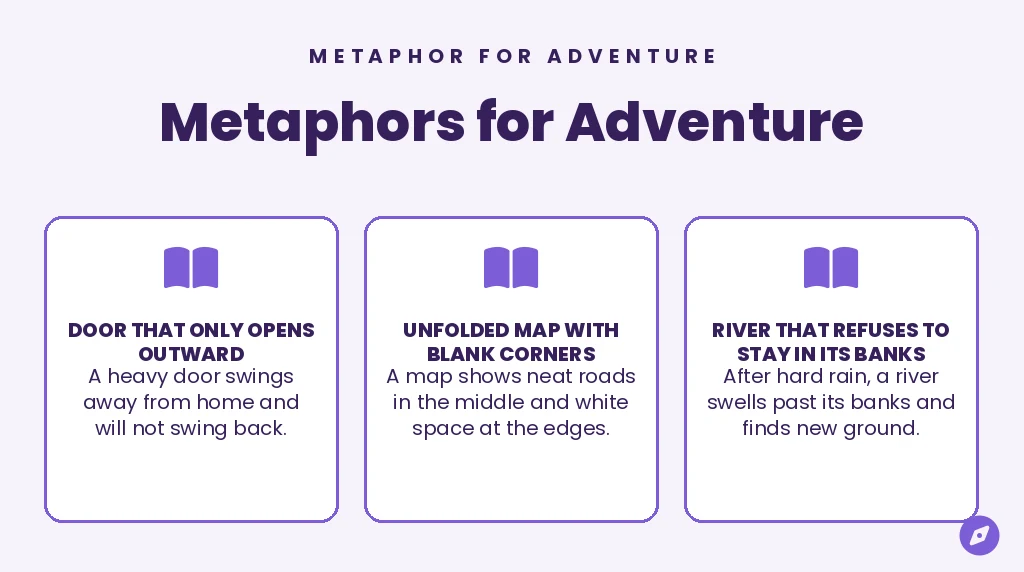
Adventure is a door that only opens outward, and once you step through, your old routine cannot pull you back. It is also a river that refuses to stay in its banks, spilling into fields you never planned to visit. A strange road. A yes said too fast. A bag packed before doubt wakes up.
Plain words can name a trip, but they rarely carry the thump in your chest before it starts. A strong metaphor gives readers that thump. It turns nerves into weather, hope into light, and risk into ground under your feet, so a scene feels lived in rather than explained.
Below are twenty fresh metaphors for adventure, each with its meaning, why it works, another way to say it, and three examples. You will also find positive and negative options, ready made sentences, and plain advice on using them well. They suit students writing essays, writers shaping stories, and speakers who want a line people remember.
Quick Metaphors for Adventure
Here is the full set at a glance, so you can scan for the image that fits your mood first.
- Adventure is a door that only opens outward.
- Adventure is an unfolded map with blank corners.
- Adventure is a river that refuses to stay in its banks.
- Adventure is a mountain trail hidden in morning mist.
- Adventure is a storm chasing you toward clear skies.
- Adventure is an old compass with a restless needle.
- Adventure is a fire lit in the middle of nowhere.
- Adventure is a treasure hunt without a final clue.
- Adventure is a dance on a shaking bridge.
- Adventure is a steam engine leaving the last station.
- Adventure is a wild garden beyond the fence.
- Adventure is a sail caught by an unknown wind.
- Adventure is a key that fits no lock you own.
- Adventure is a drumbeat calling from the forest.
- Adventure is a tightrope stretched over a canyon.
- Adventure is a lantern swung into a dark cave.
- Adventure is a road that builds itself as you walk.
- Adventure is a chess game played against the weather.
- Adventure is a seed cracked open by distant thunder.
- Adventure is a letter written to your future self.
Metaphors for Adventure and Their Meanings
Each metaphor below takes a different route into the unknown, from doors and maps to engines and drumbeats. Notice which images pull at you, and borrow the thinking behind them for your own lines.
1. Adventure Is a Door That Only Opens Outward
Meaning
A heavy door swings away from home and will not swing back. Stepping through means change for good, even if you miss the old room behind you.
Why It Works
Everyone knows the fear of opening a door without seeing the other side. The one way swing turns a simple action into a real commitment.
Alternative Expression
Call it “a threshold you cross with both feet” for a softer tone.
Examples in Writing
Formal Example: She accepted the post abroad, knowing adventure is a door that only opens outward.
Casual Example: I bought the ticket and stopped looking back. No refunds, no regrets.
Creative Example: Mara heard the green door click behind her and smiled at the empty road.
2. Adventure Is an Unfolded Map With Blank Corners
Meaning
A map shows neat roads in the middle and white space at the edges. Adventure starts in those blank corners, where nobody has charted the way for you.
Why It Works
Maps promise control, so the empty parts feel thrilling and a little rude. Readers lean in, curious about what the white space hides.
Alternative Expression
Try “the white space at the edge of the map” when mystery matters most.
Examples in Writing
Formal Example: For the young researcher, the unstudied valley was invitation, because adventure is an unfolded map with blank corners.
Casual Example: Our route ended on the app, but we kept driving anyway. Best call ever.
Creative Example: The captain folded the chart where the ink ran out and grinned at the sea.
3. Adventure Is a River That Refuses to Stay in Its Banks
Meaning
After hard rain, a river swells past its banks and finds new ground. Adventure does the same, spilling over careful plans and carrying you farther than intended.
Why It Works
Water is familiar, yet flood water has muscle and mood. One image can hold both excitement and a welcome loss of control.
Alternative Expression
Swap in “a current too strong for the old banks” for the same flood, shorter.
Examples in Writing
Formal Example: Within a month, every timetable had shifted, for adventure is a river that refuses to stay in its banks.
Casual Example: We planned one night of camping and stayed for six. Classic us, honestly.
Creative Example: The journey took her notebooks, her schedule, and her fear in one brown rush.
4. Adventure Is a Mountain Trail Hidden in Morning Mist
Meaning
High paths vanish in mist, so you see only the next few stones. Adventure asks for that step by step trust, with the view promised but not yet given.
Why It Works
Mist softens a hard climb into something gentle and strange. It also mirrors real choices, where you rarely see the end before you begin.
Alternative Expression
Try “a path you find one step at a time” for the same patience, plainer.
Examples in Writing
Formal Example: The charity climb demanded patience, since adventure is a mountain trail hidden in morning mist.
Casual Example: We could not see the top at all, just the next rock. So we climbed.
Creative Example: Boots wet, breath short, she followed white air uphill, trusting unseen stones.
5. Adventure Is a Storm Chasing You Toward Clear Skies
Meaning
Thunder rolls behind you and the only dry place is ahead. Adventure can work that way, driving you out of a dull place toward a brighter one.
Why It Works
Storms give a scene sound, speed, and stakes in seconds. The twist is hope, because here the storm helps instead of harming.
Alternative Expression
Use “bad weather with good directions” when hardship should point the way out.
Examples in Writing
Formal Example: Losing the contract forced the team overseas, proof that adventure is a storm chasing you toward clear skies.
Casual Example: My flight was cancelled, so I took the night bus and met my best friend.
Creative Example: Rain hammered the shutters as Jonah ran, laughing, for the harbour lights.
6. Adventure Is an Old Compass With a Restless Needle
Meaning
An old compass still points north, but its needle trembles and spins before it settles. Adventure asks you to trust a guide that wobbles yet never fully lies.
Why It Works
Small objects carry big feelings well. A brass compass feels like a heartbeat you can hold, and its wobble shows doubt without speeches.
Alternative Expression
Use “a needle that dances before it points” when the wobble matters most.
Examples in Writing
Formal Example: Counsellors remind leavers that adventure is an old compass with a restless needle, not a wrong direction.
Casual Example: I changed my mind three times at the station. My needle was spinning, clearly.
Creative Example: In his pocket, the compass ticked like a tiny heart, begging him onward.
7. Adventure Is a Fire Lit in the Middle of Nowhere
Meaning
Far from any town, one small fire becomes warmth, safety, and company at once. Adventure gives that same pocket of courage inside a large, lonely unknown.
Why It Works
Firelight pulls people close in real life, and it does the same on the page. Tiny flame against vast dark makes bravery look modest and real.
Alternative Expression
Try “one small light in a wide dark place” for comfort without the camp scene.
Examples in Writing
Formal Example: The guide said adventure is a fire lit in the middle of nowhere, making an unfamiliar night bearable.
Casual Example: No signal, no plan, just beans and a fire. It felt like enough.
Creative Example: Sparks rose into black pines while wolves kept their distance beyond the light.
8. Adventure Is a Treasure Hunt Without a Final Clue
Meaning
Each clue in a hunt feels sweet because you expect a last one ahead. Adventure can remove that promise, making the searching itself the prize.
Why It Works
Games wake up the child in most readers fast. The missing clue adds a grown up ache, because life rarely ties its ribbons neatly.
Alternative Expression
Use “a hunt where the trail is the treasure” to praise journey over prize.
Examples in Writing
Formal Example: Travellers warn that adventure is a treasure hunt without a final clue, so gather satisfaction along the route.
Casual Example: We never found the waterfall from the blog, but the day was brilliant anyway.
Creative Example: Clue by clue, the twins crossed the island, laughing louder at each dead end.
9. Adventure Is a Dance on a Shaking Bridge
Meaning
Rope bridges sway with every step, and your body must adjust or freeze. Adventure asks for that balance and nerve while the ground itself refuses to stay still.
Why It Works
Movement makes the image sing, with knees bending and boards creaking. Risk suddenly feels joyful instead of grim, and grace gets its due.
Alternative Expression
Prefer “keeping your balance while the bridge sways” for a calmer scene.
Examples in Writing
Formal Example: Students abroad learned poise, for adventure is a dance on a shaking bridge with ever changing rhythm.
Casual Example: New city, new job, no clue, but I am still moving. Still dancing, basically.
Creative Example: She counted the sway, one, two, sway, and spun once for luck.
10. Adventure Is a Steam Engine Leaving the Last Station
Meaning
Steam builds, wheels groan, and the platform slides away for the last time. Adventure carries that roaring point of departure, loud, final, and thrilling.
Why It Works
Trains bring noise, weight, and speed readers can hear in their heads. The last station raises the stakes without any villain or storm.
Alternative Expression
Try “the last train out of a quiet town” for a more personal departure.
Examples in Writing
Formal Example: At dawn the volunteers boarded, aware that adventure is a steam engine leaving the last station.
Casual Example: Once that van pulled away with all my stuff, no take backs. None.
Creative Example: Coal smoke, brass bells, one shrill whistle, and Tomas was gone with morning.
11. Adventure Is a Wild Garden Beyond the Fence
Meaning
Behind a neat fence, grass stays short and flowers stand in rows. Beyond it, vines climb freely and bees run the place. Adventure lives on that untidy side.
Why It Works
Gardens feel safe, so a wild one carries wonder without much fear. The fence draws a clear line between routine and freedom.
Alternative Expression
Use “the untamed patch past the garden gate” for wonder more than risk.
Examples in Writing
Formal Example: The field trip proved that adventure is a wild garden beyond the fence, ordered by no timetable.
Casual Example: We climbed the fence behind the park and found a whole creek back there.
Creative Example: Nettles stung her ankles and blackberries stained her hands, sweet and scratchy.
12. Adventure Is a Sail Caught by an Unknown Wind
Meaning
A sail sits flat until wind fills it and pulls the boat somewhere new. Adventure catches a life that way, moved by forces you respect rather than control.
Why It Works
Sailing feels clean and hopeful, even in rough seas. The unseen wind gives writers a graceful way to talk about luck and timing.
Alternative Expression
Say “canvas filled by a wind you cannot see” for a more poetic lift.
Examples in Writing
Formal Example: A chance harbour meeting led to a year at sea, proof that adventure is a sail caught by an unknown wind.
Casual Example: One phone call and my whole summer changed ports. Just like that.
Creative Example: The white sail snapped, bellied out, and the little boat leapt forward.
13. Adventure Is a Key That Fits No Lock You Own
Meaning
A strange key turns in none of your doors, and at first that frustrates. Then curiosity wakes, because it must fit something somewhere, and finding that lock becomes the point.
Why It Works
Keys promise answers, so a key without a lock itches in the mind. It fits hidden talent and people made for places not yet found.
Alternative Expression
Try “a key still searching for its door” for a hopeful hunt.
Examples in Writing
Formal Example: Her gift for languages had no village use, yet adventure is a key that fits no lock you own.
Casual Example: My weird hobby finally made sense at that camp. It just needed its door.
Creative Example: The brass key warmed in his fist at every crossroads, still hunting.
14. Adventure Is a Drumbeat Calling From the Forest
Meaning
Past the tree line, a drum keeps a beat you feel in your ribs before you hear it clearly. Adventure often begins as that unexplained pull on your feet.
Why It Works
Sound reaches readers fast, and a drumbeat feels ancient and bodily. Longing stops sounding like an idea and starts sounding like instinct.
Alternative Expression
Use “a beat your feet cannot ignore” when the forest is not needed.
Examples in Writing
Formal Example: The explorer said adventure is a drumbeat calling from the forest, felt long before it is explained.
Casual Example: I kept hearing about that trail until I just went. It got loud.
Creative Example: Boom. Pause. Boom. Her spoon stopped halfway to her mouth.
15. Adventure Is a Tightrope Stretched Over a Canyon
Meaning
High above a canyon, a rope offers one thin line between safety and a long fall. Adventure can feel that exposed, where each careful step is a small victory.
Why It Works
Heights trigger an instant response in the body, so tension arrives free. The tightrope also honours skill, because crossing is not luck alone.
Alternative Expression
Use “a narrow line walked with steady eyes” to keep focus, lose height.
Examples in Writing
Formal Example: The founders admitted adventure is a tightrope stretched over a canyon during a company first year.
Casual Example: One exam, one shot, no retakes. I am wobbling, not gonna lie.
Creative Example: Wind tugged his shirt a mile above the river, so he watched his toes.
16. Adventure Is a Lantern Swung Into a Dark Cave
Meaning
Swing a lantern into a cave and light reveals one wet wall, one pool, one mark at a time. Adventure gives knowledge in small circles, rewarding the brave without showing everything.
Why It Works
Darkness plus moving light creates instant curiosity, and readers peer along. The small lit circle also matches how learning feels, partial and earned.
Alternative Expression
Write “a small light carried into deep dark” for mystery without the cave.
Examples in Writing
Formal Example: The historian noted adventure is a lantern swung into a dark cave, each archive revealing part of the story.
Casual Example: Night snorkelling sounded crazy until my torch lit up a turtle. Wow, just wow.
Creative Example: The lantern creaked, gold light spilling over old bones and bright coins.
17. Adventure Is a Road That Builds Itself as You Walk
Meaning
Step onto bare grass and stones appear under each footfall, just in time. Adventure rewards action that way, laying the path only after you commit to walking.
Why It Works
Roads are the oldest travel image there is, so the magic twist lands fast. The building stones turn courage into cause and effect.
Alternative Expression
Use “a path made by walking it” for plain speech over magic.
Examples in Writing
Formal Example: Mentors assured graduates that adventure is a road that builds itself as you walk, so waiting becomes delay.
Casual Example: I had no contacts and no portfolio, so I just started. It worked.
Creative Example: Stone by stone, the moor gave her a road, if she kept walking.
18. Adventure Is a Chess Game Played Against the Weather
Meaning
Chess rewards planning, until your opponent moves clouds and tips the board with wind. Adventure mixes strategy and surprise like that, forcing smart people to adapt mid game.
Why It Works
A tidy board against wild skies is funny and true at once. Readers smile, then nod, especially if their own plans have failed in interesting ways.
Alternative Expression
Try “a game where the sky keeps moving the pieces” for lighter chaos.
Examples in Writing
Formal Example: Leaders plan for months, yet adventure is a chess game played against the weather, overturned by one snowfall.
Casual Example: We planned around sunshine and got hail on day one. Weather cheats, clearly.
Creative Example: The old sailor moved his knight, then watched the gale move the sea.
19. Adventure Is a Seed Cracked Open by Distant Thunder
Meaning
A hard seed sleeps in dry soil for years until storm rain wakes it. Adventure begins in a person the same way, split open by a far off shock.
Why It Works
Small beginnings give big changes a tender face, and stuck readers can see themselves without shame. Thunder adds drama from a safe distance.
Alternative Expression
Use “a shell split by coming rain” when growth should feel quiet.
Examples in Writing
Formal Example: After the factory closed, retraining felt like renewal, for adventure is a seed cracked open by distant thunder.
Casual Example: One podcast cracked something open in me, and I booked the course that night.
Creative Example: Beyond the hills, thunder muttered, and the buried seed split smiling.
20. Adventure Is a Letter Written to Your Future Self
Meaning
Write a letter today and seal it for a person you have not yet become. Adventure is a message sent forward like that, read by the traveller who returns.
Why It Works
Letters feel intimate in a way grand quests sometimes do not. The image turns travel inward, toward growth, memory, and the self you owe.
Alternative Expression
Use “a promise mailed to tomorrow” for endings, graduations, and farewells.
Examples in Writing
Formal Example: The head teacher said adventure is a letter written to your future self, so write yours with courage.
Casual Example: Future me can thank present me later for this wild gap year.
Creative Example: She signed the page, sealed it with wax and dust, and walked on.
Positive Metaphors for Adventure
Some adventures leave you sunburnt, laughing, and already planning the next one. For scenes with that warm glow, reach for light, open gates, and friendly winds. The six options below keep a hint of risk, but tilt toward joy, growth, and good company.
- Adventure is a sunrise waiting at the top of a hill. It rewards an early start with hope and a view that makes the climb worth it.
- Adventure is a fresh page in a worn notebook. It gives a familiar life a clean space where new stories can begin.
- Adventure is a friendly wind filling your sails. It turns luck and timing into gentle help that pushes you forward.
- Adventure is a song you learn by singing it loud. It praises courage over polish and grows better the braver you get.
- Adventure is a garden gate left open in spring. It frames a new start as a welcome rather than a warning.
- Adventure is a warm campfire shared with new friends. It shows how strangers on a journey can quickly feel like family.
Negative Metaphors for Adventure
Not every journey deserves a postcard. Trips can drain savings, strain friendships, and leave people lost in every sense. The six metaphors below lean darker, with leaking boats, shifting mazes, and empty tanks, for stories that need warning or regret.
- Adventure is a leaking boat far from shore. It turns poor planning into a slow emergency that gets worse with every mile.
- Adventure is a maze with moving walls. It makes confusion feel cruel, because even good memory cannot save you.
- Adventure is a storm that steals your map. It strips away guidance at the exact moment you need it most.
- Adventure is a desert road with an empty tank. It warns that boldness without fuel or water ends in silence.
- Adventure is a cliff path crumbling underfoot. It shows danger growing with each step instead of fading behind you.
- Adventure is a locked room filling with smoke. It captures panic, poor choices, and the feeling that time is running out.
Metaphors for Adventure in Sentences
Seeing a metaphor inside a full sentence helps more than any definition, because you feel its tone at once. The table below pairs six examples with a plain note on what each one tells the reader.
| Example sentence | What it communicates |
|---|---|
| For Priya, adventure was a door that only opens outward, so she signed the contract and never asked for her old desk back. | It communicates commitment and the point of no return. |
| Adventure was a sail caught by an unknown wind, and one chance job advert carried him across the sea. | It communicates luck, timing, and a life moved beyond planning. |
| With no signal and a dying torch, adventure became a lantern swung into a dark cave for the lost walkers. | It communicates partial knowledge and courage in small steps. |
| Adventure was a dance on a shaking bridge during her first month abroad, thrilling and wobbly in equal measure. | It communicates balance, nerve, and joy under unstable conditions. |
| For the broke backpackers, adventure turned into a desert road with an empty tank somewhere past midnight. | It communicates warning, regret, and the cost of poor preparation. |
| He treated adventure as a letter written to his future self and chose the harder road on purpose. | It communicates growth, patience, and hope aimed at a later self. |
How to Use Metaphors for Adventure Naturally
Start with feeling, not with a list. Ask what the moment feels like in the body. A tight chest before a leap? A grin on a windy hill? Wet socks at mile nine? Pick the image that matches that feeling and your register. A formal report can carry a quiet compass. A personal blog can handle a shaking bridge.
Match intensity to the stakes. A tightrope over a canyon is too much for choosing a café, unless you mean it as a joke. A garden gate is too soft for a rescue at sea. One strong metaphor per scene is usually plenty, and two work only if they share a family, such as sails and winds.
Read your draft aloud and listen for bumps. If a line makes you pause to explain it, cut it or swap it. Check three things: is the picture clear, does it fit the mood, and have you used it before in the piece? Fresh, fitting, and used once. That is the craft in six words.
Metaphor vs. Simile: What Is the Difference?
A metaphor states that one thing is another thing, even though that cannot be literally true. A simile makes a softer claim, comparing two things using like or as. Saying adventure is a river claims its nature outright. Saying adventure is like a river invites readers to weigh the likeness for themselves.
Writers choose by tone. A metaphor sounds bold and settled, suiting strong narration, speeches, and opening lines. A simile sounds careful and open, suiting reflection and doubt. Neither is better in general, so many writers mix the two rather than lean on one all page long.
Here is the same idea in both forms. Metaphor: Adventure is a lantern swung into a dark cave. Simile: Adventure is like a lantern swung into a dark cave, showing one small circle at a time. The simile gives readers more space, while the metaphor walks straight in.
Common Mistakes When Writing Adventure Metaphors
- Mixing too many images: A sail, a chess game, and a campfire in one sentence fight each other and leave noise instead of a picture.
- Choosing drama that is too big: A canyon tightrope for a minor choice sounds false, so match the image to the real stakes.
- Using a tired phrase: Lines seen a hundred times slide past without effect, so twist a familiar image or build a fresher one.
- Explaining the metaphor to death: Three sentences decoding your own image kill the spark, so state it cleanly and let readers feel it.
- Forgetting the human feeling: A clever picture with no fear, hope, or joy is just decoration, so anchor every image in real emotion.
Frequently Asked Questions
What is a good metaphor for adventure?
A good metaphor for adventure is clear at first glance and keeps giving after that. Adventure is a door that only opens outward works well because everyone knows that pause before a door, and the one way swing captures commitment in one image. Pick one that fits your mood, hopeful, risky, or reflective.
How do I write my own metaphor for adventure?
Start with a real moment from a trip, a move, or a brave decision, and name the feeling in plain words. Then find an everyday object that carries the same feeling, such as a compass, a gate, or a campfire. Join the two in a short sentence, read it aloud, and cut slow words.
What is a positive metaphor for adventure?
A positive metaphor for adventure stresses welcome, light, and growth rather than danger. Adventure is a sunrise waiting at the top of a hill works well, because the climb is real but the reward is generous. Garden gates, friendly winds, and shared campfires also suit pieces that should leave readers encouraged.
What is a negative metaphor for adventure?
A negative metaphor for adventure stresses cost, confusion, or danger without the cheerful payoff. Adventure is a leaking boat far from shore shows how poor planning turns bold plans into a slow emergency. Mazes with moving walls, empty tanks, and storms that steal maps also suit warnings and hard lessons.
Can I use adventure metaphors in school essays and speeches?
Yes, and they often lift an essay or speech from correct to memorable. Pick one clear image, place it near your opening or closing, and do not crowd it with rivals. A lantern, a map with blank corners, or a letter to your future self suits formal work well.
Conclusion
Adventure asks ordinary people to leave a lit room for an unlit road, and the right metaphor helps readers feel both the fear and the pull. Borrow the image above that fits your scene, and shape fresh ones from your own travels. If wild land speaks to you most, explore metaphors for nature next for greener pictures.
Trust a single honest image over a pile of clever ones, and let your sentences move step by step into new ground. Writers who love coasts, storms, and salt air will also enjoy metaphors for the ocean for their next piece. Now close the notebook, open the door, and earn a story worth describing.