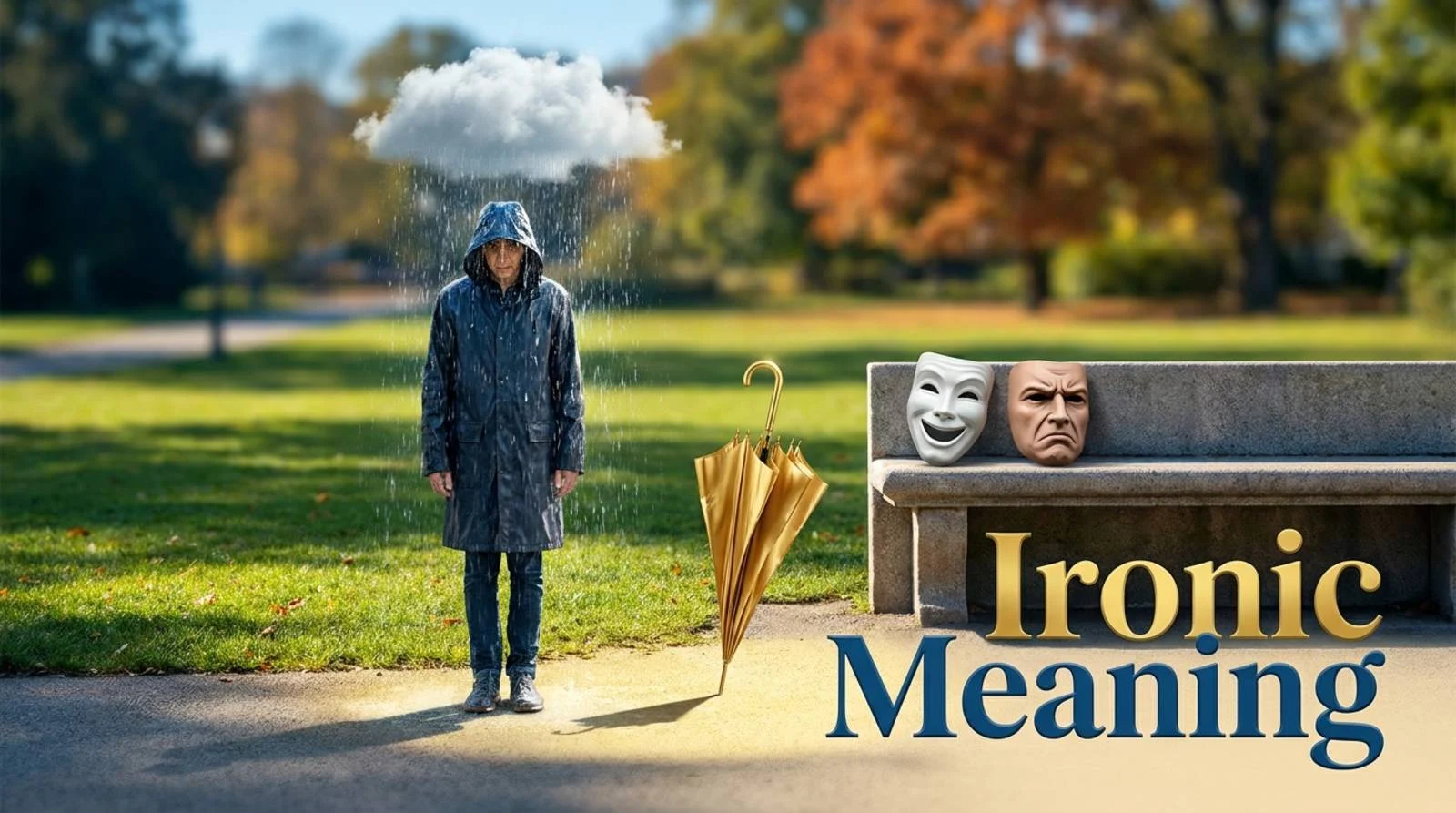
Sometimes life delivers the exact opposite of what you expect. A traffic officer gets a speeding ticket. A fire station catches fire. Someone who constantly tells people to be quiet becomes the loudest person in the room.
That unexpected contrast is where ironic meaning comes into play.
The word ironic describes something involving irony, especially a situation, statement, or result that contrasts with what people naturally expect. It can describe an outcome, a person’s words, or a situation where the reality creates an unexpected twist.
Understanding irony is useful because the word is often confused with sarcasm, coincidence, contradiction, and simple bad luck. They are not always the same thing. This guide explains what ironic means, the main types of irony, everyday examples, ironic vs. sarcastic usage, and how to use the word naturally in conversation and writing.
What Does Ironic Mean?
Ironic means involving a surprising contrast between what is expected and what actually happens, or between what someone says and what they really mean.
In simple English:
Ironic describes a situation where reality creates an unexpected contrast.
For example:
A swimming instructor is afraid of water.
People expect a swimming instructor to feel comfortable in water. The opposite situation creates an ironic contrast.
Another example:
A person writes a long article about avoiding social media, then spends five hours scrolling through social media.
The behavior clashes with the person’s message. That contrast can be described as ironic.
The important idea is contrast, not simply something being funny or unexpected.
Ironic Meaning in Simple Words
If you want the shortest possible explanation:
Ironic means surprisingly different from what you would expect, often creating a meaningful or striking contrast.
Think of it as:
Expectation → Reality → Unexpected contrast
For example:
| Expected | Actual | Result |
|---|---|---|
| A weather reporter avoids rain | They get soaked outside | Ironic |
| A professional chef burns dinner | Their own meal gets ruined | Ironic |
| Someone warns others about gossip | They spread gossip themselves | Ironic |
| A fitness coach never exercises | They avoid their own workouts | Ironic |
Not every unexpected event is automatically ironic. The contrast becomes more meaningful when the situation connects strongly with the expectation.
What Is Irony?
Irony is the broader concept behind the word ironic.
Irony happens when there is a meaningful gap between expectation and reality, appearance and truth, or words and intended meaning.
For example:
A student says, “I love surprise tests,” immediately after receiving a surprise test.
If the student actually hates surprise tests, the statement creates verbal irony because the literal words differ from the intended meaning.
Irony is common in:
- Everyday conversation
- Comedy
- Literature
- Movies
- Social media
- Speeches
- News stories
- Personal experiences
- Storytelling
It can make writing more memorable because the reader notices a gap between what appears to be happening and what is actually happening.
Ironic vs. Irony
These words are closely connected, but they have different grammatical roles.
| Word | Function | Example |
|---|---|---|
| Irony | Noun | The irony of the situation was obvious. |
| Ironic | Adjective | It was an ironic situation. |
| Ironically | Adverb | Ironically, the teacher forgot the exam. |
| Ironical | Adjective | The event had an ironical quality. |
In modern everyday English, ironic is much more common than ironical.
Examples
Irony:
The irony was impossible to miss.
Ironic:
It was ironic that the person who hated noise lived beside an airport.
Ironically:
Ironically, the person who always arrived early was late that morning.
Types of Irony
Irony can appear in several forms. Three major types are especially useful for understanding the word.
1. Verbal Irony
Verbal irony happens when someone says something that differs from their intended meaning.
Imagine someone walks outside during a terrible storm and says:
“What beautiful weather!”
The literal statement sounds positive, but the context suggests the opposite.
Verbal irony often appears in:
- Conversations
- Comedy
- Fiction
- Social commentary
- Humor
- Everyday reactions
It can sometimes overlap with sarcasm, but verbal irony and sarcasm are not identical.
2. Situational Irony
Situational irony occurs when an outcome is significantly different from what people expect.
For example:
A fire station burns down.
A fire station is expected to be a place prepared to deal with fires. Seeing the building itself destroyed by fire creates a strong contrast.
Another example:
A professional locksmith gets locked out of their own house.
The person’s profession creates an obvious expectation. The actual event goes in the opposite direction.
3. Dramatic Irony
Dramatic irony occurs when the audience or reader knows something important that a character does not know.
This is especially common in films, novels, plays, and television.
Imagine a horror movie where the audience sees a character hiding in a house while the villain is secretly approaching from behind.
The character does not know what is happening.
The audience does.
That difference in knowledge creates dramatic irony.
Ironic Examples in Everyday Life
Irony does not belong only to literature. People encounter ironic situations in ordinary life.
Example 1: The Quiet Sign
A library puts up a huge sign saying:
“Please Be Quiet.”
A group of people gathers underneath it and starts having a loud conversation.
The contrast between the message and the behavior makes the situation ironic.
Example 2: The Broken Alarm
Someone buys an expensive alarm clock because they are determined never to oversleep.
The next morning, the alarm fails, and they sleep through an important meeting.
The expected solution creates the opposite result.
Example 3: The Anti-Technology Speech
A person gives a speech about how technology is ruining communication.
Halfway through the speech, they stop because their presentation software crashes.
The situation contains a noticeable contrast between the subject and the event.
Example 4: The Lost Navigation Expert
A professional tour guide gets lost while showing visitors around their own city.
The person’s role creates a strong expectation of direction and knowledge.
The unexpected outcome creates irony.
Example 5: The Rain Complaint
Someone spends weeks complaining about how dry the weather is.
The day they finally plan an outdoor event, it rains heavily.
The timing creates an ironic situation.
Ironic vs. Sarcastic: What Is the Difference?
Ironic and sarcastic are often treated as synonyms, but they describe different ideas.
Irony focuses on contrast.
Sarcasm usually involves a mocking, cutting, or deliberately opposite statement aimed at a person, situation, or idea.
For example:
Your friend arrives 40 minutes late and says:
“Wow, I’m really early today.”
This can be sarcastic because the speaker is deliberately mocking the situation.
Now consider this:
A person spends years teaching others about punctuality, then arrives late to their own important event.
That situation can be ironic because the person’s behavior contrasts with the expectation created by their role or message.
Quick Comparison
| Ironic | Sarcastic |
|---|---|
| Focuses on contrast | Often focuses on mockery |
| Can happen without anyone making a joke | Usually involves a speaker’s deliberate remark |
| Can describe events and outcomes | Commonly describes speech or tone |
| Can be accidental | Usually intentional |
| Common in storytelling | Common in conversation |
A statement can be both ironic and sarcastic, but the two concepts should not automatically be treated as the same.
Is Every Unexpected Event Ironic?
No.
This is one of the most important distinctions when using the word ironic.
Something can be surprising without being ironic.
Suppose you forget your umbrella and it starts raining.
That is unfortunate and predictable enough to happen, but it is not automatically irony.
Now imagine a person spends an entire week telling everyone:
“It never rains here. You don’t need an umbrella.”
They then organize an outdoor event specifically because they are confident it will stay dry, and a sudden storm arrives.
The contrast is stronger because the event directly challenges the expectation.
A Useful Test
Ask yourself:
- What did people expect?
- What actually happened?
- Is there a meaningful contrast between the two?
If the answer to all three is yes, describing the situation as ironic may make sense.
Ironic Coincidence vs. Irony
An ironic coincidence can look similar to irony, but coincidence simply means that events happen together in an unexpected way.
Imagine two former classmates independently move to the same small town years after graduation.
That is an interesting coincidence.
Now imagine one of them moves there specifically because they believe they will never meet the other person again, only to discover that their new neighbor is that exact classmate.
The situation has a stronger expectation-versus-reality contrast.
Context matters.
How to Use “Ironic” in a Sentence
Here are natural examples showing different uses of the word.
Everyday Examples
- It was ironic that the person who hated traffic became a driving instructor.
- The situation was surprisingly ironic.
- Isn’t it ironic that he forgot the password he created to protect his account?
- It felt ironic to receive a reminder about punctuality after arriving late.
- The most ironic part was that she had warned everyone else about the same mistake.
Formal Writing
- The novel presents an ironic contrast between wealth and happiness.
- The situation creates an ironic relationship between the character’s ambitions and his eventual outcome.
- The author uses an ironic twist to challenge the reader’s expectations.
Casual Conversation
- That’s pretty ironic.
- What an ironic situation.
- It’s kind of ironic, honestly.
- The ironic part is that he warned me not to do exactly that.
Ironic Meaning in Conversation
In everyday conversation, ironic is often used to point out an amusing or unexpected contradiction.
For example:
- Person A: “She told everyone not to procrastinate.”
- Person B: “And then she submitted her project two weeks late?”
- Person A: “Exactly. Pretty ironic.”
Here, the word highlights the contrast between the person’s advice and behavior.
People also use ironically to introduce an unexpected twist:
“Ironically, the person who planned the entire trip was the one who missed the flight.”
The word tells the listener to pay attention to the contrast.
Ironic Meaning in Texting and Social Media
In texting, ironic usually keeps its normal meaning, but people may use it casually.
Examples:
- “Ironic that my phone died while I was trying to call for help.”
- “He posted about taking a break from social media, then uploaded ten stories. Ironic.”
- “The anti-coffee guy opened a coffee shop. That’s ironic.”
On social media, people sometimes use ironic loosely to describe anything unexpected, funny, or contradictory.
That casual usage can be broader than the traditional literary meaning.
Ironic vs. Coincidental
These words can overlap, but they emphasize different things.
Coincidental focuses on two events happening together by chance.
Ironic focuses on a contrast between expectation and reality.
For example:
Two people wearing the same shirt meet at a restaurant.
That is a coincidence.
Now imagine two people who separately complain all week about matching outfits accidentally arrive at a party wearing identical clothes.
The situation has a stronger ironic quality because the outcome clashes with their attitude.
Ironic vs. Contradictory
A contradiction involves two ideas, statements, or facts that conflict.
Irony often contains a contradiction, but not every contradiction is ironic.
For example:
“I never eat sugar,” followed by “I eat dessert every night.”
That is contradictory.
If the person is a nutrition expert who spends their career warning people against excessive sugar while secretly eating desserts every night, the contrast can also become ironic.
Contradiction = conflict between ideas or statements.
Irony = meaningful contrast between expectation and reality, words and meaning, or knowledge and understanding.
Famous-Style Ironic Situations
You do not need a literary example to understand irony. Ordinary situations can show the concept clearly.
Consider these:
- A person who hates public speaking becomes a motivational speaker.
- A professional organizer cannot find their own keys.
- A security expert forgets their own password.
- A person who tells everyone to save money buys something they cannot afford.
- A teacher gives a lesson about avoiding mistakes and accidentally makes one during the lesson.
- A chef orders takeout because they do not want to cook dinner.
- Someone writes a guide about avoiding procrastination after delaying the guide for months.
The key is not simply that these situations are funny. Their irony comes from the relationship between expectation and outcome.
How Writers Use Irony
Irony is one of the most effective tools in storytelling because it can create tension without directly explaining everything.
A writer can let the reader notice the contrast themselves.
For example, instead of writing:
Daniel was a hypocrite.
A story could show Daniel giving everyone advice about honesty while secretly hiding an important truth.
The reader recognizes the contradiction through his actions.
This makes the writing more engaging because the audience participates in interpreting the situation.
Irony Can Help Writers Create:
- Humor
- Suspense
- Tension
- Character depth
- Social commentary
- Surprise
- Emotional contrast
- Stronger endings
Good irony usually has a reason to exist. It should reveal something about a character, situation, theme, or expectation rather than being inserted simply to sound clever.
Why Irony Can Be Powerful
Irony makes people compare two things.
What should happen.
What actually happens.
That mental comparison can make an ordinary event more memorable.
For example:
A man spends his life building a fortune so his family will never struggle, but his obsession with money leaves him with almost no time for them.
The contrast between his goal and the result creates a deeper kind of irony.
This is one reason irony works so well in literature and storytelling. It can communicate an idea without stating the idea directly.
Common Mistakes When Using “Ironic”
Mistake 1: Calling Every Coincidence Ironic
An unusual coincidence is not automatically irony.
Look for a meaningful contrast.
Mistake 2: Treating Ironic and Sarcastic as Identical
Sarcasm is often a type of verbal expression involving mockery. Irony is a broader concept that can describe events, outcomes, statements, and storytelling techniques.
Mistake 3: Using Ironic Just to Mean Funny
Something can be funny without being ironic.
Humor and irony can overlap, but they are different concepts.
Mistake 4: Ignoring Context
A statement may appear ordinary until the surrounding context reveals the contrast.
For example:
“Great job.”
This could be sincere praise, sarcasm, or irony depending on what happened before it.
Context determines meaning.
A Simple Formula for Understanding Irony
When you are unsure if something is ironic, use this simple framework:
Expectation + Reality + Meaningful Contrast = Irony
For example:
Expectation: A professional lifeguard should be comfortable in water.
Reality: The lifeguard is afraid to swim.
Contrast: Their job directly conflicts with their fear.
Result: The situation can be described as ironic.
This formula is especially useful for students who are learning literary terms.
Ironic Meaning for Students
Students often encounter irony in English classes, novels, short stories, poetry, and exams.
A simple definition to remember is:
Irony is a contrast between what is expected and what actually happens, or between what is said and what is meant.
For a quick study note:
Verbal irony: Someone says something different from what they mean.
Situational irony: The outcome differs sharply from what is expected.
Dramatic irony: The audience knows something a character does not.
Easy Student Example
A character says:
“I am completely safe.”
The reader already knows there is danger behind the character.
That can create dramatic irony.
How to Remember the Meaning of Ironic
Think about a simple question:
“Is reality playing against the expectation?”
- If someone who hates cold weather moves to the Arctic, there is an obvious contrast.
- If a person who claims to love punctuality repeatedly arrives late, there is another contrast.
- If an audience knows the truth while a character remains unaware, dramatic irony appears.
The word becomes easier to understand once you stop thinking of irony as simply “something funny” and start looking for the gap between expectation and reality.
Frequently Asked Questions
What does ironic mean in simple words?
Ironic means that something happens in a way that contrasts with what people expect. It can also describe words whose intended meaning contrasts with their literal meaning.
What is an example of irony?
A professional driving instructor getting a speeding ticket is a common example. The person’s profession creates an expectation of careful driving, while the actual event goes against that expectation.
Is ironic the same as sarcastic?
No. Sarcasm usually involves a mocking or cutting statement, while irony is a broader concept involving contrast. A sarcastic statement can contain verbal irony, but irony does not always involve sarcasm.
What are the three main types of irony?
The three commonly taught types are verbal irony, situational irony, and dramatic irony. Verbal irony involves words and intended meaning, situational irony involves unexpected outcomes, and dramatic irony occurs when the audience knows something a character does not.
Can something be ironic and funny?
Yes. Irony often creates humor because an unexpected contrast can be amusing. However, something does not have to be funny to be ironic.
Is every coincidence ironic?
No. A coincidence is an unexpected event or connection that happens by chance. Irony involves a meaningful contrast between expectations, reality, words, or knowledge.
What is the difference between ironic and ironically?
Ironic is an adjective, while ironically is an adverb.
Example:
“It was an ironic situation.”
“Ironically, he forgot his own birthday.”
How do you use ironic in a sentence?
You can use ironic to describe a meaningful contrast.
Example:
“It was ironic that the person who always reminded everyone to be punctual arrived late.”
What does ironic mean in texting?
In texting, ironic generally has the same meaning as in standard English. People often use it casually to point out an unexpected contradiction or amusing contrast.
Final Takeaway
The simplest way to understand ironic meaning is to look for the gap between expectation and reality.
If someone says one thing but means another, you may be seeing verbal irony. An outcome sharply contradicts what people expect, it may be situational irony. If the audience knows something a character does not, that is dramatic irony.
The word is more precise than simply saying something is funny, strange, or coincidental. Good use of ironic depends on context and contrast.
Once you start asking, “What did I expect to happen, and what actually happened?”, irony becomes much easier to recognize in conversation, writing, literature, movies, and everyday life.