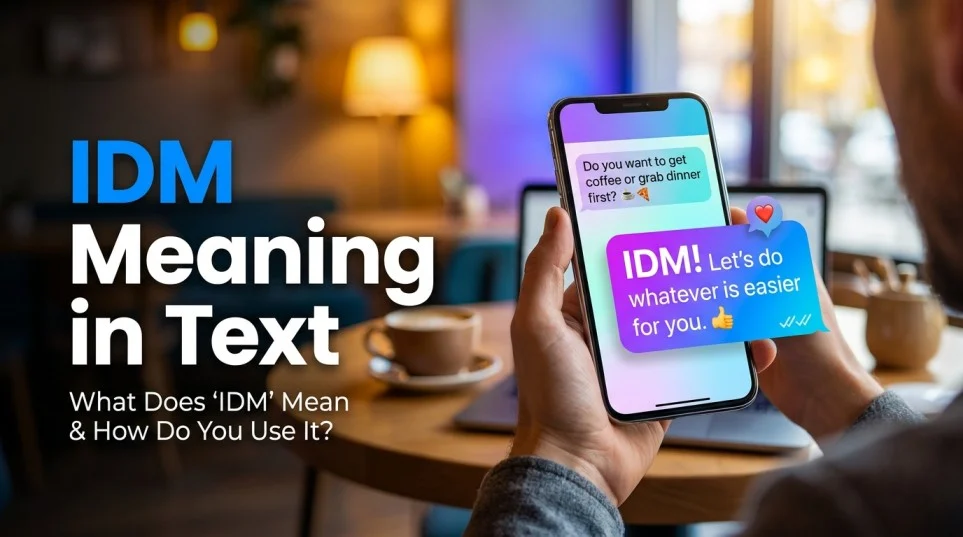
Have you ever received a message containing just three letters, “IDM,” and wondered what the sender was trying to say? You’re not alone. Texting abbreviations can make everyday conversations quicker, but they can also leave you guessing when you don’t recognize them.
The IDM meaning in text is usually “I Don’t Mind.” People use it in casual messages when they’re comfortable with a suggestion, don’t have a particular preference, or don’t mind doing something. For example, if a friend asks, “Pizza or burgers?” and you reply, “IDM,” you’re telling them that either choice works for you.
You’ll commonly see IDM in text messages, social media conversations, and group chats. However, its meaning can depend on the subject and surrounding words. It’s also different from abbreviations like IDK (I Don’t Know) and IDC (I Don’t Care). Understanding these differences helps you respond naturally without misreading someone’s tone.
What Does IDM Mean in Texting?
IDM stands for “I Don’t Mind” in texting. It’s an informal abbreviation people use to express acceptance, flexibility, or a lack of preference.
Instead of typing a complete sentence, someone can write IDM to show that a suggestion or situation is perfectly fine with them. It makes quick conversations easier, especially when people are discussing everyday plans.
For example:
- Friend: “Do you want to watch a comedy or an action movie?”
- You: “IDM.”
- Meaning: You’re comfortable watching either type of movie.
The expression doesn’t necessarily mean you’re excited about the suggestion. It simply shows that you don’t have a problem with it.
Imagine your friend wants to change your meeting time from 5 PM to 6 PM. If you have no issue with the change, replying “IDM” tells them that the new time works for you.
IDM Full Form and Simple Definition
The full form of IDM is I Don’t Mind.
Here’s a simple breakdown:
| Term | Meaning |
|---|---|
| IDM | I Don’t Mind |
| Full form | I Don’t Mind |
| Type | Informal texting abbreviation |
| Main purpose | Expressing acceptance or flexibility |
| Common tone | Neutral, relaxed, or agreeable |
| Typical use | Text messages, DMs, and casual conversations |
In everyday language, IDM can communicate several similar ideas:
- I’m okay with that.
- Either option works for me.
- It doesn’t bother me.
- I have no particular preference.
- You can make the decision.
- I’m comfortable with the suggestion.
Although these expressions share a similar meaning, they don’t always communicate exactly the same feeling. For instance, “I’m okay with that” can sound like direct acceptance, while “You can decide” gives the other person responsibility for making a choice.
Does IDM Always Mean “I Don’t Mind”?
No. Although “I Don’t Mind” is the common meaning in casual texting, IDM can have other meanings in different situations.
The intended meaning depends on where you encounter it.
For example:
- In a conversation about weekend plans, IDM probably means “I Don’t Mind.”
- In a discussion about computer downloads, IDM may refer to Internet Download Manager.
- In a technical discussion, the abbreviation could represent a specialized term.
The surrounding conversation is your best clue. If someone sends “IDM” while discussing where to eat, the texting interpretation makes sense. If they’re talking about downloading files on a computer, the software meaning is more likely.
What Does IDM Mean in Different Contexts?
The meaning of IDM generally stays the same across casual conversations, but the situation can change what the sender wants to communicate.
Sometimes it expresses agreement. In other situations, it shows flexibility or a willingness to help.
Let’s look at common examples.
IDM in Casual Text Messages
People often use IDM when discussing ordinary activities with friends, family members, or acquaintances.
It helps them respond without writing a complete sentence.
For example:
- “IDM going out tonight.”
- “IDM if you bring your friends.”
- “IDM staying home today.”
- “IDM if we order something different.”
These messages communicate that the suggested activity doesn’t create a problem.
However, IDM doesn’t always mean someone actively prefers the suggestion. They might simply feel comfortable with it.
IDM in Group Chats
Group chats often involve several people trying to agree on one decision. Choosing a restaurant, setting a meeting time, or planning a weekend activity can take longer than expected.
IDM helps simplify these discussions.
Example:
- Alex: “Should we meet at the mall or the coffee shop?”
- Sarah: “IDM either way.”
- James: “Let’s go to the coffee shop.”
- Alex: “Perfect!”
Sarah’s response shows that she doesn’t have a strong preference. She’s happy to go along with the group’s decision.
This abbreviation can also reduce unnecessary discussions when the choice isn’t particularly important.
IDM in Conversations With Friends
Among friends, IDM usually sounds relaxed and informal.
You might see it when someone asks for permission, suggests an activity, or offers to change an arrangement.
For example:
- Friend: “Can I bring my cousin?”
- You: “IDM.”
- Friend: “Thanks!”
Here, you’re telling your friend that bringing another person is fine.
Another example:
- Friend: “Do you mind if I call you later?”
- You: “IDM, call whenever you’re free.”
The expression makes the conversation feel easygoing without requiring a lengthy explanation.
IDM in Conversations With Someone You Like
When someone uses IDM while talking to a romantic interest, the abbreviation usually carries its regular meaning.
For example:
- Person A: “Would you like to meet for coffee on Saturday?”
- Person B: “IDM, Saturday works.”
This response communicates flexibility about the suggested date.
However, don’t assume that IDM automatically signals romantic attraction. Someone might be comfortable with your suggestion without having romantic feelings.
Look at the wider conversation instead. Their interest, questions, effort, and willingness to make plans provide more useful clues than three letters alone.
What Does IDM Mean on Snapchat, Instagram, TikTok, and WhatsApp?
If you see IDM on Snapchat, Instagram, TikTok, or WhatsApp, its basic meaning is usually “I Don’t Mind.” The abbreviation doesn’t have a separate definition for every social media platform.
What changes is the type of conversation. People use it in direct messages, group chats, comments, and replies to express that they’re comfortable with something.
Here’s how it appears on different platforms.
IDM Meaning on Snapchat
On Snapchat, IDM commonly appears in direct messages and quick conversations between friends.
Snapchat users often exchange short messages, so abbreviations help keep conversations moving. Someone might use IDM when discussing plans, responding to a question, or accepting an invitation.
Examples:
- Friend: “Wanna hang out after school?”
- You: “IDM.”
Another example:
- Friend: “Should I send you the pictures tonight?”
- You: “IDM, whenever you’re free.”
In both situations, IDM communicates that you’re comfortable with the suggestion.
IDM Meaning on Instagram
On Instagram, people use IDM in direct messages, story replies, and casual conversations.
For example, imagine someone shares two pictures and asks which one they should post.
- Friend: “Should I upload the first picture or the second?”
- You: “IDM, both look good.”
Here, IDM expresses that you don’t have a strong preference.
You might also encounter it when discussing meetups, sharing opinions, or responding to invitations.
IDM Meaning on TikTok
On TikTok, IDM can appear in comments and private messages.
People may use it when responding to questions, discussing videos, or participating in conversations about different choices.
For example:
- User A: “Which outfit should I wear for the party?”
- User B: “IDM, both look great.”
The sender isn’t choosing one outfit because they’re comfortable with either option.
Remember that IDM can have a different meaning in a specialized discussion. A music-related conversation, for example, might use IDM to refer to an electronic music genre.
IDM Meaning on WhatsApp
On WhatsApp, IDM is useful in both personal and group conversations.
Friends and family members might use it when arranging meetings, changing schedules, or deciding what to do.
Example:
- Person A: “Can we move dinner to Friday?”
- Person B: “IDM, Friday works for me.”
Another example:
- Person A: “Should we order Chinese or Italian?”
- Person B: “IDM either way.”
The abbreviation helps people communicate flexibility without writing a long response.
IDM Meaning on Facebook and Other Platforms
On Facebook, Messenger, Discord, and other messaging platforms, IDM generally carries the same meaning in casual conversations.
For example:
- “IDM joining the group.”
- “IDM if you invite everyone.”
- “IDM changing the meeting time.”
The platform doesn’t determine the definition by itself. The topic and surrounding messages provide the clues.
How to Use IDM in a Text Message
Knowing what IDM means is one thing. Using it naturally is another.
The abbreviation works best when you genuinely feel comfortable with a suggestion or don’t have a strong preference. It can make conversations shorter while still communicating your position.
Here are some common situations where IDM fits.
When You’re Okay With Someone’s Suggestion
Use IDM when someone suggests an activity or makes a plan that you’re happy to accept.
For example:
- Friend: “Let’s watch a horror movie tonight.”
- You: “IDM, sounds fun!”
You aren’t necessarily saying that horror movies are your favorite. You’re simply showing that you’re comfortable with the idea.
Other examples include:
- “IDM going to the mall.”
- “IDM trying that new restaurant.”
- “IDM watching the game at your place.”
When You Have No Particular Preference
This is one of the most common situations for IDM.
Imagine your friend asks whether you’d prefer coffee or tea. You enjoy both, so choosing one doesn’t matter much.
You can simply reply:
“IDM, you choose.”
Other examples:
- “IDM which movie we watch.”
- “IDM where we sit.”
- “IDM which day we meet.”
- “IDM either option.”
This response also gives the other person room to make the decision.
When You Want to Show Flexibility
Sometimes plans change unexpectedly. You might need to adjust a meeting time, change a location, or choose another activity.
IDM can show that you’re comfortable adapting.
For example:
- Friend: “Can we leave an hour later?”
- You: “IDM, take your time.”
Or:
- Friend: “Would it be okay if we met tomorrow instead?”
- You: “IDM, tomorrow works.”
It communicates that the adjustment isn’t a problem.
When You Want to Avoid an Unnecessary Argument
Not every decision deserves a long discussion.
If your friends are debating which restaurant to visit and you’re comfortable with either option, IDM can help end the discussion.
For example:
- Friend A: “I think we should get pizza.”
- Friend B: “Burgers would be better.”
- You: “IDM, let’s just pick one.”
However, don’t use IDM to avoid important conversations. If someone asks for your opinion about something meaningful, give them a thoughtful answer instead of brushing off the question.
When IDM Might Not Be the Right Choice
Although IDM works well in casual chats, some situations require clearer language.
Avoid relying on it when:
- You’re discussing an important personal decision.
- Someone needs your honest opinion.
- You’re communicating with a client or manager.
- The subject involves serious feelings or concerns.
- Your response could be misunderstood as indifference.
For example, if someone asks, “Do you mind if I cancel our plans?” replying only “IDM” might sound less considerate than you intend.
A better response could be:
“I’m completely fine with changing the plans. We can meet another day.”
The complete sentence communicates your feelings more clearly.
Realistic IDM Texting Examples and Conversations
Examples make internet abbreviations easier to understand because they show how people use them in everyday situations.
The following messages illustrate different ways IDM can appear in casual conversations.
Short IDM Text Message Examples
| IDM text example | What the sender means |
|---|---|
| “IDM where we eat.” | You can choose the restaurant. |
| “IDM staying home tonight.” | Staying home is fine with me. |
| “IDM if you join us.” | You’re welcome to come along. |
| “IDM waiting for you.” | Waiting doesn’t bother me. |
| “IDM which movie we watch.” | I’m comfortable with either movie. |
| “IDM changing the plans.” | The change is acceptable. |
| “IDM helping you.” | I’m willing to help. |
| “IDM going there tomorrow.” | Tomorrow works for me. |
| “IDM either way.” | Both options are fine. |
| “IDM if we’re a little late.” | A small delay isn’t a problem. |
These examples show the flexibility behind the abbreviation. However, remember that IDM doesn’t always communicate excitement or enthusiasm.
IDM in Different Texting Conversations
Here are a few longer conversations that demonstrate how the abbreviation works.
Example: Choosing a Restaurant
- Alex: “Do you want pizza or Chinese food?”
- Sam: “IDM, whatever you prefer.”
- Alex: “Let’s get pizza then.”
- Sam: “Perfect!”
Sam doesn’t have a strong preference, so Alex makes the choice.
Example: Making Weekend Plans
- Emma: “Are you free on Saturday?”
- Olivia: “I think so. Why?”
- Emma: “Want to meet on Sunday instead?”
- Olivia: “IDM, Sunday works too.”
Olivia is comfortable changing the original arrangement.
Example: Offering Help
- Jack: “Would you mind helping me with my assignment?”
- Daniel: “I don’t mind helping. Send it over.”
Daniel uses the complete expression rather than the abbreviation because he’s offering help directly.
Example: Changing Plans
- Mia: “Can we watch the movie at home instead?”
- Noah: “IDM, that’s actually easier.”
Noah accepts the change and adds a little explanation.
Example: Choosing an Outfit
- Sarah: “Should I wear the black dress or the blue one?”
- Emily: “IDM, both look nice on you.”
- Sarah: “Okay, I’ll go with blue.”
Emily doesn’t have a particular preference and gives Sarah the freedom to decide.
How IDM Changes With Context
Although IDM usually means “I Don’t Mind,” the exact feeling behind it can change depending on the situation.
Consider these four interpretations:
| Context | Possible meaning | Example |
|---|---|---|
| Acceptance | The suggestion is fine. | “IDM, let’s go.” |
| Flexibility | Either option works. | “IDM which day.” |
| Tolerance | Something doesn’t bother you. | “IDM waiting.” |
| Willingness | You’re comfortable doing something. | “IDM helping out.” |
The difference may seem small, but it matters when interpreting someone’s response.
For instance, “IDM waiting” expresses tolerance for a delay. Meanwhile, “IDM which day” communicates flexibility about scheduling.
Always read the complete message instead of interpreting the abbreviation alone.
How to Reply When Someone Says IDM
When someone sends you IDM, your response depends on what you were discussing.
In most casual situations, you can acknowledge their flexibility and move the conversation forward.
When Someone Says IDM to Your Suggestion
If someone accepts your suggestion, there’s no need to overcomplicate your reply.
You can say:
- “Great, let’s do that!”
- “Sounds good.”
- “Perfect, see you there.”
- “Awesome, it’s settled.”
- “Nice, looking forward to it.”
For example:
- You: “Should we meet at the coffee shop?”
- Friend: “IDM.”
- You: “Great, let’s meet there at 5.”
When Someone Says IDM About Making a Choice
Sometimes IDM means the other person wants you to make the final decision.
Natural replies include:
- “I’ll choose then.”
- “Let’s go with the first option.”
- “How about we try something new?”
- “Okay, I’ll decide.”
- “Let’s pick the cheaper one.”
For example:
- You: “Pizza or burgers?”
- Friend: “IDM, you choose.”
- You: “Let’s get burgers today.”
This keeps the conversation moving.
When Someone Says IDM About a Change of Plans
If someone accepts a change in your schedule, acknowledge their flexibility.
Try these responses:
- “Thanks for understanding.”
- “I appreciate it.”
- “You’re the best!”
- “Great, that works better for me.”
- “Thanks for being flexible.”
For example:
- You: “Can we move our meeting to Monday?”
- Friend: “IDM.”
- You: “Thanks! Monday will work much better.”
When You Need a Clearer Answer
Sometimes IDM doesn’t provide enough information, especially when the decision matters.
If you’re unsure whether the person genuinely agrees, ask a simple follow-up question.
For example:
- “Are you sure you’re okay with that?”
- “Do you actually prefer one option?”
- “Would you rather do something else?”
- “I don’t want you to feel pressured. What would you prefer?”
These questions help avoid misunderstandings.
A person might say IDM because they’re genuinely flexible. Someone else might use it because they don’t want to disagree. A little clarification can make the conversation more comfortable.
What Does IDM Mean From a Girl or a Guy?
One common question about texting abbreviations is whether their meaning changes depending on who sends them.
With IDM, the basic definition remains the same. A girl and a guy can both use it to communicate that they don’t mind something.
However, the surrounding conversation can influence how you interpret their response.
What Does IDM Mean From a Girl?
When a girl sends IDM, she usually means “I Don’t Mind.”
For example:
- You: “Would you prefer coffee or dinner?”
- Her: “IDM, either is fine.”
She’s communicating that both suggestions are acceptable.
Other possible situations include:
- She agrees to change your meeting time.
- She doesn’t have a preference about an activity.
- She’s comfortable with your suggestion.
- She wants you to make the final choice.
However, don’t automatically interpret IDM as romantic interest.
If you’re talking to someone you like, pay attention to the entire conversation. Does she ask questions? Does she show interest in continuing the discussion?
Those details provide more meaningful clues.
What Does IDM Mean From a Guy?
When a guy sends IDM, the usual meaning is also “I Don’t Mind.”
For example:
- You: “Do you want to play football or watch a movie?”
- Him: “IDM, whatever you’re in the mood for.”
He’s showing flexibility and allowing you to choose.
It doesn’t automatically mean he’s uninterested or doesn’t care about the activity.
He might simply be comfortable with either option.
Does IDM Mean Someone Is Interested in You?
Not necessarily. IDM alone doesn’t reveal someone’s romantic feelings.
A person might use it because they’re comfortable with your suggestion, not because they’re trying to express attraction.
For example:
- “IDM meeting you tomorrow” communicates acceptance of the plan.
- “I’ve been looking forward to seeing you all week” communicates much clearer enthusiasm.
The difference is important.
If you’re trying to understand someone’s feelings, consider their overall communication rather than focusing on one abbreviation.
Look for patterns such as:
- They regularly initiate conversations.
- They remember details you’ve shared.
- They make an effort to spend time with you.
- They ask questions and show genuine interest.
- Their actions match their words.
No single texting abbreviation can confirm someone’s intentions.
Is IDM Rude, Polite, or a Sign of Indifference?
IDM is generally neutral to friendly. It often sounds polite because the complete expression “I don’t mind” can communicate acceptance without making demands.
However, the way someone uses it can change how the message feels.
When IDM Sounds Polite
IDM sounds polite when someone uses it to accept a suggestion or make another person feel comfortable.
For example:
- “IDM if you bring your sister.”
- “IDM waiting a few minutes.”
- “IDM changing the reservation.”
- “IDM if we meet tomorrow.”
In these situations, the sender communicates flexibility.
The full phrase is also a common polite response when someone asks whether a particular action bothers you.
When IDM Sounds Neutral
Sometimes IDM simply communicates that someone doesn’t have a preference.
For example:
- “Which movie should we watch?”
- “IDM.”
There’s no obvious excitement or frustration. The sender is simply saying that either choice works.
This is perfectly normal in casual conversations.
When IDM Can Sound Dismissive
Although the abbreviation isn’t inherently rude, a short reply can sometimes feel cold.
Imagine telling a friend that you’ve spent hours planning a special event. You ask whether they’re comfortable with the arrangements, and they respond with only “IDM.”
You might feel that they haven’t given your effort much attention.
The problem isn’t necessarily the abbreviation. It’s the mismatch between the seriousness of the question and the simplicity of the response.
In sensitive conversations, a more thoughtful reply is often better.
Does IDM Mean “I Don’t Care”?
No. IDM and IDC have different meanings and can create different impressions.
- IDM: I Don’t Mind.
- IDC: I Don’t Care.
The distinction is subtle but important.
If someone asks whether you want pizza or burgers, IDM suggests that you’re happy with either choice.
IDC might suggest that you aren’t particularly interested in the decision.
However, IDC doesn’t always sound rude. Friends sometimes use it casually to communicate that they have no preference.
The surrounding conversation and tone matter.
IDM vs. Similar Texting Abbreviations
IDM belongs to a larger group of internet abbreviations that people use in everyday conversations. Some look similar but communicate completely different ideas.
Understanding these differences helps you avoid confusing your friends or sending the wrong message.
Here’s a quick comparison:
| Abbreviation | Full form | Meaning |
|---|---|---|
| IDM | I Don’t Mind | I’m okay with it. |
| IDK | I Don’t Know | I don’t have the answer. |
| IDC | I Don’t Care | It doesn’t matter to me. |
| IDGAF | I Don’t Give a F*** | I strongly don’t care. |
| IMO | In My Opinion | This is what I think. |
| TBH | To Be Honest | I’m speaking honestly. |
| NVM | Never Mind | Forget what I said. |
| LMK | Let Me Know | Tell me when you know. |
| IKR | I Know, Right? | I strongly agree. |
IDM vs. IDK
IDM and IDK look similar, but their meanings are completely different.
- IDM: I Don’t Mind.
- IDK: I Don’t Know.
IDM expresses acceptance or a lack of preference. IDK communicates uncertainty or a lack of knowledge.
Example of IDM:
- Friend: “Should we meet on Friday or Saturday?”
- You: “IDM, either day works.”
Example of IDK:
- Friend: “What time does the movie start?”
- You: “IDK. Let me check.”
Remember this simple distinction: IDM is about preference, while IDK is about information.
IDM vs. IDC
IDM means “I Don’t Mind,” while IDC means “I Don’t Care.”
Both expressions can communicate that someone has no strong preference. However, their emotional tones can differ.
| IDM | IDC |
|---|---|
| I Don’t Mind | I Don’t Care |
| Usually sounds accepting | Can sound indifferent |
| Suggests flexibility | Suggests a lack of concern |
| Often feels friendly | Can feel blunt |
| “IDM which movie.” | “IDC which movie.” |
For example, if someone asks whether you’d like to eat pizza or pasta, replying IDM usually sounds like you’re happy with either choice.
Replying IDC can sound less interested in the decision.
Tip: If you want to sound friendly while expressing flexibility, IDM is generally the safer option.
IDM vs. IDGAF
IDGAF stands for “I Don’t Give a F*.”** It’s a much stronger expression than IDM.
People use IDGAF to communicate strong indifference, defiance, or a lack of concern about something.
For example:
- IDM: “I don’t mind what we watch.”
- IDGAF: “I don’t care what anyone thinks.”
The second expression carries a stronger attitude and includes profanity.
Use IDM in ordinary conversations when you’re comfortable with a suggestion. IDGAF belongs to much more informal situations and can offend people.
IDM vs. “I Don’t Care”
These expressions might seem interchangeable, but they don’t always communicate the same attitude.
Consider this situation:
- Person A: “Should we order pizza?”
- Person B: “I don’t mind.”
The response sounds relaxed and accepting.
Now consider:
- Person A: “Should we order pizza?”
- Person B: “I don’t care.”
Depending on the relationship and tone, this might sound uninterested or dismissive.
The difference comes down to the feeling behind the words. “I don’t mind” usually communicates comfort, while “I don’t care” can communicate indifference.
Other Meanings of IDM Outside Texting
Although IDM commonly means “I Don’t Mind” in casual messages, the abbreviation has several other meanings.
You’ll find these meanings in technology, music, and professional discussions.
Understanding the context helps you identify the correct definition.
IDM as Internet Download Manager
Internet Download Manager
Internet Download Manager is a Windows download-management application commonly known as IDM.
It helps users manage file downloads, organize downloading tasks, and resume supported interrupted downloads.
For example, someone might say:
- “IDM makes downloading large files easier.”
- “My IDM isn’t working properly.”
- “I use IDM to manage my downloads.”
In these examples, the abbreviation has nothing to do with texting slang.
IDM as Intelligent Dance Music
Intelligent Dance Music
Intelligent Dance Music is an electronic music genre often associated with experimental sounds, intricate rhythms, and unconventional production.
Music enthusiasts use IDM when discussing electronic artists, albums, playlists, and production styles.
For example:
- “I listen to IDM when working.”
- “That album has a classic IDM sound.”
- “Do you know any good IDM artists?”
If someone uses IDM in a conversation about electronic music, this is probably the intended meaning.
IDM as Identity Management
In information technology, IDM can stand for Identity Management.
Identity management refers to the processes and systems organizations use to manage digital identities and control access to resources.
For example, a company might use identity management systems to:
- Create employee accounts.
- Manage login credentials.
- Assign access permissions.
- Control access to internal applications.
- Remove access when employees leave.
You’ll commonly encounter this meaning in cybersecurity, IT administration, and business technology discussions.
How to Identify the Correct Meaning of IDM
Use the surrounding topic to understand which definition makes sense.
| Conversation topic | Likely IDM meaning |
|---|---|
| Friends making plans | I Don’t Mind |
| Social media messages | I Don’t Mind |
| Downloading files | Internet Download Manager |
| Electronic music | Intelligent Dance Music |
| Company accounts and access | Identity Management |
The main lesson is simple: Never assume an abbreviation has only one meaning in every situation. Context determines how people intend to use it.
Is IDM Still Used in Texting?
Yes, IDM remains a recognizable informal abbreviation in online communication.
People use it because it expresses a complete idea with just three letters. It’s especially convenient when discussing small decisions that don’t require lengthy explanations.
For example, imagine a friend asks whether you want to meet at 4 PM or 5 PM. If both times work, replying “IDM” is quicker than typing “I don’t have a preference.”
However, not everyone uses texting abbreviations regularly. Some people prefer complete sentences, while others use shorthand frequently in everyday conversations.
A few factors influence how naturally IDM fits into a conversation:
- Age and communication habits: Different people develop different texting styles.
- Friend groups: Some groups regularly use abbreviations, while others prefer standard language.
- Platform: Quick DMs and group chats encourage shorter responses.
- Relationship: Close friends may understand informal expressions more easily than professional contacts.
There isn’t a reliable universal figure showing how frequently people use IDM across all messaging platforms. It’s better to describe it as a recognized texting abbreviation rather than claim it’s one of the most popular internet slang terms.
Alternatives to IDM in Everyday Conversations
Sometimes you want to express the same idea without using abbreviations.
That’s where alternative expressions become useful. They help you communicate clearly while adjusting your tone to the situation.
Polite Alternatives to IDM
Use these expressions when speaking with someone you want to treat respectfully.
| Alternative | Example |
|---|---|
| I don’t mind. | “I don’t mind which day we meet.” |
| Either works for me. | “Either works for me. You decide.” |
| I’m fine with that. | “I’m fine with that arrangement.” |
| That’s okay with me. | “That’s okay with me. No problem.” |
| I have no preference. | “I have no preference about the location.” |
These expressions work well when you want to sound considerate without appearing uninterested.
Casual Alternatives for Friends
When chatting with friends, you can use relaxed expressions that communicate the same idea.
- “I’m cool with that.”
- “Works for me.”
- “You choose!”
- “I’m good with either.”
- “Whatever you prefer.”
- “Sounds fine.”
- “I’m down for that.”
Example:
- Friend: “Want to get coffee or ice cream?”
- You: “I’m good with either. You choose!”
This sounds natural and keeps the conversation friendly.
Professional Alternatives to IDM
IDM is informal, so complete expressions are usually better in workplace communication.
Consider these alternatives:
- “Either option is acceptable.”
- “I don’t have a particular preference.”
- “That arrangement works for me.”
- “I’m flexible with the timing.”
- “Please proceed with whichever option is more convenient.”
For example, instead of replying “IDM” to your manager’s question about a meeting time, you could write:
“I’m flexible with the timing. Please choose whichever slot works best for the team.”
This communicates the same idea while maintaining a professional tone.
Common Misunderstandings About IDM
Even a simple abbreviation can create confusion when people interpret it without considering the situation.
Here are some common mistakes worth avoiding.
Confusing IDM with IDK: These abbreviations don’t mean the same thing. IDM expresses acceptance, while IDK communicates uncertainty.
Assuming IDM means “I Don’t Care”: IDM usually sounds more accepting. IDC can communicate indifference and sometimes sounds dismissive.
Thinking IDM always expresses excitement: Someone who says IDM might simply be comfortable with a suggestion. It doesn’t necessarily mean they’re enthusiastic.
Assuming IDM changes meaning on every platform: Its common texting meaning generally remains the same across Snapchat, Instagram, TikTok, and WhatsApp.
Interpreting IDM as romantic interest: A person using IDM isn’t automatically expressing attraction. Look at the wider conversation.
Using IDM in every situation: Short abbreviations don’t always suit serious discussions, professional emails, or important decisions.
Ignoring the surrounding message: A conversation about dinner plans has a different context from one about computer software or electronic music.
The easiest way to avoid these mistakes is to read the complete conversation before deciding what someone means.
Frequently Asked Questions
Here are direct answers to common questions about the IDM abbreviation.
What does IDM stand for in texting?
IDM stands for “I Don’t Mind.” People use it in casual conversations to express acceptance, flexibility, or a lack of preference about something.
What does IDM mean in a text message from a girl?
When a girl sends IDM, she usually means “I Don’t Mind.” She might be saying that she’s comfortable with your suggestion or doesn’t have a particular preference. It doesn’t automatically indicate romantic interest.
What does IDM mean from a guy?
IDM from a guy generally means “I Don’t Mind.” He might use it to accept an invitation, agree to a change of plans, or let you choose between different options.
Does IDM mean I Don’t Mind?
Yes. In everyday texting, IDM commonly stands for “I Don’t Mind.” It’s an informal shortcut used in messages, social media conversations, and group chats.
What does IDM mean on Snapchat?
On Snapchat, IDM usually means “I Don’t Mind.” People use it in direct messages and casual conversations when they’re comfortable with a suggestion or don’t have a strong preference.
Is IDM the same as IDK?
No. IDM means “I Don’t Mind,” while IDK means “I Don’t Know.” IDM expresses acceptance or flexibility, whereas IDK communicates uncertainty or a lack of knowledge.
Is IDM rude or disrespectful?
No, IDM isn’t inherently rude. It usually sounds neutral or friendly. However, a short response can seem dismissive when someone expects a thoughtful answer during an important conversation.
How do you respond to IDM?
You can respond by making the decision or acknowledging the other person’s flexibility.
Examples include:
- “Great, let’s do that.”
- “I’ll choose then.”
- “Sounds good!”
- “Thanks for being flexible.”
Can IDM mean Internet Download Manager?
Yes. In technology discussions, IDM commonly refers to Internet Download Manager, a Windows application used to manage file downloads. The surrounding topic helps distinguish this meaning from texting slang.
Should I use IDM in professional messages?
It’s better to avoid IDM in formal emails and client communication. Use complete expressions such as “I don’t have a preference” or “Either option works for me” to communicate more clearly.
Conclusion
The IDM meaning in text is usually “I Don’t Mind.” It’s a simple abbreviation people use to express acceptance, flexibility, or a lack of preference during everyday conversations.
You’ll commonly encounter it in Snapchat messages, Instagram DMs, WhatsApp chats, and other online conversations. Someone might use it when accepting an invitation, choosing between two options, or agreeing to a change of plans.
Just remember that IDM isn’t the same as IDK or IDC. Each abbreviation communicates a different idea. Context also matters because IDM has technical and music-related meanings outside texting.
The next time someone sends you “IDM,” you’ll know what they mean and how to respond naturally.