ETF stands for Exchange-Traded Fund, an investment fund that trades on a stock exchange, much like an individual stock. Instead of buying every investment separately, you can buy shares of an ETF that holds a collection of assets, such as stocks, bonds, or commodities.
For example, imagine you want exposure to hundreds of companies but do not have enough money or time to research each one. A broad-market ETF may let you invest in a basket of companies through a single purchase. Your investment can rise or fall as the value of those holdings changes.
Understanding ETF meaning is useful for beginners because ETFs offer a practical way to access financial markets. However, they are not automatically safe or profitable. Their costs, investment strategy, underlying assets, and market risks all matter when deciding whether an ETF fits your financial goals.
What Does ETF Stand For?

ETF stands for Exchange-Traded Fund. Each part of the name explains how this investment works.
- Exchange: An ETF is traded on a stock exchange, such as the New York Stock Exchange or Nasdaq.
- Traded: Investors can generally buy and sell ETF shares during market hours through a brokerage account.
- Fund: The investment collects money from investors and uses it to hold assets according to a defined strategy.
An ETF can contain shares of many companies, government or corporate bonds, commodities, or other eligible investments. Some track a market index, while others follow a particular sector or investment strategy.
The important distinction is that buying an ETF share gives you an interest in the fund, not direct ownership of every underlying asset in your own name.
What Is an ETF in Simple Terms?
Think of an ETF as a shopping basket filled with investments.
Suppose you want to invest in technology companies. Buying shares in individual companies means choosing each company separately. A technology ETF, in contrast, may hold shares in several technology businesses.
By purchasing one ETF, you gain exposure to the collection of investments held by that fund. You do not need to place a separate trade for every company in its portfolio.
Here is a simplified example:
| Investment choice | What you own |
|---|---|
| One company stock | Shares in one company |
| A technology ETF | Shares in a fund holding selected technology investments |
| A broad-market ETF | Shares in a fund tracking a wide range of market investments |
| A bond ETF | Shares in a fund holding a portfolio of bonds |
An ETF does not eliminate investment risk. If the assets inside the fund lose value, the ETF’s market price can decline too.
How Do ETFs Work?
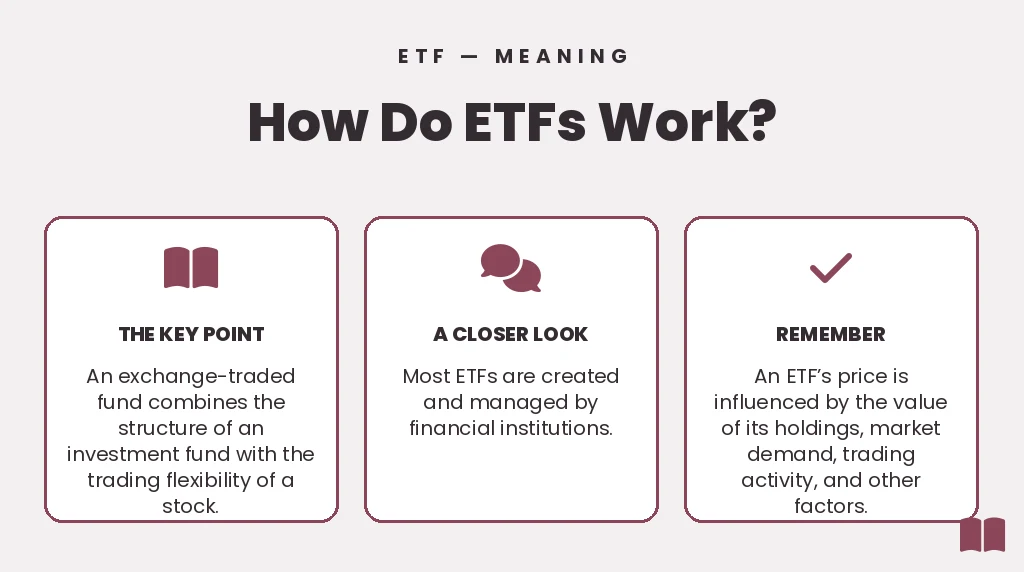
An exchange-traded fund combines the structure of an investment fund with the trading flexibility of a stock.
Most ETFs are created and managed by financial institutions. The fund follows an investment objective, such as tracking a market index, investing in bonds, or targeting a specific industry.
The process typically works as follows.
1. The ETF Holds Underlying Investments
A stock ETF might hold shares in hundreds of companies. A bond ETF may hold government or corporate bonds. Other funds can focus on commodities, specific industries, or particular investment strategies.
The fund’s holdings determine much of its exposure to market movements.
2. Investors Buy ETF Shares
You generally purchase ETF shares through a brokerage account. You select the fund, review its trading price, enter an order, and pay the applicable transaction costs.
For example, if an ETF trades at $50 per share, buying 10 whole shares costs $500 before fees. Some brokers offer fractional ETF shares, allowing smaller investments where supported.
3. The ETF Price Changes Throughout the Trading Day
Unlike traditional mutual funds, which generally transact at a calculated net asset value once per business day, most exchange-traded funds can be bought and sold at market prices throughout exchange trading hours.
An ETF’s price is influenced by the value of its holdings, market demand, trading activity, and other factors.
4. The Fund’s Value Reflects Its Holdings
An ETF’s net asset value, or NAV, represents the value of its assets minus its liabilities, divided by the number of outstanding shares.
The market price usually stays reasonably close to NAV for conventional ETFs, although premiums and discounts can occur. Trading costs and differences between the bid and ask prices can also affect what an investor actually pays.
5. Authorized Participants Help Keep Pricing Aligned
For many ETFs, authorized participants can create or redeem large blocks of fund shares by exchanging securities or cash with the fund under its operating arrangements.
This mechanism helps align the ETF’s market price with the value of its underlying holdings. It does not guarantee perfect price alignment, particularly during market stress or when underlying assets are difficult to trade.
What Are the Main Types of ETFs?
ETFs differ in what they own and what they aim to achieve. Understanding these categories can help you identify the kind of exposure a fund provides.
| ETF type | What it invests in | Example use |
|---|---|---|
| Stock ETFs | Shares of companies | Broad stock-market exposure |
| Bond ETFs | Government or corporate bonds | Exposure to fixed-income investments |
| Index ETFs | Investments selected to track an index | Following a broad market benchmark |
| Sector ETFs | Companies in a specific industry | Technology or healthcare exposure |
| Commodity ETFs | Commodity-related assets or exposure | Gold or other commodity exposure |
| Dividend ETFs | Stocks selected for dividend characteristics | Seeking dividend income |
| International ETFs | Investments in foreign markets | Geographic diversification |
| Actively managed ETFs | Investments selected by a manager | Following a particular active strategy |
| Inverse ETFs | Positions designed to move opposite a benchmark for a specified period | Short-term bearish market exposure |
| Leveraged ETFs | Exposure designed to multiply daily benchmark returns | Short-term amplified market exposure |
These categories can overlap. For instance, an international ETF can also be an index ETF.
Important: Leveraged and inverse ETFs often reset their exposure daily. Their returns over longer periods can differ significantly from simply multiplying or reversing an index’s total return over that period. They are generally more complex than conventional diversified funds.
Real-World ETF Examples
The following examples illustrate different approaches to investing. They are educational examples, not personalized investment recommendations.
Broad Stock-Market ETF
A broad stock-market ETF might track an index containing hundreds or thousands of companies. Rather than selecting each business individually, you buy one fund that follows the index.
This approach can reduce company-specific risk compared with holding only one stock, although it still carries market risk.
S&P 500 ETF
An S&P 500 ETF seeks to track an index representing approximately 500 leading publicly traded US companies. It provides exposure to large US businesses across several industries.
It does not represent the entire global stock market, and its performance can be heavily influenced by the largest companies in the index.
Bond ETF
A bond ETF may hold government bonds, corporate bonds, or a mixture of debt securities.
Investors may use bond ETFs to gain fixed-income exposure, but bond funds can lose value when interest rates rise. Credit quality, maturity, and inflation also affect their performance.
Gold ETF
A gold-related ETF may provide exposure to physical gold, gold futures, or gold-related companies, depending on its structure.
These products are not interchangeable. A fund holding physical gold has different risks and costs from a fund investing in gold-mining companies.
Before buying any ETF, check exactly what it owns rather than relying only on its name.
ETF vs. Mutual Fund: What Is the Difference?
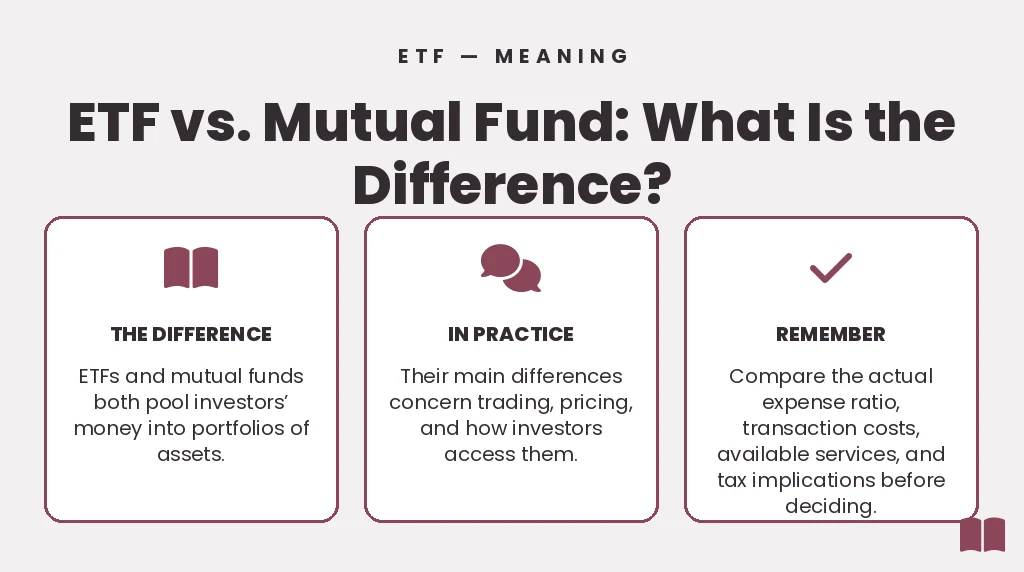
ETFs and mutual funds both pool investors’ money into portfolios of assets. Their main differences concern trading, pricing, and how investors access them.
| Feature | ETF | Traditional mutual fund |
|---|---|---|
| Trading | Usually trades throughout exchange hours | Usually transacts once daily at NAV |
| Pricing | Market price can differ from NAV | Transactions generally use the applicable NAV |
| Buying and selling | Through a brokerage account or another supported platform | Through a fund provider, broker, or platform |
| Minimum investment | Often the cost of one share, unless fractional shares are available | Depends on the fund and provider |
| Costs | Expense ratio, possible commissions, and bid-ask spread | Expense ratio and any applicable sales charges or account fees |
| Management | Can be passive or active | Can be passive or active |
| Tax treatment | Depends on the fund, investor, and jurisdiction | Depends on the fund, investor, and jurisdiction |
ETFs are not always cheaper than mutual funds, and mutual funds are not always more expensive. Compare the actual expense ratio, transaction costs, available services, and tax implications before deciding.
ETF vs. Index Fund: Are They the Same?
An index fund is an investment fund designed to track a particular index. An ETF is a fund structure that trades on an exchange.
The two terms describe different things.
An index fund can be structured as an ETF or as a mutual fund. For example, an index ETF might track a broad stock-market benchmark, while an index mutual fund tracks that same benchmark but uses a different trading structure.
The distinction matters because investors sometimes assume that every ETF is passive or that every index fund trades like a stock. Neither assumption is correct.
- ETF: Describes how the fund is structured and traded.
- Index fund: Describes the investment approach.
- Index ETF: Combines both features.
What Are the Benefits of ETFs?
ETFs can make investing more accessible, particularly for people who want exposure to a group of assets rather than selecting every investment separately.
Diversification
A diversified ETF can spread your money across multiple securities. This reduces dependence on any one company when compared with owning that company alone.
However, diversification varies. A narrowly focused sector ETF or a fund holding only a few securities may still be highly concentrated.
Trading Flexibility
Most ETFs trade during market hours. Investors can use market orders or limit orders, depending on their broker and the fund’s trading arrangements.
A limit order can help control the price you are willing to pay, although execution is not guaranteed.
Access to Different Markets
ETFs provide access to a wide range of investments, including domestic stocks, international markets, bonds, and commodities.
This can simplify portfolio construction, although access depends on your country, broker, and local regulations.
Cost Transparency
Many ETFs disclose their holdings regularly and publish information about their objectives, expenses, and performance.
Their expense ratios can be competitive, especially for broad passive index funds. Still, the expense ratio is only one part of the total cost.
Lower Starting Cost in Some Cases
Some ETFs have relatively low share prices, and certain brokers support fractional-share purchases.
A low share price does not mean an investment is cheap relative to its underlying value or that it is less risky. Your investment amount should fit your budget and risk tolerance.
What Are the Risks of Investing in ETFs?
ETFs can be useful investment tools, but their structure does not protect investors from losses.
Market Risk
If the underlying investments fall in value, the ETF can lose value too. A broad-market ETF can decline sharply during a market downturn.
Concentration Risk
An ETF may hold many securities but still be concentrated in one industry, country, or group of large companies. The number of holdings alone does not tell you how diversified the fund really is.
Liquidity Risk
Some ETFs trade actively, while others have low trading volume or hold assets that are difficult to buy and sell. Low liquidity can lead to wider bid-ask spreads and less favorable execution prices.
Tracking Error
An ETF designed to follow an index may not match that index’s return exactly. Fees, trading expenses, cash holdings, sampling, and other factors can create differences.
Interest Rate and Credit Risk
Bond ETFs can decline when interest rates rise. Funds holding lower-quality corporate debt may also face losses if borrowers become less likely to repay their obligations.
Currency Risk
An ETF investing in foreign assets may expose you to exchange-rate movements. Your return in your home currency can differ from the return reported in the fund’s local market currency.
Leverage and Derivatives Risk
Some ETFs use borrowing or derivatives to achieve their objectives. These funds can behave differently from conventional funds and may experience amplified losses or complex performance patterns.
A practical rule: Never assume an ETF is safe simply because it contains several investments. Review its holdings, investment objective, costs, liquidity, and potential downside before investing.
How Do ETFs Make Money?
Investors can potentially earn returns from ETFs in several ways, depending on the assets held by the fund.
1. Price Appreciation
If an ETF’s market price rises after you buy it, selling at a higher price can produce a gain before costs and taxes.
For example, suppose you purchase 10 shares at $50 each. Your initial investment is $500. If the price later rises to $55, those shares are worth $550, creating a $50 unrealized gain before costs and taxes.
If the price falls to $45, their value drops to $450, representing a $50 unrealized loss.
2. Dividends and Distributions
Some ETFs receive dividends from stocks or interest from bonds. Depending on the fund’s policy, these earnings may be distributed to investors or reinvested.
A distribution is not guaranteed, and its amount can change. It should not be confused with a guaranteed return.
3. Total Investment Return
Total return considers changes in the investment’s value and any income or distributions, with the treatment of reinvestment specified by the calculation.
For a fair comparison between ETFs, look at total returns over similar periods and check whether the figures include reinvested distributions and account for fund expenses.
What Is an ETF Expense Ratio?
The expense ratio is the annual operating expense of a fund expressed as a percentage of its assets.
For example, suppose you invest $10,000 in an ETF with a 0.20% annual expense ratio.
[
$10,000 \times 0.002 = $20
]
That equals approximately $20 in annual fund operating expenses if your investment balance stays at $10,000 for the full year. The actual amount changes with your balance and the fund’s expenses.
The expense ratio is generally reflected in the fund’s performance rather than charged as a separate bill to the investor.
Other costs may include:
- Brokerage commissions, if applicable
- Bid-ask spreads
- Currency conversion charges
- Account fees
- Taxes on distributions or realized gains
When comparing similar funds, lower costs can help, but the investment strategy, holdings, tracking quality, and risk should also influence your decision.
How to Buy an ETF for Beginners
Buying an ETF is usually straightforward, but choosing an appropriate fund requires research.
Step 1: Define Your Investment Goal
Decide what you want the investment to do. You might be seeking long-term growth, income, bond exposure, or diversification across markets.
Your time horizon matters. Money needed for near-term expenses generally should not be exposed to substantial market risk without careful consideration.
Step 2: Choose a Regulated Brokerage Platform
Look for a broker authorized to serve residents of your country. Check its regulatory status, fees, account requirements, deposit methods, and withdrawal rules.
Availability differs by country. If you live in Pakistan, verify that the platform legally accepts Pakistani residents, supports your funding method, and complies with applicable foreign-exchange and tax requirements. Do not assume every international brokerage service is available to you.
Step 3: Research the ETF
Review the fund’s official prospectus or factsheet. Pay particular attention to:
- Investment objective and benchmark
- Underlying holdings and geographic exposure
- Expense ratio and other costs
- Historical performance and volatility
- Trading volume and bid-ask spread
- Fund structure and distribution policy
- Currency exposure and relevant risks
Historical performance is useful context, but it cannot reliably predict future results.
Step 4: Decide How Much to Invest
Choose an amount that fits your financial circumstances and does not depend on money needed for essential expenses.
Consider whether you already own similar investments. Buying several ETFs with overlapping holdings may add less diversification than you expect.
Step 5: Place Your Order
Search for the ETF using its name or ticker symbol. Confirm that you have selected the correct fund, review the quoted price, and choose an appropriate order type.
A market order prioritizes execution at the best available prices, but the final price can differ from the displayed quote. A limit order specifies the maximum price you are willing to pay when buying, although it may not execute.
Step 6: Review Your Investment Over Time
Check whether the ETF still matches your goals, portfolio allocation, and risk tolerance. You do not need to react to every daily price movement.
Rebalancing may be appropriate when your portfolio moves substantially away from your intended allocation. Consider transaction costs and tax consequences before making changes.
Are ETFs a Good Investment for Beginners?
ETFs can be a useful starting point for learning about investing because they offer access to diversified portfolios through a relatively simple trading structure.
A broad, low-cost ETF may be easier to understand than a complex product built around leverage, derivatives, or a narrow market theme. However, suitability depends on your circumstances, investment horizon, risk tolerance, and the fund’s actual holdings.
Before investing, ask yourself three questions:
- Do I understand what the fund owns? If its strategy is unclear, investigate before buying.
- Can I handle a decline in value? Even diversified stock ETFs can lose substantial value during market downturns.
- Are the costs and rules clear? Check fees, taxes, account restrictions, and withdrawal arrangements.
For beginners, understanding the underlying investments is more important than chasing whichever ETF recently delivered the highest return. A simple investment you understand can be easier to manage than a fashionable product with risks you have not evaluated.
Common ETF Mistakes to Avoid
Small misunderstandings can lead to poor investment decisions. Watch out for these common mistakes.
- Choosing only by past performance: A strong recent return does not guarantee future gains.
- Ignoring fund holdings: An ETF’s name may sound diversified even when its portfolio is concentrated.
- Overlooking trading costs: A low expense ratio does not eliminate bid-ask spreads, commissions, or currency charges.
- Confusing dividends with free money: Distributions are part of the fund’s overall economics and are not guaranteed.
- Buying complex ETFs without understanding them: Leveraged and inverse products can behave unexpectedly over longer holding periods.
- Assuming every ETF is tax-efficient: Tax treatment depends on fund structure, distributions, your residence, and applicable laws.
- Trading emotionally: Frequent buying and selling in response to short-term market movements can increase costs and undermine a consistent investment plan.
Frequently Asked Questions
1. What does ETF mean in simple words?
ETF means Exchange-Traded Fund. It is an investment fund whose shares trade on a stock exchange. One ETF can provide exposure to a collection of stocks, bonds, or other assets.
2. What is an ETF in finance?
In finance, an ETF is a pooled investment vehicle with shares that generally trade on an exchange during market hours. Its value depends on its underlying assets, investment strategy, and market pricing.
3. Is an ETF the same as a stock?
No. A stock represents ownership in an individual company, while an ETF share represents an interest in a fund that holds or gains exposure to a portfolio of investments. Both can trade on stock exchanges.
4. Can you lose money investing in ETFs?
Yes. ETF prices can fall when their underlying investments decline. Some funds also carry additional risks related to leverage, liquidity, currency movements, or concentrated holdings.
5. Do ETFs pay dividends?
Some ETFs distribute dividends or other income they receive from their investments. Others reinvest income or follow different distribution policies. Payments and amounts are not guaranteed.
6. How much money do you need to buy an ETF?
The minimum depends on the ETF’s share price, your broker’s requirements, and whether fractional shares are available. You should also account for transaction costs and avoid investing money needed for essential expenses.
7. Are ETFs better than mutual funds?
Neither is universally better. ETFs usually offer intraday exchange trading, while traditional mutual funds generally transact once daily at NAV. Costs, investment choices, tax treatment, and account features can determine which structure suits you.
8. What is the difference between an ETF and an index fund?
An ETF is a fund structure that trades on an exchange. An index fund follows a particular market index. An ETF can be an index fund, and an index fund can also be structured as a mutual fund.
9. How do ETFs make money?
Investors can earn returns through increases in the ETF’s value and through distributions such as dividends or interest. Returns can also be negative, and fund expenses reduce performance.
10. Are ETFs safe for beginners?
Some diversified, transparent ETFs may be easier for beginners to understand than complex investment products. However, all investments carry risks, and no ETF guarantees profits or protects every investor from losses.
Final Thoughts
Understanding ETF meaning is the first step toward making informed investment decisions. An exchange-traded fund lets you buy shares in a portfolio of investments through a single listed product, offering a convenient way to access different markets.
The real value of an ETF depends on what it holds, how it operates, how much it costs, and how well it fits your goals. A broad stock ETF, a bond ETF, and a leveraged ETF can have very different risk profiles despite sharing the same basic structure.
Take time to read the fund’s official documents, compare total costs, and understand its potential losses before investing. The aim is not simply to find an ETF that is popular today, but to understand the investment you are choosing.