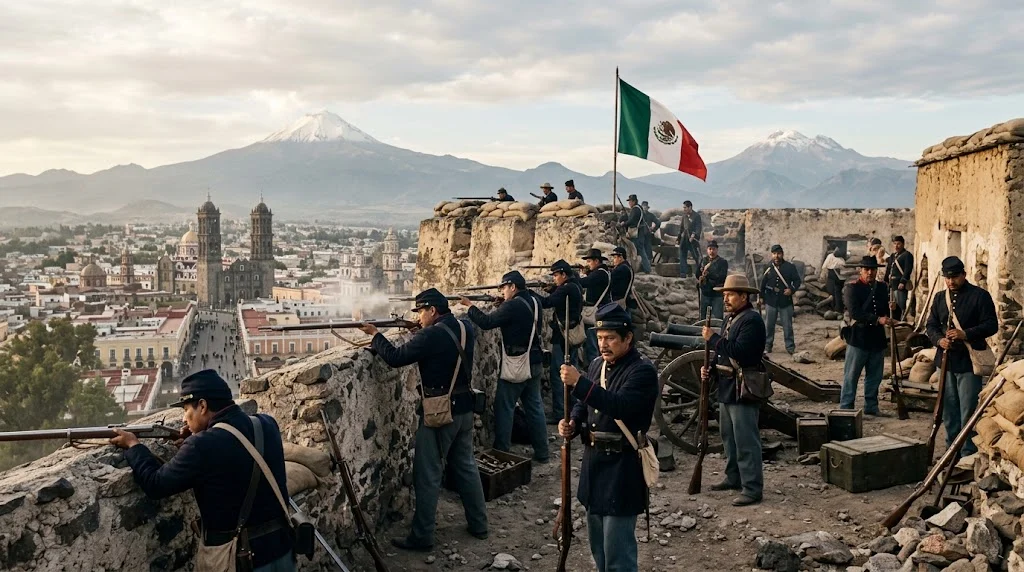
Cinco de Mayo means “Fifth of May” in Spanish. The date commemorates the Mexican victory over the French at the Battle of Puebla on May 5, 1862. It is a day connected to Mexican history, national sovereignty, resistance, and cultural identity.
One important detail is often missed: Cinco de Mayo is not Mexican Independence Day. Mexico celebrates its Independence Day on September 16. Cinco de Mayo remembers a particular military victory that took place decades after Mexico began its struggle for independence.
What Does Cinco de Mayo Mean?
The Spanish phrase Cinco de Mayo literally translates to “May 5” or “Fifth of May.”
Historically, the date refers to the Battle of Puebla, fought on May 5, 1862, during the French intervention in Mexico.
Mexican forces under General Ignacio Zaragoza defeated French troops commanded by General Charles Ferdinand Latrille, Count of Lorencez, near the city of Puebla. Mexican government historical records identify the forts of Loreto and Guadalupe as important defensive positions during the battle.
So, in its historical sense, Cinco de Mayo represents more than a date on the calendar.
It recalls a moment when Mexican forces successfully defended Puebla against a powerful invading army.
Simple Definition
Cinco de Mayo is a Mexican commemoration held on May 5 to remember the Mexican victory over France at the Battle of Puebla in 1862.
That is the core Cinco de Mayo meaning.
Why Is Cinco de Mayo Celebrated?
Cinco de Mayo is celebrated because the Battle of Puebla became an important symbol in Mexican history.
In the years before the battle, Mexico faced severe financial and political difficulties. President Benito Juárez suspended payments on foreign debts. Britain, Spain, and France sent forces to Mexico, but diplomatic agreements led Britain and Spain to withdraw. France continued its military intervention.
French forces then advanced toward Puebla.
On May 5, 1862, Mexican troops defended the city and successfully repelled repeated French attacks. The Mexican government’s historical account describes French attacks against the Fort of Guadalupe being turned back, eventually forcing the French forces to withdraw.
The victory did not end the French intervention.
That distinction matters.
France later captured Mexico City and established a French-backed empire. The French were eventually expelled, and the struggle against the intervention continued for several years.
Cinco de Mayo therefore commemorates one important victory, not the complete defeat of France.
The Battle of Puebla in 1862
The Battle of Puebla took place during a complicated period in Mexican history.
Mexico had recently gone through the Reform War, a civil conflict involving competing political visions for the country. The resulting financial crisis contributed to the events that preceded the French intervention.
France saw an opportunity to intervene.
General Ignacio Zaragoza organized Mexican defenses around Puebla. The French army was regarded as a highly experienced and powerful military force at the time. Mexican troops nevertheless managed to stop the French advance during the May 5 battle.
The Mexican government records that the fighting began in the morning and continued until the French forces withdrew later that day.
Key Facts About the Battle
| Detail | Information |
|---|---|
| Date | May 5, 1862 |
| Location | Puebla, Mexico |
| Mexican commander | General Ignacio Zaragoza |
| French commander | Charles Ferdinand Latrille, Count of Lorencez |
| Mexican president | Benito Juárez |
| Mexican result | Victory |
| Historical context | French intervention in Mexico |
| Important defensive sites | Forts Loreto and Guadalupe |
The battle’s significance came partly from the contrast between the two forces.
Mexican troops faced an invading French army that had considerable military experience. The successful defense of Puebla therefore became a powerful symbol of national resistance.
Who Was Ignacio Zaragoza?
Ignacio Zaragoza was the Mexican general who commanded the Army of the East during the Battle of Puebla.
His role is central to the history of Cinco de Mayo.
Zaragoza positioned Mexican forces around Puebla and directed the defense against the French advance. Mexican government records describe his decision to concentrate forces in Puebla and prepare the city for defense.
After the battle, Zaragoza reported the Mexican victory to the government by telegram. The battle quickly became an important event in the national memory of Mexico.
His name is therefore closely connected with Cinco de Mayo and the Battle of Puebla.
What Role Did Benito Juárez Play?
Benito Juárez was president of Mexico during the events surrounding the Battle of Puebla.
The financial crisis that preceded the French intervention was closely connected with his government’s decision to suspend foreign debt payments. France used the situation as part of the justification for its intervention, while Britain and Spain ultimately reached arrangements and withdrew.
Juárez did not personally command the Battle of Puebla.
That distinction is useful when explaining Cinco de Mayo history.
Juárez was Mexico’s president. Zaragoza was the general commanding the Mexican forces at Puebla.
Did Mexico Win the War on Cinco de Mayo?
No.
This is one of the most important facts to understand.
Mexico won the Battle of Puebla, but the French intervention continued after May 5, 1862.
French forces later captured Mexico City and supported the establishment of the Second Mexican Empire under Maximilian I. Mexican resistance continued, and French forces were eventually driven out.
So there is a major difference between these two statements:
- Mexico won the Battle of Puebla: Yes.
- Mexico ended the French intervention on May 5: No.
That small distinction makes a big difference when explaining the historical meaning of Cinco de Mayo.
Cinco de Mayo vs. Mexican Independence Day
People frequently confuse these two dates.
They commemorate different events.
| Cinco de Mayo | Mexican Independence Day |
|---|---|
| May 5 | September 16 |
| Commemorates the Battle of Puebla | Commemorates the beginning of Mexico’s independence movement |
| Battle took place in 1862 | Independence movement began in 1810 |
| Connected to French intervention | Connected to Spanish colonial rule |
| Associated with Puebla | Celebrated throughout Mexico as a major national holiday |
Mexico’s Independence Day is September 16, not May 5. The Smithsonian specifically notes that Cinco de Mayo should not be confused with Mexican Independence Day.
This is probably the single most useful fact for anyone searching “Cinco de Mayo meaning.”
Why Is Cinco de Mayo Important?
The importance of Cinco de Mayo comes from what the Battle of Puebla represented.
The Mexican victory showed that a better-equipped invading force could be resisted by Mexican troops defending their country.
The victory also had an important psychological and symbolic effect. The Smithsonian notes that the result strengthened Mexican military morale and national pride.
There is another layer to its significance.
Cinco de Mayo connects a specific historical event with broader ideas of:
- National sovereignty
- Resistance
- Mexican identity
- National pride
- Historical memory
- Community
- Cultural heritage
It is important not to turn the holiday into a vague story about Mexican independence. Its actual history is more specific and, in many ways, more interesting.
How Is Cinco de Mayo Celebrated?
Celebrations can include parades, music, dancing, food, community events, educational programs, and cultural performances.
However, celebrations vary significantly depending on location.
Cinco de Mayo has a particularly visible cultural presence in the United States, where Mexican-American communities and other communities have developed public celebrations around the date.
In Mexico, the day is strongly associated with the Battle of Puebla, with Puebla itself having an especially direct connection to the historical event. Mexican government institutions continue to commemorate the battle through official ceremonies and historical presentations.
This difference between historical commemoration and modern cultural celebration is worth remembering.
The same date can carry different meanings for different communities.
Cinco de Mayo Food and Traditions
Modern Cinco de Mayo celebrations are often associated with Mexican food.
Common foods served at celebrations may include:
- Tacos
- Tamales
- Enchiladas
- Guacamole
- Salsa
- Mole
- Churros
- Mexican-style grilled dishes
Music and dancing are also common parts of public celebrations.
Mariachi performances, traditional dances, colorful decorations, and community gatherings may appear at events, particularly in the United States.
But food is not the historical reason for the holiday.
The food, music, and festivities are modern cultural expressions associated with the celebration. The historical foundation is the Battle of Puebla.
That distinction helps keep the meaning accurate.
Why Do Americans Celebrate Cinco de Mayo?
Cinco de Mayo developed a particularly strong presence in the United States.
The holiday became connected with Mexican-American identity and cultural expression, and over time it also became widely recognized in American popular culture.
The Smithsonian notes that Cinco de Mayo celebrations in the United States have developed beyond the original historical event and have become associated with Mexican-American culture.
This explains why someone in the United States may encounter large Cinco de Mayo festivals, restaurant promotions, public events, and cultural programs even though the historical battle occurred in Mexico.
The American celebration can therefore have two layers:
Historical layer: remembering the Battle of Puebla.
Cultural layer: celebrating Mexican heritage and Mexican-American culture.
Is Cinco de Mayo a National Holiday in Mexico?
Cinco de Mayo has an important place in Mexican history, but its status should not be confused with Mexico’s most prominent nationwide national celebrations.
The date is particularly significant in Puebla, where the battle occurred.
The Mexican government continues to commemorate the Battle of Puebla through official ceremonies and historical events. For example, Puebla marked the 164th anniversary of the battle in May 2026 with a public reenactment and commemorative activities.
This local connection is important because Cinco de Mayo is often perceived outside Mexico as if it were the country’s equivalent of its Independence Day.
It is not.
What Happened After the Battle of Puebla?
The Mexican victory at Puebla did not stop France from pursuing its objectives.
French forces returned with greater strength. Mexico City eventually fell to the French, and Maximilian I was installed as emperor of Mexico.
Mexican resistance continued.
The French eventually withdrew, and Maximilian was captured and executed in 1867. Benito Juárez returned to the presidency.
This later history gives Cinco de Mayo additional context.
The Battle of Puebla was an important victory within a much larger struggle.
It was a moment of resistance, not the final chapter.
What Makes the Battle of Puebla Historically Significant?
One useful way to understand the battle is to look beyond the celebration itself.
The victory mattered because it challenged expectations.
Mexico’s forces successfully defended Puebla against a major French assault. The event gave the Mexican government and military a morale boost at a time of severe political and military pressure.
The battle also became part of Mexico’s historical memory.
Over time, May 5 developed into a symbolic date associated with defending national sovereignty.
That is why simply describing Cinco de Mayo as a “Mexican party” misses the central historical story.
Common Misconceptions
Myth 1: Cinco de Mayo is Mexican Independence Day
False.
Mexican Independence Day is September 16.
Cinco de Mayo commemorates the Battle of Puebla in 1862.
Myth 2: Mexico defeated France permanently on May 5
False.
Mexico won the Battle of Puebla, but France continued its intervention afterward.
Myth 3: Cinco de Mayo is celebrated only for food and drinks
Incomplete.
Food and festivities are part of many modern celebrations, but the historical foundation is a military victory at Puebla.
Myth 4: Cinco de Mayo has exactly the same meaning everywhere
Not necessarily.
Its historical meaning comes from Mexico, while celebrations in the United States have also become connected with Mexican-American culture and heritage.
Myth 5: The Battle of Puebla was unimportant because the war continued
Misleading.
The battle did not end the conflict, but its victory had significant symbolic and morale value and became an enduring part of Mexican historical memory.
Cinco de Mayo at a Glance
If you need the answer quickly, remember these points:
- Cinco de Mayo means “Fifth of May.”
- It refers to May 5, 1862.
- The date commemorates the Battle of Puebla.
- Mexican forces defeated French forces in that battle.
- General Ignacio Zaragoza commanded the Mexican Army of the East.
- Benito Juárez was Mexico’s president.
- The victory did not end the French intervention.
- Cinco de Mayo is not Mexican Independence Day.
- Mexican Independence Day is September 16.
- Modern celebrations can include food, music, dancing, parades, and cultural events.
Why the Meaning of Cinco de Mayo Gets Confused
There is an interesting reason the holiday can seem confusing.
The historical event is relatively specific.
The modern celebration is much broader.
Someone searching for Cinco de Mayo may be asking about Mexican history. Another person may be looking for the meaning of the phrase. Someone else may want to know why people eat Mexican food and attend festivals on May 5.
All three questions connect to the same date, but they have different search intent.
A useful explanation should therefore begin with the historical definition before discussing modern traditions.
That gives readers the context they need instead of presenting Cinco de Mayo as only a festive occasion.
Frequently Asked Questions
What does Cinco de Mayo mean?
Cinco de Mayo means “Fifth of May” in Spanish. It commemorates the Mexican victory over French forces at the Battle of Puebla on May 5, 1862.
What happened on Cinco de Mayo in 1862?
On May 5, 1862, Mexican forces under General Ignacio Zaragoza defeated French forces near Puebla. The Mexican government identifies the forts of Loreto and Guadalupe as important defensive positions in the battle.
Is Cinco de Mayo Mexico’s Independence Day?
No. Mexico’s Independence Day is September 16. Cinco de Mayo commemorates the Battle of Puebla in 1862.
Who did Mexico fight on Cinco de Mayo?
Mexican forces fought the French Army during the French intervention in Mexico.
Who was Ignacio Zaragoza?
Ignacio Zaragoza was the Mexican general who commanded the Army of the East during the Battle of Puebla.
Did Mexico win the entire war on Cinco de Mayo?
No. Mexico won the Battle of Puebla, but the French intervention continued. French forces later captured Mexico City and supported the establishment of the Second Mexican Empire.
Why do people eat Mexican food on Cinco de Mayo?
Food has become part of many modern Cinco de Mayo celebrations, particularly in the United States. The historical reason for the date, however, is the Battle of Puebla.
Why is Cinco de Mayo important in the United States?
In the United States, Cinco de Mayo has become associated with Mexican-American culture and heritage as well as the historical Battle of Puebla.
When is Cinco de Mayo?
Cinco de Mayo is observed every year on May 5.
Conclusion
Cinco de Mayo is more than a day of food, music, and celebrations. Its historical meaning comes from the Battle of Puebla on May 5, 1862, when Mexican forces defeated the French army in an important victory during the French intervention in Mexico. The day later became a lasting symbol of resistance, national pride, and Mexican cultural identity.
Understanding the history also clears up a common misconception: Cinco de Mayo is not Mexico’s Independence Day. It remembers a specific battle, while Mexican Independence Day is celebrated on September 16. Knowing this difference makes the meaning of Cinco de Mayo much clearer and helps separate its historical roots from the many cultural traditions associated with the date today.