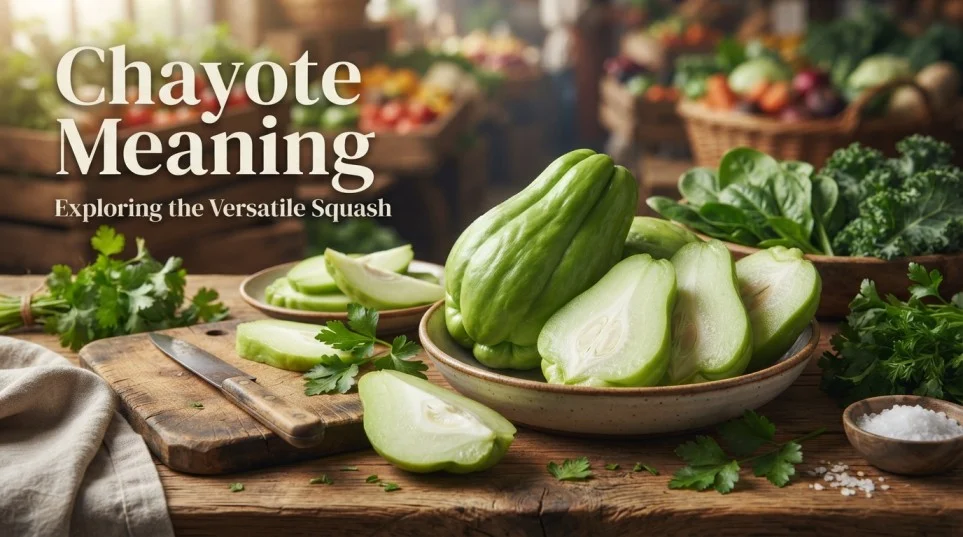
Have you ever come across the word chayote in a recipe, grocery store, or food article and wondered what it actually means? Chayote meaning is quite simple: chayote is an edible fruit from a climbing vine that is usually prepared and eaten as a vegetable.
Its scientific name is Sechium edule, and it belongs to the Cucurbitaceae, the same plant family that includes cucumbers, pumpkins, melons, and zucchini. Chayote usually has a green, pear-like shape with a firm texture and mild flavor. Depending on the variety, its skin may be smooth or slightly wrinkled.
What makes chayote interesting is its unusual botanical and culinary identity. Technically, it is a fruit because it develops from the flowering part of a plant and contains a seed. In everyday cooking, however, people treat it as a vegetable. It can be eaten raw, steamed, boiled, sautéed, roasted, stuffed, or added to soups and stews.
What Does Chayote Mean?
Chayote means an edible, pear-shaped fruit that is commonly used as a vegetable.
The word chayote generally refers to the edible fruit produced by the chayote vine. It is particularly associated with cuisines that developed in or around Mesoamerica, although the plant is now cultivated and eaten in many parts of the world.
In simple English:
Chayote is a mild-tasting, pear-shaped edible fruit that people usually cook like a vegetable.
The word can be confusing at first because chayote does not look like many fruits people commonly eat. It is green, firm, and often used in savory dishes rather than sweet recipes.
Quick Meaning
| Term | Meaning |
|---|---|
| Chayote | An edible fruit commonly used as a vegetable |
| Scientific name | Sechium edule |
| Plant family | Cucurbitaceae |
| Common shape | Pear-shaped |
| Typical color | Green or pale green |
| Flavor | Mild and fresh |
| Texture | Crisp when raw, tender when cooked |
| Common use | Salads, soups, stir-fries, stews, side dishes |
What Is Chayote?
Chayote is the edible fruit of a climbing vine. The plant grows well in warm climates and can spread along supports such as trellises, fences, or other structures.
The fruit is usually green and pear-shaped. Some varieties have a smooth surface, while others have folds, grooves, or wrinkles.
Inside the fruit is pale flesh surrounding a single central seed. Both the flesh and seed are edible when properly prepared.
Chayote is sometimes called chayote squash, even though it is not a squash in the everyday sense of the word. It belongs to the same broader botanical family as many familiar squash and cucumber plants.
One reason chayote is so useful in cooking is its relatively neutral flavor. It does not dominate a dish. Instead, it tends to absorb the flavors of sauces, spices, herbs, and other ingredients.
Is Chayote a Fruit or a Vegetable?
This is probably the most common question about chayote.
Botanically, chayote is a fruit. Culinary-wise, it is generally treated as a vegetable.
The difference comes down to how the terms are being used.
Botanically, a fruit develops from the flowering part of a plant and usually contains seeds. Chayote fits that description.
In the kitchen, however, chayote is usually prepared in savory dishes. It is not commonly used like sweet fruits such as apples, peaches, or mangoes.
That is why both statements can be correct:
- Chayote is botanically a fruit.
- Chayote is culinarily used as a vegetable.
This same kind of classification difference happens with several other foods, so there is no contradiction.
What Does Chayote Look Like?
A fresh chayote usually resembles a small green pear.
Its appearance can vary depending on the variety and growing conditions. Some chayotes are fairly smooth, while others have noticeable wrinkles or ridges.
A typical chayote has:
- Green or pale-green skin
- A pear-like shape
- Firm flesh
- A single central seed
- A slightly uneven or ridged surface in some varieties
- Pale flesh inside
When cut open, the inside is much less dramatic than the outside. The flesh is generally light in color and firm.
The unusual shape is one reason people often search for what is chayote after seeing one for the first time.
What Does Chayote Taste Like?
Chayote has a mild, fresh, slightly vegetal flavor.
Its flavor is not particularly sweet. Instead, it has a clean taste that works well with savory ingredients.
The texture can be even more noticeable than the flavor.
Raw Chayote
Raw chayote is:
- Crisp
- Juicy
- Firm
- Mild
- Refreshing
Its texture can remind some people of cucumber, although the flavor and structure are different.
Cooked Chayote
Cooking makes chayote softer and more tender.
Depending on the method, it can become:
- Tender but still firm
- Soft and juicy
- Slightly creamy
- More savory after absorbing seasonings
Chayote is especially good for recipes where you want an ingredient that can carry seasoning without overpowering everything else.
Why Does Chayote Have Such a Mild Flavor?
This is one of the things that makes chayote different from strongly flavored vegetables.
A tomato can bring acidity. A chili brings heat. Garlic brings a powerful aroma. A bitter green can dominate a dish.
Chayote generally does not behave that way.
Its mild character allows it to work as a texture carrier. It can provide substance and crunch while allowing other ingredients to take the lead.
For example, chayote sautéed with garlic, ginger, chili, and soy sauce will take on much of the character of those ingredients.
That makes it useful for cooks who want to experiment with different seasonings without fighting against a strong natural flavor.
How Do You Pronounce Chayote?
A common English pronunciation of chayote is approximately:
chah-YOH-tee
The middle syllable receives the strongest emphasis.
You may hear slight pronunciation differences depending on the speaker’s language and region. That is normal, especially because the word has traveled across languages and cultures.
If you are ordering chayote or asking about it in a market, chah-YOH-tee is a useful pronunciation to know.
Where Does Chayote Come From?
Chayote has a long history in Mesoamerica, particularly in areas connected with present-day Mexico and Central America.
The plant thrives in warm environments and grows as a climbing vine. From its historical growing regions, it spread to other parts of the world where the climate allowed it to grow successfully.
Today, chayote appears in different regional cuisines, including dishes from parts of Latin America, the Caribbean, Asia, and other warm areas.
This wider distribution explains why the same food can have several different names.
Chayote is therefore not a newly invented health-food trend. It is a traditional food plant with a long culinary history.
What Are the Other Names for Chayote?
Chayote has several common names around the world.
Some of the names you may encounter include:
- Chayote squash
- Vegetable pear
- Mexican squash
- Mirliton
- Christophene
- Christophine
- Sechium edule
These names can make recipe research confusing.
For example, searching only for “chayote recipes” may give you different results from searching for “mirliton recipes,” even though both terms can refer to the same plant.
If you are trying to identify a food from a recipe, checking alternative names can make your search much easier.
Why Is Chayote Called Vegetable Pear?
The name vegetable pear comes largely from its appearance and culinary use.
Chayote can resemble a green pear because of its shape. But it is not botanically related to a true pear.
The name is more of a visual and culinary description than a scientific classification.
So:
Vegetable pear ≠ actual pear.
Chayote is a member of the gourd family, while a true pear belongs to a completely different plant group.
How Do You Eat Chayote?
There are many ways to eat chayote.
Its versatility is one of the reasons it appears in so many different cuisines.
You can:
- Slice it into salads.
- Steam it as a side dish.
- Boil it for soups and stews.
- Sauté it with garlic and onions.
- Stir-fry it with other vegetables.
- Roast it with herbs and spices.
- Add it to curries.
- Stuff it with savory fillings.
- Pickle it.
- Combine it with meat or seafood.
- Use young, tender pieces in fresh dishes.
The best method depends on the texture you want.
If you want crunch, keep the cooking time relatively short. If you want softer pieces for a soup or stew, longer cooking works well.
Can You Eat Chayote Raw?
Yes, chayote can be eaten raw.
Young and tender chayote can be sliced or shredded and added to salads, slaws, or other fresh dishes.
Raw chayote has a firm, crisp texture, so it can be useful when you want something that adds crunch without a very strong flavor.
A simple raw preparation could include:
- Thinly sliced chayote
- Lime or lemon juice
- Fresh herbs
- A little salt
- Black pepper
- Optional chili
This keeps the preparation simple and lets the natural texture stand out.
Can You Eat Chayote Skin?
Yes, chayote skin is edible.
You do not necessarily need to peel it before cooking.
However, the decision depends on the fruit and the recipe.
Young chayote may have tender skin that works perfectly well when left on. Older or tougher chayote can have a skin texture some people find less pleasant.
A useful rule is:
If the skin looks tender and feels pleasant, you can leave it on. If it seems tough, peeling may improve the final dish.
Always wash the fruit properly before cutting or cooking it.
Can You Eat the Chayote Seed?
Yes. The central seed is edible.
Unlike many fruit seeds that are normally discarded, the seed inside chayote can be cooked and eaten.
Some people enjoy its texture, while others prefer to remove it depending on the recipe.
You do not need to remove the seed simply because it is a seed.
If you are preparing chayote for the first time, you can cook it with the seed and decide later if you prefer the texture without it.
How to Cut Chayote
Preparing chayote is fairly straightforward.
Basic Method
- Wash the chayote thoroughly.
- Place it on a stable cutting board.
- Cut it in half lengthwise.
- Decide if you want to keep or remove the central seed.
- Slice, dice, or cut it into wedges.
- Cook according to your recipe.
The exact cutting style depends on the dish.
Thin slices work well for stir-fries and salads. Cubes are useful for soups and stews. Larger wedges can work for roasting.
How to Cook Chayote
Chayote does not require complicated cooking techniques.
Steaming
Steaming keeps the flavor clean and the texture relatively delicate.
It is a good option when you want to serve chayote as a simple side dish.
Boiling
Boiled chayote becomes tender and can be added to soups, stews, or other preparations.
Avoid cooking it far longer than necessary if you want it to maintain some structure.
Sautéing
Sautéing is one of the easiest ways to introduce chayote to your regular meals.
Try it with:
- Garlic
- Onion
- Ginger
- Black pepper
- Chili
- Herbs
- A small amount of oil
Stir-Frying
Because chayote can maintain some firmness, it works well in stir-fries.
You can combine it with carrots, peppers, mushrooms, onions, green beans, tofu, chicken, or other ingredients.
Roasting
Roasting can bring out a deeper savory character.
Cut chayote into manageable pieces, add a little oil and seasoning, then roast until tender.
The result will be quite different from raw chayote, which makes roasting useful if you want to explore its flavor.
A Simple Chayote Recipe for Beginners
If you have never tried chayote before, a simple garlic sauté is a good starting point.
Ingredients
- 1 to 2 chayotes
- 1 tablespoon cooking oil
- 1 or 2 garlic cloves
- Salt
- Black pepper
- Optional chili flakes
- Optional lemon or lime juice
Instructions
- Wash the chayote.
- Cut it into thin slices.
- Heat oil in a pan.
- Add the garlic and cook briefly.
- Add the sliced chayote.
- Season with salt and black pepper.
- Cook until tender while keeping some texture.
- Add chili flakes if desired.
- Finish with a little lemon or lime juice.
This is a useful first recipe because it lets you notice the natural flavor instead of covering it with a heavy sauce.
Chayote Nutrition
Chayote is naturally low in calories and provides water, fiber, vitamin C, folate, potassium, and other nutrients.
Its exact nutritional profile depends on the serving size and preparation method.
One important point is that the nutritional value of the final dish depends on what you add to it.
For example, lightly steamed chayote with herbs is very different nutritionally from chayote that has been heavily fried or covered in a rich sauce.
So it is more useful to think of chayote as a nutritious vegetable-style ingredient rather than treating it as a miracle food.
Nutrients Associated With Chayote
Chayote can contribute:
- Fiber, which supports normal digestive function
- Vitamin C, an antioxidant nutrient involved in normal immune function
- Folate, an important B vitamin
- Potassium, an essential mineral
- Water, because the fruit has a high water content
A balanced diet matters more than any single ingredient, but chayote can easily fit into a varied eating pattern.
Chayote Health Benefits
Because chayote contains fiber, vitamin C, folate, potassium, and water, it can be a useful part of a balanced diet.
Potential nutritional advantages include:
Supports a Fiber-Rich Diet
The fiber in plant foods contributes to a healthy eating pattern and normal digestive function.
Adds Vitamin C
Chayote provides vitamin C, which plays several important roles in the body.
Provides Potassium
Potassium is an essential mineral involved in normal body functions, including fluid balance and muscle activity.
Adds Variety to Meals
This benefit is easy to overlook.
Eating a wider variety of vegetables and plant foods can make a diet more diverse and enjoyable. Chayote gives cooks another mild ingredient to work with.
Health claims should still be kept realistic. Chayote is food, not a treatment for a medical condition.
Chayote vs. Zucchini
Chayote and zucchini are sometimes compared because both have mild flavors and belong to the Cucurbitaceae family.
But they are noticeably different.
| Feature | Chayote | Zucchini |
|---|---|---|
| Shape | Pear-like | Long and cylindrical |
| Raw texture | Crisp and firm | Softer |
| Flavor | Mild and fresh | Mild and slightly sweet |
| Seed structure | One central seed | Many soft seeds |
| Common use | Soups, salads, stir-fries | Sautéing, grilling, baking, soups |
| Plant family | Cucurbitaceae | Cucurbitaceae |
Zucchini can sometimes substitute for chayote in cooked dishes, but the texture will not be exactly the same.
Chayote tends to provide a firmer bite, especially when lightly cooked.
Chayote vs. Cucumber
The cucumber comparison is also understandable.
Both can be crisp and refreshing when raw, but their culinary personalities are different.
Cucumber is strongly associated with fresh salads, pickles, sandwiches, and chilled dishes.
Chayote has a wider transition from raw to cooked. It can work in a salad but also fits naturally into soups, stir-fries, stews, and cooked side dishes.
So if you are looking for a simple comparison:
Cucumber is usually more refreshing and watery, while chayote is firmer and more neutral.
Chayote vs. Pear
The name “vegetable pear” can make people assume chayote tastes like a pear.
It does not.
A ripe pear is naturally sweet and juicy. Chayote is much more neutral and savory.
The comparison mainly comes from the shape.
| Chayote | Pear |
|---|---|
| Mild vegetable-like flavor | Sweet fruit flavor |
| Usually cooked as a vegetable | Commonly eaten as a sweet fruit |
| Gourd family | Rose family |
| Single central seed | Several seeds |
| Usually green | Many colors and varieties |
So if someone tells you chayote tastes like a pear, take that as a description of its shape rather than a promise of sweetness.
Why Is Chayote Used in So Many Different Cuisines?
Chayote has several qualities that make it easy to adapt.
It is relatively mild. It can be cooked in different ways. It holds its shape reasonably well. It can absorb seasoning. It works with other vegetables, meat, seafood, herbs, and spices.
That flexibility helps explain its presence in many regional dishes.
A food does not need an intense flavor to become useful. Sometimes the most valuable ingredient is the one that quietly supports the rest of the dish.
Chayote is a good example of that idea.
Common Names Can Change the Search Results
If you are searching for recipes, knowing alternative names can make a big difference.
Suppose you search for:
“chayote recipes”
You may find one group of recipes.
But searching:
“mirliton recipes”
or
“christophine recipes”
may reveal traditional recipes from another region using the same ingredient.
This is useful when researching older cookbooks, regional dishes, or recipes from different cultures.
Is Chayote a Squash?
Chayote is commonly called chayote squash, especially in English-language food contexts.
However, “squash” can be confusing because people often use the term for familiar fruits such as zucchini, butternut squash, and acorn squash.
Chayote belongs to the same broad botanical family as many squash plants, but it is a distinct species.
Its scientific name is:
Sechium edule
That is the most precise way to identify the plant.
Is Chayote a Healthy Food?
Chayote can be part of a healthy, balanced diet.
It provides nutrients and is naturally low in calories, while its mild flavor makes it easy to combine with other vegetables and whole foods.
Still, it is better to avoid exaggerated claims.
Chayote does not need to be presented as a superfood to be valuable. Its real advantage is practical: it gives you another nutrient-containing plant food that can be prepared in many different ways.
The cooking method matters too.
Steaming, boiling, roasting, or lightly sautéing can produce very different meals from deep-frying or using a heavy sauce.
What Can You Make With Chayote?
Once you understand its mild flavor and firm texture, the recipe possibilities become easier to imagine.
Try using chayote in:
- Fresh salads
- Vegetable soups
- Chicken soup
- Beef stews
- Stir-fries
- Vegetable curries
- Roasted vegetable dishes
- Stuffed vegetable recipes
- Pickled preparations
- Mixed vegetable side dishes
You can also experiment with combinations such as:
Chayote + garlic + ginger
Chayote + chili + lime
Chayote + onion + herbs
Chayote + tomato + spices
Chayote + seafood
The ingredient is mild enough to work with both simple and strongly seasoned dishes.
Common Mistakes When Preparing Chayote
If you are trying chayote for the first time, a few simple mistakes can affect the result.
Overcooking It
Cooking chayote for too long can turn its pleasant firm texture into something overly soft.
Using Too Little Seasoning
Because the natural flavor is mild, chayote often benefits from herbs, spices, citrus, garlic, or other flavorful ingredients.
Assuming It Tastes Sweet
Its pear-like appearance can create the wrong expectation. Chayote is not a sweet pear substitute.
Automatically Peeling It
The skin is edible, so peeling is not always necessary. Decide based on the texture and recipe.
Throwing Away the Seed Automatically
The central seed is edible, so removing it is a preference rather than a requirement.
Why Chayote Is Worth Trying
Chayote may not be the most famous vegetable in the produce section, but that is part of its appeal.
It offers something many cooks appreciate: versatility without a strong flavor.
You can keep it raw for crunch, cook it gently for tenderness, or use stronger seasonings to turn it into a flavorful part of a larger dish.
It also gives you a chance to explore food traditions beyond the vegetables most commonly found in everyday Western grocery lists.
Sometimes discovering a new ingredient is less about finding an exotic flavor and more about finding a new way to build a familiar meal.
Frequently Asked Questions
What is the simple meaning of chayote?
Chayote is an edible, pear-shaped fruit from a climbing vine that is commonly cooked and eaten as a vegetable.
Is chayote a fruit?
Yes. Botanically, chayote is a fruit because it develops from the flowering part of the plant and contains a seed. In cooking, it is generally treated as a vegetable.
What does chayote taste like?
Chayote has a mild, fresh, slightly vegetal flavor. Its raw texture is crisp, while cooking makes it softer and more tender.
What is another name for chayote?
Common names include chayote squash, vegetable pear, Mexican squash, mirliton, christophene, and christophine.
How do you pronounce chayote?
A common English pronunciation is chah-YOH-tee. Regional pronunciation can vary.
Can you eat chayote raw?
Yes. Young, tender chayote can be eaten raw. Its crisp texture makes it suitable for salads and fresh preparations.
Can you eat chayote skin?
Yes. The skin is edible. You can leave it on if it is tender or peel the fruit if the skin feels tough.
Can you eat the chayote seed?
Yes. The central seed is edible and can be cooked with the fruit.
Is chayote the same as zucchini?
No. Both belong to the Cucurbitaceae family, but they are different plants. Chayote has a pear-like shape and one central seed, while zucchini is elongated and contains many soft seeds.
Is chayote good for you?
Chayote can be part of a balanced diet. It provides nutrients such as fiber, vitamin C, folate, and potassium and is naturally low in calories.
Final Answer:
Chayote means an edible fruit from the climbing plant Sechium edule, commonly prepared and eaten as a vegetable.
It is usually green and pear-shaped, with a mild flavor and crisp texture. It can be eaten raw or cooked, and its skin and central seed are edible.
The most important detail to remember is that chayote is botanically a fruit but culinary-wise a vegetable. Its mild taste also makes it remarkably flexible. It can fit into salads, soups, stir-fries, stews, roasted dishes, and many regional recipes.
So the next time you see the word chayote, you do not need to wonder what mysterious ingredient a recipe is talking about. Think of a mild, pear-shaped edible fruit that behaves like a vegetable in the kitchen.