The word bodega usually means a small neighborhood grocery store, especially in New York City. You might visit one to grab a cold drink, buy a snack, pick up milk, or order a quick sandwich. For many New Yorkers, a bodega is more than a place to shop. It is a familiar part of everyday neighborhood life.
However, the bodega meaning changes depending on the language and context. In Spanish, the word can refer to a storeroom, warehouse, wine cellar, or winery. In American English, particularly in New York, it commonly describes a small local shop that sells groceries, drinks, snacks, and everyday essentials.
Understanding the word means looking beyond its dictionary definition. Its Spanish roots, everyday use, and connection to New York culture explain why this simple word has become so recognizable.
What Does Bodega Mean?

A bodega is a small neighborhood store that sells everyday products, such as snacks, beverages, groceries, and household essentials. Many New York bodegas also have a deli counter where customers can order sandwiches, breakfast items, or other quick meals.
The word is particularly associated with New York City, where bodegas serve residents in apartment buildings, busy streets, and residential neighborhoods.
For example, someone might say:
“I’m stopping by the bodega to get some eggs and a bottle of water.”
This means the person is visiting a nearby shop to purchase a few everyday items.
A bodega is usually smaller and more informal than a supermarket. It may have limited floor space, shelves packed with different products, a counter for prepared food, and an owner or staff member who regularly sees the same customers.
The exact selection depends on the store. Some bodegas focus on groceries and convenience items, while others are known for sandwiches, coffee, and quick meals.
Bodega Meaning in Spanish
In Spanish, bodega has several related meanings. Its precise definition depends on the country and the situation in which the word appears.
Common meanings include:
- Storeroom: A place used to keep supplies, equipment, or other goods.
- Warehouse: A building or space where products are stored.
- Wine cellar: A place where wine is stored or aged.
- Winery: In certain contexts, a business involved in producing or selling wine.
- Small shop: In some Spanish-speaking communities, the word can refer to a local shop or grocery business.
For example, the phrase bodega de vinos refers to a wine cellar or winery, depending on the context.
This explains why translating bodega directly into English can sometimes be confusing. The word does not always mean a corner grocery store.
In New York English, its everyday meaning developed into something more specific: a small local shop that people visit for food, drinks, and daily necessities.
What Does a Bodega Store Sell?
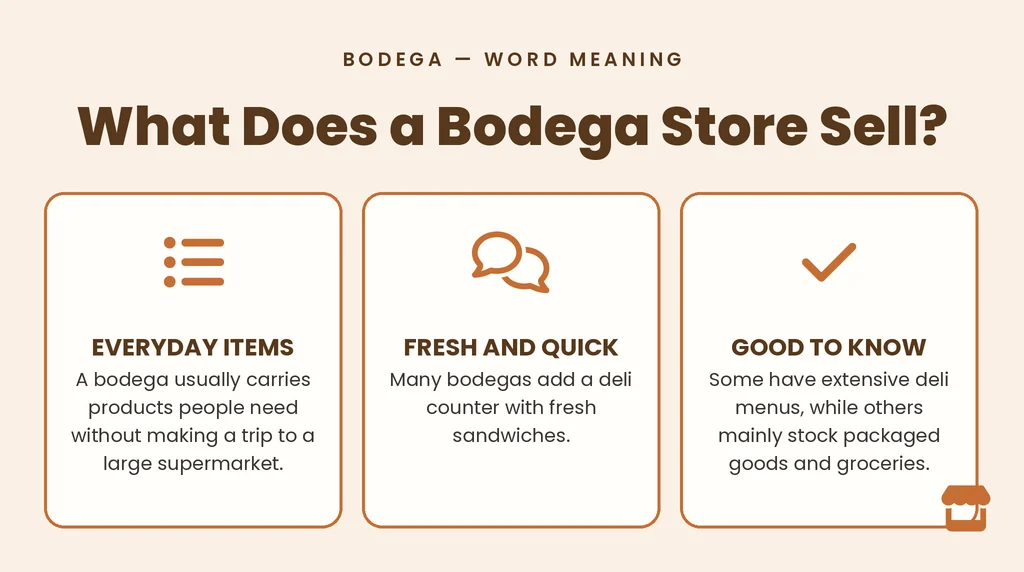
A bodega usually carries products people need without making a trip to a large supermarket. Its inventory can vary considerably according to the neighborhood, store size, and owner.
| Product Category | Common Examples |
|---|---|
| Snacks | Chips, cookies, candy, crackers |
| Drinks | Bottled water, soda, juice, energy drinks |
| Basic groceries | Milk, eggs, bread, cereal |
| Prepared food | Sandwiches, breakfast rolls, deli meals |
| Household essentials | Paper towels, cleaning products, batteries |
| Personal care | Soap, toothpaste, tissues |
| Convenience items | Gum, phone chargers, small everyday supplies |
Not every bodega sells all these products. Some have extensive deli menus, while others mainly stock packaged goods and groceries.
Why Are Bodega Sandwiches So Popular?
Many New York bodegas have a deli counter that prepares sandwiches to order. Customers may choose bread, meat, cheese, vegetables, sauces, and other toppings.
A customer might order a bacon, egg, and cheese sandwich before work or grab a quick lunch during a busy day.
These sandwiches are part of the appeal because customers can often get a simple, freshly prepared meal without visiting a full-service restaurant. The food menu, prices, and preparation options vary from one shop to another.
Why Are Bodegas Associated With New York City?
<text>New York City’s bodega culture is closely connected to neighborhood convenience, immigrant entrepreneurship, and daily urban routines.</text>
Bodegas are often located near apartment buildings, residential streets, and public transportation routes. Their locations make them useful for people who need a few groceries or a quick meal without traveling to a large store.
Many New York bodegas have also been operated by immigrant families, including people from Latin American and Caribbean communities. Their histories differ, but these businesses have become familiar features of neighborhoods across the city.
A bodega can serve several purposes at once:
- A nearby place to buy last-minute groceries.
- A quick stop for coffee, breakfast, or lunch.
- A shop where regular customers recognize the staff.
- A convenient source of everyday household items.
- A small local business that contributes to neighborhood life.
Imagine arriving home late and realizing you have run out of milk. Instead of traveling to a supermarket, you walk around the corner to a shop that is still open. That is the practical role a bodega often plays.
The cultural significance comes from this repeated, ordinary interaction. A bodega becomes part of the rhythm of a neighborhood, not simply another retail business.
Bodega vs. Convenience Store: What Is the Difference?
A bodega and a convenience store share many features, but the terms are not always used in the same way.
A convenience store is a broad retail category. It describes a shop that sells everyday products and is designed for quick purchases. A bodega is a term strongly associated with neighborhood shops in New York City and with particular local traditions.
| Feature | Bodega | Convenience Store |
|---|---|---|
| Main meaning | Neighborhood shop, especially in New York | Small shop selling everyday essentials |
| Typical products | Groceries, snacks, drinks, deli food | Snacks, drinks, groceries, convenience items |
| Prepared food | Many have made-to-order deli counters | Some sell prepared food, while others focus on packaged items |
| Cultural association | Strongly linked to New York neighborhood life | Used broadly across many countries |
| Store layout | Often independently owned, with varied layouts | Can be independent or part of a chain |
| Customer experience | May include familiar staff and regular neighborhood customers | Depends on the store and location |
The most important distinction is that bodega describes a particular kind of neighborhood shop in a specific cultural context, while convenience store is a broader retail term.
The categories can overlap. A New York bodega may also be described as a convenience store, but the term bodega often carries a stronger local identity.
Bodega Slang Meaning
The phrase bodega slang meaning usually refers to the informal American English use of the word for a neighborhood grocery shop.
The word itself is not inherently slang or offensive. It is a familiar everyday term, particularly in New York City.
You may hear it in conversations, movies, social media posts, and discussions about New York food or city life.
For example:
- “I’ll grab a soda from the bodega.”
- “The bodega downstairs makes great sandwiches.”
- “Let’s stop at the bodega before heading home.”
In each example, bodega refers to a nearby shop.
The word can also carry cultural meaning. In a New York context, mentioning a bodega may bring to mind a small local store, a deli counter, familiar neighborhood faces, or a quick breakfast sandwich.
However, the term should not be treated as a universal name for every small shop. Local vocabulary differs from place to place.
Bodega Pronunciation
The pronunciation depends slightly on the language and accent.
In American English, bodega is commonly pronounced:
boh-DAY-guh
The stress falls on the second syllable.
A simple breakdown is:
- Bo: sounds like “boh.”
- De: sounds like “day.”
- Ga: sounds like “guh.”
In Spanish, pronunciation varies by regional accent, but the word is generally pronounced with the stress on the second-to-last syllable.
If you are using the word in an everyday American conversation, “boh-DAY-guh” is a useful guide.
Bodega Origin: Where Does the Word Come From?
The word bodega comes from Spanish and ultimately traces back to the ancient Greek word apothēkē, meaning a storehouse or place for storing things.
Over time, related forms of the word developed in different languages, including Spanish bodega, which acquired meanings associated with storage spaces, wine cellars, and wineries.
In New York City English, the word became closely associated with small neighborhood grocery stores. The city’s Spanish-speaking communities and the history of local immigrant-owned businesses helped shape its everyday use.
The modern meaning reflects an interesting change in language: a word connected to storage and commerce came to identify a familiar neighborhood institution.
It is important to remember that the Spanish meaning and the New York English meaning overlap historically but are not identical in every situation.
How to Use Bodega in a Sentence

The easiest way to understand a word is to see how people use it naturally.
Here are some examples of bodega in different situations.
| Context | Example Sentence | Meaning |
|---|---|---|
| Everyday shopping | “I need to stop at the bodega for bread.” | A local grocery shop |
| Buying a drink | “She bought a cold juice at the bodega.” | A nearby convenience shop |
| Ordering food | “He got a breakfast sandwich from the bodega.” | A shop with a deli counter |
| Giving directions | “The bodega is next to the laundromat.” | A local neighborhood business |
| Talking about culture | “Bodegas are an important part of New York life.” | Neighborhood shops and their cultural role |
| Spanish context | “La bodega almacena el vino.” | The wine cellar or storage facility stores the wine |
Bodega in Casual Conversation
Here is a short example of how the word might appear in a natural conversation.
Alex: “Do we have any milk left?”
Jordan: “No, but there’s a bodega around the corner.”
Alex: “Great. I’ll pick some up.”
The conversation shows how the word works without requiring any special explanation. The speakers understand that the bodega is a nearby shop where they can buy everyday groceries.
Bodega vs. Grocery Store vs. Deli
These three terms can describe related businesses, but they emphasize different things.
- Bodega: Usually highlights a small neighborhood shop, particularly in New York City.
- Grocery store: Emphasizes a business that sells food and household groceries. It may be small or large.
- Deli: Refers to a delicatessen or food counter that sells prepared foods, sandwiches, sliced meats, cheeses, and similar products.
A single business can fit more than one category. For example, a New York bodega might sell groceries and operate a deli counter. Calling it a bodega identifies the neighborhood-shop context, while calling it a deli emphasizes the prepared food.
These distinctions are useful when interpreting the word in conversation. The surrounding sentence often tells you which aspect matters.
Frequently Asked Questions
1. What does bodega mean in simple English?
A bodega is a small neighborhood grocery store, especially one commonly found in New York City. It usually sells snacks, drinks, groceries, and everyday essentials.
2. Is bodega an English or Spanish word?
Bodega originated in Spanish and ultimately traces back to an ancient Greek word for a storehouse. It is also commonly used in American English, particularly in New York City.
3. What does bodega mean in New York?
In New York City, a bodega generally means a small neighborhood shop selling groceries, drinks, snacks, and often freshly prepared sandwiches or other deli foods.
4. Does bodega mean grocery store in Spanish?
Not always. In Spanish, bodega can refer to a storeroom, warehouse, wine cellar, winery, or certain types of shops. The exact meaning depends on regional usage and context.
5. What is the difference between a bodega and a convenience store?
A convenience store is a broad category of small retail shops selling everyday essentials. A bodega is especially associated with New York neighborhood culture and often combines grocery shopping with a deli counter.
6. Why are New York stores called bodegas?
The word comes from Spanish. Its use for neighborhood grocery shops developed within New York’s linguistic and cultural history, including the influence of Spanish-speaking communities.
7. What do bodegas usually sell?
Bodegas commonly sell snacks, bottled drinks, milk, eggs, bread, toiletries, and other everyday items. Many also prepare sandwiches, breakfast foods, and quick meals.
8. How do you pronounce bodega?
In American English, it is commonly pronounced “boh-DAY-guh,” with the stress on the second syllable.
9. Is a bodega the same as a deli?
No. A deli specializes in prepared foods and products such as sandwiches, sliced meats, and cheese. A bodega is a neighborhood shop that may also have a deli counter.
10. Can I use bodega outside New York?
Yes. The word is understood in other places, particularly when discussing New York culture. However, its meaning and familiarity vary by location, so corner shop, convenience store, or local grocery store may be clearer in other regions.
Final Thoughts on Bodega Meaning
The word bodega is a useful example of how language develops through culture and everyday life. Its Spanish roots connect it to storage spaces and wine cellars, while its familiar American English meaning points to small neighborhood grocery shops, especially in New York City.
A bodega can be a quick stop for milk, a place to grab a breakfast sandwich, or a familiar shop on the walk home. Its defining feature is not simply its size or inventory. It is the role it plays in the surrounding neighborhood.
Understanding both the original Spanish meanings and the modern New York usage helps you interpret the word accurately in conversations, writing, and popular culture.